
Imagine logging in on a Tuesday morning to find your EFIN suspended because a single phishing email bypassed your defenses. For many tax professionals, the real panic sets in when they realize that failing to have a documented data breach response plan for accounting firms now carries FTC penalties of up to $50,685 per violation. We know you’d rather focus on your clients than worry about whether your paperwork satisfies a federal auditor. It’s common to feel confused about where your Written Information Security Plan (WISP) ends and where a dedicated response strategy begins.
This guide will show you exactly how to build a regulatory-compliant plan that protects your reputation and your livelihood. You’ll learn how to navigate the FTC 30-day notification rule and get a clear checklist for the critical first 24 hours after an incident. We’ll walk through the specific steps needed to meet IRS Publication 4557 standards and give you the peace of mind that comes with a truly complete security framework for the 2026 filing season.
Key Takeaways
- Understand why IRS Publication 4557 and the FTC Safeguards Rule make a formal response plan a mandatory requirement for your firm’s security.
- Learn how to develop a comprehensive data breach response plan for accounting firms that identifies your incident team and establishes clear protocols for detecting unauthorized e-file activity.
- Master the tactical first 24 hours of a breach by knowing exactly how to isolate devices and secure administrative credentials without losing forensic evidence.
- Stay compliant with strict federal reporting deadlines, including the FTC 30-day rule and immediate IRS Stakeholder Liaison notification to protect your EFIN.
Why do accounting firms need a formal data breach response plan in 2026?
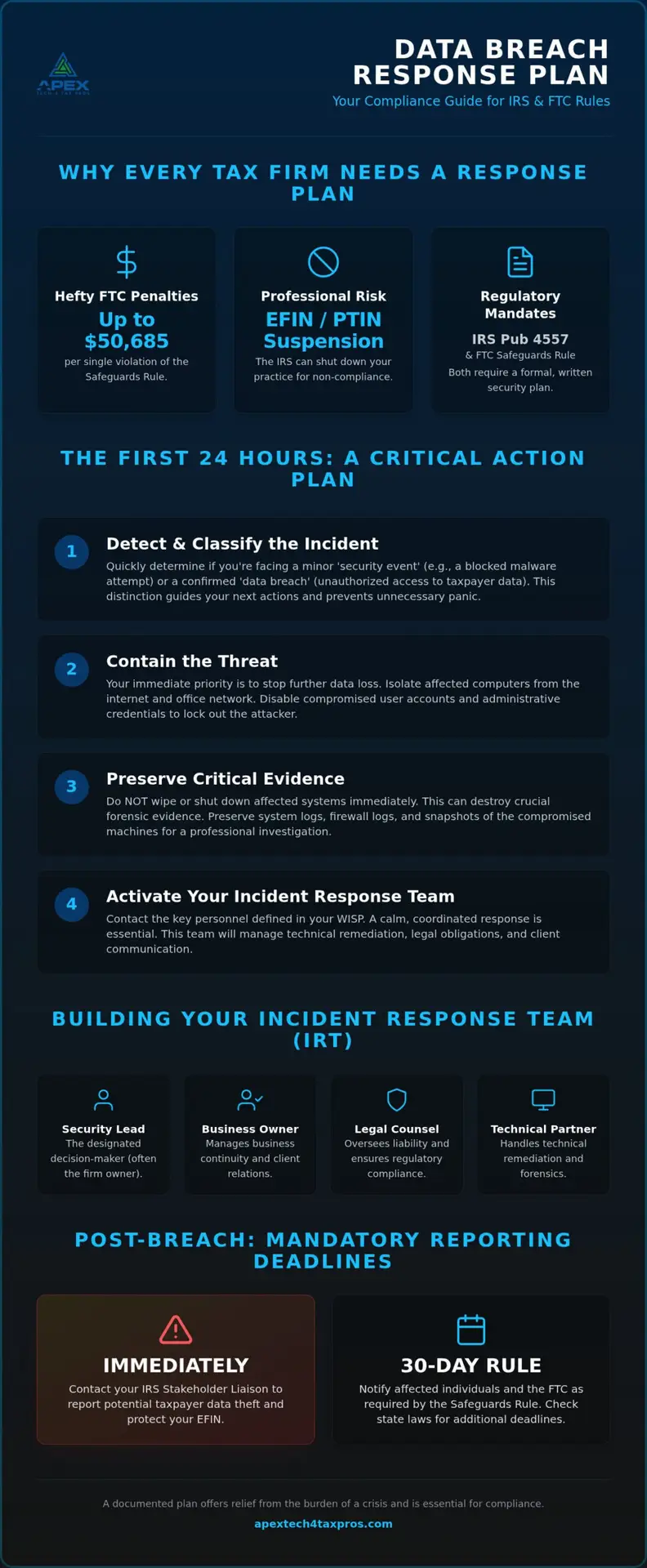
A data breach response plan for accounting firms is a structured roadmap designed to identify, contain, and report security incidents involving sensitive taxpayer data. It’s no longer just a suggestion; it’s a mandatory requirement under IRS Publication 4557 and the FTC Safeguards Rule (16 CFR Part 314). For 2026, the fiscal stakes are higher than ever. Non-compliance can lead to civil penalties of up to $50,685 per violation and $43,792 per day. Having a clear incident response plan ensures you aren’t scrambling when a crisis hits your office.
The Regulatory Burden: IRS Pub 4557 and FTC Safeguards
The IRS and FTC require specific “Safeguarding Taxpayer Data” protocols for every firm. This is especially critical during the PTIN renewal window, as the IRS verifies your compliance status on Form W-12. If you lack a documented response strategy, you risk more than just fines. The IRS has the authority to suspend your EFIN or PTIN credentials, which effectively shuts down your practice. Your plan must specifically account for failures in the “Security Six.” For example, if a hacker bypasses your MFA or exploits unencrypted files, your response plan dictates exactly how to report the failure. A Custom WISP Document serves as the essential container for these required response procedures.
Beyond the Fines: Protecting Your Firm’s Reputation
A breach during the Jan-Apr peak doesn’t just invite federal scrutiny; it destroys client trust. When taxpayers hand over their Social Security numbers, they expect total protection. A pre-defined process offers relief from the burden of decision fatigue during a crisis. By using a WISP IT System Assessment, you can identify vulnerabilities before they become headline-making disasters. A documented data breach response plan for accounting firms signals to clients that their data is in safe, capable hands even when threats evolve. This proactive approach is what distinguishes a professional firm from a vulnerable one.
What are the core components of an effective incident response plan for accounting firms?
Building a robust data breach response plan for accounting firms requires more than just templates; it demands a clear chain of command. Before a crisis strikes, you should perform a WISP IT System Assessment to pinpoint exactly where your digital perimeter might buckle. This diagnostic approach allows you to build your response strategy on technical facts rather than assumptions. It’s the difference between a panicked reaction and a disciplined recovery.
Defining Your Incident Response Team (IRT)
Even in a solo practice, you must designate a ‘Security Lead’ to own the decision-making process during an incident. Your team should include the firm owner for business decisions, your legal counsel for liability oversight, and a specialized partner like Apex Tech 4 Tax Pros to handle technical remediation. These defined roles ensure that while you manage client anxiety, your technical experts are securing the perimeter and preserving evidence. Having these contacts ready in advance provides immediate relief when every minute counts.
Incident Classification: Is it a Breach or an Event?
Not every technical hiccup is a disaster. A ‘security event’ might be a simple failed login or a blocked malware attempt, while a ‘data breach’ involves confirmed unauthorized access to sensitive taxpayer records. Establishing these triggers prevents unnecessary panic and ensures you only activate your full plan when necessary. The FTC’s data breach response guide provides excellent criteria for making these distinctions. Once a breach is confirmed, your containment strategy must focus on stopping data exfiltration. This involves disconnecting affected hardware from the internet and disabling compromised accounts without deleting the system logs needed for forensic analysis. By following a structured data breach response plan for accounting firms, you protect your evidence and your reputation simultaneously.
What should a tax office do in the first 24 hours of a data breach?
The first 24 hours determine whether a security incident becomes a manageable recovery or a regulatory disaster. Your data breach response plan for accounting firms provides the necessary discipline to navigate this “Day Zero” window with precision. Following a chronological checklist ensures that you don’t miss critical steps while under the pressure of a potential compromise.
- Step 1: Isolate affected hardware immediately. Disconnect from the network but don’t power down; this preserves volatile memory and system logs.
- Step 2: Reset all administrative passwords and verify that Multi-Factor Authentication (MFA) is still functioning across your tax software platforms.
- Step 3: Document every action, including the discovery timestamp and the suspected scope of the breach.
- Step 4: Contact your insurance carrier to activate your cyber liability coverage and access their legal resources.
Containment and Eradication Steps
Isolating infected workstations is critical to prevent ransomware from migrating across your entire office network. You shouldn’t “wipe and reload” a compromised system before a forensic image is captured. Attempting to fix the problem prematurely destroys the digital evidence required to identify the entry point and the extent of data exfiltration. Containment is about stopping the bleeding without destroying the fingerprints left behind by the intruder.
Evidence Preservation for IRS Audits
Maintaining a strict “Chain of Custody” for digital evidence is a core component of IRS Publication 4557 compliance. Forensic preservation is the act of protecting data integrity for legal review. This documentation proves to federal auditors that you took reasonable steps to secure taxpayer data following an incident. If your current response strategy feels incomplete, you can get a Custom WISP Document that includes these tactical checklists to ensure you’re never caught off guard.
Notification Requirements and Post-Breach Compliance
Once the technical threat is neutralized, your focus must shift to legal and regulatory disclosure duties. Under the FTC Safeguards Rule, you’re required to report breaches affecting 500 or more consumers to the Federal Trade Commission within 30 days of discovery. This is a hard deadline. Having a Custom WISP Document ensures your response follows a pre-defined path that satisfies these federal auditors. Failing to meet these timelines can trigger the significant 2026 penalties mentioned earlier.
You also have a duty to notify affected clients. These notices should be professional and empathetic, clearly stating what happened and what steps you’ve taken to protect them. Compliance with various state privacy laws is essential here, as many states have stricter timelines than the federal government. Maintaining this transparency is what preserves your reputation after a data breach response plan for accounting firms is activated.
Who to Call: The IRS and State Authorities
The IRS Stakeholder Liaison is your primary ally in preventing identity theft. You should notify them immediately so they can flag compromised Social Security numbers and block fraudulent e-files before they process. This protects your EFIN from being associated with fraudulent activity. You should also report the incident to state tax agencies and local law enforcement to create an official paper trail. This documentation is vital for your next PTIN renewal window on Form W-12.
Updating Your WISP After an Incident
Every breach is a learning opportunity. Conduct a “Post-Mortem” analysis to find the root cause of the incident. Use these findings to update your Cybersecurity Awareness Training for your staff. Refined training prevents the same mistake from happening twice. It demonstrates to regulators that your data breach response plan for accounting firms is a living, evolving document that prioritizes taxpayer safety.
Securing Your Practice Against 2026 Regulatory Risks
The 2026 tax season demands more than just technical security; it requires a documented roadmap for when things go wrong. Failing to maintain a data breach response plan for accounting firms exposes your practice to FTC penalties of up to $50,685 per violation and risks the suspension of your EFIN. By mastering the tactical first 24 hours and adhering to strict notification timelines, you protect your clients and your professional standing. Our team brings over 20 years of combined tax and IT expertise to help you navigate these complex federal mandates. We provide IRS Publication 4557 compliant solutions and bilingual support to ensure every tax office has the protection it deserves. Don’t wait for a crisis to discover the gaps in your security framework. Book a WISP Assessment with Apex Tech 4 Tax Pros today to verify your compliance and gain true peace of mind. You’ve worked hard to build your firm; let’s work together to keep it safe.
Frequently Asked Questions
Do small tax preparers really need a data breach response plan?
Yes, every professional tax preparer is legally required to maintain a response plan regardless of firm size. The FTC Safeguards Rule classifies tax offices as financial institutions; this makes a data breach response plan for accounting firms a mandatory condition for keeping your EFIN. Even if you work alone, you must have a documented process to protect taxpayer data and meet the federal reporting deadlines that apply to all PTIN holders.
What is the difference between a WISP and a response plan for IRS compliance?
A Written Information Security Plan (WISP) is your broad, proactive strategy for preventing unauthorized access to taxpayer information. In contrast, a response plan is a tactical roadmap used only after a security incident occurs. While the WISP outlines your daily defenses, the response plan provides the specific steps for containment and notification required by IRS Publication 4557 and the FTC Safeguards Rule to protect your practice.
How quickly must I notify the IRS after discovering a data breach?
You must notify your local IRS Stakeholder Liaison immediately upon discovering a potential or confirmed data breach. This allows the IRS to flag compromised Social Security numbers and block fraudulent e-filed returns before they’re processed. Rapid notification is essential for protecting your EFIN and demonstrating compliance during the 2026 PTIN renewal window, as federal auditors prioritize firms that act quickly to mitigate taxpayer harm.
Are there specific penalties for accounting firms that fail to report a breach?
Yes, the financial stakes for non-compliance are severe in 2026. The FTC can impose civil penalties of up to $50,685 per violation; each day of non-compliance is often treated as a separate offense with fines reaching $43,792. Beyond monetary costs, the IRS can suspend your EFIN or PTIN credentials. This effectively shuts down your practice until you can prove your data breach response plan for accounting firms meets federal standards.
Can a WISP template help me build my response plan?
A high-quality WISP template provides the necessary structure to build a compliant response plan. It acts as the container for your incident team contact info, containment protocols, and notification checklists. Apex Tech 4 Tax Pros offers a Custom WISP Document that integrates these tactical response steps. This ensures your firm meets IRS Publication 4557 requirements while providing a clear roadmap to follow during the critical first 24 hours of an incident.