
Did you know the average cost of a data breach climbed to $4.88 million in 2024, according to the IBM Cost of a Data Breach Report? For an independent tax professional, the stakes are even more personal, as failing to meet federal standards can lead to IRS penalties and the loss of your PTIN. To stay compliant, you must follow a specific ftc safeguards rule checklist for tax preparers that includes appointing a Qualified Individual, encrypting all client data, and maintaining a Written Information Security Plan (WISP).
At Apex Tech 4 Tax Pros, we’ve spent over 20 years combining tax expertise with IT security right here in Dallas. We understand that you’d rather spend your time with your clients than worrying about encryption protocols or technical jargon. This guide provides a definitive checklist to help you meet every requirement without the technical headache. We will break down the nine core elements of the rule, identify specific exemptions for firms with fewer than 5,000 consumers, and show you how to protect your practice from both data breaches and regulatory audits. You’ll walk away with a clear path to compliance and the peace of mind that your firm is legally protected for 2026.
Key Takeaways
- Understand how the FTC Safeguards Rule classifies tax preparers as financial institutions, making data security a mandatory requirement for maintaining your PTIN.
- Access a comprehensive ftc safeguards rule checklist for tax preparers that outlines the nine essential security elements, from appointing a Qualified Individual to conducting regular risk assessments.
- Learn why a Written Information Security Plan (WISP) is the critical physical evidence required by IRS auditors to prove your firm’s compliance.
- Identify specific exemptions for smaller practices handling fewer than 5,000 consumers, allowing you to focus your resources on the most impactful security measures.
- Discover how professional security subscriptions can transform complex regulatory burdens into manageable, automated processes that protect your clients and your reputation.
What is the FTC Safeguards Rule for Tax Preparers?
The FTC Safeguards Rule is a federal mandate requiring tax preparers to implement a comprehensive security program to protect client data. While the term “financial institution” usually brings to mind large Wall Street banks, the Gramm-Leach-Bliley Act actually applies this label to anyone significantly engaged in financial activities, including tax preparation. This means that even a solo practitioner working from a home office is legally bound to the same data protection standards as a national firm. It’s helpful to remember that the Safeguards Rule is the law itself, while your Written Information Security Plan (WISP) is the physical document that proves you’re in compliance. Following a structured ftc safeguards rule checklist for tax preparers ensures you don’t miss the technical nuances required by federal regulators.
Why does the IRS care about the FTC Safeguards Rule?
The link between the IRS and the FTC is closer than many pros realize. During your annual PTIN renewal process, you must affirm that you’re aware of your legal obligation to protect taxpayer data. The IRS points to Publication 4557 as the essential roadmap for these protections. They want to see that you aren’t just using a firewall, but that you have a documented strategy to handle threats. This isn’t about red tape; it’s about keeping your professional license safe and your clients’ identities secure. Utilizing a reliable ftc safeguards rule checklist for tax preparers is the most efficient way to organize these security efforts before tax season begins.
Who is required to comply in 2026?
Every tax professional who handles client nonpublic personal information (NPI) must comply with the core components of the rule. There’s no small business exemption for the requirement to have a WISP. We understand that many independent preparers operate in bilingual environments where clear, accessible guidance is often hard to find. Whether you serve an English or Spanish speaking clientele, your data security obligations remain the same. Our goal is to simplify these rules so you can focus on your clients instead of thick IT manuals. Compliance is a shared journey, and having the right tools makes the burden much lighter for everyone involved.
The 2026 FTC Safeguards Rule Checklist: 9 Core Requirements
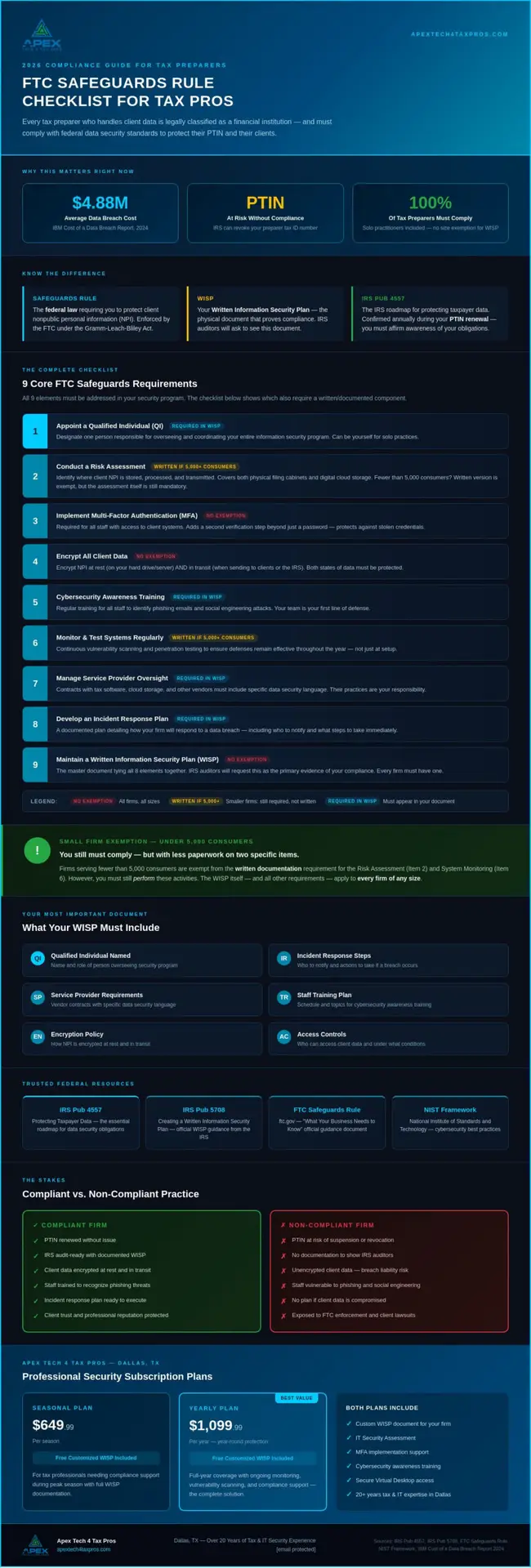
The FTC Safeguards Rule outlines nine pillars that form the backbone of a secure tax practice. Working through a comprehensive ftc safeguards rule checklist for tax preparers helps ensure you aren’t leaving any doors open to bad actors. While the list might look technical, it’s really about creating a culture of security that protects your hard work and your clients’ trust.
A major component of this checklist is the risk assessment. You’ll need to identify where your client data might be vulnerable, whether that’s through your physical filing cabinets or your digital cloud storage. If you handle data for fewer than 5,000 consumers, you’re actually exempt from the requirement to put this assessment in writing, though the evaluation itself is still vital. If you’re feeling unsure about where to start, a professional IT assessment can pinpoint those gaps for you. It’s often a relief to have an expert eye confirm what’s working and what needs a quick fix.
Technical controls are the next step. You must implement Multi-Factor Authentication (MFA) for anyone with access to client systems. The rule also requires you to encrypt all nonpublic personal information both when it’s sitting on your hard drive and when you’re sending it to a client or the IRS. Regularly monitoring these systems through vulnerability scanning ensures your defenses stay strong throughout the year.
How do I implement administrative and technical safeguards in my office?
Your team is your most important asset in this process. Providing regular Cybersecurity Awareness Training empowers your staff to spot phishing emails before they click. You also need to keep an eye on your vendors. Make sure your tax software and cloud storage providers are following the same high standards. It’s your responsibility to ensure your contracts with these service providers include specific language about their data security obligations.
Who can serve as the Qualified Individual for a small tax firm?
The Qualified Individual is the person responsible for the firm’s security posture. For a solo practitioner or a small office, this can absolutely be you or a trusted office manager. You don’t need to be a coding expert to hold this title; you just need to be the person who ensures the security plan is being followed and updated. Using a clear ftc safeguards rule checklist for tax preparers makes this role manageable, allowing you to stay focused on your clients’ returns while professional experts handle the technical heavy lifting.
Implementing Your Written Information Security Plan (WISP)
While the program itself is the work you do to stay safe, the WISP is the physical evidence that an auditor will ask for first. It’s the primary document that brings your ftc safeguards rule checklist for tax preparers to life. Without a written plan, you lack the “receipt” required to show the IRS you’re meeting your legal obligations. A compliant WISP must be specific to your firm, detailing your scope, your designated person, and your specific incident response strategy.
How do I create a WISP that is ready for an IRS audit?
The most common mistake we see is using a generic, one-size-fits-all download. The FTC is very clear that your plan must be tailored to your firm’s actual complexity and the specific software you use. A Custom WISP Template ensures your documentation matches your real-world operations. You should also treat this as a living document. Auditors often flag firms that haven’t updated their plan for the current tax year. For specific guidance on what needs to be in there, IRS Publication 4557 remains the gold standard for tax pros.
What steps should I take if my tax firm experiences a data breach?
Your WISP isn’t complete without a clear incident response plan. We like to think of this as a “fire drill” for your office data. It should outline exactly who to call and what steps to take the moment you suspect a problem. This includes your mandatory reporting duties to the IRS and state authorities. If you want to make sure your documentation is actually audit-ready before the busy season hits, reach out for a custom security assessment today. It’s the fastest way to turn a complex requirement into a manageable win for your practice.
Simplifying Compliance with Professional Security Solutions
Running a tax practice is a high-pressure job, especially with the 2026 mandates looming. We believe that checking off your ftc safeguards rule checklist for tax preparers shouldn’t keep you up at night. Our goal is to take that technical weight off your shoulders so you can focus on what you actually enjoy, which is helping your clients navigate their tax situations. By partnering with specialists, you transform a complex legal requirement into a streamlined, automated part of your business operations.
Our Seasonal ($649.99) and Yearly ($1,099.99) subscriptions provide a comprehensive path to total compliance, including a free customized WISP. A Professional IT Assessment is the best way to start, as it removes all the guesswork from the process and gives you a clear roadmap. Treating security as a client-facing benefit doesn’t just satisfy the IRS; it builds a foundation of trust that increases the overall value of your firm.
Why does professional IT support beat a DIY approach for tax offices?
The risk of “not knowing what you don’t know” is high in technical security. While our sister company, APEX Tax Solutions, handles the complex world of tax representation and resolution, we at Apex Tech 4 Tax Pros focus on the technical infrastructure that keeps that work secure. With over 20 years of combined experience in both tax and IT, we understand the specific software and regulatory hurdles you face. We don’t just provide generic tech support; we provide security specifically engineered for the way tax professionals actually work.
What are the next steps to get my tax practice ready for 2026?
The relief of being truly audit-ready before the first day of tax season is hard to overstate. Your final checklist item is simply to verify your current posture with someone who speaks your language. Whether you need help in English or Spanish, our Dallas-based team is ready to walk through your requirements. Send us an email at info@at4tp.com to schedule a consultation and move your practice from vulnerability to secure compliance today.
Secure Your Practice for the 2026 Tax Season
Navigating federal mandates doesn’t have to feel like a second job. By following a structured ftc safeguards rule checklist for tax preparers, you’ve already taken the first step toward protecting your firm from IRS penalties and data breaches. We’ve established that a customized Written Information Security Plan (WISP) is your most powerful tool for proving compliance during an audit. It’s about more than just checking boxes; it’s about the peace of mind that comes from knowing your clients’ identities are safe under your watch.
At Apex Tech 4 Tax Pros, we bring over 20 years of combined tax and IT experience to your corner. We’ve mastered the nuances of IRS Publication 4557 compliance so you don’t have to. If you’re ready to offload the technical burden and focus on your clients, we’re here to help with bilingual support in both English and Spanish. Take the final step on your checklist today and Book a WISP Assessment with Apex Tech 4 Tax Pros. You’ve built a successful practice; let’s work together to make sure it’s fully protected for years to come.
Frequently Asked Questions
Is the FTC Safeguards Rule mandatory for solo tax preparers?
Yes, the FTC Safeguards Rule is mandatory for solo tax preparers. Federal law classifies any business significantly engaged in financial activities as a financial institution, which includes independent preparers and CPAs. This means you must have a completed ftc safeguards rule checklist for tax preparers and a documented security plan in place. Being a small operation doesn’t exempt you from the legal requirement to protect sensitive taxpayer data from unauthorized access.
What is the penalty for non-compliance with the FTC Safeguards Rule in 2026?
The penalties for non-compliance can be devastating for a tax practice, ranging from heavy monetary fines to the revocation of your PTIN. The IRS and FTC have increased enforcement actions to ensure preparers are meeting their data security obligations. Beyond federal fines, you risk losing your ability to e-file and facing professional misconduct charges. Proactive compliance is the best way to avoid these penalties and protect your professional reputation.
Does having tax software in the cloud make me compliant automatically?
No, using cloud-based tax software does not grant you automatic compliance. While your software provider secures their own servers, you are still responsible for the security of your local computers, office network, and staff actions. Your ftc safeguards rule checklist for tax preparers must include local protections like Multi-Factor Authentication (MFA) and encryption for any client data you download or store on your own devices.
How often do I need to update my Written Information Security Plan (WISP)?
You must update your Written Information Security Plan (WISP) at least annually or whenever your firm experiences a significant change. Major changes include moving to a new office, hiring new employees, or implementing new tax preparation software. Regular reviews ensure your security protocols stay aligned with your current business operations. Keeping your WISP updated is a critical step in remaining audit-ready for the IRS throughout the year.
What is a ‘Qualified Individual’ under the FTC Safeguards Rule?
A Qualified Individual is the person you designate to oversee and implement your firm’s information security program. This individual is responsible for coordinating your safeguards and reporting on the effectiveness of your security plan. In a smaller tax office, the owner often fulfills this role or works with an outside expert to handle the technical requirements. The goal is to have one designated person accountable for the firm’s data protection posture.