
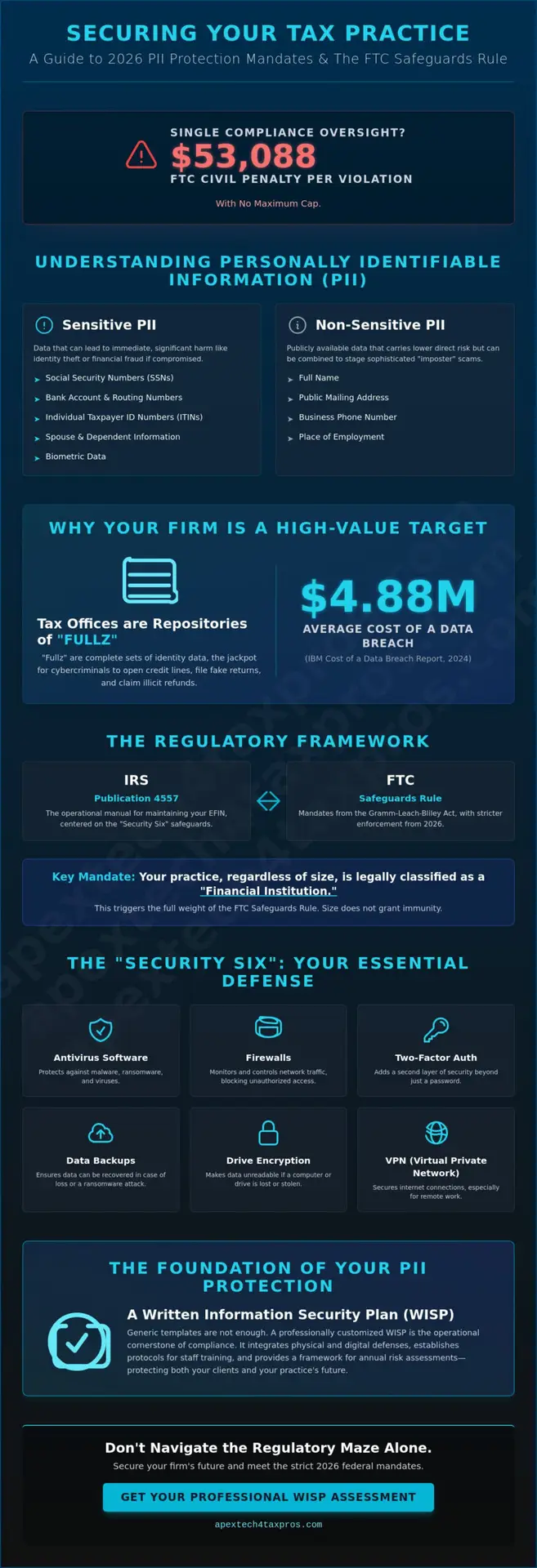
Did you know that a single oversight in compliance can now trigger an FTC civil penalty of $53,088 per violation with no maximum cap? It’s understandable why many practitioners feel a sense of dread when discussing the technical complexities of protecting client PII in a tax office. The shifting landscape between IRS Publication 4557 and the evolving FTC Safeguards Rule often feels like a moving target designed for IT experts rather than busy tax professionals. You shouldn’t have to navigate this regulatory maze alone or live in fear of the next IRS audit.
We understand the weight of your responsibility, as we’ve spent decades helping firms manage these exact high-stakes environments. This guide provides the professional clarity you need to secure your firm’s future and meet the strict 2026 federal mandates. We’ll break down the essential definitions of PII, outline the foundational “Security Six” measures, and provide a methodical framework for implementing a robust Written Information Security Plan (WISP) that protects both your clients and your practice.
Key Takeaways
- Define the scope of sensitive data by distinguishing between standard and high-risk PII within the 2026 regulatory landscape.
- Clarify the mandatory intersection of IRS Publication 4557 and the FTC Safeguards Rule to ensure your practice meets federal “financial institution” standards.
- Master a multi-layered defense strategy that integrates physical office protocols with sophisticated digital threat detection.
- Mitigate your firm’s greatest vulnerability by implementing cybersecurity awareness training and conducting thorough annual risk assessments.
- Establish a compliant operational foundation by moving beyond generic templates toward a professionally customized Written Information Security Plan (WISP) for protecting client PII in a tax office.
Understanding PII in the Tax Industry: What Exactly Needs Protection?
The definition of Personally Identifiable Information (PII) has expanded significantly as we enter the 2026 filing season. It’s no longer limited to a name or a physical address. In the context of a modern tax practice, PII encompasses any data that can be used to distinguish or trace an individual’s identity, either alone or when combined with other identifying information. Protecting client PII in a tax office requires a granular understanding of how this data is categorized and why it remains the primary target for sophisticated cybercriminal networks.
Regulatory bodies distinguish between sensitive and non-sensitive PII based on the potential harm caused by a compromise. Sensitive PII includes data points that lead to immediate financial harm or identity theft, such as Social Security Numbers (SSNs), bank account details, and biometric data. Non-sensitive PII, like a business phone number or public mailing address, carries lower risk but still demands professional oversight. Criminals often use non-sensitive data to build “imposter” scams, where they pose as trusted advisors to extract more sensitive information from your clients.
Tax offices are high-value targets because they act as centralized repositories for “fullz,” which are complete sets of identity data. A single successful breach can provide a criminal with everything needed to open fraudulent credit accounts, file false returns, and claim illicit refunds. Protecting client PII in a tax office is an operational necessity that guards against the average $4.88 million cost associated with a data breach, according to the 2024 IBM Cost of a Data Breach Report.
The Anatomy of Tax-Specific PII
Tax returns contain a dense concentration of highly sensitive data. While names and addresses are standard, the true risk lies in the “crown jewels” of identity: SSNs and Individual Taxpayer Identification Numbers. These numbers are static and difficult to change, making them incredibly valuable on the dark web. Beyond the primary taxpayer, information regarding dependents and spouses creates a multi-generational data set that requires maximum encryption. Financial account numbers used for direct deposits or tax payments add another layer of vulnerability that demands rigorous technical safeguards.
The Stakes of Non-Compliance in 2026
The regulatory environment in 2026 leaves no room for negligence. Under IRC Section 6713, civil penalties for unauthorized disclosure can reach $250 per violation. If identity theft is involved, those penalties jump to $1,000 per instance. Beyond federal fines, a data breach can result in the permanent loss of your Preparer Tax Identification Number (PTIN), effectively ending your professional career. The reputational damage is often even more severe. Clients trust you with their most intimate financial details; failing to honor that trust through inadequate security is a breach of both legal mandates and professional ethics.
The Regulatory Framework: IRS Publication 4557 and the FTC Safeguards Rule
Many tax practitioners find themselves caught in a complex web of overlapping mandates. While the previous section highlighted the specific types of data at risk, this regulatory framework dictates exactly how you must defend it. The primary confusion often stems from the dual jurisdiction of the IRS and the FTC. Both agencies have specific, non-negotiable expectations for protecting client PII in a tax office, and failing to harmonize these requirements creates significant liability for your practice.
Size doesn’t grant immunity in the eyes of federal regulators. A common and dangerous misconception is that a solo practitioner or small firm isn’t a “financial institution.” Under the Gramm-Leach-Bliley Act, any professional significantly engaged in financial activities, including tax preparation, is classified as such. This status triggers the full weight of the FTC Safeguards Rule, which is entering a stricter enforcement cycle in 2026. Whether you process fifty returns or five thousand, the legal standard for data encryption and risk management remains the same.
IRS Publication 4557: Your Security Roadmap
IRS Publication 4557 serves as the operational manual for your practice, covering seven critical areas: legal compliance, employee background checks, information security, physical security, disposal of information, reporting, and evaluation. To maintain your Electronic Filing Identification Number (EFIN), you must adhere to the “Security Six,” which are the foundational technical measures like multi-factor authentication and drive encryption. Following official IRS guidance for tax professionals is the only way to demonstrate “good faith” during an audit. Essentially, Publication 4557 transforms abstract security concepts into a daily checklist for firm-wide accountability.
The FTC Safeguards Rule Mandate
The FTC Safeguards Rule requires all tax practitioners to develop, implement, and maintain a comprehensive Written Information Security Plan (WISP). As of January 17, 2025, the maximum civil penalty for non-compliance reached $53,088 per violation, with no total cap. The 2026 standards have evolved to demand more frequent vulnerability scanning and the mandatory appointment of a “Qualified Individual” to oversee your security program. This person is responsible for coordinating your safeguards and providing regular reports on the firm’s security posture. If you haven’t yet formalized these protocols, you can access a FREE WISP Download Template to begin establishing your documented defense strategy.
The requirement for a Qualified Individual underscores the shift toward active, documented oversight. It’s no longer enough to have security software installed; you must have a designated person ensuring that those tools are functioning and that your staff is following protocol. Protecting client PII in a tax office is now a matter of continuous governance rather than a one-time technical setup.
Physical vs. Digital Safeguards: A Multi-Layered Defense Strategy
True security isn’t a single software purchase; it’s a comprehensive environment where digital defenses and physical protocols work in tandem. Protecting client PII in a tax office requires you to look beyond your monitor and consider the tangible risks present in your daily operations. While much of the 2026 regulatory focus centers on cyber threats, the physical security of your workspace remains a critical pillar of compliance. Local hard drive storage often represents the weakest link in this chain. If a workstation is stolen or a drive fails without a redundant system, your firm faces an immediate, reportable data breach or a total loss of operational data.
A resilient strategy acknowledges that hardware is temporary but data is permanent. We advocate for a “defense in depth” model where each layer of protection serves as a fail-safe for the others. This pragmatic approach ensures that even if one safeguard is bypassed, your clients’ sensitive information remains shielded from unauthorized access. By integrating professional remedies with daily habits, you move from a state of vulnerability to one of secure compliance.
Securing the Digital Perimeter
Your digital perimeter starts with Multi-Factor Authentication (MFA). This is no longer optional; it’s a foundational requirement for all tax software and email accounts. To remain compliant with the FTC Safeguards Rule, you must also implement end-to-end encryption for every document transmitted between your firm and your clients. Emailing unencrypted PDFs is a high-risk practice that invites interception. To mitigate the threat of ransomware and hardware failure, we recommend utilizing Secure Cloud Backup. This ensures that your data is not only encrypted at rest but is also available for immediate recovery in the event of a catastrophic system failure.
Physical Security and Asset Management
Protecting client PII in a tax office also involves controlling who walks through your door and what they can see. A “Clean Desk” policy is one of the most effective ways to prevent accidental exposure to unauthorized visitors or janitorial staff. This means all physical files, tax returns, and handwritten notes containing PII must be stored in locked file cabinets whenever a practitioner is away from their desk. Managing mobile devices is equally vital. If you or your staff perform remote tax preparation, those laptops and tablets must be managed under strict asset protocols, including full-disk encryption and remote-wipe capabilities. Maintaining visitor logs and utilizing secure document disposal bins for all sensitive waste ensures that your physical perimeter is just as fortified as your digital one.
The Human Element: Staff Training and Risk Assessments
Even the most sophisticated technical safeguards can be bypassed by a single human error. While previous sections detailed the digital and physical perimeters, the human element remains the most significant vulnerability in your firm’s security chain. Protecting client PII in a tax office requires more than just installing software; it demands a cultural shift that prioritizes vigilance at every level of the organization. From the front desk receptionist to the senior partner, every member of your team must understand their role as a multi-disciplinary protector of taxpayer data.
Cybercriminals in 2026 have moved beyond generic spam to highly targeted social engineering and deepfake-based attacks. These “imposter” scams are specifically engineered to exploit the trust and professional urgency inherent in tax preparation. Without consistent reinforcement, staff members often fall victim to phishing attempts that mimic IRS communications or client requests. Data shows that baseline phishing failure rates typically range between 15% and 30% before intervention. However, with consistent Cybersecurity Awareness Training, these rates can drop to a more manageable 3-8%.
Executing an Effective Risk Assessment
A professional risk assessment is the diagnostic foundation of your Written Information Security Plan (WISP). It’s a methodical process designed to uncover hidden vulnerabilities before they are exploited. We recommend a three-step approach to ensure no data point is left exposed:
- Asset Inventory: Create a comprehensive list of all IT assets, including laptops, tablets, and mobile devices, and identify exactly where PII is stored, whether in the cloud or on local drives.
- Threat Identification: Analyze potential internal and external threats, ranging from malicious cyberattacks to accidental data deletion or hardware failure.
- Control Evaluation: Assess the effectiveness of your current security measures and prioritize improvements based on the level of risk identified during the assessment.
Cybersecurity Awareness Training for Staff
The IRS and FTC don’t just recommend training; they mandate it. A “one and done” approach during the onboarding process is insufficient for 2026 compliance. Effective training must be recurring and rhythmic to stay ahead of evolving threats like deepfake voice cloning and sophisticated business email compromise. Our specialized Risk Assessments often reveal that documented training logs are the first thing regulators request during an audit. If your training isn’t timestamped and documented, it doesn’t exist in the eyes of the law.
Simulated phishing attacks are a vital component of this educational process. By testing your team in a safe, controlled environment, you can identify which staff members require additional support without risking a live data breach. This pragmatic reinforcement builds the “muscle memory” needed to spot red flags, such as unusual sender addresses or suspicious links. Ultimately, a well-trained staff serves as your firm’s most resilient firewall, ensuring that protecting client PII in a tax office becomes a seamless part of your daily professional rhythm.
Implementing a WISP: The Foundation of Your PII Protection
A Written Information Security Plan (WISP) is the foundational document for your entire compliance posture. It isn’t just a professional recommendation; it’s a mandatory requirement under IRS Publication 4557 and the FTC Safeguards Rule. Think of the WISP as the operational blueprint for protecting client PII in a tax office. It defines how you collect, store, and eventually dispose of sensitive taxpayer data. Without this documented framework, your technical safeguards are merely isolated tools rather than a cohesive security program.
During an IRS inquiry or an FTC investigation, a well-maintained WISP serves as your primary shield. It provides the “good faith” evidence that your firm has taken reasonable, proactive steps to mitigate risk. If a breach occurs, regulators will first ask to see your WISP and your records of its implementation. Generic templates are often a liability in these high-stakes moments. Regulators look for evidence that your plan reflects your actual daily workflow and that you’ve integrated these protocols into your tax preparation process.
Why Customization Matters
Customization is the difference between a paper shield and a steel one. Your plan must account for your specific software environment, whether you utilize Lacerte, Drake, or UltraTax. It needs to reflect your office size, your remote work policies, and your specific technology stack. Professional Risk Assessments play a critical role here. They inform the WISP by identifying the unique vulnerabilities of your firm, ensuring that your policies aren’t just generic statements but are engineered for your specific niche. A plan that doesn’t mention your actual storage locations or your specific staff roles won’t stand up to federal scrutiny.
Taking Action: Your Path to Secure Compliance
Getting started with a Customized Written Information Security Plan (WISP) is the most decisive step you can take toward total compliance. Once implemented, your WISP requires regular reviews and updates as regulations evolve. The 2026 filing season demands a higher level of vigilance, and your documentation must keep pace. Before the next deadline arrives, use this final checklist to gauge your readiness:
- Is your WISP signed by a designated Qualified Individual?
- Have you documented your staff training and annual risk assessment?
- Are your MFA and encryption protocols explicitly detailed in the plan?
- Do you have a clear incident response procedure for potential breaches?
Protecting client PII in a tax office is an ongoing commitment to your clients’ trust and your firm’s professional legacy. By moving from a state of potential vulnerability to a state of documented compliance, you can focus on your practice with the confidence that your regulatory burdens are handled and your data is secure.
Securing Your Firm’s Professional Legacy for 2026
Apex Tech 4 Tax Pros brings over 20 years of IT security experience to this high-stakes environment. Our specialized expertise ensures your firm isn’t just checking a box but is building a resilient defense engineered specifically for the tax industry. Whether you need a comprehensive suite of services or a starting point for your documentation, we’re here to guide you toward secure compliance.
Download Your FREE WISP Template or Request a Customized Security Plan today to fortify your practice. You’ve worked hard to build your professional reputation, and we’re dedicated to helping you protect it with confidence.
Frequently Asked Questions
Is a WISP legally required for a solo tax practitioner?
Yes, a Written Information Security Plan (WISP) is a mandatory legal requirement for all tax professionals, including solo practitioners. Federal law classifies anyone significantly engaged in tax preparation as a “financial institution” under the FTC Safeguards Rule. This designation means you must have a documented security program in place to protect taxpayer data, regardless of your firm’s size or the number of returns you process annually.
Can I use a free WISP template for my tax office?
You can use a template as a foundational starting point, but it must be professionally customized to reflect your actual business operations. A generic document that doesn’t account for your specific software, such as Drake or Lacerte, or your unique hardware stack will likely fail an IRS or FTC audit. For a plan to be effective, it must accurately describe the real-world safeguards you’ve implemented for protecting client PII in a tax office.
What happens if a tax office has a PII data breach?
A data breach triggers an immediate and mandatory reporting protocol that involves multiple agencies. You must notify your local IRS Stakeholder Liaison, the FBI, and the Secret Service if directed. Additionally, the FTC requires notification within 30 days for incidents affecting 500 or more customers. Failing to follow these steps can result in significant civil penalties, which can reach $53,088 per violation under the latest FTC enforcement standards.
How often should I conduct a cybersecurity risk assessment?
You should conduct a formal risk assessment at least once per year or whenever there is a significant change to your firm’s technology or operations. Annual assessments are a core requirement of the FTC Safeguards Rule and ensure your WISP remains effective against evolving cyber threats. These reviews help identify new vulnerabilities in your network, such as outdated software or unmanaged mobile devices, before they can be exploited by criminals.
Does the IRS Publication 4557 apply to remote tax preparers?
Yes, IRS Publication 4557 applies to all tax professionals regardless of whether they work in a traditional office or a remote environment. Protecting client PII in a tax office is a requirement that follows the data, not the person. Remote preparers must implement the same level of security, including multi-factor authentication and drive encryption, on any device or home network used to access sensitive taxpayer information.
Is email a secure way to send client tax documents?
No, standard, unencrypted email is not a secure method for transmitting sensitive taxpayer data. Information sent via traditional email travels across multiple servers in plain text, making it highly susceptible to interception by cybercriminals. To remain compliant with federal security standards, you should utilize secure client portals or end-to-end encrypted messaging services that ensure data remains shielded from the moment it leaves your firm until the client receives it.
What is the difference between PII and SPII in a tax context?
The primary difference lies in the level of risk and the potential for financial harm if the data is compromised. PII is a broad category that includes any identifying data, such as a name or address. Sensitive PII (SPII) refers to high-risk information like Social Security Numbers, bank account details, and driver’s license numbers. While all client data requires protection, SPII demands the most rigorous encryption and access controls within your firm.
Who can serve as the “Qualified Individual” for my firm’s security plan?
A Qualified Individual can be an internal staff member or an external cybersecurity professional with the expertise to oversee your security program. The FTC Safeguards Rule requires this individual to coordinate your safeguards and provide regular reports on your firm’s security posture. Many practitioners choose to appoint an external expert to ensure that the technical complexities of their WISP are managed with the precision required to meet strict 2026 federal mandates.