
Did you know that processing just 11 tax returns a year now triggers a federal mandate for a formal, documented Written Information Security Plan (WISP)? For many professionals, keeping up with the minimum cybersecurity requirements for tax preparers feels like a technical distraction from their core mission. However, these regulations are the only barrier between your firm and a devastating PTIN suspension. The IRS and FTC have moved beyond general suggestions, establishing a rigid framework that demands technical precision and meticulous documentation to protect sensitive taxpayer data from increasingly sophisticated cyber threats.
We understand that the transition from consumer-grade tools to business-class security can feel overwhelming when you’re managing a busy practice. This guide provides a comprehensive breakdown of mandatory IRS and FTC security standards to protect your firm from data breaches and federal penalties. We’ll walk through the “Security Six” baseline, the necessity of multi-factor authentication, and the specific steps you must take to ensure your practice remains compliant. You’ll gain a clear roadmap for federal compliance, allowing you to face an IRS security review with total confidence.
Key Takeaways
- Understand why the FTC Safeguards Rule classifies tax firms as financial institutions and the specific legal obligations this creates for your practice.
- Identify the technical controls necessary to meet the minimum cybersecurity requirements for tax preparers, including the shift from traditional antivirus to Endpoint Detection and Response (EDR).
- Learn the essential components of a Written Information Security Plan (WISP) and why the IRS requires this document to be customized to your specific firm.
- Discover how regular risk assessments and ongoing cybersecurity awareness training protect your firm from evolving threats like AI-powered identity theft.
- Gain a clear roadmap for implementing federal security standards that safeguard your PTIN and provide peace of mind during an IRS audit.
Federal Mandates: The Legal Framework for Tax Data Protection
Many tax professionals view cybersecurity as a technical choice. In reality, it’s a legal mandate that carries the full weight of federal oversight. Under the Gramm-Leach-Bliley Act (GLBA), anyone in the business of preparing tax returns is legally classified as a “financial institution.” This designation isn’t just a label; it subjects your practice to the same rigorous data protection standards as a bank or brokerage. The IRS and FTC have synchronized their expectations to ensure that taxpayer data is shielded by a multi-layered defense system.
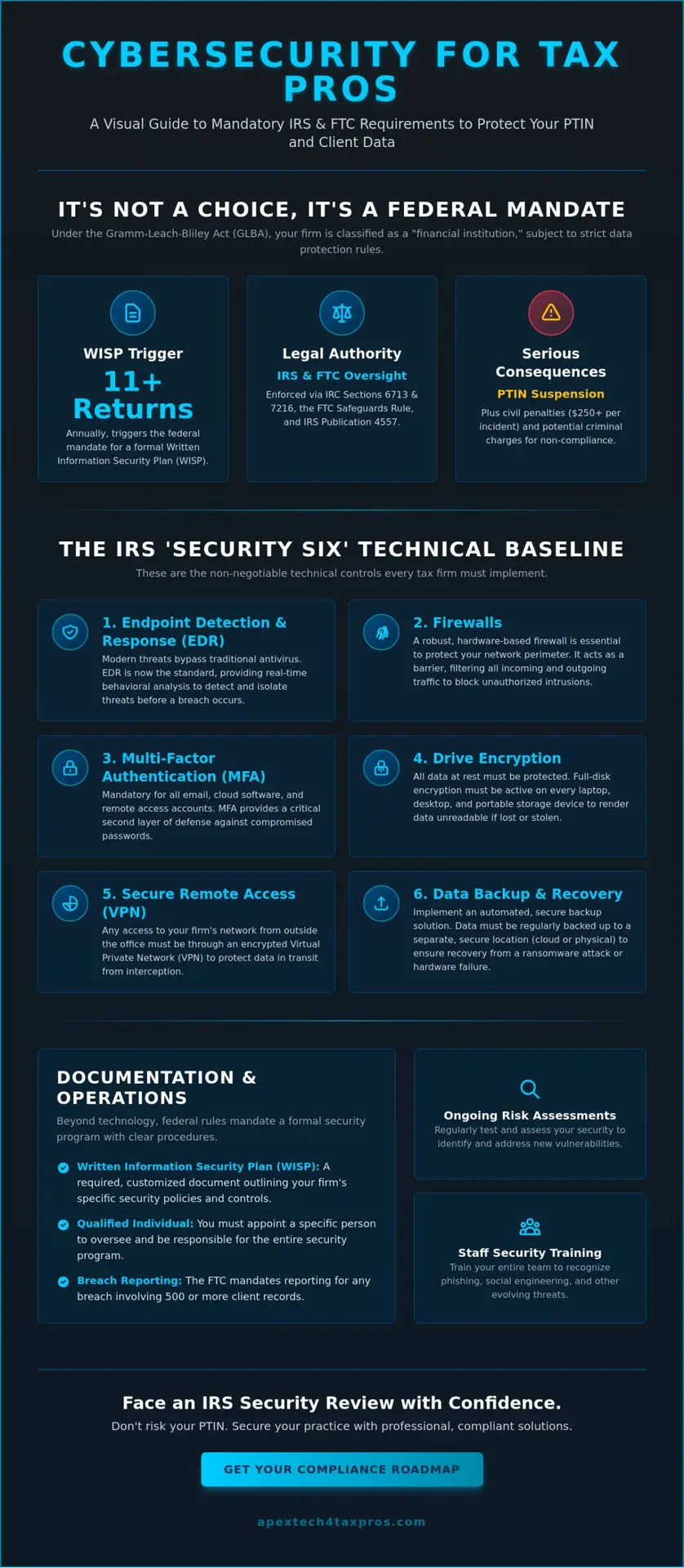
Don’t assume your firm’s size offers a shield. The IRS mandates that any preparer handling 11 or more returns annually must maintain a documented Written Information Security Plan (WISP). Federal standards for the minimum cybersecurity requirements for tax preparers apply equally to sole practitioners and large accounting firms. Ignoring these mandates risks the suspension of your PTIN and severe civil penalties. Under IRC Section 6713, unauthorized disclosure can result in fines of $250 per incident, while Section 7216 carries criminal penalties for reckless disclosures.
IRS Publication 4557 remains the cornerstone of this framework. It provides the checklist necessary to align your office with federal law. When you sign your annual PTIN renewal, you’re certifying that you’ve met these security obligations. This isn’t a mere formality. It’s a professional commitment to the “Taxes-Security-Together” initiative, which connects your EFIN security directly to your adherence to the FTC Safeguards Rule.
Understanding the FTC Safeguards Rule in 2026
The 2026 standards require a proactive stance rather than a reactive one. You must appoint a “Qualified Individual” to oversee your security program. This person is responsible for coordinating technical safeguards and ensuring regular vulnerability assessments are performed. Additionally, the FTC now mandates reporting for any data breach involving 500 or more records. These reporting requirements ensure that security failures are transparent and that clients are protected from the fallout of identity theft.
The Role of the IRS Security Summit
The IRS Security Summit is a public-private partnership that shapes current minimum cybersecurity requirements for tax preparers. By bringing together state tax agencies and the private sector, the Summit creates a unified front against cybercriminals. This cooperation ensures that as threats evolve, so do the mandatory defenses. Your compliance with these standards isn’t just about avoiding audits; it’s about participating in a national effort to secure the integrity of the tax system.
The Technical Baseline: Implementing the IRS ‘Security Six’
Building upon the legal framework established in the previous section, we must address the specific technical controls mandated by federal authorities. These are not merely suggestions; they represent the minimum cybersecurity requirements for tax preparers intended to maintain operational integrity in a high-risk digital environment. The IRS “Security Six” serves as the foundational architecture for this defense, providing a standardized baseline for every firm, regardless of size or client volume.
In 2026, the standard for antivirus protection has evolved significantly. Traditional signature-based scanning, which relies on a database of known threats, is no longer sufficient against modern, polymorphic malware. Professional firms must transition to Endpoint Detection and Response (EDR) solutions. These systems provide real-time monitoring and behavioral analysis, allowing them to identify and isolate suspicious activity before a breach occurs. Similarly, hardware-based firewalls must protect the perimeter of your office network, creating a robust barrier that filters incoming and outgoing traffic to block unauthorized intrusions.
For firms that operate globally or simply want to adopt world-class standards, Managed MXDR services UK provides an integrated framework that goes beyond basic EDR to monitor the entire network environment.
Protecting data at rest is just as critical as securing the network perimeter. Drive encryption must be active on every laptop, desktop, and portable storage device used by your staff. This ensures that if a device is physically lost or stolen, the taxpayer information remains unreadable and secure. Coupled with this, IRS Publication 4557 emphasizes the necessity of maintaining secure, encrypted backups. These backups should be stored off-site or in a secure cloud environment, providing a vital recovery path in the event of a ransomware attack or hardware failure.
Virtual Private Networks (VPN) for Secure Connectivity
Remote work and client visits often tempt professionals to use public Wi-Fi in coffee shops or hotels. This is a significant security risk. Public networks are notoriously vulnerable to interception, making it easy for cybercriminals to capture sensitive login credentials. A professional-grade VPN is essential for any connection outside the office. Unlike consumer versions, professional VPNs offer dedicated encrypted tunnels and centralized management, ensuring every byte of client data remains shielded during transmission.
MFA Implementation Across the Firm
Multi-Factor Authentication (MFA) is perhaps the most effective barrier against unauthorized access. In 2026, the standard has shifted away from SMS-based codes, which are susceptible to SIM-swapping and interception. Firms should implement app-based authenticators or hardware security keys across all platforms, including tax software, email, and cloud storage. Managing these credentials for a full staff requires a disciplined approach, but it’s a non-negotiable step in securing your firm’s future. If you’re unsure where your technical gaps lie, a professional risk assessment can identify vulnerabilities before they are exploited by bad actors.
The Written Information Security Plan (WISP): Documentation Requirements
Technical controls like encryption and firewalls are only as effective as the policy that governs them. The IRS and FTC require more than just “having” security; they demand a documented strategy known as a Written Information Security Plan (WISP). This document serves as the operational brain of your firm’s defense. It outlines how you identify risks, implement safeguards, and respond to potential incidents. For many, the WISP is the first document requested during an IRS security review or a state-level audit. Failing to produce a plan that accurately reflects your firm’s daily operations is often viewed as a primary failure to meet the minimum cybersecurity requirements for tax preparers.
A common pitfall for busy professionals is the use of generic, “fill-in-the-blank” templates. While these might seem like a time-saving solution, they often create a false sense of security. An auditor can quickly spot a document that claims to use specific encryption protocols or multi-factor authentication methods that the firm hasn’t actually deployed. At Apex Tech 4 Tax Pros, we prioritize a personalized approach to WISP development. We believe your security plan should be a mirror of your actual data flow, documenting exactly how client information enters your office, where it’s stored, and how it’s eventually destroyed or archived.
Compliance isn’t a static achievement. Your WISP must be a living document that evolves alongside your practice. Federal guidelines suggest a review and update cycle of at least once every 12 months, or whenever there is a significant change to your firm’s business practices or technical infrastructure. This ensures that as you add new staff, adopt new tax software, or transition to cloud-based services, your security posture remains aligned with the FTC Safeguards Rule.
Inventory of Information Assets
You can’t protect what you haven’t identified. A compliant 2026 WISP must include a detailed inventory of every device that touches taxpayer information. This includes servers, workstations, laptops, and even mobile devices used for email. We also focus on identifying “Shadow IT,” which refers to unapproved software or cloud storage accounts that staff might use for convenience. Documenting these assets ensures that the minimum cybersecurity requirements for tax preparers are applied consistently across the entire firm, leaving no blind spots for attackers to exploit.
Service Provider Oversight
Your responsibility for client data extends to the vendors you hire. Whether it’s your tax software provider or a cloud backup service, you must verify their security posture. A robust WISP includes mandatory contract language that requires these third parties to maintain safeguards at least as stringent as your own. Regular reviews of their SOC 2 Type II certifications or other compliance audits are essential to ensure your supply chain doesn’t become your firm’s greatest vulnerability.
Operational Safeguards: Risk Assessments and Staff Training
Technical safeguards are only as strong as the individuals operating them. While the “Security Six” provides the digital armor your firm needs, operational safeguards ensure that human error doesn’t inadvertently open the gates to unauthorized intruders. Meeting the minimum cybersecurity requirements for tax preparers in 2026 involves a shift from passive compliance to active, ongoing vigilance. This begins with a thorough risk assessment designed to identify both internal vulnerabilities and external threats before they can be exploited.
An annual risk assessment isn’t just a recommendation; it’s a core component of the FTC Safeguards Rule. You must evaluate how sensitive data is handled at every touchpoint, from the moment a client uploads a document to its final archival. This process uncovers gaps that software alone might miss, such as weak physical filing procedures or inconsistent password management. To ensure your firm remains resilient against evolving tactics, you should schedule a professional Risk Assessment to validate your current security posture.
Staff training must also evolve. The 2026 threat landscape is dominated by AI-enhanced phishing and deepfake scams that are nearly indistinguishable from legitimate communications. Cybercriminals now use synthetic identities and deepfake audio to trick staff into bypassing security protocols. A “once a year” training session is no longer sufficient to combat these sophisticated psychological tactics. Continuous education ensures that your team remains the firm’s most effective line of defense, capable of recognizing the subtle red flags of modern social engineering.
Developing a Security-First Culture
Building a security-first culture requires moving beyond technical jargon to emphasize the ethical duty of protecting client privacy. Implementing a strict “clean desk” policy during the high-pressure tax season prevents sensitive documents from being viewed by unauthorized visitors. Standard Operating Procedures (SOPs) should clearly define how data is received and shared, ensuring that every team member understands their personal accountability in maintaining the minimum cybersecurity requirements for tax preparers. Security must become a core value, not a seasonal chore.
Securing the Remote Tax Work Environment
The rise of hybrid work has expanded the traditional office perimeter to include home networks. Tax professionals must prohibit the use of personal, unmanaged computers for any tax preparation activities. Home office environments require the same level of scrutiny as the main office, including secure router configurations and the use of professional-grade VPNs. Clear incident response protocols must be in place so remote staff know exactly how to report a potential breach without hesitation, minimizing the time an attacker can remain undetected on your network.
Securing Your Firm’s Future: Professional Compliance Solutions
While understanding the minimum cybersecurity requirements for tax preparers is a vital first step, the actual implementation of these standards requires a level of technical precision that goes beyond standard office management. Many practitioners attempt to navigate these mandates using generic self-checklists. However, these tools often fail to account for the specific data flows and software integrations unique to your practice. A professional risk assessment provides an objective, expert evaluation of your firm’s vulnerabilities, ensuring that no stone is left unturned in your pursuit of federal compliance.
A customized, expert-led WISP offers more than just a shield against IRS audits; it provides the peace of mind that comes from knowing your practice is resilient. This document shouldn’t be a static file in a drawer. It’s a dynamic framework that guides your firm’s response to the unexpected. Coupled with this, implementing secure cloud backup serves as your ultimate failsafe against ransomware. If your local systems are compromised, having an encrypted, off-site copy of your data ensures that you can restore operations quickly without succumbing to criminal extortion or facing a total loss of client records.
Apex Tech 4 Tax Pros was founded to bridge the gap between complex tax law and technical IT execution. We recognize that tax professionals are often overwhelmed by the technical jargon of encryption and EDR. Our approach is designed to simplify this burden, translating the minimum cybersecurity requirements for tax preparers into a clear, actionable roadmap. We handle the technical heavy lifting so you can remain focused on the high-stakes work of tax preparation and client advisory.
The Apex Advantage for Tax Professionals
Our team brings specialized expertise in IRS Publication 4557 and the FTC Safeguards Rule. We don’t offer generic IT services; we provide security solutions engineered specifically for the tax and accounting industry. We have a proven track record of helping firms navigate security audits and maintain their EFIN and PTIN eligibility. Through ongoing support and vigilance, we ensure your firm stays ahead of evolving threats, protecting your professional reputation and your clients’ most sensitive information.
Next Steps: Starting Your Compliance Journey
Securing your practice doesn’t have to be a source of technical overwhelm. You can begin by accessing our FREE WISP download template to establish an initial baseline for your office. Once you’ve identified your basic needs, we recommend requesting a professional risk assessment to uncover deeper vulnerabilities. Contact our team today for a customized security consultation to discuss how we can tailor a compliance strategy to your firm’s specific size and workflow. Don’t wait for a data breach or an IRS review to discover the gaps in your defense. Secure your practice with a professional WISP today and move forward with confidence.
Safeguarding Your Practice and Your Clients’ Trust
Navigating the intersection of federal tax law and digital security doesn’t have to be a solitary burden. We’ve explored how the 2026 standards require a shift toward professional-grade controls, including EDR and customized WISP documentation. Adhering to the minimum cybersecurity requirements for tax preparers isn’t just about avoiding IRS penalties; it’s about building a resilient firm that can withstand the sophisticated threats of the modern era. By prioritizing regular risk assessments and staying aligned with IRS Publication 4557, you ensure that your practice remains a safe harbor for sensitive taxpayer data.
At Apex Tech 4 Tax Pros, we provide the specialized expertise needed to bridge these technical gaps. Whether you require expert-led WISP development or comprehensive risk assessment services, our mission is to protect your professional standing. You can take the first step toward a secure future today. Download Your Free WISP Template or Request a Custom Plan to align your office with federal standards. With the right safeguards in place, you can focus on your clients with the confidence that your firm is fully protected.
Frequently Asked Questions
Is a Written Information Security Plan (WISP) really mandatory for solo tax preparers?
Yes, a Written Information Security Plan (WISP) is mandatory for any tax preparer who handles 11 or more tax returns annually. The IRS doesn’t distinguish between large firms and sole practitioners regarding this requirement. Since you’re legally considered a financial institution under the Gramm-Leach-Bliley Act, you must document your safeguards to protect taxpayer data and comply with federal law.
What are the ‘Security Six’ requirements mentioned by the IRS?
The “Security Six” represents the technical baseline for minimum cybersecurity requirements for tax preparers. These foundational controls include business-class antivirus software, firewalls, multi-factor authentication (MFA), secure data backups, drive encryption, and a Virtual Private Network (VPN) for remote access. Implementing all six measures is essential to satisfy IRS Publication 4557 standards and shield your practice from common digital threats.
What are the penalties for failing to meet FTC Safeguards Rule requirements?
Failing to meet FTC Safeguards Rule requirements can result in significant civil penalties and professional repercussions. Civil penalties for unauthorized disclosures under IRC Section 6713 can reach $25,000 per year, while identity theft related violations under Section 7216 can lead to criminal fines and imprisonment. Beyond financial loss, the IRS may suspend or revoke your Electronic Filing Identification Number (EFIN), effectively ending your ability to file returns.
How often does a tax firm need to conduct a formal risk assessment?
Tax firms must conduct a formal risk assessment at least once every 12 months to remain in compliance with the FTC Safeguards Rule. You should also perform an assessment whenever your firm undergoes significant changes, such as adopting new software or hiring remote staff. Regular reviews ensure your security measures stay effective against evolving cyber threats and that your WISP accurately reflects your current operational environment.
Does my tax software provider’s security cover my firm’s compliance needs?
No, your tax software provider’s security only protects the data while it’s within their specific platform. You’re still responsible for the security of your local network, office hardware, and the transmission of data before it reaches the cloud. Compliance is a shared responsibility, meaning you must implement the minimum cybersecurity requirements for tax preparers within your own firm’s infrastructure to satisfy federal mandates.
What happens if my firm experiences a data breach but I have a WISP in place?
Having a WISP in place provides a critical legal defense and demonstrates due diligence to federal regulators if a breach occurs. While a WISP doesn’t provide immunity, it shows you took reasonable steps to protect data, which can significantly reduce the severity of penalties or fines. An active security plan also provides a clear incident response roadmap, helping your firm recover more quickly and maintain client trust.
Can I use a free WISP template to meet IRS requirements?
You can use a free template as an initial baseline, but the IRS requires your WISP to be specifically customized to your firm’s unique operations. A generic, copy-paste document often fails to reflect your actual data storage methods or third-party service providers. Using an unedited template can lead to compliance failures during an audit because it doesn’t accurately describe the safeguards you’ve actually implemented.
What is the role of a ‘Qualified Individual’ in a small tax practice?
The Qualified Individual is the person responsible for overseeing and enforcing your firm’s information security program. In a small practice, the firm owner can fulfill this role, or you can designate a specialized third-party provider to manage it. This individual must coordinate technical safeguards, perform regular testing, and report on the overall effectiveness of the security plan to ensure ongoing adherence to federal standards.