
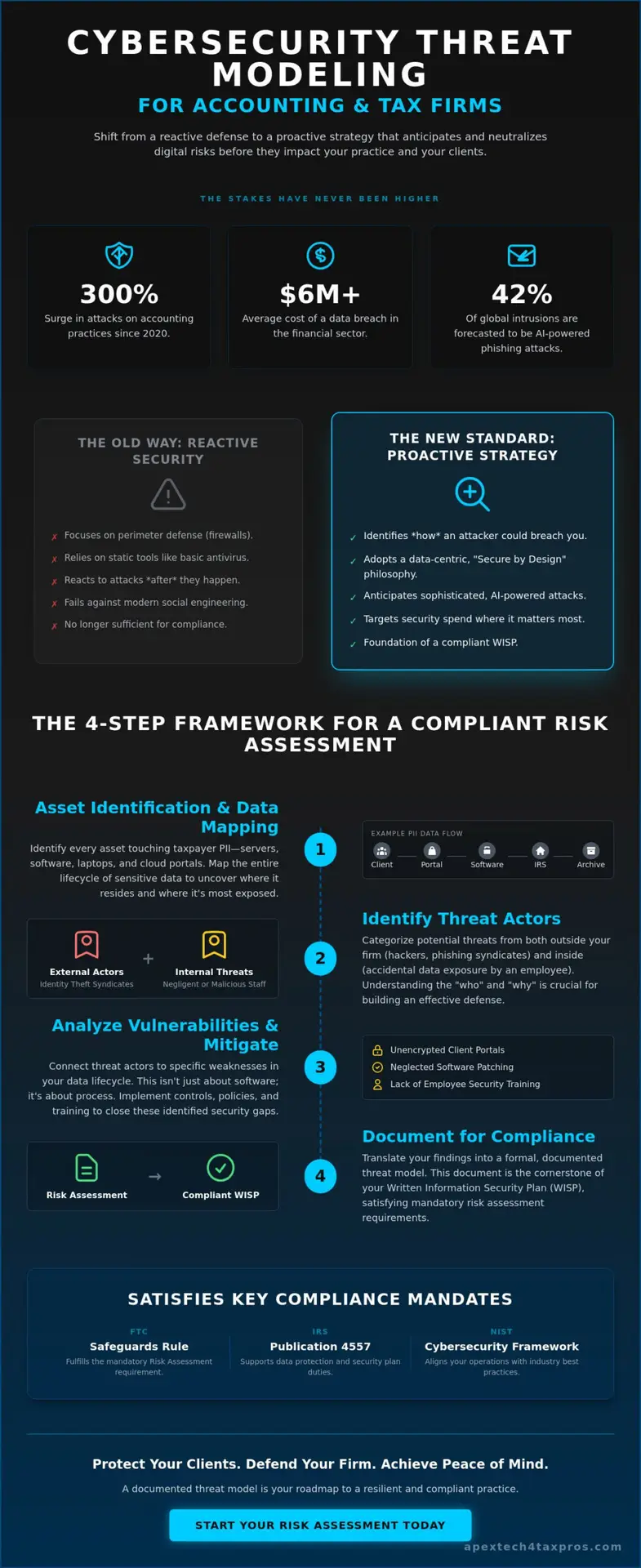
Did you know that attacks on accounting practices have surged by approximately 300% since 2020? This alarming trend makes cybersecurity threat modeling for accounting firms more than just a technical exercise; it’s a vital component of your firm’s survival. With the average cost of a data breach in the financial sector exceeding $6 million in 2026, the stakes for your practice have never been higher. You’re likely feeling the weight of the upcoming filing season and the anxiety of potential IRS non-compliance penalties. It’s common to feel overwhelmed by the gap between general IT advice and the specific mandates of the FTC Safeguards Rule.
We understand that protecting sensitive PII isn’t just about software; it’s about safeguarding the trust your clients place in you. In this guide, you’ll learn how to identify hidden vulnerabilities and secure your data by implementing a structured threat modeling process tailored for tax professionals. We’ll explore how to align your operations with the NIST Cybersecurity Framework 2.0 and create the documentation necessary to support your mandatory WISP. By the end of this article, you’ll have a clear map of your firm’s risks and the peace of mind that your practice is resilient against ransomware and regulatory scrutiny.
Key Takeaways
- Understand the critical distinction between generic security tools and a proactive strategy designed to identify and mitigate specific digital risks.
- Learn the methodical steps of cybersecurity threat modeling for accounting firms to map the lifecycle of sensitive PII from client intake to final archiving.
- Discover how a documented threat model satisfies the stringent Risk Assessment requirements mandated by the FTC Safeguards Rule and IRS Publication 4557.
- Identify common vulnerabilities within the tax data lifecycle, including risks associated with unencrypted portals and neglected software patch management.
- Gain insights into translating identified threats into formal policies that serve as the foundation for a compliant Written Information Security Plan (WISP).
What is Cybersecurity Threat Modeling for Accounting Firms?
In the specialized world of tax preparation, cybersecurity threat modeling for accounting firms is a proactive strategy designed to identify, communicate, and mitigate digital risks. While many firms focus on purchasing individual security tools, threat modeling represents the overarching strategy that dictates how those tools are deployed. It’s the difference between buying a high-end deadbolt and understanding exactly which windows a burglar might target. For a modern practice, this process isn’t optional. It’s an essential component of “due professional care,” aligning technical defense with the ethical obligations practitioners owe to their clients.
The 2026 threat landscape has evolved beyond the capabilities of reactive antivirus software. With AI-powered phishing attacks forecasted to account for over 42% of all global intrusions by the end of this year, relying on static software is a dangerous gamble. Threat modeling allows you to anticipate these sophisticated maneuvers before they penetrate your network. It shifts your posture from a passive observer to a disciplined protector of sensitive taxpayer information. This methodical approach ensures that your security spend is targeted where it matters most.
The Difference Between a Risk Assessment and a Threat Model
It’s common to confuse these two concepts, but they serve distinct roles in a robust security posture. A risk assessment identifies “what” can go wrong, such as a data breach or a server failure. In contrast, threat modeling identifies “how” an attacker might actually achieve that goal. While a risk assessment might note that your client portals are vulnerable, a threat model maps the specific path a hacker takes to exploit an unpatched vulnerability. Accounting firms need both to satisfy the rigorous requirements of the FTC Safeguards Rule. This regulation mandates a documented understanding of both potential hazards and the specific pathways through which they manifest.
Why Traditional IT Security is No Longer Enough
For years, the industry relied on “perimeter defense,” believing that a strong firewall was sufficient. Today, the focus has shifted toward data-centric security. Tax firms are high-value targets because they act as a “one-stop-shop” for identity theft, housing Social Security numbers and bank details in a single location. Simple firewalls don’t stop a social engineering attack that tricks an employee into revealing credentials. Modern practices must adopt a “Secure by Design” philosophy. This means building security into every workflow, from the initial client intake to the final filing. By focusing on the data itself rather than just the network borders, you ensure that client PII remains protected even if a single point of entry is compromised.
How to Conduct a Security Risk Assessment for a CPA Firm
Moving from the theoretical strategy of cybersecurity threat modeling for accounting firms to a practical application requires a methodical, step-by-step approach. You don’t need a background in computer science to secure your practice, but you do need a disciplined process to identify where your client data is most exposed. A thorough risk assessment serves as the foundation for your security posture, ensuring that your protective measures are proportional to the actual threats you face. This process transforms abstract anxiety into a concrete, manageable action plan.
Step 1: Asset Identification and Data Mapping
The first step is identifying every asset that touches sensitive taxpayer information. This includes your tax preparation software, local servers, cloud-based client portals, and all staff laptops. You must also account for physical assets; paper files become digital assets the moment they are scanned into your system. To perform effective data mapping, track the specific path of a Social Security number through your firm. Follow it from the initial client intake via email or portal, through the preparation and review stages, to the final e-file submission and long-term storage. Understanding this lifecycle reveals exactly where data sits at rest and where it is in transit.
Step 2: Identifying Potential Threat Actors
Security professionals categorize threats into two main groups: external and internal. External actors include identity theft syndicates that specifically target the “Professional Tax Preparer” because of the high-value data they hold. However, the insider threat remains the most overlooked risk facing accounting firms in 2026. This includes not only disgruntled employees but also well-meaning staff who accidentally delete files or fall for phishing scams. According to industry data, 82% of data breaches involve a human element, making internal awareness just as critical as external firewalls. If you haven’t recently evaluated your internal controls, a professional risk assessment can provide the clarity needed to close these human-centric gaps.
Step 3: Determining Vulnerabilities and Gaps
Once you know your assets and your threats, you must find the vulnerabilities that connect them. Common gaps in CPA firms often include a lack of Multi-Factor Authentication (MFA) on legacy software or the presence of “shadow IT.” Shadow IT occurs when staff use unapproved applications, like personal cloud storage or messaging apps, to move client files because they find the firm’s official tools cumbersome. Physical security is equally vital. Use this checklist to evaluate your office environment:
- Are server rooms or network closets kept locked at all times?
- Do computer screens in the reception area face away from public view?
- Is there a policy for securing laptops and mobile devices when staff work remotely?
- Are all physical backup drives encrypted and stored in a fireproof safe?
After identifying these gaps, prioritize them based on their likelihood and potential impact. This logical progression ensures that your budget is allocated toward mitigating the most severe risks first, providing the highest level of protection for your clients and your firm’s reputation.
Mapping Threats to IRS and FTC Compliance Standards
For tax professionals, the technical process of cybersecurity threat modeling for accounting firms isn’t merely a defensive measure; it’s a regulatory mandate. Federal authorities have shifted their focus from general recommendations to specific, enforceable standards. By mapping your identified threats to these frameworks, you ensure that your security investments are both effective and legally defensible. When an auditor asks why you chose specific technical controls, your threat model provides the evidence based on your firm’s unique risk profile. This alignment transforms security from a vague overhead cost into a documented compliance asset.
Failing to document this process carries heavy consequences. Under the current 2026 enforcement cycle, the FTC can impose civil penalties reaching as high as $50,120 per violation per day for non-compliance with the Safeguards Rule. Additionally, IRC Section 6713 outlines civil penalties for unauthorized disclosure of taxpayer information, which increase significantly if the disclosure is related to identity theft. A well-constructed threat model serves as your primary defense during a regulatory audit, proving that you’ve exercised due professional care in protecting client PII.
IRS Publication 4557: The Gold Standard for Tax Pros
IRS Publication 4557 outlines seven critical areas of focus, including legal requirements, technical safeguards, and administrative protections. It mandates that every tax preparer, regardless of firm size, implements a plan to safeguard taxpayer data. Cybersecurity threat modeling for accounting firms directly addresses this by identifying the specific pathways through which data could be compromised. This process ensures your firm meets the “Safeguarding Taxpayer Data” mandate through structured analysis rather than guesswork. In the eyes of a regulatory auditor, a security control that isn’t documented is a security control that doesn’t exist.
The FTC Safeguards Rule and Small Firm Requirements
Accounting and CPA firms are classified as “financial institutions” under the Gramm-Leach-Bliley Act (GLBA), making them subject to the FTC Safeguards Rule. This rule requires you to designate a “Qualified Individual” to oversee your security program and conduct regular risk assessments. While some very small firms have limited exemptions from certain written reporting requirements, almost all practices must have a documented risk assessment in place. A revision to the rule, effective since May 13, 2024, also mandates that you report any “notification event” affecting 500 or more consumers to the FTC within 30 days of discovery. Your threat model identifies the high-risk areas where these events are most likely to occur, allowing you to implement the encryption and multi-factor authentication (MFA) controls the FTC now strictly enforces.
Common Vulnerabilities in the Tax Data Lifecycle
Identifying where your firm is most exposed requires looking at the specific stages of the tax data lifecycle. Vulnerabilities often hide in plain sight, embedded in the very workflows that allow your practice to function. Cybersecurity threat modeling for accounting firms helps you pinpoint these weaknesses, from the moment a client sends their first document to the final archiving of a return. Without this mapping, you risk leaving critical gaps in your defense that even the most advanced antivirus cannot bridge.
The dangers aren’t limited to external hackers. Internal administrative weaknesses, such as poor password hygiene and “forever” data retention policies, create a fertile ground for breaches. If you retain client records longer than legally required or fail to encrypt your backups, you’re essentially maintaining a high-value target for identity theft syndicates. A disciplined approach to threat modeling ensures that every stage of your process, including firm administration, is scrutinized for potential failure points.
The “Client Portal” Paradox
While most firms provide secure portals, clients often bypass them in favor of the “convenience” of email attachments. This behavior creates a significant vulnerability in the intake channel. To mitigate this, you must threat model the communication path between your firm and the client. Enforcing portal use is essential; however, it requires clear communication. You can explain to clients that unencrypted email is like sending their Social Security number on a postcard. By setting a firm policy that excludes email for document exchange, you protect both the client’s PII and your firm’s integrity.
Remote Work and Mobile Device Risks
The home office environment introduces risks that aren’t present in a controlled office setting. Remote staff often use home routers with default passwords or, worse, public Wi-Fi at coffee shops. A robust threat model for 2026 must include these remote endpoints. Mandatory firm-managed VPNs are a non-negotiable requirement for any staff member accessing client data outside the office. Additionally, mobile devices used for Multi-Factor Authentication (MFA) or client calls must be secured with biometric locks and remote-wipe capabilities. If you aren’t sure where your remote gaps lie, our team can help you develop a Customized Written Information Security Plan (WISP) that covers every location where your staff works.
Ransomware: The #1 Threat to Tax Season Continuity
Ransomware is involved in approximately 24% of all data breach incidents, making it a primary concern during the high-pressure tax season. The “kill chain” typically begins with a single phishing email that an employee clicks in a rush. Once inside, the malware encrypts your files and backups, bringing your practice to a standstill. Breaking this chain requires a multi-layered approach. Secure cloud backups that are “immutable” ensure that even if your primary systems are hit, your data remains unchangeable and recoverable. Regular cybersecurity awareness training empowers your staff to recognize these threats before they can gain a foothold, turning your employees into your strongest line of defense.
From Threat Model to WISP: Implementing Your Defense
By integrating cybersecurity threat modeling for accounting firms into your administrative workflows, you create a dynamic foundation for your security posture. A threat model is not a static report to be filed away; it is a living document that directly informs your Written Information Security Plan (WISP). While the threat model identifies the specific “how” behind potential attacks, your WISP establishes the formal “how” of your firm’s defense. This transition from assessment to implementation is what transforms technical knowledge into a compliant, resilient business operation.
Translating identified threats into policy requires a methodical approach. For example, if your threat model identifies unencrypted email as a high-risk vulnerability for client intake, your WISP must codify the mandatory use of secure portals. This policy then dictates the technical controls you implement and the training your staff receives. Maintaining this relevance requires an annual review process. As we move through 2026, threat actors will continue to refine AI-driven social engineering tactics. Updating your threat model at least once a year ensures your WISP remains a shield rather than a relic of outdated security assumptions.
Building Your Written Information Security Plan (WISP)
The WISP is the formal document required by the IRS and the FTC to prove your firm has a coordinated security program. Your threat modeling data provides the essential “why” behind every policy in this document. While some practitioners start with a FREE WISP Download Template to understand the basic requirements, a template is only a starting point. To truly satisfy regulatory scrutiny, your plan must be customized to your firm’s specific assets and identified threats. A customized WISP demonstrates to auditors that you haven’t just checked a box, but have actually analyzed the unique data lifecycle of your practice.
Operationalizing Security Training
Staff members are often described as the weakest link in security, but they become your strongest asset when they are properly trained on the findings of your threat model. Training shouldn’t be a generic, once-a-year video. Effective cybersecurity awareness training is frequent, engaging, and based on the actual risks your firm faces. If your threat model highlights a surge in tax-season phishing, your training should include simulated exercises that mirror those specific scenarios. This approach builds a culture of vigilance where security becomes a shared professional responsibility.
Turning these complex regulatory requirements into a functional defense doesn’t have to be a solo endeavor. Apex Tech 4 Tax Pros specializes in bridging the gap between technical risk and firm compliance. We provide the expertise needed to move from a state of vulnerability to a state of secure, documented readiness. You can secure your firm with a professional WISP and Risk Assessment to ensure your practice is fully protected for the upcoming season and beyond.
Securing the Future of Your Practice
Implementing a disciplined strategy for cybersecurity threat modeling for accounting firms is the most effective way to transition from a state of vulnerability to one of secure compliance. By mapping the specific pathways an attacker might use to access taxpayer data, you move beyond generic IT solutions and toward a defense that satisfies both the IRS and the FTC. This methodical approach ensures that your firm isn’t just buying software; it’s building a resilient infrastructure capable of withstanding the sophisticated threats of 2026.
As specialized experts in the tax and accounting niche, our team utilizes a proven risk assessment framework to help you navigate these complex federal mandates. We understand the high-stakes environment of tax season and are here to ensure your client PII remains protected. You can protect your practice with a customized Written Information Security Plan (WISP) designed by IRS and FTC compliance experts. Taking this step today provides the peace of mind necessary to focus on what you do best: serving your clients with excellence.
Frequently Asked Questions
Is a threat model the same as a vulnerability scan?
No, these are distinct security processes. A vulnerability scan is an automated tool that identifies known software bugs or missing security patches. In contrast, cybersecurity threat modeling for accounting firms is a strategic analysis of how an attacker might navigate your specific business workflows. While a scan tells you if a door is unlocked, a threat model explains why an attacker wants to enter and the logical path they take to reach client PII.
Does the IRS require accounting firms to conduct threat modeling?
The IRS doesn’t use the specific term “threat modeling,” but it does mandate a documented risk assessment under Publication 4557. Threat modeling is the industry standard method for fulfilling this requirement. By identifying potential threats and vulnerabilities as part of your “due professional care,” you satisfy the federal expectation that you’ve analyzed the specific risks to taxpayer data within your practice’s unique environment.
How often should a CPA firm update its security risk assessment?
You should update your risk assessment at least annually or whenever you make significant changes to your firm’s technology or operations. Common triggers include migrating to new tax software, onboarding remote staff, or moving to a different cloud provider. The 2026 enforcement cycle for the FTC Safeguards Rule emphasizes that these documents must remain current to reflect the evolving nature of digital threats and regulatory requirements.
Can I use a generic WISP template without doing a threat model?
While a generic template provides a basic structure, it lacks the firm-specific analysis required for true compliance. A WISP is meant to be a reflection of your actual security controls. Without a threat model, your WISP won’t address the unique vulnerabilities of your specific client intake and storage processes. This gap can lead to significant penalties if an auditor discovers your written plan doesn’t match your operational reality.
What are the most common cybersecurity threats for tax professionals in 2026?
The most prevalent threats include AI-powered phishing, ransomware, and social engineering. AI-driven attacks are forecasted to account for over 42% of global intrusions by the end of 2026, making them a primary concern for tax pros. These attacks often target the high-pressure environment of tax season. They rely on the hope that a busy employee will click a malicious link or provide credentials to a fraudulent, yet highly convincing, portal.
How much does a professional cybersecurity risk assessment cost for a small firm?
The investment for a professional assessment varies based on the size of your staff and the complexity of your technical infrastructure. Rather than focusing on a single price point, consider the cost of a data breach, which averaged over $6 million in the financial sector in 2026. A professional assessment provides a high return on investment by identifying vulnerabilities before they result in catastrophic financial or regulatory losses.
What is the “Qualified Individual” requirement in the FTC Safeguards Rule?
The FTC Safeguards Rule mandates that every firm designate a specific person, known as a “Qualified Individual,” to oversee and enforce the security program. This person is responsible for the development of your WISP and the performance of regular risk assessments. While this individual doesn’t need a specific degree, they must have the technical authority and professional accountability to ensure your firm’s data protection measures meet federal standards.
Does my firm need a threat model if we use cloud-based tax software?
Yes, because your firm remains responsible for the data before it reaches the cloud and how it is accessed. Cloud providers secure their own servers, but they don’t protect your office’s Wi-Fi, your staff’s laptops, or the unencrypted emails clients might send you. A threat model identifies these “last mile” vulnerabilities, ensuring that your firm’s internal procedures are as secure as the specialized software you utilize.