
A data breach isn’t just a technical failure; for tax professionals in 2026, it’s a high-stakes federal compliance trigger that can result in civil penalties of up to $100,000 per violation. You’ve likely spent decades building a practice rooted in trust, and the sudden realization that sensitive client data is compromised can feel overwhelming. Implementing a robust data breach response plan for accountants is no longer a luxury. It’s a mandatory requirement under the FTC Safeguards Rule to protect both your firm’s reputation and its financial viability.
We understand the anxiety that comes with navigating the patchwork of state notification laws alongside strict IRS mandates. This guide provides the definitive, step-by-step checklist you need to manage a security event with clinical precision. You’ll learn exactly how to meet the 30 day FTC notification deadline, how to coordinate with an IRS Stakeholder Liaison, and which technical steps are required to minimize downtime. By following this structured path, you can move from a state of vulnerability to a position of secure, documented compliance.
Key Takeaways
- Define the regulatory framework that makes a data breach response plan for accountants a mandatory component of your firm’s technical infrastructure.
- Master the immediate containment protocols required to isolate compromised systems without destroying the forensic evidence needed for federal investigations.
- Navigate the complex reporting hierarchy by identifying when to contact the IRS, the FTC, and individual state authorities to remain in full compliance.
- Implement a strategic communication plan to inform clients of a security event while preserving the professional trust you’ve built over decades.
- Learn how to perform a post-incident analysis to strengthen your Written Information Security Plan (WISP) and prevent the recurrence of similar vulnerabilities.
Essential Components of an IRS-Compliant Data Breach Response Plan
A data breach response plan for accountants is a formal, documented framework engineered to mitigate operational damage and satisfy specific IRS and FTC reporting mandates. It isn’t merely a set of IT instructions for restoring a server. Instead, it’s a compliance-driven roadmap that aligns with foundational cybersecurity principles to protect non-public personal information (NPI). By 2026, the mandate for a “documented incident response” protocol within every firm’s Written Information Security Plan (WISP) has become a non-negotiable standard for tax practices of all sizes.
Relying on a generic business continuity plan is a common mistake that leaves firms vulnerable to regulatory scrutiny. IRS Publication 4557 outlines specific expectations for tax professionals that go far beyond standard data recovery. These standards require precise steps for protecting taxpayer data under IRC Section 7216 and coordinating with federal agencies. A generic plan might help you reboot your hardware, but it won’t help you navigate the $100,000 civil penalties associated with FTC Safeguards Rule non-compliance.
The Legal Foundation: GLBA and the Safeguards Rule
Under the Gramm-Leach-Bliley Act (GLBA), accounting firms are classified as financial institutions. This designation means you’re subject to the FTC Safeguards Rule, which requires the appointment of a “Qualified Individual” to execute and maintain your security strategy. While state data breach laws provide a baseline, federal mandates for tax professionals are often more stringent. These federal rules prioritize the protection of the federal tax system’s integrity, necessitating a response plan that addresses both client privacy and IRS reporting obligations. You must ensure your plan accounts for these overlapping liabilities to avoid being caught between conflicting regulatory deadlines.
Response Team Roles for Small-to-Mid Sized Firms
Effective crisis management requires clear accountability, regardless of your firm’s size. Even in a small practice, you must designate a Response Coordinator to lead the effort. The Response Coordinator serves as the central hub for all compliance documentation and communication during and after a security event. This role involves managing relationships with external partners such as cybersecurity forensic experts, legal counsel, and your local IRS Stakeholder Liaison. Identifying these contacts before a breach occurs ensures that your firm can act without hesitation. It’s about building a protective circle around your practice so you’re never making critical legal decisions in a vacuum.
Phase 1: Immediate Containment and Technical Triage Checklist
The moment you detect an unauthorized intrusion, the clock starts. Your data breach response plan for accountants must transition from a static document to an active defense strategy. The primary goal is containment. You need to stop the bleeding without compromising the very evidence the IRS and FTC will later require for their investigations. If you act too hastily by deleting files or shutting down servers improperly, you might destroy the digital breadcrumbs needed to prove the extent of the data loss.
Follow these immediate steps to secure your environment:
- Isolate compromised systems: Disconnect affected hardware from the network immediately. Don’t turn the machines off, as volatile memory (RAM) often contains traces of the malware that a restart would wipe away.
- Force-reset all firm-wide credentials: This is a critical industry-specific step. You must reset passwords for all staff, focusing heavily on PTIN and EFIN accounts. If an attacker gains control of your filing credentials, they can submit fraudulent returns in your name before you’ve even finished your initial assessment.
- Disable remote access: Shut down all VPNs and RDP connections. According to the FTC’s Data Breach Response Guide, securing the point of entry is the only way to prevent a secondary wave of exfiltration.
- Document every action: Maintain an offline, physical incident log. Digital notes on a compromised network are unreliable and could be altered or deleted by the intruder.
- Engage a forensic IT specialist: You need an expert who understands the unique integrity requirements of financial data. They’ll help you identify exactly which taxpayer records were accessed.
Securing Tax Preparation Software and Portals
Cloud-based tax software like UltraTax, Drake, or Lacerte requires specialized attention. You must lock down client portals and document exchange folders to prevent further theft of sensitive PDFs. Contact your software vendors, such as Intuit or Thomson Reuters, to report the breach. They often have internal security teams that can monitor your account for suspicious activity. Before attempting a system restore, verify the integrity of your secure cloud backup. If the backup itself was compromised during the initial attack, you’ll simply be re-introducing the threat into your “clean” environment.
Preserving Evidence for Federal Regulators
It’s tempting to “wipe and reinstall” everything to get back to work quickly. Don’t do it. Federal regulators require a forensic image of the affected hardware to determine the scope of the breach. Wiping the drive destroys logs—firewall history, login attempts, and file access records—that are essential for compliance reporting. Keep a strict chain of custody for all hardware involved. If the IRS Criminal Investigation unit gets involved, they’ll expect a clear record of who handled the equipment and when it was secured.
Phase 2: Mandatory Regulatory Notifications (IRS, FTC, and State)
Once the immediate technical threat is contained, your focus must shift toward regulatory accountability. For tax professionals, the notification window is significantly narrower than for standard retail or service businesses. While many state laws allow for notification “without unreasonable delay,” the practical reality of tax fraud means you should aim to notify the IRS within 24 hours of discovery. A specialized data breach response plan for accountants prioritizes these federal channels to prevent the submission of fraudulent returns using your firm’s credentials.
Notifying the IRS and Protecting Taxpayer IDs
The IRS Stakeholder Liaison is the primary contact for reporting compromised taxpayer data. When you initiate this contact, you’ll need to provide your EFIN, PTIN, and a precise estimate of the number of affected taxpayers. This allows the IRS to flag those accounts immediately, preventing identity thieves from claiming fraudulent refunds under your clients’ names. Following the AICPA’s guidance on cyber obligations, you should document every exchange with the Liaison. This proactive step protects your clients and serves as a vital defense against claims of “knowing or reckless” disclosure under IRC Section 7216, which can carry criminal penalties and imprisonment.
Beyond the IRS, the FTC Safeguards Rule requires notification no later than 30 days after discovering a security event involving the unencrypted information of at least 500 consumers. Simultaneously, you must navigate the 50-state patchwork of notification laws. As of 2026, 36 states require entities to report breaches directly to the Attorney General or another state agency. Failure to meet these overlapping deadlines can result in civil penalties of up to $100,000 per violation for your firm and $10,000 for individual officers. It’s a high-stakes environment where precision in timing is just as important as the content of the notice.
Law Enforcement and the FBI Cyber Task Force
Reporting the incident to the FBI’s Internet Crime Complaint Center (IC3) is essential, especially if the breach appears to be part of a coordinated cybercrime effort. While federal agents focus on the perpetrators, your formal report provides a critical piece of your compliance audit trail. Don’t overlook local law enforcement; a police report is often a mandatory prerequisite for cybersecurity insurance claims and certain state-level safe harbor provisions. These official records demonstrate that you’ve fulfilled your duty as a “financial institution” under the GLBA. They transform a chaotic crisis into a structured, legally defensible response that preserves your professional standing.
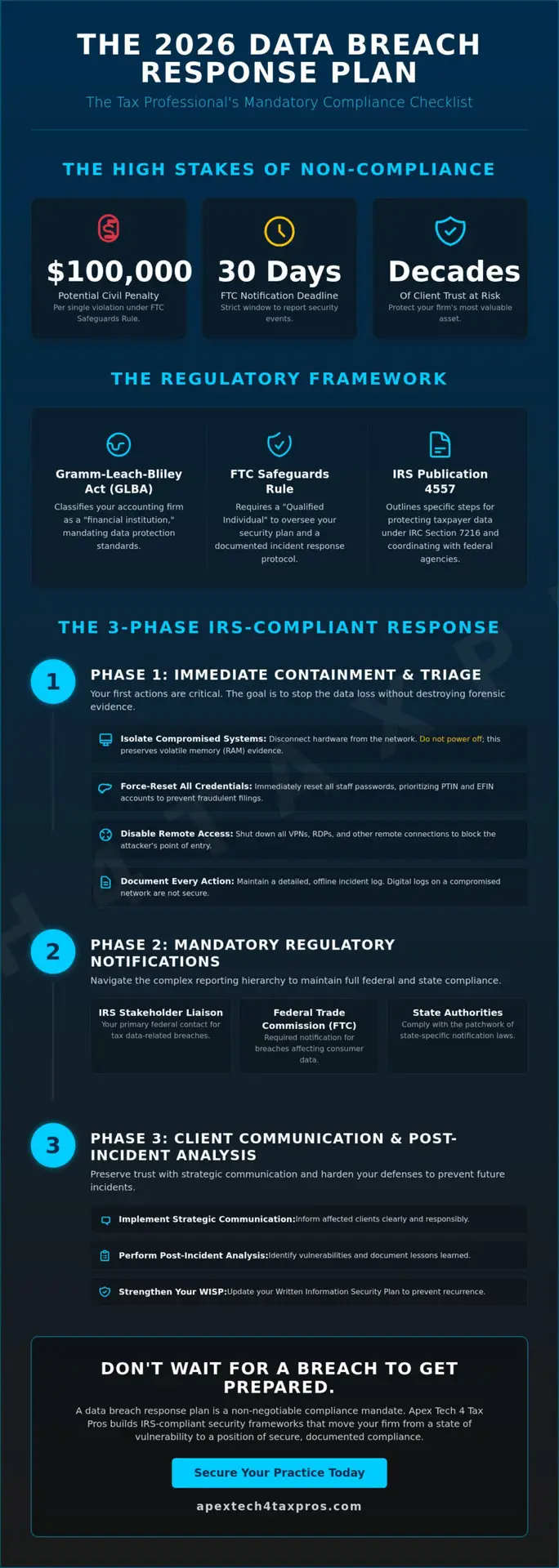
Phase 3: Client Communication and Reputation Management Strategy
Protecting your firm’s reputation after a security event requires a delicate balance of transparency and legal caution. While technical containment and regulatory filings are underway, your clients need to hear from you directly. A well-executed data breach response plan for accountants ensures that your message is controlled, empathetic, and compliant. You’ve spent years becoming a trusted advisor; maintaining that status depends on how you handle this moment of vulnerability. It is your responsibility to guide them through the next steps with the same professional precision you bring to their tax returns.
You should prepare to offer credit monitoring services as a standard protective measure for all affected individuals. This gesture signals that you take the security of their financial identity seriously and are willing to invest in their protection. Additionally, your staff must be trained to handle the inevitable influx of panicked phone calls. Clear communication scripts help employees provide consistent, factual information without inadvertently increasing the firm’s legal exposure or causing unnecessary alarm. Managing the human element is just as critical as the technical recovery.
Transparency vs. Liability: The Communication Balance
Compliant notification letters must state the nature of the breach, the specific data types involved, and the remedial steps you’ve already taken. You must avoid making definitive “all clear” declarations until your forensic investigation is fully finalized. Use secure communication channels to deliver these updates rather than standard email. This strategy prevents attackers from using the breach as a pretext for secondary phishing attempts against your clients. It also reinforces your commitment to using high-security protocols even during a crisis.
Protecting the Firm’s Professional Reputation
A proactive and organized response often results in increased client loyalty. Clients value honesty and a clear path forward more than perfection. Your cybersecurity insurance policy likely includes coverage for public relations and the costs associated with mass notifications. Leverage these resources to establish a dedicated “Frequently Asked Questions” page on your website. This provides a central repository of facts that clients can reference at their convenience, reducing the burden on your front-office staff. To ensure your team is prepared for these high-pressure interactions and understands their role in your security culture, consider implementing Cybersecurity Awareness Training as a core part of your risk management strategy.
By treating the communication phase as a professional service rather than a legal burden, you preserve the integrity of your practice. Your goal is to move the client from a state of fear to a state of informed security. This methodical approach demonstrates that while a breach occurred, your firm remains the best-equipped partner to manage their sensitive financial data moving forward.
Hardening Your Practice: Integrating Response Plans into Your WISP
The resolution of a security event doesn’t mark the end of your compliance journey; it signals the beginning of a mandatory hardening phase. A “Post-Mortem” analysis is the most critical step in this process. You must identify the root cause of the breach, whether it was a sophisticated phishing attempt or a vulnerability in a legacy software portal. This isn’t about assigning blame but about fulfilling the “Continuous Improvement” mandate central to modern federal regulations. A data breach response plan for accountants must be a living component of your broader security strategy, evolving as new threats emerge in the 2026 landscape.
Your Written Information Security Plan (WISP) should be updated immediately following any incident to reflect the lessons learned. If the breach occurred because of a lack of Multi-Factor Authentication (MFA) or unencrypted data transfers, these must be established as non-negotiable standard protocols. The IRS “Security Six” requirements are the floor, not the ceiling. Integrating your response protocols directly into your WISP ensures that your firm remains vigilant and that your technical infrastructure is engineered to prevent a recurrence of the same vulnerability. Apex Tech 4 Tax Pros specializes in this integration, helping firms automate their compliance through customized WISPs that bridge the gap between technical security and regulatory documentation.
Annual Risk Assessments and Vulnerability Scanning
Moving from a reactive posture to a proactive defense requires a commitment to regular testing. The IRS expects your response plan to stay current with 2026 threats, which necessitates shifting toward quarterly security reviews rather than a single annual check. Vulnerability scanning helps you identify open ports or outdated software before an attacker does. These reviews provide the documented evidence federal regulators look for during an audit to prove you’ve exercised due diligence. You can learn more about our Risk Assessment services to see how a professional evaluation can identify hidden gaps in your current perimeter.
Staff Training: The Ultimate Firewall
Technology alone cannot protect a firm if the human element remains a weak point. Ongoing cybersecurity awareness training is the most effective way to reduce the risk of social engineering. By implementing simulated phishing attacks, you can measure your firm’s readiness and identify staff members who may need additional support. This methodical approach to education transforms your employees into an active part of your defense rather than a potential point of entry. To ensure your firm meets the baseline requirements for 2026, you can download our FREE WISP Template to start your compliance journey today. Taking these steps now ensures that your practice remains a secure, trusted environment for your clients’ most sensitive financial data.
Securing Your Firm’s Future Through Proactive Compliance
A data breach doesn’t have to be the end of your professional story. By implementing a structured data breach response plan for accountants, you’ve taken the first step toward safeguarding your legacy and your clients’ trust. You now understand that true security is a methodical cycle of assessment, containment, and transparent communication. These aren’t just technical hurdles; they’re the essential components of a practice built to withstand the complexities of the 2026 regulatory environment. Each protocol you’ve learned serves to protect the sensitive financial data that defines your practice.
Our team brings over 20 years of technical security experience to your practice, offering solutions specifically engineered for tax and accounting professionals. We specialize in ensuring your operations meet the rigorous standards of IRS Publication 4557 and the FTC Safeguards Rule. Secure your firm with a customized WISP and Response Plan today to move from a state of vulnerability to a position of documented strength. Your commitment to these protocols isn’t just about avoiding heavy non-compliance fines; it’s about honoring the trust your clients place in you every day. You’ve built a practice on integrity, and we’re here to help you protect it.
Frequently Asked Questions
Do I really need a written data breach response plan if I’m a solo practitioner?
Yes, the FTC Safeguards Rule applies to all tax professionals regardless of their firm’s headcount. Every solo practitioner is classified as a financial institution and must maintain a documented data breach response plan for accountants as part of their Written Information Security Plan (WISP). This requirement ensures that sensitive taxpayer data is protected by a structured recovery process even in a single-person office.
How quickly does the IRS require me to report a data breach?
You should contact the IRS immediately, ideally within 24 hours of discovering a security event. While the FTC provides a 30 day window for specific events involving 500 or more consumers, the IRS requires faster action to flag compromised taxpayer IDs. Rapid reporting to your Stakeholder Liaison is the most effective way to prevent identity thieves from submitting fraudulent returns using your firm’s credentials.
What is the penalty for an accountant who fails to report a data breach?
Penalties for non-compliance are severe and can include civil fines of up to $100,000 per violation under the FTC Safeguards Rule. Additionally, unauthorized disclosure of taxpayer information can trigger IRC Section 6713 civil penalties of $250 per incident. In cases of knowing or reckless disclosure, IRC Section 7216 allows for criminal fines of up to $1,000 and imprisonment for up to one year per violation.
Does my general business liability insurance cover a data breach?
Standard general liability insurance typically doesn’t cover cyber-related losses or data breaches. Most general policies explicitly exclude technical security events; therefore, you likely need a specific cyber liability policy or a dedicated rider. These specialized policies are engineered to cover the high costs of forensic investigations, legal notifications, and credit monitoring services that a standard business policy ignores.
Which state’s data breach law do I follow if my clients live in multiple states?
You must follow the data breach notification laws of the state where the affected client resides. If your practice serves clients across multiple states, your data breach response plan for accountants must account for the specific timelines and reporting requirements of each jurisdiction. This often results in a patchwork of deadlines ranging from “without unreasonable delay” to specific 30 or 60 day windows.
Who is the IRS Stakeholder Liaison and how do I find mine?
The IRS Stakeholder Liaison serves as the official link between the IRS and the tax professional community. You can find your local representative by visiting the IRS.gov website and searching the directory for Stakeholder Liaison by state. These officials are your primary point of contact for reporting compromised EFINs or PTINs and coordinating with the IRS Criminal Investigation unit during a crisis.
Can the IRS shut down my EFIN if I have a data breach?
Yes, the IRS has the authority to suspend or shut down your Electronic Filing Identification Number (EFIN) following a breach. If federal investigators determine that your technical infrastructure is compromised, they’ll halt your ability to transmit returns to protect the integrity of the tax system. Restoring your filing privileges often requires documented proof that you’ve remediated the security gap and updated your WISP.
What should be included in a client notification letter after a breach?
A compliant notification letter must include the date of the breach, the specific types of data exposed, and the actions your firm is taking to mitigate the damage. You should also provide clear instructions for clients, such as setting up credit freezes or enabling multi-factor authentication on their personal accounts. Transparency in these letters helps preserve your professional reputation while meeting your legal disclosure mandates.