
Did you know that 73% of small businesses experienced a cyberattack in the last year? For a tax professional, this isn’t just a tech issue; it’s a direct threat to your professional standing and your clients’ most private data. You likely feel the pressure of the FTC Safeguards Rule and the fear of a potential IRS audit, yet the complex world of cybersecurity for small accounting firm compliance often feels buried under technical jargon like WISP and MFA. It’s frustrating to face enterprise-level threats on a small-firm budget, especially as the Corporate Transparency Act increases the sensitivity of the data you handle.
We understand the weight of this responsibility and the need for pragmatic, protective solutions. This article will show you how to secure your practice against modern threats while achieving full compliance with IRS Publication 4557. You’ll learn how to implement the “Security Six” essentials and protect sensitive PII through a manageable daily routine. We’ll preview the exact steps needed to move your firm from a state of vulnerability to a position of documented, secure compliance.
Key Takeaways
- Understand why modern federal regulations have transitioned data protection from a recommended practice to a mandatory documentation requirement for all tax professionals.
- Identify the essential components of a 2026 security stack, focusing on phishing-resistant multi-factor authentication and end-to-end encryption for client document storage.
- Learn how to execute a formal risk assessment and data inventory to identify vulnerabilities before they lead to regulatory penalties or data loss.
- Evaluate the critical differences between generic internet templates and a professionally customized Written Information Security Plan (WISP) designed for your specific operational risks.
- Discover a structured, five-step roadmap for implementing cybersecurity for small accounting firm compliance that satisfies the rigorous standards of IRS Publication 4557.
Why Cybersecurity for Small Accounting Firms is a Federal Mandate
Historically, many tax practitioners viewed data protection as a defensive choice rather than a legal obligation. This perspective is no longer sustainable. Under the updated FTC Safeguards Rule, cybersecurity for small accounting firm operations has transitioned into a strict federal mandate. The Gramm-Leach-Bliley Act (GLBA) requires all financial institutions, including small tax practices, to implement safeguards for customer information. It’s no longer about whether you want to secure your data, but how you’ll prove you’ve done it during a federal audit.
Cybercriminals often prioritize firms with 1 to 10 employees. These practices handle high-value data like Social Security numbers and bank details, yet they frequently lack the robust defenses of larger enterprises. If you lose control of this data, the consequences are severe. The IRS can suspend your Electronic Filing Identification Number (EFIN), effectively shutting down your business. Beyond federal penalties, which can reach $100,000 per violation under the FTC, the reputational damage from a breach often proves impossible to recover from. Effective protection relies on established information security principles that ensure confidentiality, integrity, and availability.
The FTC Safeguards Rule vs. IRS Publication 4557
The FTC Safeguards Rule requires firms to designate a “Qualified Individual” to oversee their security program. For a small practice, this person is often the owner or a specialized partner. IRS Publication 4557 acts as your operational guide, detailing the specific steps needed to protect taxpayer data. Central to both regulations is the Written Information Security Plan (WISP). A WISP isn’t just a suggestion; it’s a mandatory document that the IRS or FTC will request first during any inquiry or after a reported breach. Developing a robust strategy for cybersecurity for small accounting firm compliance requires understanding how these two documents work together.
Common Vulnerabilities in Small Practice Infrastructure
Many firms still rely on consumer-grade routers or unencrypted email for document transmission. These tools aren’t built for professional regulatory environments. Fragmented IT systems, where data lives across various disconnected platforms, create significant security gaps. It’s a common misconception that your tax software provides a complete shield. While professional software is secure, it doesn’t protect the local network or the human errors that lead to over 90% of successful financial sector breaches. Relying on software alone leaves the rest of your digital office exposed to sophisticated AI-powered phishing attacks.
The Minimum Viable Security Stack for Tax Professionals in 2026
Building a resilient defense requires more than just installing software. It demands a coordinated “Security Six” approach as outlined in IRS Publication 4557. This framework ensures that your practice meets the technical requirements of the FTC Safeguards Rule while protecting your most valuable asset: client trust. A robust strategy for cybersecurity for small accounting firm operations starts with securing the perimeter and the endpoints where sensitive data lives.
Implementing Strong Access Controls
Multi-factor authentication (MFA) is your practice’s first line of defense. While many firms use SMS-based codes, these are increasingly vulnerable to interception. Transitioning to authenticator apps or phishing-resistant FIDO2 security keys provides a much higher level of protection. You must also manage administrative privileges carefully. Not every staff member needs “Admin” rights to every application. By limiting these permissions, you contain the potential damage if a single account is compromised. Using a professional password manager ensures your team can access shared software securely without resorting to insecure spreadsheets.
Data Encryption and Secure File Sharing
Sending sensitive documents as standard email attachments is a direct compliance violation. These files are often transmitted in plain text, making them easy targets for interception. You should instead utilize a secure client portal that offers end-to-end encryption for both transmission and storage. This ensures that only the intended recipient can access the data. For staff working remotely, full-disk encryption for laptops is mandatory. If a device is lost or stolen, encryption prevents unauthorized parties from accessing the taxpayer information stored on the hardware. Implementing these tools is the foundation of cybersecurity for small accounting firm management.
Basic antivirus software is no longer sufficient against 2026’s AI-powered threats. You need endpoint detection and response (EDR) tools that actively monitor for suspicious behavior rather than just matching known virus signatures. This active threat detection is vital when 90% of breaches start with sophisticated phishing. Finally, your stack must include secure cloud backup. Ransomware can cripple a small firm overnight. Having an off-site, encrypted backup ensures you can recover your data without paying a ransom or suffering permanent loss. If you aren’t sure where your current gaps lie, performing a formal risk assessment is a logical next step to verify your defenses.
Evaluating Your Strategy: WISP Templates vs. Professional Plans
The Written Information Security Plan (WISP) is the cornerstone of cybersecurity for small accounting firm compliance. While the FTC Safeguards Rule mandates this documentation, many practitioners fall into the trap of using a generic, “fill-in-the-blank” template. This approach often fulfills the letter of the law while failing the spirit of security. A static document sitting in a drawer offers no protection against an active breach or a focused federal audit. You need more than a piece of paper; you need a strategy that reflects your actual daily operations.
When a Free Template is Not Enough
Generic templates cannot account for your specific software environment or local hardware configurations. Federal regulators expect a WISP to reflect a firm’s actual risks, which requires a formal risk assessment that no template can perform for you. Using a basic form creates a false sense of security. You have the document, but you don’t have the underlying process. If an auditor asks how you’ve implemented your specific encryption protocols, a generic template won’t provide the answer. While a free template is a helpful starting point for the absolute basics, it rarely survives the scrutiny of a rigorous IRS investigation.
The ROI of Professional Cybersecurity Management
Many owners attempt a DIY approach to save costs, yet they often lose significant billable hours to technical troubleshooting and regulatory research. Professional management transforms compliance from a administrative burden into a strategic advantage. A customized Written Information Security Plan acts as a form of audit insurance. It demonstrates to regulators that you’ve taken deliberate, expert-guided steps to protect client PII. This level of diligence builds trust with high-value clients who increasingly demand proof of your security posture before handing over sensitive financial data.
Finally, a WISP must remain a living document to be effective. The IRS expects annual reviews and updates to reflect new threats or changes in your firm’s infrastructure. Relying on a one-time template often leads to outdated protocols that fail to address 2026’s sophisticated AI-driven attacks. Professional cybersecurity for small accounting firm documentation ensures your plan evolves alongside both technology and regulation. This methodical approach moves your firm from a state of potential vulnerability to a state of secure, documented compliance.
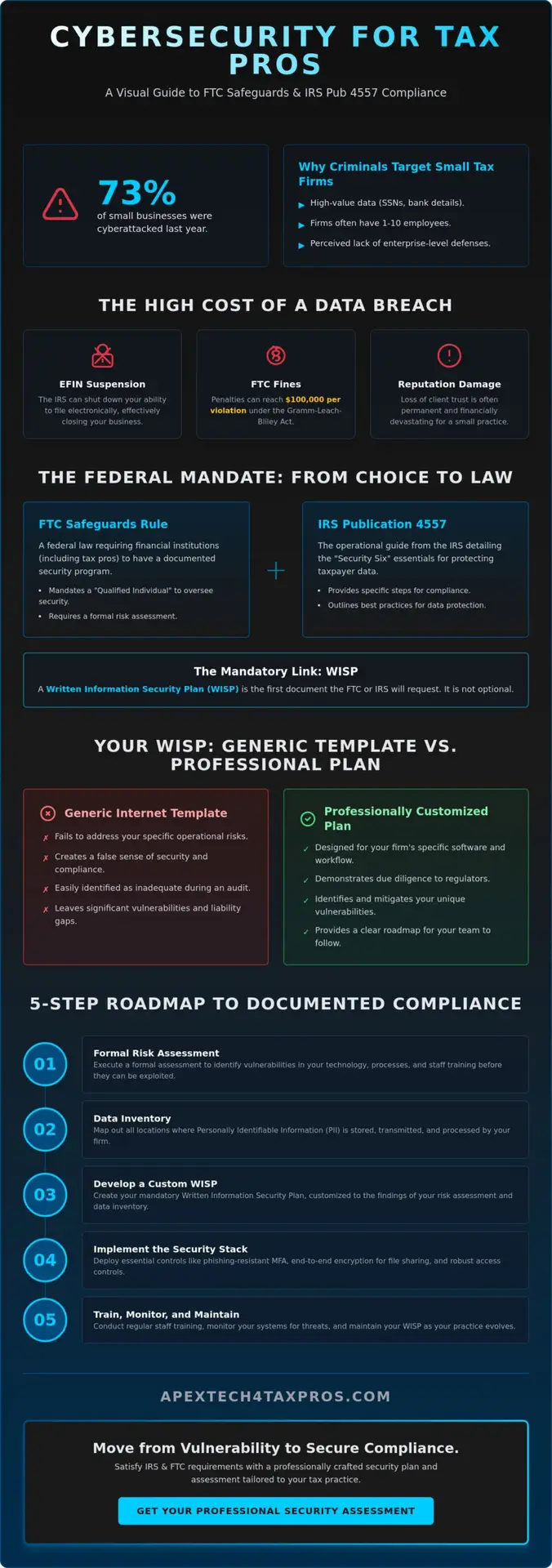
A 5-Step How-To Guide for Small Firm Cybersecurity Implementation
Implementing a comprehensive strategy for cybersecurity for small accounting firm operations doesn’t require a background in computer science. It requires a methodical, disciplined approach that mirrors the precision you apply to tax preparation. By following a structured roadmap, you can move from a state of vulnerability to full compliance with federal standards. This process ensures that your practice remains resilient against evolving digital threats while satisfying the documentation requirements of the IRS and FTC.
- Step 1: Conduct a Comprehensive IT Asset and Data Inventory. You cannot secure what you haven’t identified. Begin by listing every piece of hardware, from office desktops to the personal mobile devices staff use for email. Document every cloud application and storage platform where client data resides.
- Step 2: Perform a Formal Risk Assessment. This is the diagnostic phase of compliance. Evaluate how data moves through your firm and identify where security might fail.
- Step 3: Draft and Implement Your Customized WISP. Use the findings from your inventory and assessment to create a Written Information Security Plan. This document must be specific to your firm’s unique hardware and software environment.
- Step 4: Launch Mandatory Cybersecurity Awareness Training. Security is a team effort. Provide your staff with the tools and knowledge to recognize sophisticated phishing attempts and social engineering.
- Step 5: Establish a Regular Schedule for Monitoring and Plan Updates. Compliance is an ongoing commitment. Set recurring dates for plan reviews, password updates, and system audits to ensure your defenses remain current.
Conducting Your First Risk Assessment
A risk assessment serves as the diagnostic phase of compliance. To begin, you must trace the lifecycle of Personally Identifiable Information (PII) within your office. PII often hides in unexpected places, such as email archives, local desktop folders, or unmanaged cloud apps. Beyond digital storage, you must evaluate your physical security protocols. This includes verifying office access controls, enforcing clean desk policies, and ensuring that paper shredding procedures are strictly followed. Identifying these gaps allows you to apply professional remedies where they are needed most.
Training Your Team to Spot Threats
Human error remains the most significant vulnerability in any practice. Modern phishing simulations are essential for teaching staff to recognize the sophisticated scams prevalent in 2026. These simulations prepare your team for deepfake invoices and highly personalized emails that bypass traditional filters. It’s vital to establish a no-blame culture for reporting incidents. If a staff member clicks a suspicious link, they must feel safe reporting it immediately so that your security protocols can contain the threat. Your team is the primary maintainer of your WISP’s effectiveness. When every employee understands the principles of cybersecurity for small accounting firm safety, your practice becomes a much harder target for criminals. To ensure your firm stays ahead of these threats, you can start your risk assessment today with our specialized tools.
Partnering for Long-Term Compliance and Data Protection
General IT providers often prioritize system uptime and hardware repair. While these functions are necessary, they don’t address the specific regulatory burdens placed on tax professionals. Effective cybersecurity for small accounting firm management requires an advisor who speaks the language of IRS Publication 4557 and the FTC Safeguards Rule. You need a partner who understands that a technical glitch isn’t just a nuisance; it’s a potential compliance failure that could jeopardize your EFIN and your firm’s future.
Partnering with a specialist allows you to move from a state of constant compliance stress to one of security confidence. As federal regulations continue to evolve throughout 2026, staying ahead of new mandates like the Corporate Transparency Act’s data requirements becomes a core mission rather than a secondary task. This proactive stance ensures your firm remains a “hard target” for cybercriminals while providing the documented proof of due diligence that IRS auditors demand. Professional oversight transforms security from a technical hurdle into a manageable, disciplined routine.
The Apex Tech Advantage for Tax Professionals
We bridge the gap between complex tax preparation workflows and rigorous IT security standards. Our mission-driven approach focuses on protecting the financial practitioner through specialized knowledge of federal data protection laws. We don’t just offer generic tech support. We provide the specific frameworks, such as a Customized Written Information Security Plan (WISP), that allow you to focus on your clients while we handle the technical heavy lifting. You can secure your firm today with a customized WISP from Apex Tech 4 Tax Pros and ensure your practice meets every mandatory requirement.
Next Steps: Your Path to a Secure Practice
Taking the first step toward compliance doesn’t have to be overwhelming. You can begin by reviewing our free WISP template to understand the baseline requirements the IRS expects from your practice. However, documentation is only part of the solution. To truly uncover hidden vulnerabilities in your network or staff protocols, you should schedule a professional risk assessment. This diagnostic phase provides the clarity needed to prioritize your security investments effectively.
Ultimately, investing in cybersecurity for small accounting firm operations is an investment in your firm’s legacy. Protecting client PII isn’t just about avoiding FTC fines that can reach $100,000 per violation. It’s about honoring the trust your clients place in you every time they share their most sensitive financial information. By implementing a structured security routine today, you ensure that your practice remains a safe, capable, and compliant pillar of the professional community for years to come.
Securing Your Firm’s Future and Professional Legacy
Maintaining a secure practice in 2026 requires moving beyond basic antivirus software to a documented, disciplined framework. You’ve seen that the IRS and FTC now demand specific safeguards, including a Written Information Security Plan that reflects your actual risks. Effective cybersecurity for small accounting firm management isn’t just about avoiding penalties; it’s about protecting the legacy of trust you’ve built with every client over the years. By implementing the “Security Six” and establishing a manageable routine, you transform compliance from a burden into a strategic advantage.
At Apex Tech 4 Tax Pros, we’ve specialized in customized WISP development since 2002. Our mission is to bridge the gap between complex tax workflows and IRS Publication 4557 compliance. Whether you need expert-led risk assessments or a roadmap for team training, we provide the professional remedies your practice needs to stay resilient. You don’t have to navigate these high-stakes federal requirements alone.
Download Your FREE WISP Template or Schedule a Consultation to begin your transition to secure compliance. Taking these proactive steps today ensures your firm remains a safe harbor for sensitive client data. You have the tools to protect your practice, and we’re here to support your long-term success.
Frequently Asked Questions
Does a solo practitioner really need a Written Information Security Plan (WISP)?
Yes, every paid tax preparer is legally required to maintain a WISP regardless of firm size. The FTC Safeguards Rule and IRS Publication 4557 apply to all professional tax practitioners, including solo owners. Without this documented plan, you risk failing a federal audit even if you haven’t experienced a breach. It serves as your defensive blueprint for protecting taxpayer data and proving your due diligence to regulators.
What are the specific IRS penalties for not having a cybersecurity plan?
The IRS can impose severe administrative penalties, including the immediate suspension of your PTIN or the revocation of your EFIN. This effectively prevents you from filing returns and operating your business. Additionally, the FTC can levy civil penalties of up to $100,000 per violation of the Safeguards Rule. These financial and operational hits often prove more damaging than the technical recovery costs of an actual data breach.
How often does a small accounting firm need to update its security risk assessment?
You must update your security risk assessment at least once per year to remain compliant with federal standards. It’s also necessary to perform a new assessment whenever you implement significant changes to your infrastructure, such as switching tax software or moving to a new cloud provider. Regular updates ensure your cybersecurity for small accounting firm strategy addresses the most current AI-driven threats and hardware vulnerabilities.
Can I use personal cloud storage like Google Drive or Dropbox for client tax files?
Standard consumer versions of Google Drive or Dropbox typically do not meet the strict encryption and access control requirements of IRS Publication 4557. To remain compliant, you must use enterprise versions that allow for end-to-end encryption and detailed audit logs. Without these professional-grade controls, you cannot guarantee the confidentiality of sensitive client PII as required by the Gramm-Leach-Bliley Act and other federal regulations.
What is the ‘Qualified Individual’ requirement in the FTC Safeguards Rule?
The FTC Safeguards Rule requires every firm to designate a specific “Qualified Individual” to oversee and enforce their information security program. For a small practice, this can be an internal staff member or a specialized third-party partner. This individual is responsible for coordinating all technical safeguards and ensuring that the firm’s WISP is regularly reviewed and updated to reflect your firm’s current operational risks and technical environment.
Is cybersecurity insurance enough to protect my firm from a data breach?
Insurance is a vital recovery tool, but it is not a substitute for a mandatory security program. Most carriers now require documented proof of a WISP and active MFA before they will issue or renew a policy. While insurance helps cover legal fees and notification costs, it won’t prevent the loss of your EFIN or restore your professional reputation after a preventable data breach occurs due to negligence.
How do I know if my current IT provider is meeting IRS Publication 4557 standards?
You should ask your provider to demonstrate how their services map directly to the “Security Six” and the requirements of IRS Publication 4557. General IT providers often focus on uptime rather than regulatory documentation. If they cannot provide a clear report on your firm’s risk assessment or help you maintain your WISP, they may not be meeting the specialized standards required for cybersecurity for small accounting firm compliance.
What should I do immediately if I suspect my firm has been breached?
You must immediately disconnect affected devices from the internet to contain the threat while avoiding the urge to delete any files. Contact your local IRS Stakeholder Liaison and your state’s tax agency within 24 hours of discovery. Early reporting is a critical component of your WISP and helps mitigate the long-term impact on your clients. Finally, notify your insurance carrier and legal counsel to begin the formal recovery process.