
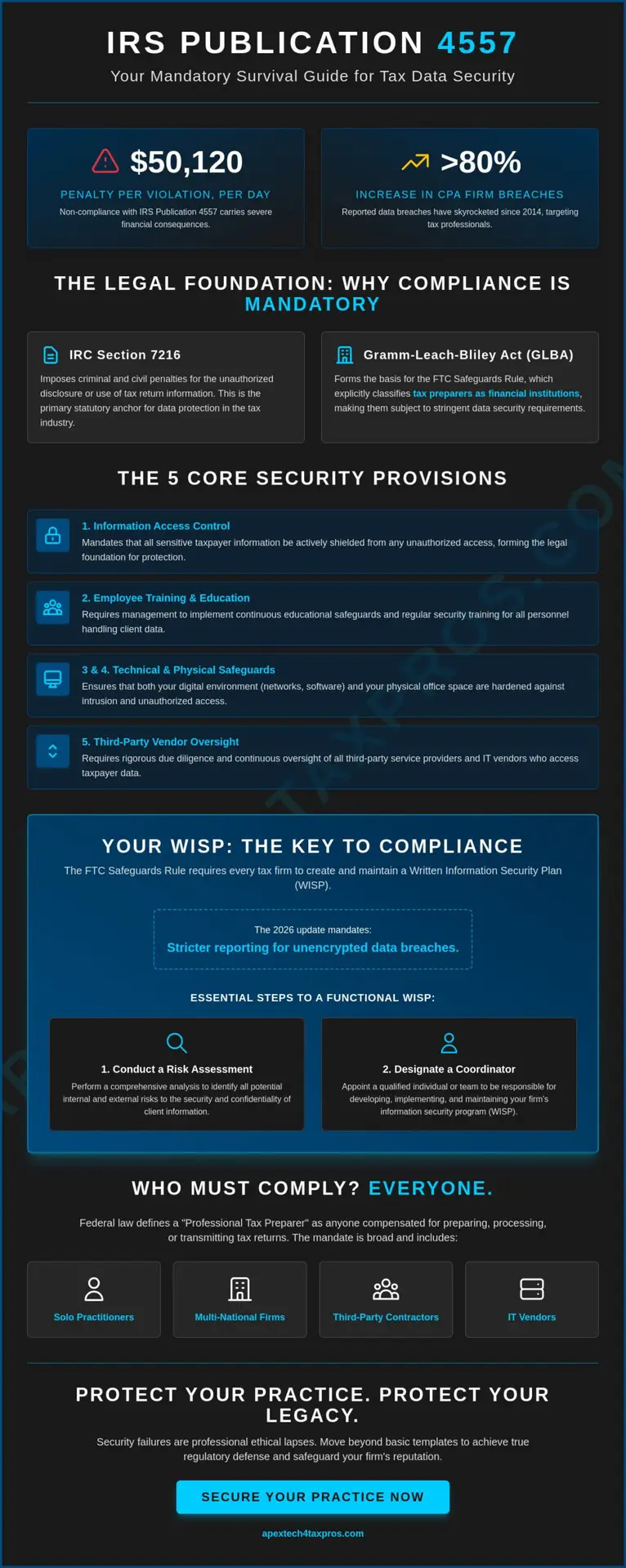
With penalties for non-compliance reaching $50,120 per violation per day, IRS Publication 4557 is no longer a set of helpful suggestions; it’s a mandatory survival guide for your practice. Since 2014, reported data breaches at CPA firms have increased by over 80 percent, leaving many professionals feeling vulnerable during the height of tax season. This irs publication 4557 summary provides the clarity you need to bridge the gap between complex federal mandates and your daily operations.
You likely feel the weight of these regulatory burdens while trying to manage a demanding client load. It’s frustrating when technical jargon obscures your legal obligations and leaves you questioning your firm’s safety. We’ll help you master these complexities and transform rigid requirements into a robust security framework that protects your reputation. This guide breaks down the “Security Six” foundational controls, explains the latest FTC Safeguards Rule updates, and provides a clear roadmap for implementing your required Written Information Security Plan, or WISP.
Key Takeaways
- Understand how IRC Section 7216 and the Gramm-Leach-Bliley Act establish the legal framework that makes these security standards mandatory for every tax practice.
- This irs publication 4557 summary clarifies the seven key security provisions you must implement to align with current federal mandates and NIST standards.
- Learn how the 2026 updates to the FTC Safeguards Rule specifically impact tax professionals and require stricter reporting protocols for unencrypted data breaches.
- Discover the practical steps for conducting a comprehensive risk assessment and designating a security coordinator to oversee your firm’s compliance framework.
- Identify why a customized Written Information Security Plan (WISP) is essential for moving beyond basic templates to achieve true regulatory defense.
Understanding IRS Publication 4557: The Foundation of Tax Data Security
IRS Publication 4557 serves as the definitive technical roadmap for every firm entrusted with sensitive taxpayer information. It isn’t merely a set of suggestions; it represents the federal standard for maintaining the integrity of our voluntary tax system. By outlining specific safeguards, the IRS provides a framework designed to mitigate the rising tide of identity theft and financial fraud. This irs publication 4557 summary highlights how the document has evolved to meet the 2026 threat landscape, moving far beyond basic password hygiene to require a comprehensive, multi-layered security posture. The core objective is clear: protecting the taxpayer’s trust by ensuring their data remains confidential and secure throughout the entire preparation process.
The legal weight behind these standards is substantial. Compliance is enforced through several statutory anchors, most notably IRC Section 7216, which imposes criminal and civil penalties for the unauthorized disclosure or use of tax return information. Additionally, the Gramm-Leach-Bliley Act (GLBA) provides the legislative foundation for the FTC Safeguards Rule, which explicitly classifies tax preparers as financial institutions. This classification means that failing to adhere to the standards in Publication 4557 isn’t just a technical oversight; it’s a violation of federal law that can result in significant fines and federal oversight. In 2026, staying compliant means aligning your operations with the NIST Cybersecurity Framework 2.0 as referenced in the latest IRS updates.
Who is Required to Follow Publication 4557?
The scope of these regulations is broad and leaves no room for ambiguity. Whether you’re a solo practitioner operating from a home office or a partner in a multi-national accounting firm, the mandate applies to your practice. Federal law defines a “Professional Tax Preparer” as any individual or entity that prepares, processes, or transmits tax returns for compensation. This circle of compliance also extends to your third-party contractors and IT vendors. If an outside entity has access to the taxpayer data you’re responsible for, they’re legally required to adhere to the same rigorous standards. You can’t outsource your liability; you must ensure every link in your data chain is secure.
The Relationship Between Data Protection and Professional Ethics
Security failures represent more than just technical glitches. They’re professional ethical lapses that can jeopardize your career. A single data breach can lead to the immediate revocation of your professional license and irreparable damage to your firm’s reputation. The IRS has shifted its stance, moving these requirements from “suggested best practices” to “strict legal mandates” that define professional competency. Adhering to this irs publication 4557 summary is your primary defense against the “Dirty Dozen” tax scams, which frequently target tax professionals as high-value entry points for larger fraud schemes. Protecting your clients’ data is now inseparable from protecting your professional legacy.
The Seven Key Security Provisions of Publication 4557
The tactical implementation of data security for tax professionals begins with the specific requirements detailed in the official IRS Publication 4557. This irs publication 4557 summary focuses on the essential provisions that form the bedrock of a compliant practice. Provision 1 establishes the legal foundation for protection, mandating that taxpayer information be shielded from unauthorized access. Provision 2 shifts the focus to the human element, requiring management to implement educational safeguards and regular training for all personnel. Provisions 3 and 4 address technical and physical safeguards, respectively, ensuring that both your digital environment and your physical office space are hardened against intrusion. Finally, Provision 5 requires rigorous oversight of third-party service providers. You must conduct due diligence on every vendor that touches your data ecosystem to ensure they maintain standards equivalent to your own.
Adherence to these provisions is not a one-time event but a continuous cycle of vigilance. As cyber threats evolve, the interpretation of “reasonable” security measures changes. For example, Provision 2 now necessitates that firm employees understand how to recognize sophisticated phishing attempts that specifically target tax software credentials. Conducting a thorough risk assessment is the most reliable way to ensure these provisions are fully integrated into your workflow and that no vulnerabilities are left unaddressed.
Electronic Safeguards: Beyond Basic Antivirus
Modern threats require more than just a firewall or a standard antivirus subscription. Implementing Multi-Factor Authentication (MFA) is now a mandatory standard for all tax preparation software and any system containing taxpayer data. It serves as your most effective defense against the 81 percent of breaches caused by password compromises. Encryption is equally vital for compliance. You must secure data at rest on your local servers and data in transit through secure client portals. Utilizing a secure cloud backup ensures you meet the “Availability” requirement of the publication, providing a resilient recovery path after a system failure or ransomware event. These technical layers work in tandem to create a “defense-in-depth” posture that protects your clients’ most sensitive financial details.
Physical and Administrative Security Measures
Security isn’t limited to the digital realm; it extends to the physical walls of your office. You must secure the “paper trail” by establishing strict shredding protocols for all physical documents containing sensitive information. Hardware inventory management is also a critical requirement. Every laptop, tablet, and mobile device used for tax work must be tracked, and access should be restricted to authorized personnel only. If a breach occurs, Publication 4557 and the FTC Safeguards Rule require a documented Incident Response Plan. For breaches affecting 500 or more consumers, you have a 30-day window to report the event to the relevant authorities. Being prepared with a clear administrative roadmap is the difference between a controlled response and a regulatory disaster.
Publication 4557 vs. the FTC Safeguards Rule: The Compliance Intersection
Understanding the hierarchy of federal data security mandates is essential for any tax professional aiming for full regulatory adherence. While they’re often discussed interchangeably, a distinct relationship exists between these two authorities. The Federal Trade Commission establishes the overarching legal mandate through the FTC Safeguards Rule, which classifies tax preparers as non-banking financial institutions. Conversely, this irs publication 4557 summary identifies the IRS’s industry-specific application of those federal laws. In essence, the FTC sets the legal “what,” while Publication 4557 provides the tactical “how” for the tax industry.
The 2026 compliance landscape has become significantly more rigorous due to recent revisions. A critical update published in the Federal Register now requires financial institutions to report unencrypted data breaches affecting 500 or more consumers within 30 days of discovery. This shift emphasizes that the IRS and FTC are no longer just providing guidance; they’re actively enforcing a standard of transparency and accountability. Both mandates converge on the requirement for a formal, documented risk assessment. You must evaluate how taxpayer data is collected, stored, and transmitted, then implement safeguards that specifically address those identified vulnerabilities. A central pillar of this framework is the appointment of a “Qualified Individual,” a designated professional responsible for overseeing and enforcing your firm’s entire security program.
Why One Without the Other Leads to Compliance Gaps
Relying solely on the tips found in Publication 4557 without a formal Written Information Security Plan (WISP) creates a dangerous regulatory gap. While the publication offers excellent technical advice, the FTC Safeguards Rule legally requires the WISP as the administrative anchor of your security posture. The IRS now utilizes these FTC standards as a benchmark during EFIN and CAF number audits. If you cannot produce a documented WISP that aligns with the irs publication 4557 summary guidelines, you risk failing these audits regardless of your actual technical security. Coordinating your IT strategy to satisfy both agencies simultaneously isn’t just efficient; it’s the only way to ensure your practice remains standing under federal scrutiny.
The Consequences of Non-Compliance in 2026
The risks associated with ignoring these intersections are no longer theoretical. As of 2026, financial penalties for non-compliance with the FTC Safeguards Rule can reach as high as $50,120 per violation, per day. Beyond these staggering costs, the operational risks are even more severe. The IRS maintains the authority to revoke your EFIN, effectively terminating your ability to e-file for clients and ending your practice’s primary revenue stream. We’re also seeing a sharp rise in civil liability. When a breach occurs, the absence of a compliant security framework provides a clear path for client lawsuits, as it demonstrates a failure to meet the “reasonable care” standards defined by federal law. Protecting your firm requires a disciplined, documented approach to these intersecting regulations.
Practical Implementation: Moving from Summary to a Functional WISP
Transforming this irs publication 4557 summary into an operational reality requires a systematic, disciplined approach. You can’t simply download a generic document and expect it to satisfy a federal auditor during a review of your credentials. Effective compliance is an active process that begins with a deep understanding of your firm’s unique technical footprint. The IRS explicitly requires that your security measures be appropriate to the size and complexity of your practice. To move from theory to a functional defense, you should follow a structured five-step implementation process:
- Step 1: Conduct a comprehensive data security risk assessment to identify specific vulnerabilities in your hardware, software, and physical office space.
- Step 2: Designate a security coordinator who possesses the authority to oversee the compliance framework and manage incident responses.
- Step 3: Draft a customized Written Information Security Plan (WISP) that details your firm’s specific protocols for handling and protecting taxpayer data.
- Step 4: Implement ongoing cybersecurity awareness training to mitigate the risk of human error among your staff.
- Step 5: Regularly monitor and test your safeguards to ensure they remain effective against the latest digital threats and evolving tax scams.
Following these steps ensures that your security posture is not just a static file on a shelf, but a living part of your business operations. A functional WISP acts as your firm’s primary defense, providing both technical direction for your IT staff and legal protection for your partners.
The Role of Risk Assessments in Publication 4557
A risk assessment is the essential diagnostic phase of your security strategy. You must map the flow of taxpayer information from the moment a client provides it until it’s safely archived or destroyed. This process reveals “where the data lives,” whether it resides on a local server, a mobile device, or a cloud platform. You’re required to evaluate both internal and external threats, ranging from sophisticated phishing scams to the risks posed by disgruntled employees or lost hardware. Documenting these findings provides the “paper trail” the IRS expects during an inquiry, proving that your firm took deliberate, professional steps to identify and close security gaps. Without this documentation, your security claims lack the evidence needed for federal compliance.
Staff Training: The Often-Overlooked Requirement
Publication 4557 mandates ongoing education because the human element remains a primary target for cybercriminals. A one-time meeting at the start of tax season isn’t sufficient to maintain a secure environment. Your team needs consistent training on social engineering tactics, such as “spear-phishing” emails that mimic official IRS communications or software update alerts. Firm leadership must establish a culture where security is prioritized over speed, even during the busiest weeks of the year. When every employee understands that data protection is a core part of their job description, the likelihood of a successful breach drops significantly. It’s about building a human firewall that complements your technical defenses.
If you’re ready to secure your practice and move beyond basic templates, we provide a customized Written Information Security Plan (WISP) designed specifically for the 2026 regulatory environment.
Beyond the Summary: Securing Your Practice with Apex Tech 4 Tax Pros
While this irs publication 4557 summary provides the necessary conceptual framework for data protection, the true challenge lies in the granular implementation of these standards within your specific environment. A generic WISP template often falls short of 2026 IRS expectations because it lacks the customization required to address your practice’s unique hardware and software configurations. Federal auditors look for an active, living security program rather than a static document that was merely signed and filed away. We bridge the gap between tax preparation workflows and advanced technical security, ensuring that your compliance efforts are both legally defensible and operationally efficient.
Our customized Written Information Security Plan (WISP) solutions are engineered to align perfectly with every provision of Publication 4557. We provide proactive protection through rigorous risk assessments that identify vulnerabilities before they can be exploited. Additionally, our secure cloud backup services ensure that your client data remains available and resilient even in the face of catastrophic hardware failure or ransomware attacks. This comprehensive approach allows you to focus on your clients while we manage the technical complexities of federal data security and the intersection of IT infrastructure with regulatory adherence.
Our Mission: Protecting Your Firm and Your Clients
We understand the pressure that comes with navigating high-stakes regulatory environments. Our goal is to move your practice from a state of compliance anxiety to a position of operational confidence. You deserve a partner who speaks the specific language of the IRS and understands the technical nuances of modern IT infrastructure. By combining our heritage of professional authority with technical precision, we ensure your firm’s legacy is protected against the evolving digital threats identified in the 2026 tax season. We don’t just provide tools; we offer a disciplined process that guides you from vulnerability to secure compliance.
Taking Action for a Secure 2026 Tax Season
Your compliance journey should begin with a thorough review of your current security posture against the Publication 4557 checklist. It’s vital to address these requirements before the intense pressure of the tax season rush begins. Waiting until an audit is announced or a breach occurs is a strategy that carries too much risk for a professional practice. Taking a disciplined approach to your security today ensures that you’re prepared for whatever challenges the coming year may bring. Secure your firm with a customized WISP today and gain the peace of mind that comes from knowing your data is in safe, capable hands.
Securing Your Firm’s Future for 2026 and Beyond
Adhering to the standards detailed in this irs publication 4557 summary is a commitment to your firm’s longevity and professional integrity. You’ve seen how the intersection of IRS guidance and FTC law creates a complex, mandatory framework for every modern tax practice. Successfully navigating these requirements requires more than just a passing knowledge of technical jargon. It demands a disciplined, documented strategy that includes expert-led risk assessments and ongoing cybersecurity awareness training for your entire team. Relying on generic templates is no longer a viable defense against the sophisticated threats of 2026.
With over 20 years of technical security experience, we specialize in bridging the gap between tax operations and federal compliance. We understand the weight of these regulatory burdens and offer the precise, pragmatic solutions your practice needs to remain secure. Our mission is to transform your compliance obligations into a robust security posture that protects your reputation and your clients’ most sensitive data. Protect your practice and meet IRS standards; get your Customized WISP now. Taking these steps today ensures you can approach the next tax season with confidence and operational stability. Your firm’s future is in safe, capable hands.
Frequently Asked Questions
Is IRS Publication 4557 legally binding for all tax preparers?
Yes, Publication 4557 is legally binding for all professional tax preparers who handle taxpayer data for compensation. While the document is titled as a guide, its provisions are enforced through federal laws like IRC Section 7216 and the Gramm-Leach-Bliley Act. Failing to implement these standards can result in significant financial penalties and the revocation of your Electronic Filing Identification Number, or EFIN. It’s a critical standard for professional competency.
What is the difference between a WISP and IRS Publication 4557?
IRS Publication 4557 is the instructional roadmap that provides technical guidance, while a Written Information Security Plan, or WISP, is the actual document required by the FTC Safeguards Rule. Think of the publication as the curriculum and the WISP as your firm’s specific, documented response to that curriculum. This irs publication 4557 summary emphasizes that you need the WISP to demonstrate legal compliance during an audit.
Can I use a free WISP template to satisfy IRS Publication 4557 requirements?
You can use a free template as a starting point, but the IRS requires your WISP to be specifically customized to your firm’s unique operations. A generic document that hasn’t been tailored to your hardware, software, and staff workflows will likely fail a regulatory review. The IRS and FTC mandate an active security program that accurately reflects how you protect data in your specific office environment.
How often should a tax firm perform a risk assessment under Pub 4557?
You should perform a formal risk assessment at least once per year or whenever significant changes occur in your firm’s technical infrastructure. This includes adding new software, hiring new staff, or moving to a cloud-based environment. Regular assessments ensure that your safeguards remain effective against the evolving threat landscape and that your WISP reflects the current, real-world state of your practice’s security posture.
What happens if a tax professional fails an IRS security audit?
Failing an IRS security audit can lead to the immediate suspension or revocation of your EFIN, effectively ending your ability to file returns for clients. You may also face civil and criminal penalties under IRC Section 7216 for the unauthorized disclosure of taxpayer information. Additionally, the FTC can impose fines as high as $50,120 per violation per day for non-compliance with the Safeguards Rule standards.
Does Publication 4557 require me to use a specific type of encryption?
The IRS doesn’t mandate a specific brand of software, but it requires encryption that meets current industry standards for data both at rest and in transit. This generally means using AES-256 bit encryption for stored files and TLS 1.2 or higher for digital communications. Using secure client portals instead of standard email is a critical component of meeting these technical safeguard requirements for sensitive data.
Is staff cybersecurity training mandatory according to the IRS?
Yes, staff cybersecurity awareness training is a mandatory requirement under Provision 2 of Publication 4557. The IRS recognizes that human error is a primary cause of data breaches, so you must provide ongoing education on topics like phishing and social engineering. This training must be documented to prove that your firm is taking proactive, professional steps to protect the sensitive taxpayer information entrusted to your care.
How does the FTC Safeguards Rule change what is required in Pub 4557?
The FTC Safeguards Rule provides the overarching legal authority that makes the guidelines in Publication 4557 mandatory. Recent 2026 updates to the rule have introduced stricter breach reporting requirements and the mandate to designate a Qualified Individual to oversee your security program. This intersection means your irs publication 4557 summary must now include more rigorous administrative documentation to satisfy both federal agencies simultaneously.