
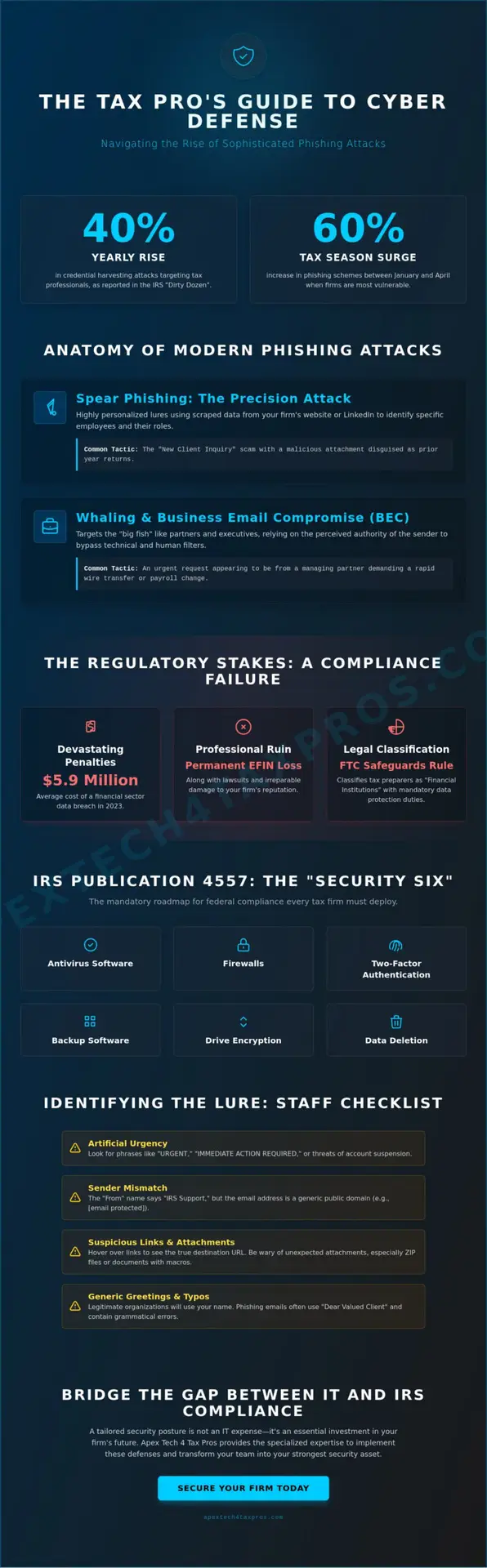
It’s 2:00 PM on April 10, and a busy staff member receives an urgent email from “IRS Support” regarding a missing client form. One click later, your firm’s entire database of sensitive Social Security numbers is being harvested by a criminal syndicate. According to the IRS 2023 “Dirty Dozen” report, phishing for tax professionals remains a primary threat, with credential harvesting attacks rising by 40% each year. You’ve spent decades building a reputation for accuracy, yet you understand that a single lapse in judgment can jeopardize your practice’s future.
We’re here to help you bridge the gap between complex IT security and your daily tax operations. You’ll learn how to identify sophisticated phishing schemes, maintain federal compliance under IRS Publication 4557, and build a vigilant culture that safeguards your clients’ most sensitive data. This article provides a clear roadmap for meeting mandatory WISP requirements and transforming a non-tech-savvy workforce into your firm’s strongest line of defense.
Key Takeaways
- Understand why the high density of sensitive client data makes your firm a primary target and how to recognize the anatomy of modern cyber attacks.
- Navigate complex regulatory requirements by aligning your practice with IRS Publication 4557 and the FTC Safeguards Rule to mitigate the risks of phishing for tax professionals.
- Master a practical checklist of visual and linguistic red flags to help your staff identify deceptive tactics and bypass the psychological pressure of artificial urgency.
- Implement a “Defense in Depth” strategy that prioritizes Multi-Factor Authentication (MFA) as your most critical safeguard against unauthorized access.
- Discover the advantage of a tailored security posture that bridges the gap between specialized IT technicality and IRS regulatory standards.
The Anatomy of Modern Phishing for Tax Professionals
In the specialized world of tax preparation, What is Phishing? refers to a deceptive attempt to steal sensitive client data by masquerading as a trustworthy entity. For the tax professional, these attacks aren’t just nuisances; they’re calculated threats to your firm’s regulatory compliance and hard-earned reputation. Attackers view tax professionals as high-value targets because your servers house a dense concentration of Personally Identifiable Information (PII). While a standard retail breach might yield a single credit card number, a successful breach of a tax firm provides a complete financial profile, including Social Security numbers, bank details, and income histories.
The IRS reported a 60 percent increase in schemes involving phishing for tax professionals during the 2023 filing season. This “Tax Season Surge” occurs between January and April when firms are most vulnerable due to high workloads and tight deadlines. Cybercriminals exploit this seasonal pressure, knowing that a busy accountant is less likely to scrutinize a suspicious email. At Apex Tech 4 Tax Pros, we focus on bridging the gap between these sophisticated threats and your firm’s security requirements, ensuring your data integrity remains uncompromised during peak periods.
Spear Phishing: The Precision Attack
Spear phishing for tax professionals involves highly personalized lures. Attackers often scrape data from LinkedIn or your firm’s website to identify specific employees and their professional roles. A common tactic is the “New Client Inquiry” scam. In this scenario, a fraudster sends an email posing as a prospective client who needs immediate help with a complex tax issue. They attach a file, supposedly containing their prior year’s returns, which actually contains malware designed to bypass your security safeguards. Another frequent ruse involves “Software Update” notifications that mimic popular tax preparation platforms, tricking staff into downloading malicious patches that compromise the entire network.
Whaling and Business Email Compromise (BEC)
Whaling targets the “big fish” within a firm, such as partners, owners, or senior executives. These attacks rely on the perceived authority of the sender to bypass traditional technical filters. You might receive an urgent request that appears to come from a managing partner, demanding a rapid wire transfer or an immediate change to payroll routing for a high-profile employee. Business Email Compromise is a sophisticated fraud targeting high-level financial authority through the exploitation of compromised or spoofed corporate email accounts. These schemes are particularly dangerous because they often lack the typical red flags of generic spam, appearing instead as legitimate internal communication within the firm.
The Regulatory Stakes: Why Phishing is a Compliance Issue
For a Dallas tax professional, a single clicked link isn’t just a technical error; it’s a regulatory failure. The IRS and Federal Trade Commission (FTC) view data protection as a mandatory standard of care rather than an optional IT preference. Under the FTC Safeguards Rule, which underwent significant updates effective June 9, 2023, tax preparers are classified as financial institutions. This classification means you’re legally required to implement specific administrative, technical, and physical safeguards to protect client data. Failing to identify phishing for tax professionals can lead to devastating financial penalties and the permanent loss of your Electronic Filing Identification Number (EFIN).
The legal consequences of a data breach are often compounded by the loss of professional standing. When a firm falls victim to a scam, the financial impact includes forensic investigation costs, credit monitoring for affected clients, and potential lawsuits. Recent industry data shows that the average cost of a data breach in the financial sector reached $5.9 million in 2023. Staying current with IRS security warnings is a core part of maintaining professional ethics. Cybersecurity is a non-negotiable duty you owe to every taxpayer who trusts you with their social security numbers and financial history.
IRS Publication 4557 and the “Security Six”
IRS Publication 4557 provides the roadmap for federal compliance. It mandates the “Security Six,” a group of essential protections every firm must deploy. These steps include antivirus software, firewalls, two-factor authentication, backup software, drive encryption, and data deletion. While these tools provide a technical shield, phishing defenses specifically satisfy the critical requirement for employee training. You must document your staff training sessions and your defensive protocols to survive a potential IRS audit. Without documented evidence that your team can spot phishing for tax professionals, your firm remains in a state of non-compliance.
The Role of the Written Information Security Plan (WISP)
A Written Information Security Plan is a formal document that details how your firm protects sensitive information. It’s no longer a suggestion; it’s a requirement that every tax pro must have in place for 2026. Your WISP must explicitly address email security and staff awareness training to be considered valid by federal regulators. Many firms struggle to bridge the gap between their daily operations and these formal documentation requirements. You can utilize Apex Tech 4 Tax Pros WISP services to create a tailored plan that meets these rigorous standards. A well-crafted WISP ensures that your firm isn’t just reacting to threats but is following a disciplined, professional process to safeguard its future.
Identifying Red Flags: A Practical Guide for Firm Staff
Vigilance serves as your primary defense against sophisticated cyber threats. While traditional scams were once easy to dismiss due to poor grammar, modern phishing for tax professionals utilizes high-level social engineering to bypass critical thinking. Staff members must adopt a disciplined approach to every communication that enters their inbox. Criminals often exploit the high-pressure environment of tax season, hoping that a busy professional will prioritize speed over security. By slowing down and applying a methodical review process, your firm can maintain the data integrity required by federal regulatory standards.
Technical Warning Signs
Attackers frequently use “Friendly Name” spoofing to mirror the identities of trusted entities. A sender might appear as “Internal Revenue Service” in the display name, yet a closer look at the actual email header reveals a domain completely unrelated to government agencies. You should also scrutinize file attachments for hidden extensions. A file named “Client_Tax_Docs.pdf.exe” is a malicious executable, not a document. To verify a link’s safety, hover your mouse cursor over the hyperlinked text to see the actual destination URL appear in the bottom corner of your browser window.
The landscape changed significantly in 2023 with the rise of generative AI. Scammers now produce perfectly written emails that lack the tell-tale typos or awkward phrasing of the past. This evolution makes technical inspection even more vital for compliance. According to the IRS Security Summit warning, these attacks are increasingly targeted, using specific industry terminology to appear legitimate. Your firm’s security posture must adapt to these flawless imitations by focusing on the source rather than the style of the message.
Psychological Triggers in Tax Scams
Phishing attempts often rely on a manufactured sense of urgency to trigger an emotional response. Common themes include “IRS Audit Notice,” “EFIN Suspension,” or “Account Locked” alerts designed to provoke immediate action. These messages demand that you click a link or provide credentials to fix a non-existent problem. Another frequent trap involves “Too Good to be True” offers, such as an unexpected influx of high-value new leads during peak season. These are often lures to capture your login data or install malware on your network.
The “Helpful Colleague” ruse is particularly dangerous for Dallas firms with multiple staff members. In this scenario, an attacker impersonates a partner or internal employee, asking for a quick favor like wire transfers or sensitive client files. This tactic exploits the natural trust within a boutique firm structure. Because Apex Tech 4 Tax Pros has spent 20 years bridging the gap between tax preparation and IT security, we understand that these psychological triggers are engineered to bypass your technical safeguards. Maintaining a skeptical mindset regarding any request for sensitive information is the best way to protect your firm’s reputation and client trust.
Strategic Defenses: Moving Beyond Antivirus
Antivirus software acts as a necessary gatekeeper, yet modern adversaries frequently bypass these perimeter defenses with ease. A robust security posture for Dallas firms requires a “Defense in Depth” strategy. This multi-layered approach ensures that if one control fails, others remain to safeguard sensitive client data. The 2023 Verizon Data Breach Investigations Report found that 74% of all breaches involve a human element. This statistic proves why relying on software alone is a liability for any practice handling sensitive financial records. By stacking technical controls with administrative policies, you create a resilient environment that protects your firm’s reputation.
Implementing Multi-Factor Authentication (MFA)
Standard passwords aren’t sufficient for high-stakes tax environments where a single set of credentials can unlock thousands of tax returns. Implementing Multi-Factor Authentication (MFA) serves as the primary defense against stolen credentials. While SMS-based codes offer basic protection, they’re vulnerable to SIM-swapping attacks. Secure authenticator apps or hardware keys provide a more resilient barrier. Tax practices should enforce MFA across every entry point, including email accounts and specialized preparation software, to align with IRS Publication 4557 standards and ensure total data integrity.
Staff Training and Phishing Simulations
Annual compliance meetings often result in rapid knowledge decay. Effective phishing for tax professionals involves ongoing micro-learning modules that keep threats top-of-mind throughout the year. Controlled phishing simulations allow firms to identify which team members are prone to clicking malicious links without actual risk. It’s vital to establish a “No-Blame” culture. When an employee reports a mistake immediately, the firm can isolate the threat within minutes. This proactive reporting protects the practice’s bottom line and prevents a minor error from becoming a catastrophic breach.
Advanced Threat Protection (ATP) software provides an automated layer of security by scanning attachments and links in virtual sandboxes before they reach an employee’s inbox. This technology detects “Zero-Day” threats that standard antivirus might miss. These technical safeguards must work in tandem with secure cloud backups. If a phishing attempt leads to a ransomware infection, an immutable, off-site backup ensures the firm restores operations quickly. This integrated framework bridges the gap between basic IT and a professional-grade security posture required by modern tax regulations.
Ready to strengthen your firm’s regulatory compliance? Contact our team today to build your tailored security plan.
Bridging the Gap: The Apex Tech 4 Tax Pros Approach
Apex Tech 4 Tax Pros understands that tax practitioners don’t just need an IT person; they need a partner who speaks the language of the IRS. Our firm bridges the gap between complex technical requirements and the daily realities of running a tax practice. We utilize a “Dual-Expert” approach that draws on over 20 years of experience in both information technology and high-stakes regulatory environments. It’s a disciplined strategy that positions us as a guardian for your firm. This background ensures that your data integrity remains uncompromised while you focus on serving your clients. Our specialized defenses against phishing for tax professionals are built on the principle of zero trust and personal accountability.
Customized WISPs and Compliance Support
Federal law mandates that every paid tax preparer maintains a Written Information Security Plan (WISP). We don’t believe in one-size-fits-all templates that leave your firm exposed. Our team conducts a professional risk assessment to identify specific vulnerabilities within your local network and cloud applications. We then build a customized roadmap that aligns with IRS Publication 5708 standards. Whether you manage a small boutique office or a large multi-partner firm, we ensure your security posture is proportional to your risk. This methodical process removes the uncertainty of compliance and protects you from the 15% increase in regulatory scrutiny seen in recent years.
Continuous Protection and Training
Technology is only one part of the defense equation. Sophisticated phishing for tax professionals often targets the human element through social engineering. We provide comprehensive cybersecurity awareness training that empowers your staff to recognize and report suspicious activity before a breach occurs. Our service suite also includes:
- Proactive 24/7 system monitoring to detect anomalies in real-time.
- Secure, encrypted cloud backups to ensure business continuity.
- Regular security patches and software updates to close known exploits.
The peace of mind that comes from professional oversight is invaluable. You can stop worrying about the latest digital threats and return to the work that matters most. Schedule a consultation to secure your practice today and move toward a future of verified compliance.
Securing Your Firm’s Future Against Modern Threats
The landscape of phishing for tax professionals continues to evolve, moving from simple email scams to sophisticated social engineering. Protecting your practice requires more than just basic antivirus software; it demands a comprehensive strategy that bridges the gap between technical security and regulatory compliance. With over 20 years of specialized experience in IT and tax preparation, our family-owned firm understands the unique pressures you face. We help you navigate the strict standards of IRS Publication 4557 through expert-led risk assessments that identify vulnerabilities before bad actors do.
Maintaining data integrity isn’t just a best practice, it’s a federal mandate. A robust defense starts with a tailored Written Information Security Plan (WISP) that reflects your firm’s specific workflow. Don’t leave your clients’ sensitive information or your professional reputation to chance. By implementing disciplined safeguards today, you ensure your practice remains resilient against tomorrow’s threats.
Secure your practice and achieve IRS compliance with a customized WISP from Apex Tech 4 Tax Pros.
Your commitment to security today builds the trust your clients will rely on for years to come.
Frequently Asked Questions
What is the most common phishing scam targeting tax professionals today?
The most common phishing for tax professionals involves “new client” inquiries that contain malicious links or attachments disguised as tax documents. These emails often arrive during peak filing seasons, such as the period between January 15 and April 15, to exploit a practitioner’s sense of urgency. Attackers typically use PDF or Excel files embedded with malware to harvest your EFIN or PTIN credentials and compromise your firm’s data integrity.
Does the IRS ever send emails to tax professionals about client issues?
The IRS doesn’t initiate contact with tax professionals by email to request personal or financial information regarding a client’s account. Official communication regarding sensitive tax matters is exclusively handled through the U.S. Postal Service. If you receive an unsolicited email claiming to be from the IRS, it’s a scam and you should report it to phishing@irs.gov immediately. This protocol has remained the agency’s gold standard for over 20 years.
How can I tell if an email from a “new client” with an attachment is safe?
You can’t verify the safety of an attachment just by looking at the file extension or the sender’s name. Instead of opening unsolicited files, require all potential clients to upload documents through a secure, encrypted client portal. This practice eliminates the risk of a single click compromising your entire local network. If a prospect refuses to use your secure system, it’s a red flag that the inquiry isn’t legitimate.
Is a WISP legally required for solo tax practitioners?
A Written Information Security Plan (WISP) is a legal requirement for every tax practitioner, including solo practitioners, under the FTC Safeguards Rule. This federal mandate requires firms to document how they protect client data through administrative, technical, and physical safeguards. Failing to maintain a current WISP can lead to regulatory scrutiny during an IRS office visit or a data breach investigation. It’s a foundational document for your firm’s compliance.
What should I do if a staff member accidentally clicks a phishing link?
You must immediately isolate the affected device by disconnecting it from the internet and the local network. After isolation, your IT team should change all passwords for the staff member’s accounts, including their email, tax software, and EFIN portal. It’s vital to review your system logs to determine if any data was exfiltrated during the 5 to 10 minutes following the initial click. Prompt action prevents a single error from becoming a total breach.
How often should my firm conduct cybersecurity awareness training?
Your firm should conduct formal cybersecurity awareness training at least four times per year to stay ahead of evolving threats. Supplementing these sessions with monthly simulated phishing tests keeps security top of mind for your staff. Regular training ensures that phishing for tax professionals remains a topic your team is prepared to handle, reducing the likelihood of a successful attack by 70 percent. Vigilance is a skill that requires constant refinement.
Can AI-powered phishing filters catch every malicious email?
AI-powered filters provide a strong first line of defense, but they don’t catch 100 percent of malicious emails. Sophisticated spear phishing attacks often use clean domains and personalized language to bypass automated detection systems. You must rely on a multi-layered security strategy that combines technical filters with rigorous staff education. Technology is a tool, but your team’s vigilance is the final safeguard for your clients’ sensitive data.
What are the penalties for non-compliance with the FTC Safeguards Rule?
The FTC can levy civil penalties of up to $51,744 per violation for non-compliance with the Safeguards Rule as of January 2024. Beyond these federal fines, firms often face state-level penalties and the devastating cost of a damaged reputation. Implementing a robust WISP and maintaining data integrity isn’t just about security; it’s a critical step in protecting your firm’s financial stability and professional legacy.