
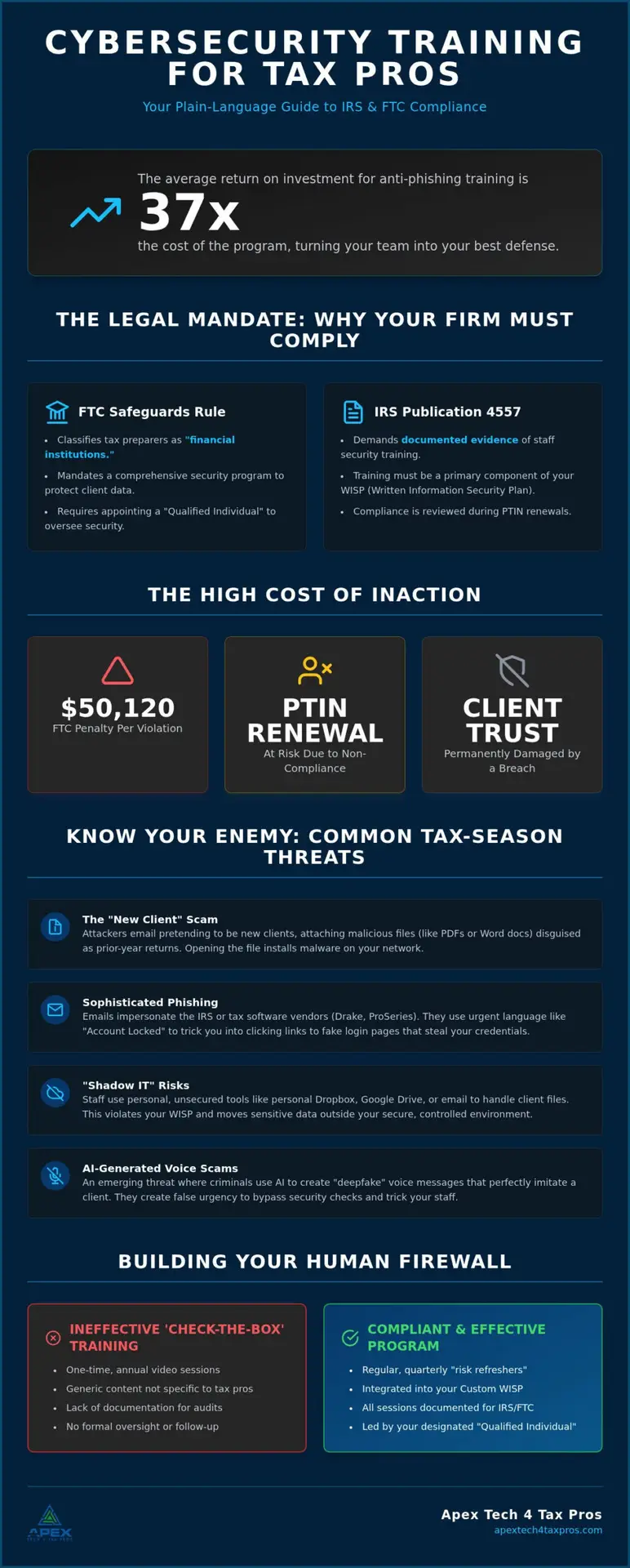
Did you know that the average return on investment for anti-phishing training is 37 times the cost of the program? For many firm owners, cybersecurity awareness training for tax professionals feels like just another box to check during an already packed tax season. It’s understandable to feel overwhelmed by technical jargon and the looming threat of FTC penalties that can now reach $50,120 per violation. You want to protect your clients’ sensitive data, but you also need a strategy that doesn’t disrupt your daily workflow or confuse your team.
In this guide, we’ll show you how to implement a staff training program that satisfies IRS Pub 4557 mandates while building a genuine culture of security. We’ll break down the requirements of the FTC Safeguards Rule into plain language so you can move from vulnerability to confident compliance. We are going to look at managing seasonal staff, identifying sophisticated scams, and creating the documentation you need to protect your firm during an audit.
Key Takeaways
- Understand how the FTC Safeguards Rule and IRS Publication 4557 classify tax preparers as financial institutions, making documented staff education a non-negotiable requirement.
- Learn to identify sophisticated tax-specific threats like the “New Client” scam and social engineering tactics designed to bypass your technical defenses.
- Discover how to implement effective cybersecurity awareness training for tax professionals by moving from annual “check-the-box” sessions to a proactive, quarterly training schedule.
- See how integrating staff training into your Written Information Security Plan (WISP) protects your firm from costly penalties and builds a resilient culture of security.
Why is specialized cybersecurity awareness training mandatory for tax firms?
Under the Gramm-Leach-Bliley Act, the FTC classifies tax preparers as financial institutions. This isn’t just a technical label; it’s a legal mandate that places your firm under the strict oversight of the FTC Safeguards Rule. At its core, cybersecurity awareness training for tax professionals is a formal educational program designed to help staff identify, report, and mitigate threats to sensitive taxpayer data. It transforms your team from a potential security liability into a proactive human firewall. Effective security awareness training isn’t about scaring your staff with doomsday scenarios. It’s about providing the relief that comes from knowing every person in your office understands how to handle a suspicious email or an unusual phone call.
How do I comply with the FTC Safeguards Rule?
Compliance requires more than just a quick video once a year. You must appoint a “Qualified Individual” to oversee your entire security program, which includes coordinating these training sessions. IRS Publication 4557 also demands documented evidence that your staff received education on protecting taxpayer information. Instead of one-time events, you need regular “risk refreshers” to keep up with evolving digital scams. This training should be a primary component of your Custom WISP Template, ensuring your written plan matches your office’s actual behavior. Documenting these sessions is crucial for audit protection.
The stakes of non-compliance in 2026
The consequences of ignoring these requirements are real and immediate. As of July 31, 2026, the FTC can impose penalties of up to $50,120 per violation. Beyond the fines, the IRS can use non-compliance as grounds to impact your PTIN renewal or levy practitioner penalties under Circular 230. A single data breach often results in a permanent loss of client trust. Most small firms don’t survive the reputational damage and legal costs that follow a major security failure. Protecting your firm is about more than avoiding a fine; it’s about ensuring your business remains viable for years to come.
Identifying tax-specific threats: beyond basic phishing
While technical firewalls are essential, they can’t stop a staff member from clicking a link they believe is from a legitimate client. Criminals know that your focus is on deadlines, not digital forensics. This is why cybersecurity awareness training for tax professionals is so critical. According to industry data from the Verizon DBIR, 68% of data breaches involve the “human element.” Criminals aren’t just hacking into servers; they’re tricking your team into handing over the keys.
Take the “New Client” scam as a primary example. An attacker sends an email inquiring about your tax services and attaches a PDF they claim is their prior year return. In reality, that file contains malware that can silently compromise your entire network. We’re also seeing more AI-generated deepfake voice messages in 2026. These calls sound exactly like your clients and often create a sense of false urgency to bypass your usual security checks, making it harder than ever to distinguish a real request from a scam.
How can I recognize a sophisticated tax season phishing attempt?
Most phishing follows a pattern designed to make you act without thinking. You’ll receive an email that looks like it’s from the IRS or a software vendor like ProSeries or Drake. It usually includes a psychological trigger, like “Account Locked” or “Urgent Security Update Required.” If you click the link, you’re sent to a look-alike domain that mirrors a login portal perfectly. Once you enter your credentials, the hackers have everything they need to access your client data before you even realize the URL was slightly misspelled.
Why is “Shadow IT” such a big threat to my WISP compliance?
It’s common for staff to use personal cloud storage like Dropbox or personal emails to finish work from home. This is known as “Shadow IT,” and it’s a major violation of your Written Information Security Plan (WISP). When client files leave your secure network, you lose control over who can see or access them. Transitioning your team to a Secure Virtual Desktop helps keep all data in one encrypted environment. If you’re worried about where your data is actually living, it’s a good idea to book an IT assessment to find those hidden gaps.
How to implement a training program that satisfies IRS Publication 4557
Building an effective training program starts with understanding your team’s current knowledge levels. Instead of guessing, you can use an IT Assessment to pinpoint exactly where your staff needs the most help. While many firms treat cybersecurity awareness training for tax professionals as a one-time annual event, the IRS suggests that a consistent, quarterly approach is far more effective. By using a mix of short video modules, interactive quizzes, and real-world scenarios, you ensure that security stays top-of-mind without causing “training fatigue” during your busiest months.
How should I manage security when onboarding seasonal or remote staff?
Seasonal preparers and remote contractors often have the same level of access to sensitive data as your full-time partners, but they may not be as familiar with your office policies. It’s helpful to implement a “Security First” checklist on their very first day. This should cover your multi-factor authentication requirements and specific data handling rules. To keep your network clean, you must also have a clear process for revoking all system access the moment their contract ends. This simple step prevents dormant accounts from being exploited long after tax season is over.
What specific records will an IRS auditor look for in my training program?
Documentation is the difference between a compliant firm and one facing penalties. When an auditor asks for proof of your security program, they want to see a formal Training Log that aligns with IRS Publication 5708. This log needs to include the dates of each session, the names of all attendees, and a brief description of the topics covered. Keeping these records organized provides the documentation trail you need to prove a genuine “culture of security.” If you’re ready to start building this trail, you can enroll in our cybersecurity awareness training to get your team up to speed quickly.
Building a culture of security with Apex Tech 4 Tax Pros
With over 20 years of combined tax and IT experience, we’ve seen first-hand how much the regulatory landscape has changed for independent preparers. We don’t act like a corporate vendor; we’re your knowledgeable colleagues who understand the unique grind of tax season. We handle the technical heavy lifting so you can focus on your clients. Our cybersecurity awareness training for tax professionals is designed specifically for this niche, ensuring your compliance isn’t just a document on a shelf, but a daily habit for your entire team.
Why does specialized training provide better protection than generic corporate programs?
Generic programs often focus on general office safety and miss the specific IRS and FTC requirements that impact your PTIN. Our training is engineered specifically for tax offices and is available in both English and Spanish to serve diverse teams. This ensures that every member of your office, from seasonal clerks to senior partners, understands the exact traps that target tax data. We approach security with the same professional rigor our sister company, APEX Tax Solutions, brings to complex tax resolution matters.
How can I start building an audit-ready culture in my office today?
Moving from vulnerability to secure compliance is a relief, not a burden. We offer a Seasonal subscription for $649.99 and a Yearly subscription for $1,099.99, both of which include a free customized WISP to serve as your security foundation. To find the gaps in your current setup, you should book a WISP Assessment today or email us at info@at4tp.com. Taking this step ensures you’re ready for the 2026 filing season with a documented “culture of security” that protects your practice and your clients.
Secure your firm’s future today
Implementing cybersecurity awareness training for tax professionals isn’t just about avoiding a $50,120 FTC penalty; it’s about protecting the client relationships you’ve spent years building. By moving beyond once-a-year sessions and embracing a documented culture of security, you turn a complex regulatory burden into a competitive advantage. You’ve learned that threats like AI deepfakes and “New Client” scams require specialized defenses that generic training programs simply can’t provide.
Our team brings over 20 years of combined tax and IT expertise to help you navigate these federal requirements. Whether you need bilingual support for your staff or a free customized WISP included with your subscription, we provide the pragmatic tools you need to stay audit-ready. It’s time to stop worrying about data breaches and start focusing on your clients with total confidence. Compliance doesn’t have to be a struggle when you have the right partner by your side.
Book Your WISP Assessment and Secure Your Practice today to see how easily you can achieve full compliance. We’re ready to help you protect what matters most.
Frequently Asked Questions
Is cybersecurity training a legal requirement for small tax offices?
Yes, cybersecurity training is a legal requirement for all tax offices because the FTC classifies tax preparers as financial institutions. Under the Safeguards Rule, you must implement an information security program that includes regular staff education. This mandate applies to independent preparers just as strictly as it does to large CPA firms. Failing to provide this training leaves your practice vulnerable to significant federal penalties and legal scrutiny.
How often should my staff undergo cybersecurity awareness training?
Your staff should undergo training at least quarterly to maintain effective compliance and stay ahead of evolving digital threats. While some firms attempt a “one-and-done” annual session, the IRS suggests ongoing education is necessary to keep security top-of-mind. Implementing cybersecurity awareness training for tax professionals on a quarterly basis ensures that seasonal staff and year-round employees are equally prepared to identify sophisticated phishing attempts during the busiest months.
What does the IRS Publication 4557 say about employee training?
IRS Publication 4557 identifies employee training as a fundamental requirement for any tax professional’s security plan. It specifically states that you must provide security awareness training to all employees and verify that they understand their responsibilities. This publication emphasizes that even the best technical firewalls don’t protect your data if a staff member inadvertently provides credentials to a scammer. Documenting this training is essential for demonstrating your “culture of security.”
Can I use a free WISP template for my staff training program?
You can use a free WISP template as a foundation, but you must customize it to document your specific training protocols. A generic document won’t protect you during an audit if it doesn’t accurately describe how you educate your staff. The IRS requires your written plan to match your office’s real-world actions. Using a custom WISP template ensures your cybersecurity awareness training for tax professionals is properly integrated.
What happens if my tax firm fails an IRS security audit?
Failing an IRS security audit can lead to severe consequences, including civil penalties and the potential suspension of your PTIN. The FTC can also impose fines of up to $50,120 per violation for non-compliance with the Safeguards Rule. Beyond the financial impact, you risk losing your ability to file returns electronically and damaging your reputation with clients who trust you to keep their most sensitive financial information private.