
A tax practice without a WISP faces federal compliance exposure, including possible FTC penalties when a violation continues. The Federal Trade Commission’s 2026 figures are up to $50,685 per violation and $43,792 per day for ongoing violations. These are potential enforcement penalties, not one automatic fine simply for lacking a document.
A Written Information Security Plan (WISP) is a mandatory federal requirement for U.S. tax professionals. It documents how your firm protects taxpayer information and guides staff on handling data and responding to security incidents.
This article explains how federal requirements apply, what factors shape legal exposure, and how to assess your next compliance steps. It will help you consider the penalties for not having a WISP without confusing possible enforcement with an automatic outcome.
A tax preparation practice without a WISP may face federal compliance risks, including possible FTC penalties when a violation continues. The 2026 figures from the Federal Trade Commission are up to $50,685 per violation and $43,792 per day for continuing violations.
A WISP connects your firm’s security responsibilities to its actual operations.
It will also help you understand the potential penalties for not having a WISP without confusing a possible enforcement action with an automatic outcome.
Key Takeaways
- Identify how the FTC Safeguards Rule applies to your tax practice and what a written security program needs to address.
- Separate the consequences of missing documentation from penalties that may follow a continuing violation or improper disclosure.
- Review the federal requirements relevant to your firm, including the rules tied to safeguarding taxpayer information.
- Use a risk assessment to spot gaps in your security practices and determine what your WISP should document.
IRS Mandated WISP: What Happens if Your Business Lacks a WISP?
A missing WISP leaves a tax practice without documented safeguards for sensitive client data. Assess federal rules, state requirements, and the security measures your operations need.
-
Identify applicable federal WISP requirements
Check which federal requirements apply to your tax practice and document how your safeguards address them. The Federal Trade Commission identifies 16 CFR Part 314 as the FTC Safeguards Rule. It requires covered firms to maintain a written information security program with administrative, technical, and physical safeguards. IRS Publications 4557 and 5708 help tax professionals understand taxpayer-data security expectations.
What are the penalties for violating the FTC Safeguards Rule? The FTC may pursue civil enforcement when a covered firm fails to meet its obligations. The nature and duration of the violation, the safeguards in place, and the response can matter. A missing plan can also leave employees without documented direction when handling phishing or a suspected disclosure.
Your WISP must reflect your firm’s size, operations, and the sensitivity of the data you handle. A solo preparer and an office with employees may have different systems and access roles, but both need a plan that documents applicable safeguards and responsibilities. Do not adopt a generic plan without tailoring it to your actual work.
-
Check state WISP requirements
List the states connected to your operations and client data, then identify relevant privacy, security, and breach-response requirements. Requirements and penalties can vary by state, so a federal review alone may not cover every applicable duty.
How do WISP requirements and penalties vary by state? Applicable state laws determine which safeguards, notifications, and consequences may apply. Record each relevant jurisdiction and map its requirements to a policy, responsible person, and response procedure. For example, note where your practice operates and where affected clients reside.
-
Review deadlines and minimum security measures
Keep your WISP current as your systems, staff responsibilities, or business operations change. Review the plan against your firm’s risks and safeguards, and revise it when changes affect how you protect taxpayer information.
Are there deadlines or minimum security measures for a required WISP? Maintain an up-to-date plan with administrative, technical, and physical safeguards. To create one, conduct a risk assessment, assign responsibility, document safeguards and incident response, train employees who handle client data, and test whether controls work.
WISP compliance and potential penalties
Assess compliance by comparing the security policies your firm documents with the practices employees follow. A WISP supports that review, but a document alone does not establish that safeguards work during daily operations or after an incident.
- Distinguish a missing plan from a continuing violation. A data breach does not automatically establish a specific violation, and there is no single fine imposed solely because a WISP is absent. The Federal Trade Commission cites penalties of up to $50,685 per violation and $43,792 per day for ongoing violations. Whether enforcement applies depends on the conduct and how the violation is addressed.
- Keep your current WISP, dated revisions, risk assessment, staff training records, and incident-response procedures organized. Document access reviews and corrective actions, too. For example, if an employee reports a suspicious message, record how the firm responded and update the plan if the incident reveals a gap.
- What evidence can help demonstrate WISP compliance? Keep records that connect written procedures to the safeguards your firm uses, including assigned responsibilities, staff acknowledgments, and security reviews. When you change software or grant an employee access to client files, document the review and update the plan if the change affects your procedures.
- Check state exposure separately. What are the state penalties for failing to have a WISP? State consequences depend on the laws that apply to the firm and affected client information. Identify relevant jurisdictions and document applicable security and breach-response obligations. This helps your practice address state requirements alongside federal duties, rather than treating one plan as a substitute for jurisdiction-specific review.
To organize your plan and supporting records, use this WISP compliance guidance as a reference point.
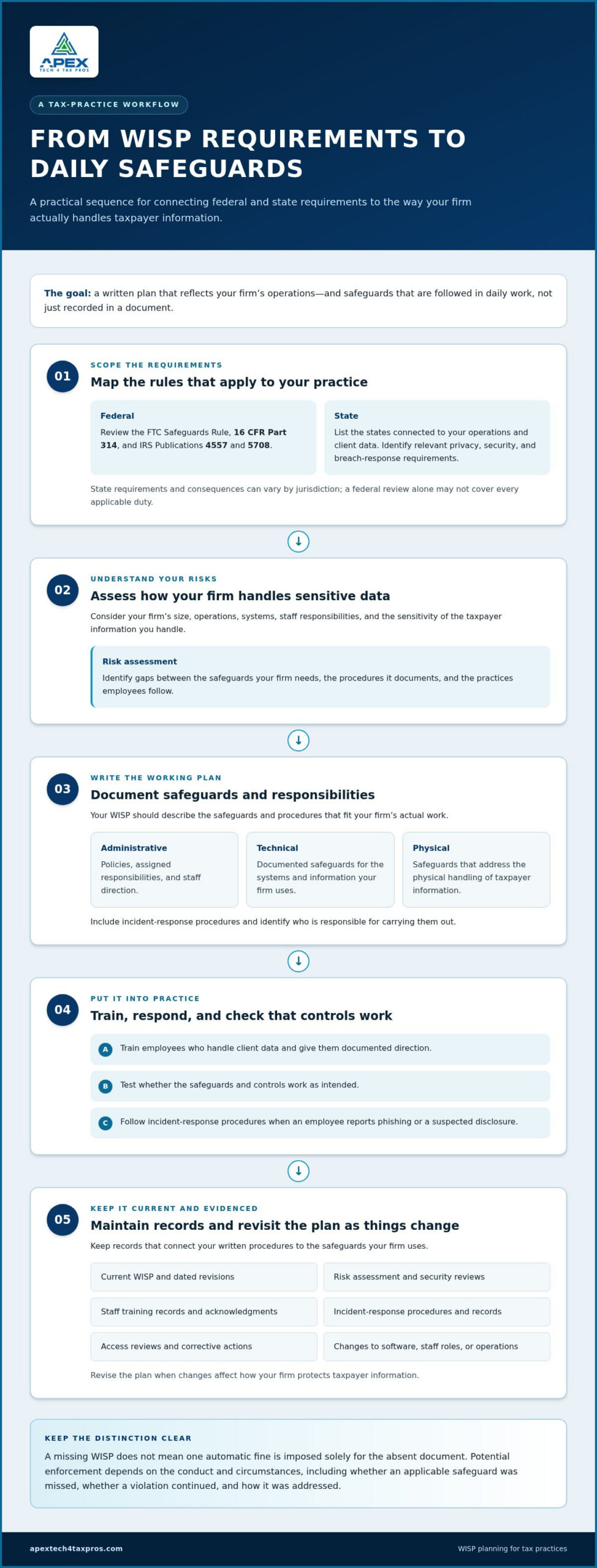
Federal penalties and legal exposure for missing a WISP
- Separate a missing document from the conduct regulators examine. A federal penalty is not one automatic charge attached to every absent WISP. Assess whether the firm failed to meet an applicable safeguard, mishandled taxpayer information, or continued a violation after it was identified. For example, a breach involving exposed client records can bring attention to both written policies and actual security practices.
- Assess continuing violations under the FTC Act. The Federal Trade Commission cites a penalty of up to $53,088 per violation, applied per day while the violation continues. Treat the amount as a potential enforcement exposure, not a flat WISP fine. Record when the issue was discovered, what systems or records were involved, and which corrective actions stopped the violation.
- Review other federal exposure tied to the conduct. Under the Gramm-Leach-Bliley Act, financial institutions may face up to $100,000 per violation, with personal penalties up to $10,000 for officers and directors. IRC Section 7216 addresses specified knowing or reckless disclosure or use of tax-return information; covered conduct can carry imprisonment of up to one year. Identity-theft-related conduct can carry a fine of up to $100,000.
- Prepare a clear incident response record. Preserve the security assessment, the written plan in effect, breach discovery notes, decisions, and corrective work. An accounting firm should capture who accessed affected taxpayer files and when access was restricted. These records help explain the firm’s response and distinguish a promptly contained incident from an unresolved weakness. Keep the plan aligned with operating practices, rather than treating a template as proof of compliance.
Which U.S. laws or regulations require a WISP?
- Map the federal framework to your tax practice. The Gramm-Leach-Bliley Act (GLBA) establishes financial privacy and security requirements, while the FTC Safeguards Rule sets requirements for covered financial institutions. The Federal Trade Commission identifies 16 CFR Part 314 as the Safeguards Rule. For a tax professional, assess whether the firm’s services and handling of taxpayer information place it within these requirements.
- Distinguish the law from the IRS materials that help tax professionals apply it. IRS Publications 4557 and 5708 address safeguarding taxpayer data and developing a written information security plan. Use them to translate security duties into firm procedures, such as documenting risk assessment, employee responsibilities, and incident response. The publications provide practical guidance; the plan records how the practice carries out its security program.
- Review the paid preparer’s certification obligations. Since 2024, Form W-12 requires paid preparers to certify that they maintain a WISP, under penalty of perjury. Treat the certification as an operational responsibility, not a substitute for the written plan. Keep the document aligned with the firm’s current systems, client-data access, and safeguards, so its statements reflect actual practices.
- Separate federal requirements from state rules. Federal obligations may apply alongside state privacy, data-security, or breach-notification laws relevant to the firm and its clients. Identify the states connected to your operations, then record which requirements affect your security policies and response procedures. This helps avoid treating one federal document as proof that every jurisdiction’s rules have been addressed.
Use a WISP assessment to map your current policies and practices against applicable requirements.
Apex Tech 4 Tax Pros: Customized Written Information Security Plan (WISP)
Apex Tech 4 Tax Pros helps tax and accounting professionals turn security requirements into documented, practical procedures. If your firm needs a plan shaped around its operations, a Customized Written Information Security Plan can document relevant risks, safeguards, and response steps.
Turn to this support when your current plan no longer reflects your systems, staff access, or handling of taxpayer information. Risk Assessments help identify gaps to address, while Cybersecurity Awareness Training supports employees who manage sensitive client data. Secure Cloud Backup can also support data protection and recovery planning.
A WISP is one part of an active security program; it should reflect the safeguards your firm actually uses and be updated as operations change. Contact Apex Tech 4 Tax Pros to discuss a practical next step for your tax practice.
Make your next security decision a practical one
Keep your WISP aligned with how your tax practice operates. Review it when systems, staff responsibilities, or client workflows change, and document updates to security procedures. Choose a concrete next step, such as assigning responsibility for an unresolved risk or refreshing staff cybersecurity training.
Understanding the penalties for not having a WISP is only part of protecting your practice. The next step is building a clear, workable process for safeguarding taxpayer information. Apex Tech 4 Tax Pros supports that work with customized WISPs, risk assessments, and cybersecurity awareness training tailored to tax professionals.
For help deciding what to address first, contact Apex Tech 4 Tax Pros. A focused conversation can help you move from uncertainty toward a more organized security program, one practical improvement at a time.
Frequently Asked Questions
What are the penalties for not having a WISP?
Potential penalties for not having a WISP include FTC fines, PTIN revocation, and EFIN suspension. The Federal Trade Commission states that the FTC Act penalty for a continuing violation is up to $53,088 per violation, applied per day while the violation continues. A certification should be accurate and reflect the security practices you actually follow. Keep your certification truthful and ensure your written plan reflects your actual security practices.
Who Must Have a WISP?
U.S. tax professionals who prepare returns and handle taxpayer information must maintain a WISP. This includes independent preparers, home-based practitioners, and tax offices of every size. Your plan should reflect the systems you use, who can access client records, and how your firm handles sensitive information.
Is a WISP really mandatory for tax professionals, or just recommended?
A WISP is a federal requirement for tax professionals, not merely a best-practice suggestion. Form W-12 asks paid preparers to certify that they maintain one. Treat that certification as an accountability step: before affirming it, make sure your written plan exists and describes your firm’s real safeguards. A generic document that does not fit your operations cannot accurately represent your program.
What Is a WISP and Why Does It Exist?
A WISP is a written framework for protecting the information your firm handles. For tax professionals, it documents security responsibilities and procedures, such as controlling access to client files and responding to suspicious emails. Staff should be able to use it to follow consistent practices, not rely on informal assumptions.
What does WISP stand for?
WISP stands for Written Information Security Plan. It is a required document that explains how your firm protects sensitive information and assigns security responsibilities. For example, a tax office can use its WISP to document who oversees security, how staff handle taxpayer records, and what steps to take when a possible incident occurs.
What does WISP stand for in this context?
For tax professionals, a WISP documents how the firm protects taxpayer information in its actual day-to-day operations. It should cover how client documents arrive, who can access electronic files, and how staff respond to a suspected phishing message. A plan is not just paperwork: it must describe safeguards and procedures your firm follows.