
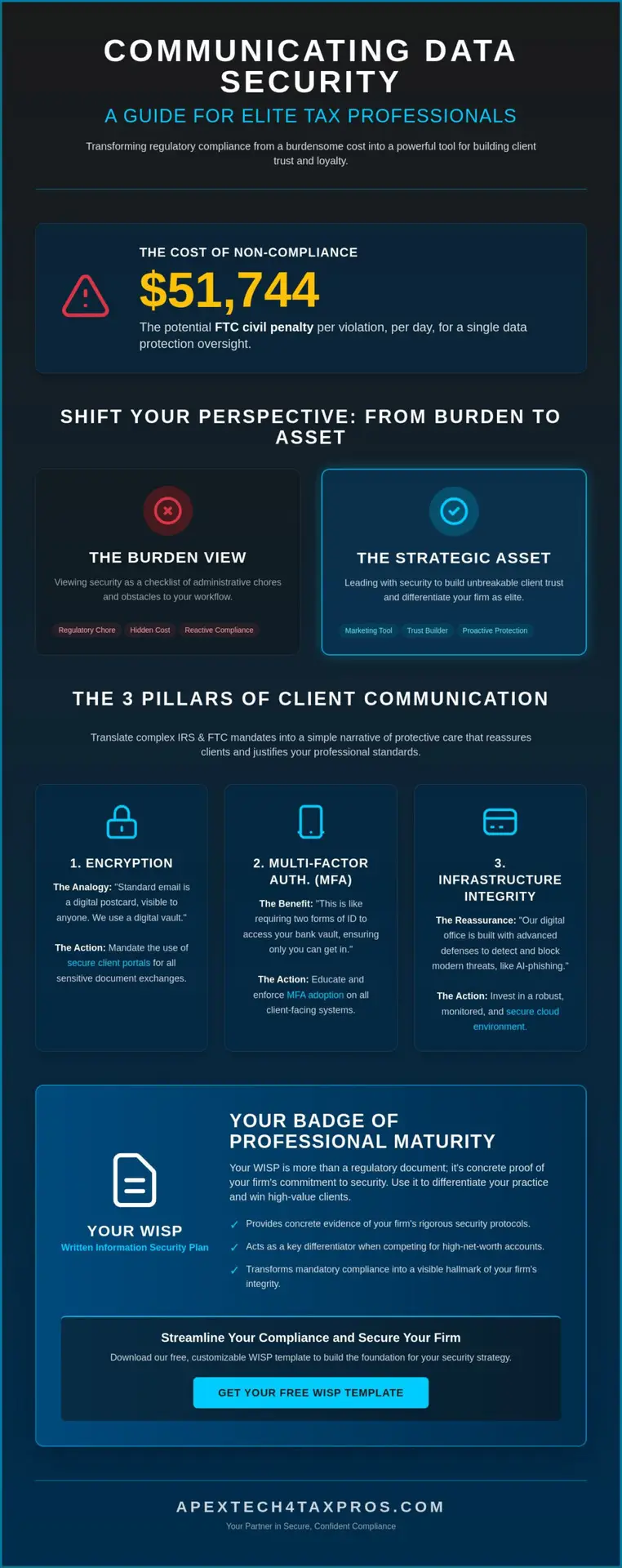
Did you know that as of early 2026, a single oversight in your data protection protocols can trigger FTC civil penalties of up to $51,744 per violation, per day? You likely feel the weight of these increasing regulatory burdens. It’s particularly frustrating when clients send sensitive PII through unencrypted email or resist multi-factor authentication. Learning how to communicate data security to tax clients is the essential bridge between technical compliance and a reputation for elite professionalism.
We understand that security often feels like a hidden cost that your clients don’t fully appreciate. This guide will show you how to transform complex mandates like IRS Publication 4557 and the FTC Safeguards Rule into a powerful trust-building tool. We’ll explore strategies for securing client cooperation with portals, documenting your mandatory Written Information Security Plan (WISP), and using our free WISP template to streamline your process. You’ll learn to move from a state of potential vulnerability to a position of secure, confident compliance that reinforces your role as a premier advisor.
Key Takeaways
- Reframe data protection from a regulatory burden into a strategic asset that builds client loyalty and distinguishes your firm as an elite provider.
- Learn how to communicate data security to tax clients by translating technical IRS Publication 4557 mandates into clear, protective benefits that reassure your most sensitive accounts.
- Identify high-impact touchpoints in the tax cycle and use proven scripts to secure client adoption of multi-factor authentication and secure portals.
- Understand why a robust infrastructure, supported by a Customized Written Information Security Plan (WISP), is the necessary foundation for authentic security claims.
- Discover how to use professional risk assessments and team training to transform your mandatory compliance into a visible hallmark of your firm’s integrity.
Beyond Compliance: Why Security Communication is Your Best Marketing Tool
For many tax professionals, the FTC Safeguards Rule feels like a checklist of administrative chores. You might view the mandates for encryption and risk assessments as obstacles to your daily workflow. However, the most successful firms in 2026 are flipping this narrative. They don’t just “do” security; they lead with it. When you master how to communicate data security to tax clients, you stop being a commodity and start being a guardian. This shift transforms a mandatory regulatory expense into your most effective marketing asset.
Trust is the primary currency of the tax profession. While a competitor might try to win business by offering the lowest fees, a secure firm wins by offering peace of mind. Clients in 2026 are weary of frequent data breaches and the constant threat of identity theft. They are actively seeking an advisor who understands the gravity of the modern threat environment. By integrating foundational data security principles into your initial consultations, you signal that your firm operates at a higher tier of professional care. This transparency satisfies the IRS expectation of professional due diligence. It also builds a defensive wall around your client base that low-cost, less-secure competitors cannot penetrate.
The Shift from “Safe” to “Proactive”
Passive protection is the security that happens in the background, like a quiet antivirus program or a silent firewall. Proactive security communication is a deliberate, visible strategy. It involves educating your clients on the specific reasons behind your protocols. Modern tax clients have a heightened expectation for digital hygiene. They want to know that their sensitive PII isn’t sitting in an unmonitored inbox or on an unprotected server. When you take the lead on how to communicate data security to tax clients, you redefine your professional role. You are no longer just a tax preparer. You are a multi-disciplinary protector of their financial identity and legacy.
Turning the FTC Safeguards Rule into a Value Proposition
Your Written Information Security Plan (WISP) is much more than a regulatory requirement to avoid a $51,744 per day penalty. It’s a badge of professional maturity. When you mention your WISP during a discovery call or include a summary in your onboarding materials, you provide concrete evidence that your firm is engineered for the 2026 threat landscape. This level of documentation is a key differentiator when you are competing for high-net-worth accounts. These clients value the discipline, vigilance, and seriousness required to maintain such rigorous standards. It proves you have a well-defined, methodical process for handling their most sensitive information, which naturally leads to higher client retention and referrals.
What to Tell Your Clients: Translating IRS Pub 4557 into Reassurance
Technical regulations often sound like white noise to the average taxpayer. While you understand the legal gravity of IRS Publication 4557, your clients are primarily concerned with the safety of their families and their financial legacies. Mastering how to communicate data security to tax clients requires a shift in vocabulary. You must translate rigid federal mandates into a narrative of protective care. When you explain that your protocols exist to prevent identity theft rather than just to satisfy a regulator, you build a bridge of trust that justifies your firm’s professional fees.
The “Big Three” of 2026 security; encryption, multi-factor authentication (MFA), and cloud integrity; should be the pillars of your client conversations. Explain that standard email is essentially a digital postcard that can be intercepted by anyone. This is why your firm strictly requires the use of secure portals for all document exchanges. You can also address the rise of AI-powered phishing attacks by explaining that your systems are engineered to detect anomalies that the human eye might miss. Mentioning these advanced defenses shows you are vigilant against modern threats without resorting to alarmist rhetoric. If you need a starting point for these internal standards, you can download a free WISP template to see how these requirements are structured.
The “Technical vs. Reassuring” Language Map
Confusing a client with “tech-speak” often leads to resistance rather than cooperation. Use the following framework to shift the focus from software processes to peace-of-mind outcomes.
| Technical Term | Client-First Benefit |
|---|---|
| Multi-Factor Authentication (MFA) | A “Two-Key” vault system that ensures only you can access your files. |
| AES-256 Encryption | Military-grade digital shredding that makes data unreadable to hackers. |
| WISP (Written Information Security Plan) | A federally mandated roadmap specifically designed to protect your identity. |
| Secure Cloud Backup | Off-site protection that ensures your records survive local hardware failures. |
Highlighting Your Written Information Security Plan (WISP)
A customized WISP is more than a binder on a shelf; it’s a testament to your firm’s professional maturity. Tell your clients directly that you have a comprehensive, federally mandated plan in place to safeguard their most sensitive details. Explain that every member of your team undergoes Cybersecurity Awareness Training to ensure that human error, which remains a factor in a significant percentage of breaches, is minimized. When clients see that your staff is as disciplined as your software, they feel confident that their data is in safe, capable hands. This level of transparency differentiates your practice from firms that treat security as an afterthought.
Strategic Touchpoints: Where and When to Discuss Data Privacy
Establishing a culture of security requires more than a single announcement. It involves integrating protective messaging into every stage of the tax lifecycle. When you consider how to communicate data security to tax clients, you must identify high-impact moments where your guidance feels like a value-add rather than an interruption. By seeding security updates into your standard workflows, you normalize these protocols and reduce the friction that often accompanies new technical requirements. This methodical approach reinforces your position as a disciplined, vigilant advisor who prioritizes client safety as much as financial accuracy.
The initial intake and the year-end review are the most natural opportunities for what we call the “Security Minute.” This is a brief, focused discussion where you reaffirm your commitment to data protection. Adhering to IRS requirements for a data security plan is a continuous obligation, and your clients should see that commitment in action. Mentioning a recent risk assessment or an update to your internal training protocols during these meetings provides tangible evidence of your firm’s professional maturity. It transforms a backend compliance task into a visible hallmark of your service quality.
Optimizing the Engagement Letter
Your engagement letter serves as both a legal contract and a psychological foundation for the relationship. It’s the ideal place to set explicit expectations for secure behavior. A well-crafted data protection clause might read: “To safeguard your sensitive financial information, our firm utilizes encrypted portals for all document exchanges. We will never request your Social Security Number, banking details, or other PII via standard email or text message.” By including this language, you protect the firm and the client simultaneously. It’s also appropriate to link your professional fees to these high standards. Clients are often more willing to accept premium pricing when they understand it supports a secure, professional-grade infrastructure.
Digital Real Estate: Portals and Signatures
Your digital presence should act as a passive trust builder. The secure client portal shouldn’t feel like a hurdle; it should be positioned as the “front door” of your practice. Use simple, professional badges on your website to signal compliance with industry standards. Your email signature is another valuable touchpoint. Instead of a generic disclaimer, include a monthly “Security Tip” or a brief note about your latest Cybersecurity Awareness Training. This keeps data safety top-of-mind for your clients throughout the year. These small, consistent signals build a narrative of heritage and experience, distinguishing your specialized firm from more generalized service providers who may treat security as an afterthought.
The “Security Conversation” Framework: Scripts for Tax Pros
Technical implementation is only half the battle. The true test of a firm’s professional maturity lies in how its staff handles the human element of data protection. Most technical guides focus on the “what” of compliance, but they often ignore the “how” of interpersonal delivery. Mastering how to communicate data security to tax clients requires a structured framework that balances empathy with professional authority. This approach ensures that your clients feel protected rather than policed. By following a methodical, four-step model, you can resolve resistance and reinforce your firm’s elite status.
The first step is to validate the client’s perspective. Acknowledge that modern security requirements can feel like an additional burden in an already complex financial life. Once you’ve established empathy, transition to the standard by citing IRS Publication 4557 or the FTC Safeguards Rule. This shifts the “blame” from your firm to a higher regulatory authority. Next, provide the remedy by introducing your secure portal as the professional-grade solution. Finally, set a firm boundary by explaining that you no longer accept PII via standard email. This logical progression guides the client from a state of potential vulnerability to a state of secure compliance.
If you are concerned about your team’s ability to handle these high-stakes interactions, our Cybersecurity Awareness Training provides the specific communication tools needed to maintain compliance while preserving client relationships.
Script: When a Client Objects to MFA or Portals
When a client complains that multi-factor authentication is “inconvenient,” it is essential to remain firm yet supportive. You might say: “I completely understand that these extra steps feel like a hurdle when you’re busy. However, it’s important to remember that this inconvenience is a significant barrier for hackers, not just a hurdle for you. Our goal is to ensure your data is as safe as it would be in a high-security vault. If you have a moment, I can provide a white-glove walkthrough of the portal to make sure the process is as smooth as possible for you.”
Script: Announcing Your New Security Standards
Announcing updated protocols for 2026 should be framed as an investment in the client’s future. Your firm-wide communication should be direct and reassuring: “As we enter the 2026 tax season, our firm is renewing its commitment to your data privacy. We have updated our internal security protocols to exceed the latest federal standards mandated by the IRS and the FTC. These enhancements, including our mandatory secure portal and multi-factor authentication, are designed specifically to protect your financial identity. We take our role as your data guardian seriously and welcome any questions you may have about our updated Written Information Security Plan (WISP).”
Building the Infrastructure to Back Up Your Word
Professional communication is only as strong as the technical reality supporting it. If you master how to communicate data security to tax clients but fail to implement professional-grade safeguards, you risk a catastrophic breach of trust. Authentic reassurance requires a methodical alignment between your words and your infrastructure. When you tell a client their data is safe, you must have the documentation and systems to prove it. This is why a Customized Written Information Security Plan (WISP) is the cornerstone of your firm’s integrity. It provides the technical roadmap that backs up every promise you make during an intake meeting or year-end review.
A true culture of security goes beyond mere compliance. It involves a disciplined approach where every team member understands their role as a data guardian. By integrating Cybersecurity Awareness Training into your firm’s “security story,” you show clients that your protection isn’t just a software setting. It’s a human commitment. This holistic view of security, where tech and training work in unison, is what differentiates an elite practice from a generic service provider.
Authenticity in Data Protection
Security is not a static achievement; it’s a continuous process of vigilance. Moving beyond “check-the-box” compliance requires regular Risk Assessments to identify and remediate evolving vulnerabilities. Your Secure Cloud Backup must be more than a simple storage bin. It must be a verified, recoverable asset that ensures business continuity during a crisis. When you can confidently explain the redundancy and recoverability of your systems, you move from vague promises to concrete proof points that resonate with high-stakes clients.
Partnering for Professional-Grade Security
The complexity of the 2026 threat landscape means that tax professionals shouldn’t attempt to DIY their cybersecurity infrastructure. Navigating federal regulations while managing a busy firm is a high-stakes balancing act that requires specialized expertise. Partnering with a dedicated provider ensures that your technical infrastructure meets the clinical precision required by the FTC and IRS. This professional partnership provides the “proof points” you need for effective client talks, allowing you to speak with the authority of a seasoned advisor.
Apex Tech 4 Tax Pros bridges the gap between technical compliance and client-facing communication. We provide the infrastructure and assessments that allow you to focus on your clients while we focus on the threats. Get your Customized WISP and start leading with security to differentiate your practice and build lasting client trust.
Elevating Your Practice Through Protective Excellence
Reframing data security from a regulatory burden into a strategic advantage is more than a 2026 trend. It’s a fundamental shift in how elite tax professionals operate. By utilizing the communication frameworks and strategic touchpoints discussed, you move beyond “check-the-box” compliance. You create a narrative of vigilance that reassures your clients and safeguards your firm’s reputation. This methodical approach ensures that your clients see you not just as a preparer, but as a dedicated guardian of their financial identity.
Mastering how to communicate data security to tax clients ensures that your technical investments, such as encryption and MFA, are recognized as premium value by those you serve. However, these conversations must be anchored in a robust, documented infrastructure. As specialists in the IRS and FTC Safeguards Rule, we help you bridge this gap through customized WISP development and comprehensive staff cybersecurity training. These tools provide the “proof points” needed to turn technical mandates into professional reassurance.
Don’t leave your firm’s security story to chance. Secure Your Practice with a Customized WISP Today and provide your clients with the authentic protection they deserve. You have the expertise to handle their taxes; let us provide the peace of mind that their data remains in safe, capable hands.
Frequently Asked Questions
How do I tell my tax clients I am using a new secure portal?
Frame the transition as a significant upgrade to their personal data protection rather than a change in software. You should explain that the portal acts as a digital vault, ensuring that their sensitive PII never travels through insecure channels like standard email. This proactive approach signals that your firm operates with the clinical precision required in high-stakes financial environments. It reinforces your role as a disciplined protector of their financial identity.
What is IRS Publication 4557 and should I mention it to clients?
IRS Publication 4557 is the federal roadmap for safeguarding taxpayer data, and mentioning it adds a layer of professional authority to your security claims. You don’t need to explain the technical minutiae. Instead, refer to it as the gold standard of federal compliance that your firm strictly follows. This transparency provides authentic reassurance that your internal protocols are engineered to meet the highest industry standards for data protection.
How can I explain the need for Multi-Factor Authentication (MFA) to older clients?
Use the “two-key vault” analogy to explain the necessity of MFA to clients who may find the technology unfamiliar. Mastering how to communicate data security to tax clients involves translating technical hurdles into protective benefits. Explain that MFA is like a safety deposit box that requires two different keys to open, ensuring that even if a password is stolen, their identity remains secure. This grounded, pragmatic explanation reduces friction and builds trust.
Can I still send tax returns via email if they are password protected?
No, you should avoid sending sensitive documents via email even if they are password protected. Standard email is essentially a digital postcard that can be intercepted during transit, and simple passwords are often easily bypassed by modern hacking tools. A professional-grade secure portal is the only method that ensures data is encrypted both at rest and in transit. Adhering to this boundary protects both your firm and your client’s legacy.
What should I do if a client refuses to use my secure document system?
You must remain firm in your commitment to professional standards while offering a “white-glove” walkthrough to reduce their technical anxiety. Explain that your firm’s adherence to the FTC Safeguards Rule is a non-negotiable part of your professional due diligence. If a client continues to resist, politely inform them that you cannot compromise the security of their data or the firm’s compliance. Most clients will appreciate the seriousness with which you handle their information.
How does a Written Information Security Plan (WISP) help me with my clients?
A WISP serves as the physical proof of your firm’s professional maturity and your commitment to client safety. When you are learning how to communicate data security to tax clients, the WISP provides the “proof points” needed to justify your protocols. It shows that your security isn’t a generic afterthought but is specifically engineered for your practice. Sharing a summary of your plan demonstrates that you have a methodical process for handling complex regulatory requirements.
What are the most common security concerns tax clients have in 2026?
Clients in 2026 are primarily concerned with identity theft and the rise of sophisticated AI-powered phishing attacks. They are increasingly aware of the mandatory 30-day breach notification requirements and expect their advisors to be vigilant. Addressing these concerns directly by mentioning your regular risk assessments and staff training protocols builds confidence. It signals to the client that their sensitive data is in safe, capable hands that understand the modern threat landscape.
Is it professional to charge a “security fee” to my tax clients?
Yes, it is professional to include security as part of your value proposition, though many firms prefer to bundle it into their overall professional fees. Reframe the cost as an investment in high-grade infrastructure and protective excellence. High-net-worth clients specifically value the discipline and vigilance required to maintain a secure environment. When you communicate the value of your secure cloud backups and encrypted systems, the cost becomes a hallmark of your firm’s elite status.