
Could a malicious email cost your practice $51,744 daily? In 2026, your incident response plan for tax preparers must include documented breach protocols, a 30-day FTC notification window for 500+ clients, and AES-256 encryption per the January 2026 IRS Pub 4557 update. We know federal rules feel like a second job. At Apex Tech 4 Tax Pros, with 20 years of experience, we help you build a compliant plan without the jargon. This guide covers encryption and deadlines. Note: this is information, not legal advice.
Key Takeaways
- Learn how to meet 2026 IRS and FTC mandates by establishing a documented incident response plan for tax preparers that protects your PTIN and client data.
- Identify the essential NIST-aligned stages of an effective plan, including how to designate a “Qualified Individual” to oversee your firm’s security.
- Discover the specific step-by-step reporting protocols required for notifying the IRS and FTC within their strict 2026 deadlines.
- Simplify your compliance journey by moving from uncertainty to security with practical tools like cybersecurity awareness training and secure virtual desktops.
Why is an incident response plan required for tax preparers in 2026?
An incident response plan for tax preparers isn’t just a technical document; it’s a mandatory roadmap for your practice. It defines exactly how you detect, contain, and recover from a data breach. Under the FTC Safeguards Rule and IRS Publication 4557, this plan is a legal requirement for all tax offices, regardless of size. When you renew your PTIN for the 2026 season, you’ll encounter a specific attestation box. By checking it, you’re confirming to the federal government that you have these protections in active use. This makes the plan a prerequisite for your professional credentials.
The legal mandates: FTC Safeguards vs. IRS Pub 4557
The FTC Safeguards Rule, specifically 16 CFR Part 314, classifies tax preparers as financial institutions. This law mandates a Written Information Security Plan (WISP), which you can establish using a Custom WISP Document. Your IRP serves as the critical procedural component of that document. While the law sets the legal standard, IRS Publication 4557 provides the specific guidance on what “adequate” security looks like for a modern firm. Following a standard incident response process ensures you aren’t just guessing during a crisis. It moves you from a state of vulnerability to a state of secure compliance.
The cost of inaction: Fines and PTIN consequences
Ignoring these requirements carries heavy risks. As of 2026, the FTC can levy penalties as high as $51,744 per violation, per day. Beyond the financial hit, the IRS can suspend your EFIN or revoke your PTIN if they find you’ve been negligent with client data. This is effectively the end of a tax practice; without these credentials, you can’t sign returns or transmit data. We’re here to help you turn this burden into a professional relief. Please remember that while we track these regulations closely, this content is for informational purposes and isn’t legal advice.
What are the essential components of a compliant incident response plan?
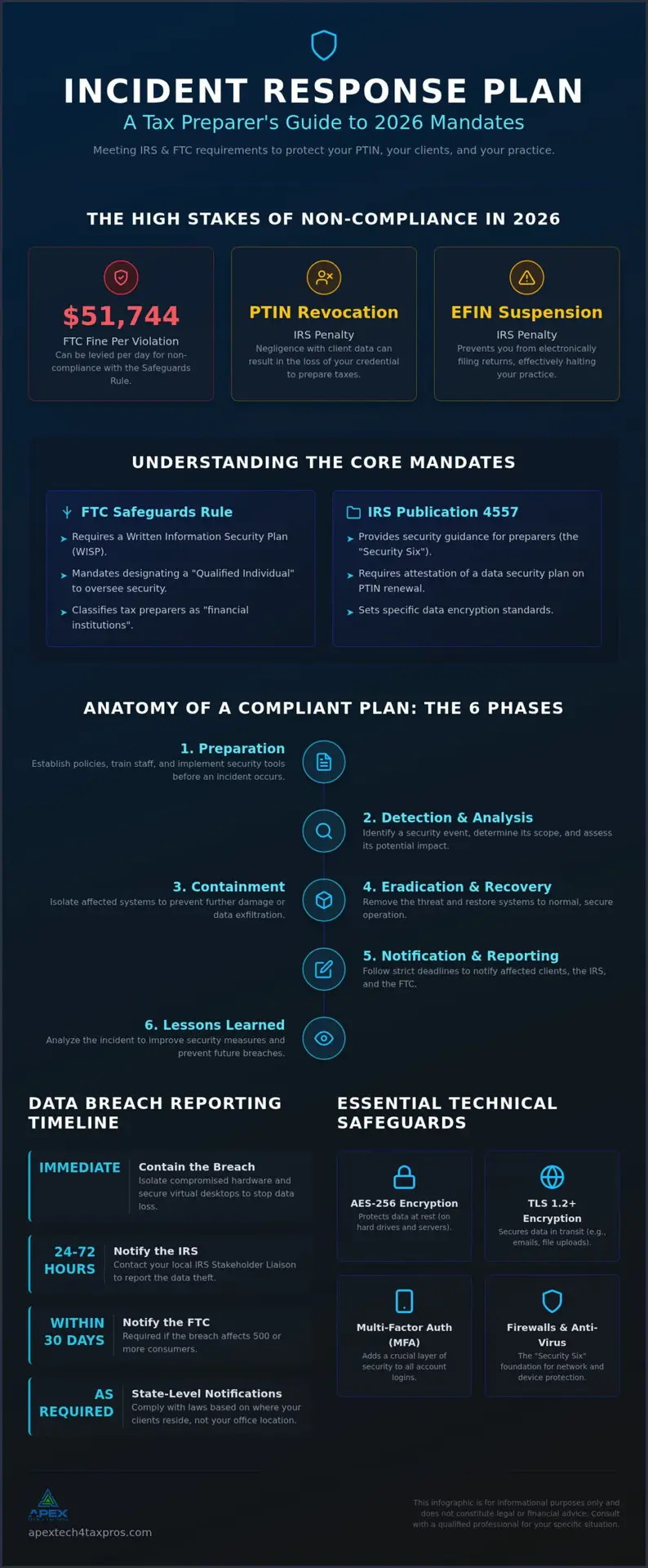
A compliant incident response plan for tax preparers aligns with the NIST framework, covering six critical phases: Preparation, Detection, Containment, Eradication, Recovery, and Lessons Learned. This structure ensures you aren’t scrambling during a crisis. Your plan should include the “Security Six” controls, such as firewalls and anti-virus software, which act as your first line of defense. Pre-drafted communication templates for clients and regulators are also vital; the FTC now requires notification within 30 days of discovering a breach affecting 500 or more people.
Technical safeguards and the WISP connection
Your incident response strategy doesn’t exist in a vacuum. It relies on Customized WISP Documents to set the ground rules for data handling. According to IRS Publication 4557, your recovery phase must prioritize technical safeguards like Multi-Factor Authentication (MFA) and specific encryption standards. Specifically, you should use AES-256 for data at rest and TLS 1.2 or higher for data in transit to ensure that even if data is intercepted, it remains unreadable to unauthorized parties.
The importance of a “Qualified Individual”
The FTC Safeguards Rule requires every tax office to designate a “Qualified Individual” to oversee and enforce the security program. This person is responsible for coordinating the response when things go wrong. If you’re a solo practitioner or run a small firm, you don’t have to carry this technical weight alone. Many of our peers choose to partner with specialized IT Risk Assessment experts to fulfill this requirement. This approach provides professional relief, ensuring your practice stays compliant while you focus on your clients. If you’re unsure where to start, you might consider a professional security review to identify gaps in your current setup.
How to manage a data breach: Step-by-step reporting and notification
Managing a breach is about speed and precision. A well-structured incident response plan for tax preparers prioritizes immediate containment. This involves isolating compromised hardware and securing your Secure Virtual Desktop environment to stop data exfiltration. Once the threat is contained, the clock starts on reporting. Per IRS Publication 4557, you must contact your local Stakeholder Liaison, ideally within 24 to 72 hours of discovery.
Federal rules also require notifying the FTC within 30 days if a breach affects 500 or more consumers. However, don’t overlook state-level laws. These requirements are based on where your clients reside, not where your office is located. If you have clients in multiple states, you may need to follow several different notification protocols simultaneously. Your incident response plan for tax preparers must account for these geographic variations to avoid state-level penalties.
Contacting the IRS Stakeholder Liaison
When you call the Liaison, have your firm name, EFIN, and a brief description of the incident ready. They don’t just record the event; they actively help by flagging compromised taxpayer accounts. This proactive step prevents fraudulent returns from being processed in your clients’ names, which is a massive relief for both you and them. They’ll guide you through the specific steps to protect the tax ecosystem from further harm.
Client notification and reputational recovery
Your communication with clients should be transparent and empathetic. Explain what happened, what data was involved, and what you’re doing to fix it. Offering identity theft protection or credit monitoring shows you’re committed to their safety. Taking these steps helps preserve the trust you’ve built over years of service. If you need help documenting these procedures, you can Book a WISP Assessment to ensure your reporting steps are fully compliant.
How can tax preparers implement a response plan without an IT department?
Implementing an incident response plan for tax preparers doesn’t have to be a technical nightmare. We view compliance as a professional relief, a way to move from “what if” anxiety to a state of secure confidence. By adopting a framework specifically engineered for tax workflows, you essentially create a professional insurance policy for your practice. This allows you to focus on your clients’ returns while knowing your regulatory obligations are being met.
A key part of this implementation is Cybersecurity Awareness Training. By educating your staff on how to spot phishing and social engineering, you stop breaches before they start. This proactive approach is often the most effective way to avoid ever needing to trigger your emergency response protocols. It’s about building a culture of security that feels natural, not forced, and satisfies the training mandates of IRS Pub 4557.
The “Seasonal” vs. “Yearly” approach to protection
Our subscriptions fit the specific needs of independent preparers. The Seasonal subscription ($649.99) is perfect for those who need to get compliant quickly before the filing rush. If you’re looking for year-round support, our Yearly subscription ($1,099.99) provides ongoing risk assessments and training. Both options include a free customized WISP, ensuring your incident response plan for tax preparers is fully documented and audit-ready without the need for an in-house technical team.
Partnering with a knowledgeable colleague
We bring over 20 years of combined tax and IT experience to the table, and we’re proud to work alongside our sister company, APEX Tax Solutions, to provide holistic support for tax professionals. This unique dual identity allows us to speak your language and understand the high-stakes environment you operate in daily. While we provide technical guidance, please remember to confirm specific legal requirements for your firm with your own counsel. Ready to close your security gaps? Book a WISP Assessment Today and let’s get your practice protected.
Secure your practice for the 2026 filing season
Establishing an incident response plan for tax preparers is no longer just a best practice; it’s a fundamental requirement for maintaining your PTIN and professional standing. By setting clear protocols for breach detection and adhering to the strict 30-day FTC notification window, you transform a complex regulatory burden into a manageable professional standard. You don’t need a massive IT budget to stay protected. Our Seasonal and Yearly subscriptions are specifically designed for independent preparers, providing IRS Publication 4557 compliant frameworks and a free customized WISP to ensure you’re audit-ready.
With over 20 years of combined tax and IT experience, we’re here to serve as your knowledgeable partner in cybersecurity. We understand the high stakes of your environment and provide the protective reassurance you need to focus on your clients. Don’t leave your firm’s future to chance when professional relief is just a click away. You can Book a WISP Assessment to Protect Your Practice today. Let’s work together to ensure your sensitive data stays in safe, capable hands.
Frequently Asked Questions
What is the maximum fine for an IRS Safeguards Rule violation in 2026?
While the IRS enforces Publication 4557, the FTC Safeguards Rule carries the heaviest financial weight for tax professionals. In 2026, penalties for non-compliance can reach $51,744 per violation, per day. These fines are often triggered after a breach reveals that a firm lacked a proper incident response plan for tax preparers. Additionally, individual officers can face personal fines of up to $10,000 per violation for failing to oversee security protocols.
Can I really lose my PTIN for not having a Written Information Security Plan (WISP)?
Yes, you can lose your ability to sign returns if you fail to maintain a WISP. The 2026 PTIN renewal process includes a mandatory security attestation where you confirm compliance with federal data protection laws. If an audit or data breach reveals you checked that box without having a documented plan in place, the IRS may suspend your EFIN or revoke your PTIN for professional negligence and misrepresentation.
How quickly must I notify the IRS if I suspect a data breach?
You should contact your IRS Stakeholder Liaison within 24 to 72 hours of discovering a potential data theft. Prompt reporting allows the IRS to protect your clients by flagging their accounts for fraudulent activity. Remember that this is separate from the FTC requirement, which mandates notification within 30 days for breaches affecting 500 or more consumers. Your incident response plan for tax preparers should clearly list both of these distinct reporting timelines.
Is a free incident response plan template enough to satisfy an IRS audit?
A basic template is a starting point, but it rarely satisfies an audit on its own. IRS Publication 4557 requires your plan to be adequate for your specific firm’s operations and technical environment. Auditors look for evidence that your procedures are customized, regularly updated, and understood by your staff. Relying on a generic, unedited document often leaves critical gaps in encryption standards and specific reporting protocols that can lead to failed compliance checks.
Does the FTC Safeguards Rule apply to one-person tax practices?
Yes, the FTC Safeguards Rule applies to all tax preparers because the Gramm-Leach-Bliley Act defines you as a financial institution. Whether you have fifty employees or work alone, you’re legally required to protect taxpayer data. While some requirements for a written risk assessment are simplified for firms with fewer than 5,000 consumers, you must still have a documented security plan and a designated individual responsible for your office’s cybersecurity.