
What good is a security plan if it doesn’t match the way your tax firm actually handles taxpayer data? Tax professionals know they need to protect sensitive information, but the relationship between the FTC Safeguards Rule, IRS guidance, and a Written Information Security Plan (WISP) can be unclear. Effective IRS Safeguards Rule compliance services from providers like Apex Tech 4 Tax Pros should do more than provide a generic document. They should help connect requirements to your firm’s systems, risks, and daily work.
This article explains how the Safeguards Rule, IRS Publication 4557, and your WISP fit together, and what useful compliance support should address. You’ll learn how a tailored plan connects with practical security controls and staff responsibilities, and how a risk assessment or cybersecurity training can support that work. The goal is a manageable next step toward stronger protection, not more paperwork for its own sake. This is general information, not legal advice; confirm how requirements apply to your firm.
Key Takeaways
- Understand how the FTC Safeguards Rule, IRS guidance, your WISP, and security tools serve different but connected roles in protecting taxpayer data.
- Effective IRS Safeguards Rule compliance services should connect risk assessment and written policies with practical safeguards and clear staff responsibilities.
- Evaluate compliance support by looking for a clear scope, an assessment grounded in your firm’s actual operations, a tailored WISP, and practical follow-through.
- Apex Tech 4 Tax Pros connects customized WISPs with risk assessments, cybersecurity awareness training, and secure cloud backup to help turn documented policies into action.
What Do IRS Safeguards Rule Compliance Services Actually Do?
IRS Safeguards Rule compliance services help a tax firm assess, document, and support safeguards for sensitive information. Useful support connects regulatory guidance to the firm’s actual systems, people, and workflows, rather than treating a written plan as the whole security program.
These terms have distinct roles. The FTC Safeguards Rule is a regulation under the Gramm-Leach-Bliley Act; the FTC’s guidance on the Safeguards Rule explains its requirements for covered institutions. IRS Publication 4557 offers tax-professional guidance on safeguarding taxpayer data, while Publication 5708 provides a resource for creating a Written Information Security Plan (WISP). The WISP is the firm’s written security plan, not the regulation or a software product. Security tools, such as multifactor authentication, encryption, and backups, are separate measures that can help put safeguards into practice. Firms should review current FTC guidance and confirm how requirements apply to their circumstances.
How is a WISP different from the Safeguards Rule?
The Rule sets regulatory requirements for covered institutions; the WISP documents how a firm organizes its information security program. IRS publications explain and support tax-professional implementation, but they aren’t interchangeable with the regulation. A template can help structure a plan, yet the firm still needs to make it reflect its operations and safeguards. A customized WISP for tax professionals can connect documented policies to the practice’s real environment.
Who can benefit from compliance support?
Independent preparers, EROs, CPAs, enrolled agents, bookkeepers, and small-to-mid-sized firms may benefit from support that clarifies responsibilities and practical next steps. A home-based preparer and a seasonal office may handle taxpayer information differently, but neither should assume another firm’s setup fits its own. Reviewing how data moves through the practice, who can access it, and which systems are used helps make security planning specific. Each firm should confirm its own regulatory obligations.
Which IRS and FTC Safeguards Rule Topics Should a Service Address?
Useful IRS Safeguards Rule compliance services should connect assessed risks to written policies, assigned responsibility, and safeguards people can follow. The Federal Trade Commission’s FTC Safeguards Rule guidance describes the rule’s requirements for covered institutions. IRS Publication 4557 offers tax-professional guidance, while the firm’s WISP records how its security program addresses relevant risks and safeguards. Confirm which requirements apply to your practice.
How should a risk assessment inform the WISP?
Start with the information the practice handles: taxpayer records, where they’re stored or used, who can access them, and how they move through tax software, email, devices, and backup systems. Consider relevant threats and weaknesses, such as access that’s broader than staff need or data stored without appropriate protection. Findings should guide documented choices about safeguards and responsibilities, not just fill out a generic checklist. An assessment can clarify priorities, but it doesn’t eliminate risk or by itself establish legal compliance.
The WISP should connect those findings to safeguards the firm can put into practice. Access controls limit who can reach systems or records. Firewalls control network access routes; encryption protects data; and multifactor authentication (MFA) verifies identity. Backup practices and incident preparation also deserve attention where applicable. Each policy should make clear who is responsible and what staff should do.
Why do staff and service providers belong in the discussion?
Staff training helps people handle taxpayer information consistently and recognize suspicious messages or other security concerns. The FTC’s rule also addresses service-provider oversight for covered institutions, so firms should consider which outside providers handle customer information and how oversight is addressed. For a practical starting point, explore tax-focused WISP and security support that connects documented policies with implementation.
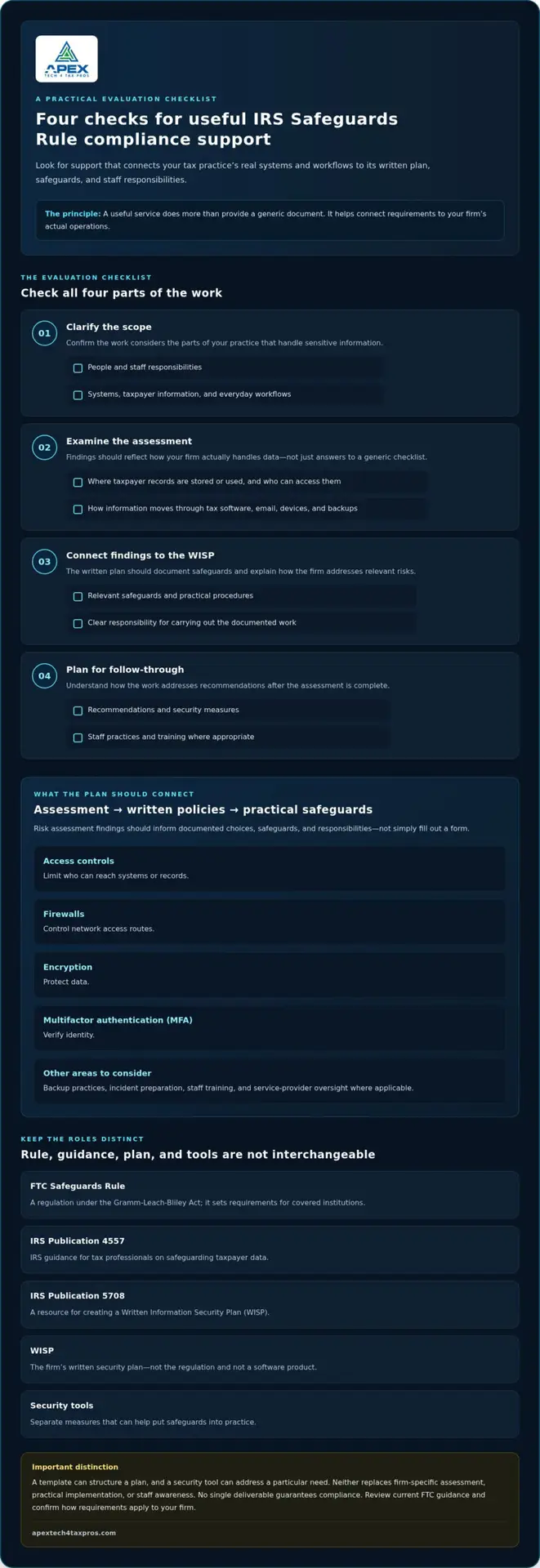
How Can You Evaluate IRS Safeguards Rule Compliance Services?
Good IRS Safeguards Rule compliance services should make the work understandable and specific to your practice. Use this sequence to evaluate the support:
- Clarify the scope. Identify whether the work covers your practice’s people, systems, taxpayer information, and workflows.
- Examine the assessment. Findings should reflect how your firm handles data, not just answers to a generic checklist.
- Connect findings to the WISP. The written plan should document relevant safeguards, assigned responsibilities, and practical procedures.
- Plan follow-through. Know how recommendations, staff practices, and security measures will be addressed after the assessment.
A template can provide a useful structure, but a document alone won’t assess your systems or help staff follow procedures. A security tool can address a particular need, yet it doesn’t replace a firm-specific plan, thoughtful implementation, or staff awareness. Look for support that brings those parts together without suggesting that any single deliverable guarantees compliance.
What deliverables make support useful in practice?
Useful deliverables may include a customized WISP, clear risk assessment findings, prioritized actions, and staff training where appropriate. Each safeguard has a distinct purpose: secure cloud backup supports recovery of stored information, MFA verifies identity, and encryption protects data. The right combination depends on the firm’s systems and assessed needs.
How should the firm’s plan stay usable over time?
Review the WISP when relevant systems, workflows, or risks change. Clear responsibilities and training help staff understand how written procedures apply to daily work. A customized WISP document can reflect your practice rather than rely on boilerplate alone.
To connect your firm’s needs with practical next steps, explore a WISP IT system assessment.
How Does Apex Tech 4 Tax Pros Turn Compliance Support Into a Practical Plan?
Effective IRS Safeguards Rule compliance services should lead to practical security work, not stop at paperwork. Apex Tech 4 Tax Pros follows a measured process: understand how your practice handles taxpayer information, assess its security needs, develop a tailored WISP, and support steps to put safeguards into practice. The focus is on connecting the plan to your actual operations and priorities.
Which Apex services connect planning with implementation?
A customized WISP documents security policies and responsibilities in a way that reflects a tax practice’s needs. A risk assessment helps identify potential gaps and inform priorities; staff training helps people understand how to follow procedures and handle information carefully. These services complement one another, but none replaces the firm’s ongoing attention to its security practices.
Secure cloud backup supports the availability of information when stored data needs to be recovered. It serves a different purpose from the WISP, which documents the firm’s security approach, and doesn’t replace the broader plan. For staff readiness, Apex offers cybersecurity awareness training to help reinforce security practices.
What is a clear next step for a tax practice?
Begin with a conversation about your current plan, systems, and practical priorities. Apex supports tax professionals nationwide, with bilingual support and 20+ years of combined tax and IT experience.
Book an assessment to discuss where your security work stands and what steps may fit your practice. Apex’s services support security planning and implementation; they don’t guarantee legal compliance. Confirm how applicable requirements relate to your firm.
Make Your Next Security Step Practical
Effective IRS Safeguards Rule compliance services should connect the written plan to your firm’s real systems, risks, and responsibilities. A tailored WISP documents the approach, while assessment findings, staff training, and practical safeguards help put it into action. No single document or tool does the whole job.
Apex Tech 4 Tax Pros provides specialized cybersecurity and compliance support for tax and accounting professionals nationwide, including customized WISPs, risk assessments, awareness training, and secure cloud backup. With bilingual support and 20+ years of combined tax and IT experience, Apex can help you identify a manageable next step while keeping your practice’s needs at the center. This support helps with security planning and implementation, but it isn’t a legal guarantee; confirm how requirements apply to your firm.
Ready to review your current plan, systems, and priorities? Book a WISP Assessment and take a clear, practical step toward stronger protection of taxpayer information.
Frequently Asked Questions
What are IRS Safeguards Rule compliance services?
IRS Safeguards Rule compliance services help a tax firm understand relevant security expectations, assess its practices, document its approach in a WISP, and support appropriate safeguards. The WISP is the firm’s written plan, not the regulation itself. Scope depends on the firm’s operations and applicable requirements. Review current information from the IRS, including Publications 4557 and 5708, and the Federal Trade Commission (FTC) before deciding what support your practice needs.
Do tax preparers need a WISP?
Tax professionals should review IRS guidance on protecting taxpayer information, including Publications 4557 and 5708. A WISP records how a firm approaches information security, but it doesn’t replace safeguards or serve as legal advice. Whether specific requirements apply, and how they apply, can depend on the firm’s circumstances and current rules. Consult official IRS and FTC resources, and confirm how those requirements relate to your practice.
Is an IRS WISP template enough to meet security requirements?
An IRS WISP template can give a firm a useful starting structure, but an uncustomized document may not reflect its actual data, systems, risks, or responsibilities. Tailor the plan to the practice and connect its written procedures with safeguards in use, such as access controls and backups. A completed document by itself doesn’t establish compliance. Use current IRS and FTC guidance to assess what your firm’s situation calls for.
What should a WISP compliance service include?
Depending on the firm’s needs, useful support may include a firm-specific risk assessment, a customized WISP, practical recommendations, and staff awareness training. Keep the plan distinct from the safeguards it documents: multifactor authentication verifies identity, encryption protects data, and backups support data recovery. Each addresses a different security need. Review what the service covers and compare its recommendations with current official guidance relevant to your practice.
Does hiring a compliance service guarantee Safeguards Rule compliance?
No. A service can help assess risks, document security practices, and support implementation, but it can’t guarantee that a firm meets every applicable requirement. The firm’s systems, decisions, staff practices, and ongoing attention to security also matter. Requirements and guidance may change, so consult current IRS and FTC materials and confirm how they apply to your organization. Treat outside support as assistance with the work, not a substitute for your responsibilities.
For structured data, consider using Article schema for the post and FAQPage schema for these questions and answers.