
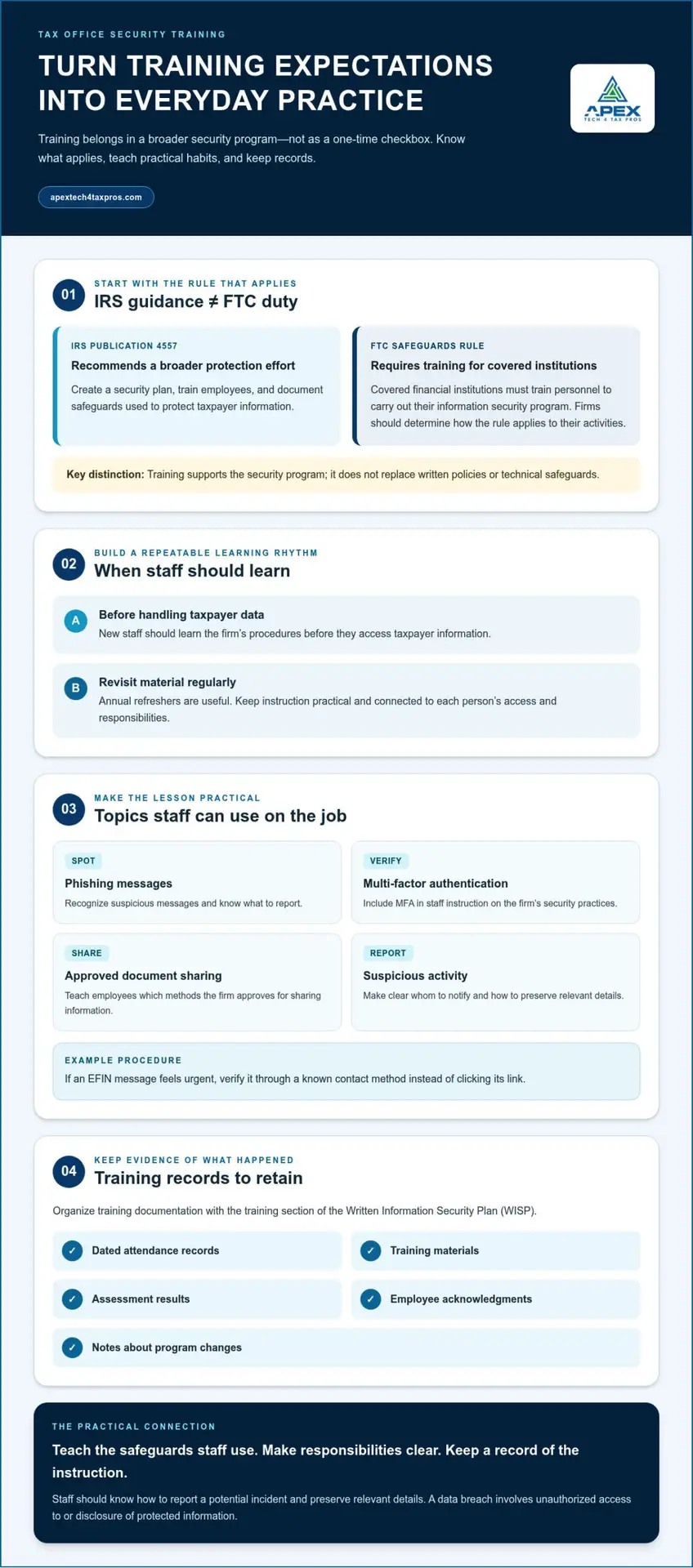
Annual security training is a sound yearly practice for tax firms, but the exact legal expectation depends on which rules apply. The mandatory security training tax professionals need to plan for includes the IRS’s recommendation in Publication 4557 to train employees and document safeguards; the FTC Safeguards Rule requires covered financial institutions to train personnel to carry out their information security program. Together, these expectations make training part of a broader security program, not a one-time checkbox.
It’s reasonable to want a clear answer about what’s required and how often staff should revisit the material. This article explains the difference between mandatory security training tax requirements and recommended annual refreshers, outlines practical topics for tax-office training, and describes records that can document training. You’ll also learn how to connect staff instruction with your written security plan and the safeguards used to protect taxpayer information.
Key Takeaways
- Separate the IRS’s security guidance from FTC training duties that apply to covered financial institutions, then determine which expectations fit your firm.
- Plan recurring, practical staff training and keep records that show what was covered and who took part.
- Understand how business deductions differ from employee education-expense rules, and what factors affect the tax treatment.
- State tax rules can add distinct requirements or credits; learn what to review and how a tailored WISP can help organize your security program.
IRS and FTC security-training expectations
A publication is an official document that explains an agency’s guidance or requirements. The Internal Revenue Service’s Publication 4557 recommends that tax professionals create a security plan, train employees, and document safeguards used to protect taxpayer information. This makes training part of a broader protection effort, not a substitute for written policies or technical controls.
A security program is the set of policies and safeguards an organization uses to protect information. The FTC Safeguards Rule requires covered financial institutions to train personnel to carry out their information security program. Tax firms should determine how the rule applies to their activities and align employee instruction with each person’s access and responsibilities. Annual refreshers are useful, and new staff should learn procedures before handling taxpayer data. Training can cover phishing, multi-factor authentication, approved document sharing, and how to report suspicious messages.
Procedures are the steps employees follow to perform security tasks consistently. For example, an internal procedure can tell staff to verify an urgent EFIN message through a known contact method, rather than clicking its link. A response is the action taken after a potential security incident; staff should know whom to notify and how to preserve relevant details. A data breach is unauthorized access to or disclosure of protected information, making prompt reporting and clear responsibilities essential. Tax offices can use tax-office security training resources to structure practical instruction around these risks.
What records should employers keep for security training tax deductions? Keep dated attendance records, training materials, assessment results, employee acknowledgments, and notes about program changes. Store them with the training section of the Written Information Security Plan (WISP) to show what employees learned and how the instruction supports the firm’s safeguards.
Every tax preparer with a PTIN must comply with Security Six requirements; non-compliance risks fines of up to $100,000 per violation. Under 16 CFR 314.4, the GLBA Safeguards Rule requires employee training.
Can employers deduct the cost of required security training?
A deductible business expense is a cost a business claims against income under applicable tax rules. The requirement to train employees does not, by itself, establish how every training invoice is treated. Separate the security obligation from the tax question, and retain records showing what the business purchased and why.
Start with the invoice. Record the provider, payment date, amount, course description, and employees who attended. Keep the agenda or course materials, attendance confirmations, and any completion records. For example, documentation for phishing-response training should explain how the content relates to staff duties and taxpayer-data protection. These details help the firm and its tax professional assess the expense based on the actual circumstances.
Next, distinguish employee training from education claimed by an individual worker. The rules for self-employed security specialists allow some work-related courses or seminars, but exclude education that qualifies someone for a new trade or meets minimum education requirements for their current trade. These limits concern an individual’s education expenses; they do not automatically determine how an employer treats staff security training. Keep the two situations separate in bookkeeping and tax records.
A practical review can follow these steps:
- Match each charge to an invoice, payment record, and course description.
- Document the business purpose, such as teaching staff to recognize phishing or report suspicious access.
- Keep attendance and completion evidence with the firm’s training records.
- Provide the records to the tax professional preparing the business return, with the firm’s entity and accounting details.
Consistent documentation makes the review clearer, but the training requirement and tax treatment remain separate questions. A tax office can connect staff instruction to its broader security planning, while keeping course expenses identifiable for tax preparation.
Are security training expenses deductible as a business expense under IRS rules?
A deductible business expense is a cost that may reduce taxable business income under applicable tax rules. For a self-employed U.S. security specialist, work-related education courses or seminars may be deductible if they meet the relevant requirements. That does not make every security-awareness session automatically deductible: the course’s purpose and the taxpayer’s work matter.
Work-related education means instruction connected to a person’s existing trade or business. A self-employed security specialist can’t deduct education that qualifies them for a new trade or business, or that meets minimum education requirements for their current work. For example, a course that prepares someone to enter a different profession falls outside these deduction criteria, even if it includes useful security skills.
Employment status changes the analysis. A security specialist earning wages from a W-2 job can’t deduct expenses from that job as self-employment education expenses. By contrast, a self-employed specialist may assess a course or seminar against the work-related education criteria. The police academy example illustrates the boundary: a self-employed specialist can’t deduct police academy costs to become a state police officer.
Before tax preparation, organize the facts behind each training charge:
- Identify who paid, such as the business or the individual worker.
- Keep the invoice, course description, payment record, and completion documentation together.
- Write down how the training relates to the person’s existing work, such as protecting client records.
- Separate employee security instruction from education an individual claims for self-employment.
These distinctions help prevent a security requirement from being mistaken for an automatic tax deduction. When reviewing a training expense, consider the learner’s work status, the course content, and whether the education supports existing work or qualifies the learner for a new occupation. For example, training staff to follow an office’s data-handling procedures differs from a course intended to meet entry requirements for another profession. Keep records that make the distinction clear, and classify the expense according to the taxpayer’s specific circumstances.
Do state tax rules differ for mandatory workplace security training?
A state tax credit reduces tax owed under a state program. New York State offers a security officers training tax credit, but eligibility focuses on qualified building owners and qualified security officers. It is a distinct state incentive, not a general credit for every workplace cybersecurity course.
A qualified security officer is an officer who meets the program’s eligibility criteria. New York’s credit is $3,000 for each qualified security officer providing protection for a building or buildings owned by the taxpayer. If that officer isn’t employed for a full year, the credit is prorated. The New York State Division of Homeland Security and Emergency Services makes the final determination of the allowable credit amount.
A tax credit certificate is the state-issued document required to qualify for this credit. The taxpayer must employ qualified security officers and receive the certificate from the New York State Division of Homeland Security and Emergency Services. The credit is refundable, meaning it may be claimed under the program even when it exceeds the tax otherwise owed.
Claiming the credit also depends on the taxpayer’s filing type. Corporations use Form CT-631; taxpayers other than corporations use Form IT-631. A tax office reviewing this program should distinguish security-officer protection from employee cybersecurity awareness training. The credit’s stated qualification concerns building owners and qualified officers, not simply paying for staff instruction.
- Identify whether the taxpayer owns a qualifying building and employs qualified security officers.
- Track an officer’s employment period because a partial year affects proration.
- Retain the required certificate and records supporting the officer’s qualifying work.
- Use CT-631 for a corporation or IT-631 for another taxpayer type.
For ordinary staff training expenses, keep course and payment records separate from any state credit claim. This keeps documentation for each tax treatment clear during preparation.
Apex Tech 4 Tax Pros: Customized Written Information Security Plan (WISP)
Apex Tech 4 Tax Pros helps tax and accounting firms turn security expectations into documented, practical safeguards. Its Customized Written Information Security Plan (WISP) can organize your firm’s policies, responsibilities, and response procedures around how you handle taxpayer information. It’s a useful next step when your existing plan needs to reflect current operations or staff need clear guidance they can follow.
A WISP works alongside staff training; it doesn’t replace it. Pairing written procedures with Cybersecurity Awareness Training helps connect policies to daily decisions, such as handling suspicious messages or sharing client documents securely. Risk Assessments and Secure Cloud Backup can also support a broader approach to identifying risks and protecting business information.
For help aligning your written plan and staff practices, contact Apex Tech 4 Tax Pros at info@at4tp.com.
Make security training part of your firm’s routine
Make training records a living part of office operations. Regularly review staff responsibilities, note changes in how taxpayer information is handled, and use those changes to guide future instruction. Treat mandatory security training tax planning as an ongoing business process, with documentation kept organized and accessible.
If your firm needs help connecting its written security practices with staff awareness, choose a next step that fits your needs. You can Book a WISP Assessment or email info@at4tp.com to discuss your tax office’s security needs.
Clear routines help your team put security expectations into practice. Start with one manageable improvement and build from there.
Frequently Asked Questions
Is mandatory security training tax deductible for employees in the United States?
A W-2 employee shouldn’t assume required training is personally deductible. The stated rule for self-employed education expenses says expenses from a W-2 job can’t be deducted as self-employment education expenses. That rule doesn’t establish whether another tax treatment applies. Keep the course receipt and description, and distinguish training paid by the employer from a course paid for personally.
Is employer-provided mandatory security training taxable income to employees?
Required status alone doesn’t determine whether employer-provided training is taxable income. Record whether the employer paid the provider directly or reimbursed the employee, along with the course purpose and its connection to job duties. Those details support proper classification under applicable federal tax and payroll rules, without assuming all employer-paid training receives the same treatment.
What IRS rules apply to security training required by law or regulation?
Internal Revenue Service Publication 4557 recommends that tax professionals create a security plan, train employees, and document safeguards protecting taxpayer information. Separately, the FTC Safeguards Rule requires covered financial institutions to train personnel to carry out their information security program. These address security practices, not whether an employee can claim a personal deduction or whether training is taxable compensation.