
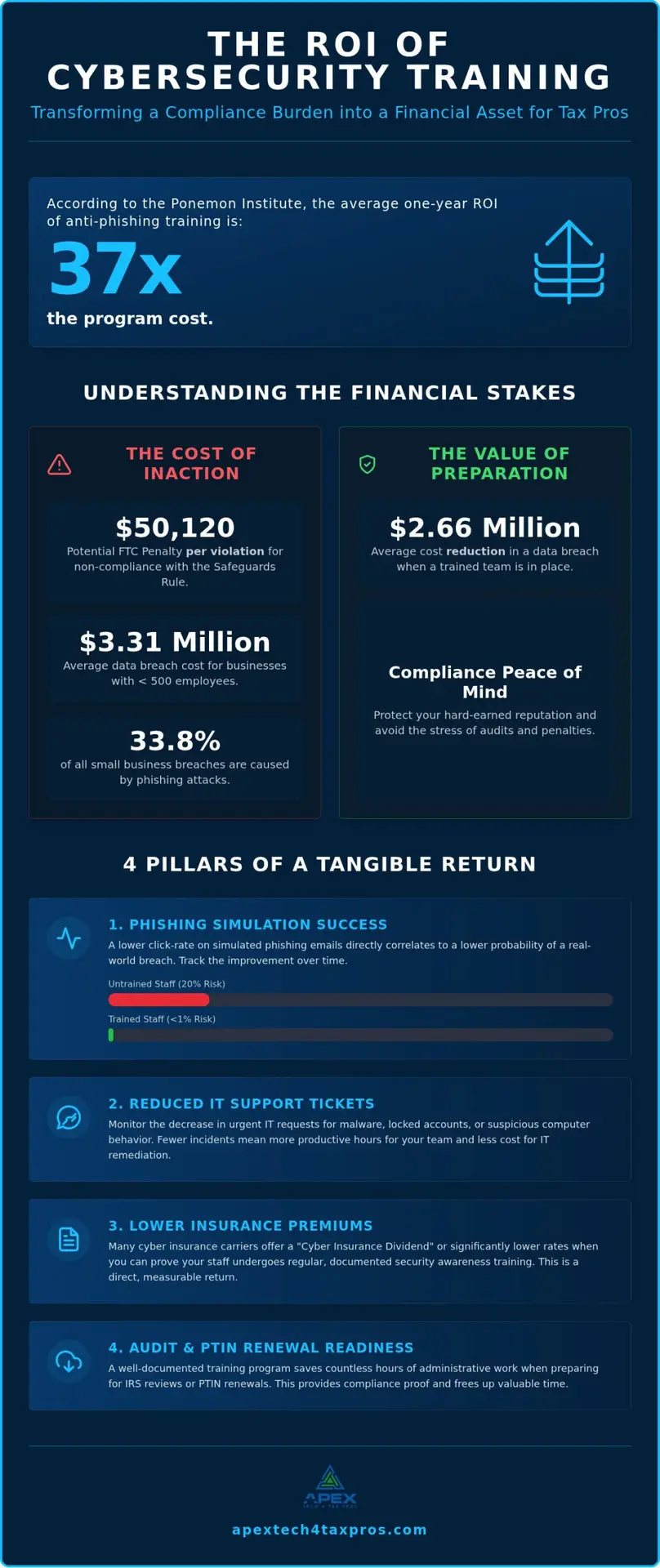
What if your security budget actually paid you back? Many tax pros see IRS Publication 4557 as just another expensive hurdle, but the Ponemon Institute found that the average one-year ROI of anti-phishing training is 37 times the program cost. In our experience helping firms for over 20 years, we’ve seen that measuring roi of cybersecurity awareness training is about more than avoiding the FTC’s $50,120 per-violation penalties. It is the most effective way to transform a mandatory compliance burden into a measurable financial asset that protects your practice during the peak of tax season.
We understand the stress of keeping up with the FTC Safeguards Rule while managing a growing firm. It’s tough to justify new expenses when your staff is already stretched thin and budgets are tight. This article provides a clear framework to quantify your training’s impact, moving beyond corporate jargon to show you how a secure team actually saves you money. You’ll learn how to achieve compliance peace of mind and protect your hard-earned reputation without the typical headache.
Key Takeaways
- Shift your mindset from viewing IRS compliance as a burden to seeing it as a way to safeguard your practice’s hardest-earned revenue.
- Get a clear roadmap for measuring roi of cybersecurity awareness training so you can prove the financial value of a well-prepared team.
- Understand the real cost-benefit ratio of training by comparing affordable seasonal protection against the high price of ransomware recovery.
- Learn how to integrate security education into your daily workflow to create a “human firewall” that works alongside your technical defenses.
Why should tax firms measure the ROI of cybersecurity awareness training?
Measuring roi of cybersecurity awareness training often feels like a secondary task compared to filing returns, but it’s actually your firm’s most vital financial metric. For tax professionals, ROI isn’t just about revenue growth; it’s about aggressive risk mitigation. Phishing remains the top attack vector for small businesses, accounting for 33.8% of all breaches. When your staff understands Security awareness fundamentals, they transition from being a vulnerability to becoming a “human firewall.” The return on investment is the difference between the manageable cost of a training program and the catastrophic $3.31 million average cost of a data breach for businesses with fewer than 500 employees.
How does the FTC Safeguards Rule impact your bottom line?
The FTC Safeguards Rule isn’t a suggestion. It’s a federal mandate that classifies your firm as a financial institution. This law requires you to implement a documented training program for all employees. If you fail to meet these standards, the financial risk is steep. The FTC can impose penalties of up to $50,120 per violation. To build a strong foundation for this requirement, many firms start with a Custom WISP Template. This document serves as the anchor for your entire security strategy, ensuring your training efforts align with IRS and FTC expectations.
The true cost of a tax season data breach
Imagine a breach hitting in the middle of March. A single incident can cause days of total downtime during your most profitable months. Beyond the immediate loss of billable hours, you face the high costs of mandatory client notifications and potential lawsuits. IBM and Verizon reports indicate that having a trained team can reduce breach costs by an average of $2.66 million. Protecting your reputation is priceless, but the math shows that proactive training is a clear financial win.
How do you calculate the tangible returns on security training?
Calculating the actual value of your security program doesn’t have to be a complex math problem. It starts with a clear baseline. You can’t track improvement if you don’t know your starting point. By performing a professional IT Assessment, you identify current vulnerabilities and set a standard to measure against. This data-driven approach is essential for measuring roi of cybersecurity awareness training because it allows you to see exactly how your team’s behavior changes over time.
Once you have your baseline, focus on these four pillars of measurement:
- Phishing Simulation Success: Track the percentage of staff who correctly identify and report test emails.
- Support Ticket Volume: Monitor the decrease in urgent IT requests related to malware infections or suspicious computer behavior.
- Insurance Premium Reductions: Many carriers offer a “Cyber Insurance Dividend” or lower rates when you prove your staff undergoes regular training.
- Audit Readiness: Documented training hours significantly reduce the time spent gathering proof for IRS or FTC compliance reviews.
Using phishing simulation rates as a KPI
A lower click rate among your employees directly correlates to a lower probability of a real-world breach. If one out of five staff members clicks a suspicious link, your risk rate is 20%. Reducing that number to zero through monthly testing effectively closes a major door for hackers. These efforts align with National cybersecurity initiatives that emphasize proactive defense. Testing keeps security top-of-mind for seasonal hires who might not be as familiar with your office protocols.
Quantifying time saved during PTIN renewal and audits
When it’s time for PTIN renewals or an unexpected IRS audit, having your records in order is a massive relief. Documented Cyber Security Training proves you’ve taken the necessary steps to protect taxpayer data. This saves hours of administrative scrambling and provides the compliance peace of mind we all want. A team that knows how to handle sensitive data without constant supervision is a team that stays productive. If you’re ready to see where your firm stands, you can start with a baseline assessment today.
What are the common misconceptions about cybersecurity training costs?
Many tax pros assume that professional security education is a luxury reserved for large accounting firms with massive budgets. This misunderstanding often leads to expensive mistakes. When you’re measuring roi of cybersecurity awareness training, you have to weigh the cost of a program against the price of a local disaster. A single ransomware incident can easily hit a small office for $10,000 or more in immediate recovery fees. Investing in a Seasonal subscription at $649.99 provides a massive return by preventing those out-of-pocket expenses before they occur.
Another myth is the “one-and-done” approach to compliance. Some preparers think a single meeting at the start of the year is enough to satisfy the IRS. IRS Publication 4557 actually requires ongoing awareness because social engineering tactics change constantly. If your training is static, your defenses are already outdated. Real security comes from a consistent culture of vigilance, not a single checkbox on a form once a year.
The danger of the “Small Firm” fallacy
Hackers don’t ignore small firms; they prioritize them. They assume you don’t have the time to build sophisticated defenses. This makes your practice a perfect “gateway” target for supply chain attacks. By gaining access to your system, a criminal can potentially reach the financial data of every client you serve. Your size doesn’t protect you, but your team’s awareness certainly does. We’ve seen this first-hand through our work with our sister company, APEX Tax Solutions, where the human element is always the first line of defense.
Template vs. Professional Training: A false economy?
Using a free template without active training creates a “paper shield.” It might satisfy a quick glance, but it won’t hold up during a rigorous IRS audit or a real phishing attempt. Our Yearly subscription at $1,099.99 is our highest-value option because it keeps your firm protected all year long. It includes a customized WISP and ongoing education that evolves with new threats. To see how we can help you move beyond generic templates, you should view our training and WISP packages today.
How can tax professionals maximize their firm security ROI today?
Maximizing your return means making security a seamless part of your firm’s DNA. It shouldn’t be a separate, scary task. Start by integrating training into your onboarding process for every seasonal employee. When a new hire understands your security culture from day one, they’re far less likely to make a costly error in the heat of tax season. You can further amplify this ROI by pairing your team’s knowledge with technical controls like a Secure Virtual Desktop. This combination ensures that even if a mistake happens, your core data remains isolated and protected.
Security isn’t just a shield; it’s a marketing tool. Clients in 2026 are more aware of data risks than ever before. Telling them your firm undergoes regular training and follows a strict Written Information Security Plan builds deep trust. Beyond the marketing value, documentation is your best friend. Keeping a detailed training log serves as concrete evidence of “due care” if the IRS ever questions your protocols. This makes measuring roi of cybersecurity awareness training easier because you can see the direct link between your efforts and your firm’s legal protection.
Creating a culture of security in your tax office
Training doesn’t have to be a chore. Keep it engaging by using real-world examples from your own office experiences. Your WISP should be a living document that grows as your staff learns. When the team feels involved in the process, they take personal accountability for client data. It’s about creating an environment where everyone feels like a protector of the firm’s legacy.
Next steps for 2026 compliance
The best way to find your biggest ROI opportunities is to look at your current setup. We’ve spent over 20 years in Dallas helping tax pros navigate these requirements. We recommend scheduling a professional review to see where you can tighten things up without adding unnecessary stress. You can Book your WISP Assessment today or email info@at4tp.com to get a customized plan that fits your specific needs.
Protecting Your Practice’s Financial Future
Transforming cybersecurity from a compliance headache into a measurable asset is one of the smartest moves you can make for your practice. We’ve explored how focusing on tangible metrics like reduced phishing clicks and simplified audit preparation helps you gain more than just safety; you gain time and peace of mind. Measuring roi of cybersecurity awareness training allows you to see exactly how your investment prevents the catastrophic costs of a data breach while strengthening your reputation with clients.
We bring over 20 years of combined tax and IT experience to help you meet IRS Publication 4557 requirements with confidence. Our Seasonal and Yearly subscriptions are tailored specifically for independent preparers who need expert protection without the corporate jargon. It’s time to stop worrying about the next threat and start focusing on your growth. You’ve built a great practice, and we’re here to help you keep it that way.
Secure your firm with a Yearly Subscription and Free WISP
Frequently Asked Questions
Is cybersecurity training a legal requirement for CPAs?
Yes, it’s a mandatory requirement under federal law. The FTC Safeguards Rule classifies tax firms as financial institutions, which means you must implement a documented employee training program. Additionally, IRS Publication 4557 explicitly lists security awareness as a core obligation for any professional handling taxpayer data. Failing to meet these standards can lead to steep fines and potentially jeopardize your ability to file returns.
How much does cybersecurity training for tax professionals typically cost?
The cost varies depending on the level of support and customization your firm requires. Some offices opt for basic self-service platforms, while others prefer managed programs that include compliance documentation and a Written Information Security Plan. We offer both Seasonal and Yearly subscriptions that are specifically priced to provide high value for independent preparers and small tax offices without the corporate overhead.
What is the most effective way to measure if my staff is actually learning?
Running regular, unannounced phishing simulations is the most reliable way to track progress. By monitoring how many employees click on test links versus how many report them, you get a concrete metric for measuring roi of cybersecurity awareness training. You can also measure success by tracking the decrease in malware-related support tickets and observing how quickly new seasonal hires adopt your firm’s security protocols.
Can cybersecurity training help lower my firm professional liability insurance?
Yes, many insurance carriers now offer premium discounts or better coverage terms for firms that can prove they conduct regular staff training. In 2026, many cyber liability applications actually require proof of a training program as a condition for coverage. Carriers view a trained team as a lower risk, which can lead to a “Cyber Insurance Dividend” that directly improves your firm’s profitability.
How often should my tax office staff undergo security awareness training?
You should treat training as an ongoing process rather than a single annual meeting. The IRS recommends continuous awareness because social engineering tactics change rapidly, especially during the peak of tax season. We suggest conducting monthly phishing simulations and brief quarterly refreshers. This approach ensures that security stays top-of-mind for your permanent staff and is quickly absorbed by any temporary seasonal help.