
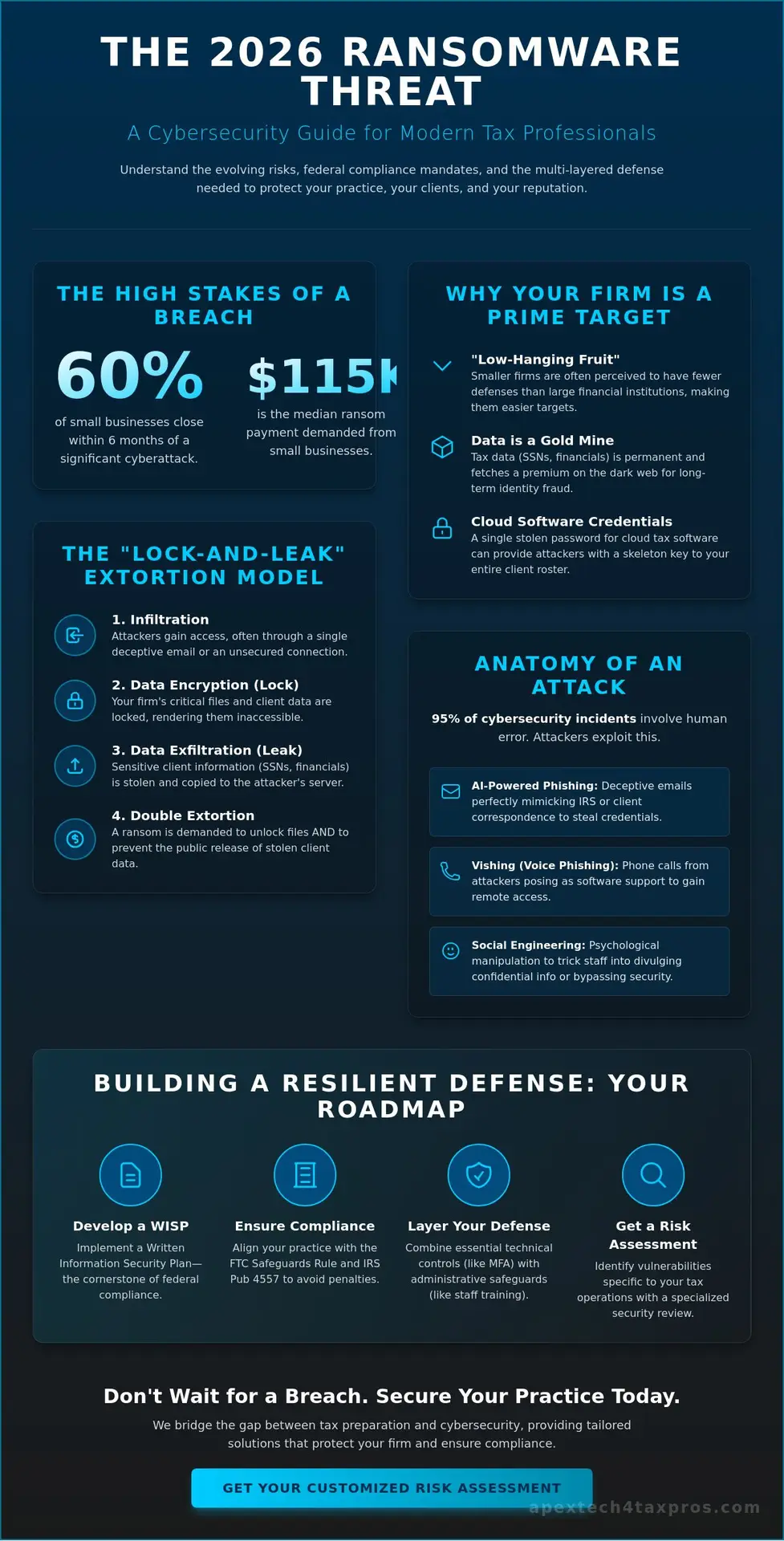
Did you know that 60% of small businesses close within six months of a significant cyberattack? For a tax professional in 2026, the threat of ransomware for small business isn’t just a technical glitch; it’s a regulatory and financial crisis. You’ve worked hard to build your practice on a foundation of trust, yet you likely feel the weight of increasing FTC Safeguards Rule requirements and the constant fear of a single human error undoing years of effort. It’s exhausting to keep up with federal mandates while trying to serve your clients during peak season.
You don’t have to become an IT expert to protect your firm from these evolving threats. We’re here to bridge the gap between tax preparation and cybersecurity. This guide will show you how to shield your practice from the $115,000 median ransom payment while meeting mandatory IRS and FTC security standards. We’ll explore the current risk landscape, provide a roadmap for federal compliance through a Written Information Security Plan (WISP), and offer practical steps to secure your sensitive data and your professional reputation.
Key Takeaways
- Understand why the lock-and-leak extortion model makes ransomware for small business a critical threat to your firm’s data integrity and client trust.
- Identify the sophisticated phishing and vishing tactics attackers use to deceive staff and gain unauthorized access to sensitive taxpayer information.
- Learn how to align your practice with the FTC Safeguards Rule and IRS Publication 4557 to avoid severe financial penalties and regulatory scrutiny.
- Discover the essential technical and administrative layers of a resilient defense, including the implementation of a customized Written Information Security Plan (WISP).
- Explore how a specialized risk assessment can bridge the gap between your daily tax operations and complex federal cybersecurity requirements.
Understanding the Ransomware Threat to Small Tax Practices in 2026
Ransomware is no longer just a digital nuisance; it’s a direct threat to your professional license and your firm’s future. In the tax industry, we’ve seen a definitive shift toward the “lock-and-leak” extortion model. This isn’t just about losing access to your files. Attackers now encrypt your data and simultaneously steal sensitive client information. If you refuse to pay, they threaten to publish your clients’ Social Security numbers and financial histories on the dark web. This double extortion turns a technical failure into a public relations and regulatory catastrophe. Gaining a clear perspective on what is ransomware and how it specifically targets our industry is the first step toward building a resilient defense.
Maintaining data integrity is a core component of your professional ethics. As a tax professional, you’re a steward of your clients’ most intimate financial details. Securing this information isn’t an optional IT project; it’s a mandatory safeguard required by federal law. When you understand the specific mechanics of ransomware for small business, you can move from a state of anxiety to one of secure compliance.
Why Small Firms Are Prime Targets
Many practitioners believe their firm is too small to attract a cybercriminal’s attention. This misconception makes you a “low-hanging fruit” target. Large financial institutions have multi-million dollar security budgets, so attackers pivot toward smaller firms with fewer defenses. A single tax return is a gold mine for identity thieves. While a stolen credit card has a short shelf life, a taxpayer’s identity is permanent. On the dark web, comprehensive tax data fetches a premium because it allows for sophisticated, long-term fraud that can’t be easily resolved with a phone call to a bank.
The Evolution of Attacks in 2026
By 2026, the sophistication of ransomware for small business has reached a tipping point. AI-driven phishing campaigns now mimic IRS correspondence or client emails with frightening accuracy. These messages don’t have the spelling errors of the past; they’re professionally written and perfectly timed for tax season. We’ve also seen a surge in Ransomware-as-a-Service (RaaS). This business model allows low-level criminals to lease powerful extortion tools specifically designed to target professional service firms. These attackers increasingly focus on stealing credentials for cloud-based tax software, knowing that a single login provides a skeleton key to your entire client roster.
Anatomy of an Attack: How Ransomware Enters an Accounting Firm
Understanding the entry points for ransomware for small business is essential for any tax firm aiming for true data integrity. While many practitioners focus on high-tech hacks, the reality is often much more mundane. Cybercriminals exploit the busiest times of the year, relying on the high-pressure environment of tax season to bypass your defenses. They don’t always break in; frequently, they’re invited in through a single misplaced click or an unsecured connection. Research indicates that human error is a factor in 95% of cybersecurity incidents, making your staff the most targeted part of your infrastructure.
Beyond email, “vishing” or voice phishing has become a sophisticated tool for modern extortionists. An attacker might call your office posing as a representative from a well-known tax software provider, claiming there’s a problem with your account that requires immediate remote access. Social engineering is the psychological manipulation of individuals into performing actions or divulging confidential information, such as a receptionist providing a password over the phone to someone posing as technical support. These tactics are designed to create a sense of urgency that overrides standard security protocols.
The IRS-Themed Phishing Hook
In 2026, the most effective scams are those that mimic official regulatory requirements. You might receive an email with the subject line “Action Required: Update your EFIN registration.” It looks identical to legitimate IRS correspondence, complete with official logos and professional formatting. When a staff member opens the attached PDF or Excel document to “verify” their credentials, a hidden dropper script executes in the background. This script silently downloads the ransomware payload, often waiting for a period of inactivity to begin encrypting your server. Conducting a thorough risk assessment can help identify these hidden vulnerabilities in your workflow before they’re exploited.
Vulnerabilities in Remote and Hybrid Work
The shift toward remote work has opened new doors for attackers. Many small firms allow staff to use home computers for tax preparation without the protection of a robust Virtual Private Network (VPN). If a home router is unsecured, it becomes a gateway for firm-wide infection. The CISA #StopRansomware Guide emphasizes that securing Remote Desktop Protocol (RDP) is a critical step, as exposed RDP ports are a primary target for brute-force attacks. Every laptop and tablet used for client data must have managed endpoint security to prevent “shadow IT”—the use of unauthorized apps like personal Dropbox accounts to move sensitive documents—from creating unmonitored gaps in your security perimeter.
Beyond Data Loss: The Regulatory Consequences of a Breach
A ransomware attack on a tax practice represents more than a temporary operational shutdown. In the eyes of federal regulators, it’s often viewed as a failure to maintain the data integrity you’ve sworn to protect. For many practitioners, the most devastating blow isn’t the ransom demand itself, but the regulatory scrutiny that follows. The FTC Safeguards Rule, which classifies tax preparers as financial institutions, mandates specific administrative and technical protections. Failing to meet these standards can lead to civil penalties reaching $51,744 per violation per day as of 2026. This level of financial exposure can easily eclipse the cost of the ransom itself, making ransomware for small business a true existential threat.
When an incident occurs, you’re legally bound to a series of mandatory notification requirements. You must inform the IRS, your state Attorney General, and every affected client whose nonpublic personal information (NPI) was compromised. This process is not just a formality; it’s a public admission of a security failure that can permanently erode client trust. Following the CISA #StopRansomware Guide provides a baseline for the response protocols regulators expect to see in place when investigating your firm’s due diligence.
The FTC Safeguards Rule and Your Liability
The 2026 regulatory environment requires every firm to designate a specific “Security Coordinator.” This individual is responsible for overseeing your firm’s security program and ensuring that regular risk assessments are performed. If an audit reveals “willful neglect” of these standards, the penalties are severe. Regulators look for evidence of a Written Information Security Plan (WISP) and proof of ongoing employee training. Without these safeguards, a firm is essentially defenseless in a post-breach legal battle. Compliance isn’t about checking a box; it’s about proving you’ve taken reasonable steps to prevent ransomware for small business from compromising taxpayer data.
IRS Publication 4557: The Tax Pro Benchmark
The IRS views protecting taxpayer data as a fundamental duty of an Electronic Return Originator (ERO). Under IRS Publication 4557, a ransomware attack is frequently interpreted as a failure of professional due diligence. The 2026 standards set by the Security Summit emphasize that compliance is not optional for any ERO. A significant breach can result in the immediate suspension or loss of your Electronic Filing Identification Number (EFIN) and Preparer Tax Identification Number (PTIN). Losing these credentials effectively ends your ability to practice, transforming a technical issue into a career-ending event.
Building a Resilient Defense: The Multi-Layered Protection Framework
Defending against ransomware for small business requires a shift from reactive troubleshooting to proactive guardianship. A single security software isn’t enough to protect the high-value data within a tax practice. You need a multi-layered framework that creates redundant barriers between cybercriminals and your client files. This strategy ensures that if one safeguard is bypassed, additional layers remain to preserve your data integrity and professional standing. By addressing the technical, administrative, and human elements of your firm, you can build a defense that satisfies both IRS standards and your own peace of mind.
The WISP: Your Compliance Shield
A Written Information Security Plan (WISP) is the foundational document of your defense. While many practitioners look for a quick fix, a generic template won’t hold up during a ransomware audit or an FTC investigation. Your WISP must be tailored to your specific office workflows, documenting how you identify risks and what protocols you follow to mitigate them. It serves as your legal proof of due diligence. To begin this process, you can utilize our FREE WISP Download Template as a structured starting point for your firm’s unique security roadmap.
Advanced Technical Safeguards
Technical protection in 2026 goes beyond traditional antivirus software. We recommend implementing Endpoint Detection and Response (EDR), which uses behavioral analysis to spot ransomware activity in real-time, rather than just scanning for known viruses. Multifactor Authentication (MFA) must be active on every tax software login and email account to prevent credential-based breaches. Furthermore, your data layer requires immutable backups. Unlike standard cloud storage, immutable backups are “locked” and cannot be changed or encrypted by a ransomware script. When these are stored in an air-gapped or off-site environment, they provide a guaranteed recovery path that bypasses the 24-day average downtime many firms face after an attack.
Incident Response: What to Do If Hit
The first 60 minutes after discovering an intrusion are critical. If you suspect an attack, immediately disconnect the affected devices from the network to stop the encryption from spreading. Don’t shut the computers down; keeping the power on preserves vital forensic evidence in the system’s memory that investigators will need. Your response plan should include immediate contact with the IRS Stakeholder Liaison to report the potential compromise of taxpayer data. We strongly advise against paying a ransom. There’s no guarantee the attackers will return your data, and paying can lead to severe legal complications if the criminal group is on a federal sanctions list. To ensure your firm is truly prepared, schedule a specialized Risk Assessment to identify and close your security gaps before an incident occurs.
Bridging the Gap: Tailored Cybersecurity Solutions for Tax Professionals
Apex Tech 4 Tax Pros functions as a “Dual-Expert Guardian” for accounting firms. We understand that your primary focus is serving your clients and navigating complex tax codes, not troubleshooting network vulnerabilities. Our mission is to bridge the gap between tax preparation and IT security by providing solutions specifically engineered for the regulatory environment of 2026. Because we specialize exclusively in the tax industry, we recognize that ransomware for small business requires a response that accounts for both technical recovery and federal compliance. We don’t just fix computers; we protect your professional standing and the data integrity of every client on your roster.
A generic IT provider might understand basic networking, but they often lack the specialized knowledge required to secure tax-specific software like Drake, Lacerte, or UltraTax. Our team brings 20 years of experience to the table, ensuring that your technical safeguards don’t interfere with your firm’s productivity. As a family-owned boutique firm, we prioritize personal accountability. When you partner with us, you aren’t just another ticket in a corporate queue. You’re working with advisors who treat your firm’s safety with the same discipline and vigilance you apply to your clients’ returns.
Why a Niche Provider Matters
Generalist IT firms often overlook the specific “lock-and-leak” threats that target financial records. We’ve designed our Secure Cloud Backup services to be immutable and air-gapped, ensuring that your financial records remain untouched even if a ransomware script enters your local network. Our deep familiarity with IRS Publication 4557 and the FTC Safeguards Rule allows us to build defenses that are audit-ready from day one. This tailored approach removes the heavy lifting of security management from your shoulders, allowing you to operate with confidence during the high-stakes pressure of tax season.
Next Steps for Your Practice
Securing your practice begins with a clear understanding of your current vulnerabilities. We offer comprehensive Risk Assessments that look beyond simple antivirus software to identify the specific gaps in your administrative and technical controls. From there, we develop a customized WISP that serves as your roadmap for federal compliance and long-term resilience. You’ve spent years building your reputation; don’t let a single cyber incident erase that hard work. To ensure your firm is protected by experts who speak your language, schedule your professional Risk Assessment today and take the first step toward a secure, compliant future.
Securing Your Professional Legacy Against Evolving Threats
The threat of ransomware for small business has transformed into a sophisticated regulatory challenge. Protecting your tax practice requires a move beyond basic antivirus toward a comprehensive, multi-layered defense strategy. By prioritizing a customized Written Information Security Plan (WISP) and implementing immutable backups, you satisfy federal mandates while ensuring your firm remains operational during the most critical times of the year.
At Apex Tech 4 Tax Pros, we bring over 20 years of specialized experience in tax-industry IT to every partnership. Our deep expertise in IRS Publication 4557 and the FTC Safeguards Rule allows us to act as your trusted advisor, bridging the gap between complex technology and your daily tax operations. As a family-owned firm, we take personal accountability for your data integrity; we provide the clinical precision and protective reassurance you need to focus on your clients.
Don’t leave your firm’s future to chance. You can Protect your firm with a Customized WISP and Secure Cloud Backup today. Taking these proactive steps now ensures you remain audit-ready and resilient, allowing you to serve your clients with complete confidence.
Frequently Asked Questions
Is my small tax practice really a target for ransomware?
Yes, your practice is a primary target. Cybercriminals focus on small tax firms because they often lack the enterprise-grade security of large banks while holding equally valuable data. Statistics show that 88% of all ransomware incidents involve small and midsize businesses. Your client files contain permanent identity data, making your firm a high-value destination for attackers looking for the easiest path to a profitable breach.
Does my professional liability insurance cover ransomware attacks?
Standard professional liability insurance typically does not cover cyber-related losses. You generally need a specific cyber liability policy or rider to address the costs of data recovery, legal fees, and regulatory fines. In 2026, insurers have become more stringent; they often require proof of a Written Information Security Plan (WISP) and multi-factor authentication before they will issue a policy or honor a claim after an attack.
What is a Written Information Security Plan (WISP) and do I need one?
A WISP is a formal document that outlines how your firm protects taxpayer data through administrative, technical, and physical safeguards. Federal law, specifically the FTC Safeguards Rule, mandates that every tax professional has a WISP in place. It isn’t just a recommendation; it’s a legal requirement that serves as your primary defense during an IRS audit or a data breach investigation.
Can I just use a free WISP template for IRS compliance?
A free template is an excellent starting point, but it isn’t sufficient for full compliance on its own. The IRS and FTC require your plan to be tailored to your specific office workflows and risks. A generic document that doesn’t reflect your actual practices will likely be rejected during a regulatory review. You must customize the template to document your unique software, staff training, and incident response protocols.
How long does it take to recover from a ransomware attack?
The average downtime following an attack is 24 days. This recovery period includes the time needed to identify the breach, scrub your systems of malicious code, and restore data from backups. For a small tax practice, three weeks of lost productivity during peak season can be devastating. This is why having immutable backups and a tested incident response plan is critical for reducing operational paralysis.
What is the “Z-pattern” of ransomware and how does it affect cloud storage?
The “Z-pattern” refers to the methodical way ransomware moves through your network, jumping from local drives to mapped network shares and connected cloud storage. If you use standard cloud syncing services, the software may automatically sync your encrypted files to the cloud, overwriting your clean data. To prevent this, you need a specialized backup solution that is air-gapped or utilizes versioning to preserve unencrypted copies.
Should I pay the ransom if my tax data is encrypted?
We strongly advise against paying the ransom. Statistics show that 51% of small businesses pay, yet there is never a guarantee that attackers will provide a working decryption key or delete your stolen data. Additionally, the Department of the Treasury warns that paying certain criminal groups could violate OFAC regulations. Focusing on a resilient, multi-layered defense is the only way to ensure the long-term safety of your practice.
What are the specific IRS notification requirements after a data breach?
If you experience a breach involving ransomware for small business, you must contact your local IRS Stakeholder Liaison immediately. This allows the IRS to take steps to protect your clients from fraudulent returns filed in their names. You’re also required to notify your state Attorney General and any affected clients whose nonpublic personal information was compromised, adhering to the specific timelines set by your state’s data breach notification laws.