
A breach can damage an accounting firm’s reputation by weakening client confidence and prompting prospective clients to question how sensitive records are protected. Reputational damage from a data breach in accounting can continue after the technical incident is contained, affecting business relationships, leadership credibility, and the firm’s ability to retain or attract clients. The impact depends on the incident and the firm’s response.
For tax and accounting professionals, protecting financial information is central to the trust clients place in the relationship. A security incident can prompt clients, employees, business partners, and other stakeholders to reassess that trust. The firm’s response also shapes how they understand what happened and whether the organization acts accountably.
This article explains how a cyberattack can affect relationships and future business, and how clear communication and security improvements can help rebuild trust. It also covers how regulatory scrutiny may challenge leadership and how disruption can create costs beyond the immediate technical response. Understanding these effects helps firms make informed decisions about preparedness, incident response, and ongoing safeguards.
Key Takeaways
- Consider how lost client confidence can affect renewals and make new business harder to win after an accounting breach.
- Prepare clear, honest incident communications and pair them with visible security improvements to support trust recovery.
- Understand how investigations can put leadership decisions and the firm’s security practices under scrutiny.
- Look beyond immediate response expenses: disruption, remediation, and lost business can create costs that persist over time.
What Is The Reputation Risk Of A Cyber Security Breach In Financial Services?
A cyber incident can change how clients judge an accounting firm’s care, not just its technical defenses. For a firm holding tax returns and financial records, confidence depends on how it handles sensitive information before and after exposure.
Trust, Goodwill, and Customer Loyalty
Trust is a client’s belief that the firm will protect their information and act responsibly if an incident occurs. A breach can weaken that belief, and goodwill built through reliable service may not ease concerns about exposed records. For example, a client whose tax documents were accessed may hesitate to share information next year. That hesitation can lead to client turnover, even after the firm closes the immediate security gap.
Effects on Business Relationships and Opportunities
Reputation risk extends beyond clients to partners, employees, and investors who rely on the firm’s judgment. A referral partner may pause introductions while reviewing what happened, and employees may question whether safeguards protect their work. Investors may scrutinize leadership’s decisions and the response. Each relationship matters because confidence influences whether people continue working with the firm or pursue other opportunities.
Client departures can reduce recurring work and weaken referrals. A prospective client comparing accounting firms may choose one that explains its safeguards and response plan more clearly. The firm then faces two challenges: retaining existing clients and rebuilding confidence with new prospects. This is how reputational damage from a data breach in accounting can affect business beyond the exposed records.
Consider an office that discovers an unauthorized account accessed stored client files. Clients may ask what information was involved, which systems were affected, and what the firm has changed. Clear, consistent answers help people understand the incident; silence or conflicting explanations can deepen doubt. Partners also need accurate information to assess their own exposure and decide whether to continue shared work.
Client loyalty depends on visible safeguards and accountable remediation, not assurances alone. A firm can explain the steps it took to restrict access, review affected data, and address the weakness. These actions give clients, employees, and business partners specific reasons to assess the response, rather than relying only on public statements.
Public relations and security improvements to rebuild trust
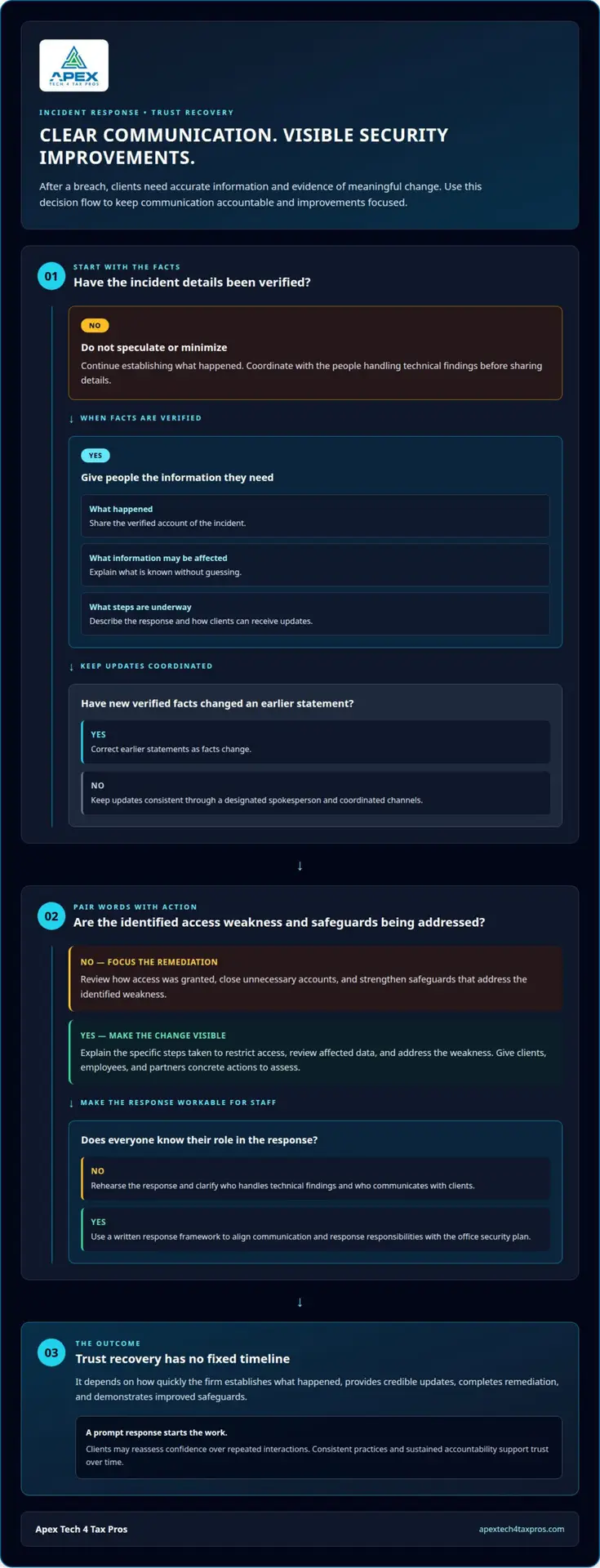
After an incident, clients need clear facts and evidence of meaningful change. A coordinated response connects public communication with practical cybersecurity improvements.
Erosion of Public Trust and Brand Credibility
Public trust is confidence that a firm protects information and communicates honestly when security fails. A breach can weaken that confidence if clients question whether the firm understands the exposure or has addressed its cause. For an accounting practice, inconsistent explanations can deepen concern. Clear updates and specific remediation help people judge the response by its actions, not its assurances.
Crisis Communication and Trust Restoration
Crisis communication means giving affected people accurate, timely information through a designated spokesperson and consistent channels. Explain what happened, what information may be affected, what steps are underway, and how clients can receive updates. Don’t speculate or minimize the incident. Correct earlier statements if verified facts change.
Communication works best alongside visible security improvements. Review how access was granted, close unnecessary accounts, and strengthen safeguards that address the identified weakness. Rehearse the response so staff know who handles technical findings and who communicates with clients. A written response framework can align these responsibilities with a tax office security plan.
Clients, partners, and employees across the United States may hear different accounts unless the firm coordinates its updates. Consistent facts and documented improvements give each audience a clearer basis for evaluating the response.
Examples and Trust-Rebuilding Timelines
Examples of major public cyber incidents include Equifax in 2017 and cybersecurity provider Okta’s breach in October 2023; neither is an accounting-firm example. For accounting practices, the relevant scenario is an exposed client-file system that prompts questions about affected records, access controls, and corrective action.
There’s no fixed timeline for rebuilding trust. It depends on how quickly the firm establishes what happened, provides credible updates, completes remediation, and demonstrates improved safeguards. Clients may reassess their confidence over repeated interactions, so updates and consistent practices matter after the initial announcement. A prompt response starts the work; sustained accountability supports it.
Regulatory investigations and leadership credibility
After an attack, regulatory scrutiny can extend the impact beyond technical recovery. Investigators may examine the firm’s security decisions, incident records, and follow-up controls.
Regulatory Scrutiny and Compliance Demands
Regulatory scrutiny is a review of how a business protected information and responded to a breach. It matters because an inquiry can require leadership to explain safeguards, decisions, and remediation with clear records. Regulators may require enhanced monitoring, reporting, or controls after an incident, adding compliance work and expense.
Preserve relevant records, including access logs, incident timelines, and communications. For example, a documented sequence can show when staff identified unusual access, restricted it, and assessed affected files. Consistent records help the firm answer questions accurately instead of reconstructing decisions from memory.
Requirements depend on the rules that apply to the business and the information involved. A tax practice should identify its obligations, assign a responsible person, and maintain current security documentation. That preparation supports resilience and gives leaders a practical basis for responding to an inquiry.
Potential Fines and Leadership Credibility
Potential fines are one possible consequence of a breach, alongside lawsuits, reparations, and increased compliance demands. How they apply depends on the circumstances and relevant requirements, so no single amount describes every organization. Leadership credibility can suffer if decision-makers cannot explain the firm’s safeguards or show how they addressed identified weaknesses.
After an attack, leaders should establish a clear review process: preserve records, document decisions, identify control gaps, and track remediation to completion. Each step links oversight to evidence. A written record of security investments and assigned responsibilities helps show that leadership treated the incident as an operational risk, not just an IT problem.
Rebuilding credibility takes sustained follow-through. If a firm promises stronger access controls, leaders should document their implementation and review whether they remain in place. Employees need clear ownership of ongoing tasks, while leadership should revisit unresolved findings. This disciplined approach makes accountability visible and helps keep corrective work on track.
Long-term financial costs of data breaches
A breach can create costs across an accounting firm, not just in its technology budget. The financial impact may include lost billable capacity, delayed client work, response coordination, remediation, and business opportunities that fail to progress. Separating these categories helps leaders see how an incident affects operations over time.
These estimates illustrate how disruption severity can change the scale of reputational costs; they are not a forecast for an individual accounting firm.
More than 75% of the total costs of business continuity and IT security failures were business costs rather than departmental IT expenditures. For a small practice, this distinction matters: a staff member pulled into incident coordination may also handle fewer client tasks, while a delayed project can affect later scheduling and capacity.
How much revenue can an accounting firm lose from breach-related reputational damage? There’s no single figure that applies to every firm. The effect depends on client departures, postponed engagements, referral activity, and how much productive work is displaced by response and remediation.
To assess the impact on your firm, compare client cancellations, postponed engagements, referral inquiries, staff time redirected, and recovery spending before and after an incident. Separate one-time response expenses from recurring effects, such as reduced client work or ongoing remediation. This helps leadership identify which costs need immediate attention and which require longer-term operational planning.
Security improvements should address the vulnerability behind the incident, while protecting time for ordinary client work. A focused IT system assessment can help identify gaps and prioritize corrective actions, making security decisions part of business planning rather than an isolated technical expense.
Apex Tech 4 Tax Pros: Customized Written Information Security Plan (WISP)
Apex Tech 4 Tax Pros helps tax and accounting firms turn security responsibilities into practical safeguards. Its Customized Written Information Security Plan (WISP) documents how a firm identifies risks, protects sensitive information, and responds to security concerns. Consider a tailored plan when your current procedures are informal, your systems or staff have changed, or you need clearer documentation of your security practices.
Risk Assessments can help identify vulnerabilities that need attention, while Cybersecurity Awareness Training supports staff in recognizing and handling security threats. Secure Cloud Backup helps protect access to business data if files are lost or systems are disrupted. These offerings address different parts of preparedness, so firms can focus on the gaps most relevant to their operations.
For practical support with your firm’s security planning, contact Apex Tech 4 Tax Pros at info@at4tp.com.
Make Your Next Security Step Deliberate
Reducing reputational damage from a data breach in accounting is ongoing work, not a task that ends when a document is completed or an incident is closed. Make security part of routine business decisions: revisit procedures when systems, staff responsibilities, or information-handling practices change. This keeps protections aligned with how your firm operates, rather than leaving them as policies people rarely use.
Choose one practical action to move forward. You might review who owns security decisions, identify a process that needs clearer documentation, or schedule time to assess whether current safeguards still fit your firm. A focused next step is easier to maintain than a broad commitment without clear ownership.
Apex Tech 4 Tax Pros supports tax and accounting professionals with security planning and related services. If you’d like help identifying a useful next step for your practice, contact Apex Tech 4 Tax Pros. Thoughtful preparation can help your firm protect client confidence while keeping security manageable as the work changes.
Frequently Asked Questions
How Does a Cyberattack Affect a Company’s Reputation?
A cyberattack can lead clients and business partners to question whether a firm handles information responsibly. That concern can affect referrals, renewals, and negotiations with prospective clients. For example, a partner considering shared work may ask how access is controlled and how incidents are handled. Clear, consistent answers help stakeholders assess the firm’s conduct rather than rely on speculation.
How does a data breach damage an accounting firm’s reputation?
A breach can damage an accounting firm’s reputation by making clients question how carefully it protects their financial records. That concern can surface in routine decisions, such as whether to upload documents through the firm’s usual process. Reputational damage from a data breach in accounting can also affect referrals: a satisfied client may hesitate to recommend the firm until it can explain its response and safeguards.
What percentage of accounting firms lose clients after a data breach?
There isn’t one reliable percentage that applies to every accounting firm after a breach. Client departures depend on factors such as what information was exposed, how the firm handled questions, and whether clients trust its corrective steps. A firm can measure its retention impact by tracking cancellations and nonrenewals, then comparing the changes with its usual client patterns.
How does reputational damage affect client retention and new business for accountants?
Reputational damage can make current clients reconsider renewals and prospective clients delay choosing a firm. For example, a business owner comparing accountants may ask how taxpayer documents are shared, stored, and accessed. Firms can make these conversations more concrete by describing their data-handling practices consistently and aligning client-facing explanations with actual procedures.
What U.S. laws require accounting firms to notify clients after a data breach?
Notification duties depend on the information involved, the firm’s circumstances, and applicable federal and state requirements. Accounting firms should assess the affected data and where impacted individuals are located, then determine which notification rules and timelines apply. The Gramm-Leach-Bliley Act and FTC Safeguards Rule concern the protection of customer information, but notification obligations should be assessed separately for each incident.
What should an accounting firm do immediately to limit reputational damage after a breach?
First, restrict compromised access and preserve relevant system records so the incident can be investigated. Then establish what information and systems were affected, assign one person to coordinate updates, and prepare accurate client communications. Keep a dated record of response decisions and corrective actions. This gives staff a consistent source of facts and helps prevent conflicting explanations as the investigation develops.