
In 2026, your tax practice’s cybersecurity posture is just as critical to your final sale price as your annual EBITDA. While you have spent years building a loyal client base and steady revenue, a single technical liability can now devalue your life’s work during the final stages of a deal. Sophisticated buyers are no longer just looking at your books; they are scrutinizing your federal compliance through a rigorous selling a tax practice due diligence security checklist to ensure they aren’t inheriting the risk of a multimillion dollar data breach.
We understand the anxiety that comes with proving your firm is truly secure. You’ve likely felt the mounting pressure of the FTC Safeguards Rule and the evolving requirements of IRS Publication 4557, wondering if your current Written Information Security Plan (WISP) would pass a professional audit. This guide will show you how to protect your firm’s valuation and ensure a smooth exit by mastering the modern cybersecurity requirements of tax practice M&A. We will walk through the essential technical safeguards and documentation you need to provide a buyer with a clean bill of health and a frictionless transfer of sensitive client data.
Key Takeaways
- Modern buyers now prioritize data integrity over traditional goodwill, making your cybersecurity posture a primary driver of firm valuation.
- Our selling a tax practice due diligence security checklist helps you navigate the complex federal requirements of IRS Publication 4557 and the FTC Safeguards Rule.
- You’ll learn why a robust Written Information Security Plan (WISP) serves as the essential documentation buyers require to verify your regulatory compliance.
- Discover how to evaluate your technical infrastructure and secure cloud backup systems to eliminate hidden IT liabilities before listing your practice.
- Proactive risk assessments can identify potential deal killers early, allowing for a frictionless transition of sensitive client data.
Why Security Due Diligence is the “Silent Deal Killer” in Tax Practice Sales
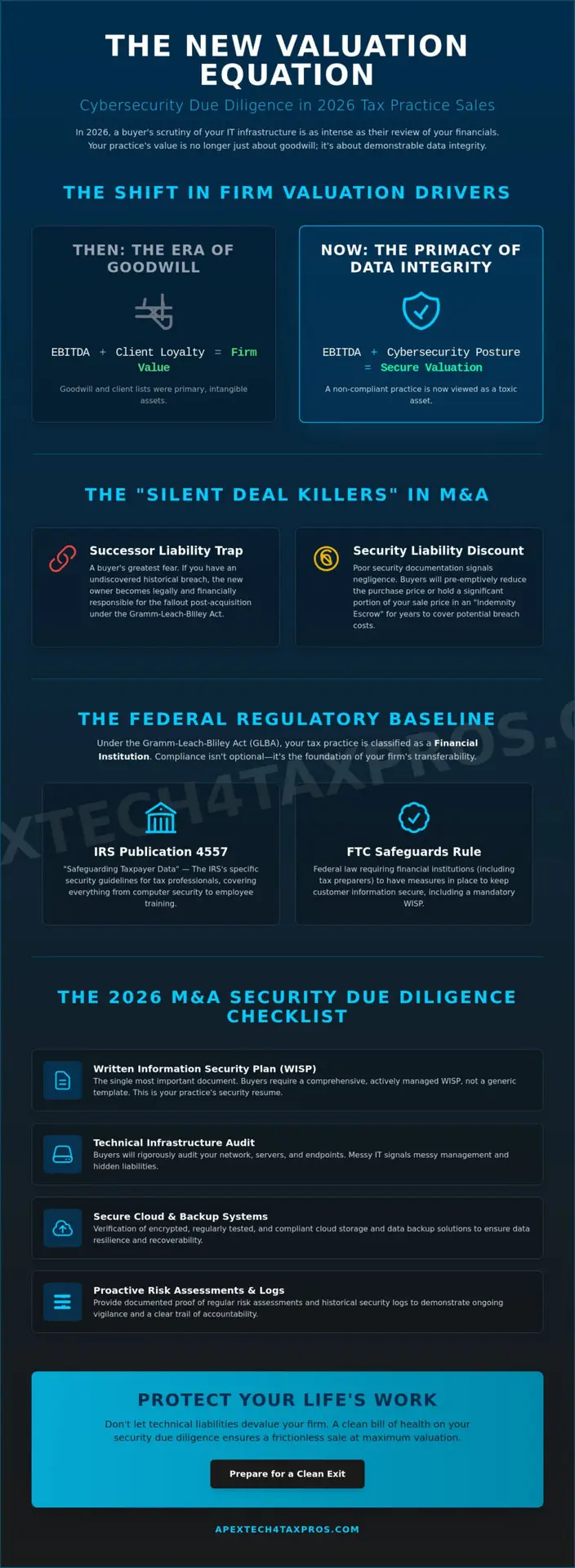
Security due diligence in the tax and accounting M&A space is the systematic investigation of a firm’s technical infrastructure, data handling policies, and regulatory compliance. It goes far beyond a simple review of profit and loss statements. In 2026, the traditional concept of “goodwill” has been largely superseded by “data integrity” as the primary driver of firm valuation. A practice with a high-quality client list but a non-compliant security posture is increasingly viewed as a toxic asset. When a buyer discovers unaddressed vulnerabilities, they don’t just see a technical fix; they see a potential multimillion dollar liability that could end their career.
This realization often leads to deal termination or the implementation of an “indemnity escrow.” This is where a significant portion of your sale price is held in a restricted account for several years to cover potential breach costs. Beyond the financial impact, poor security documentation carries a heavy psychological weight. If a seller cannot produce a selling a tax practice due diligence security checklist or a current WISP, it signals to the buyer that the entire practice might be managed with similar negligence. Preparing a comprehensive selling a tax practice due diligence security checklist is the only way to prove your firm is an asset rather than a liability.
The Difference Between Preparer Due Diligence and M&A Due Diligence
Many firm owners mistakenly believe that their annual compliance with IRS Form 8867 satisfies a buyer’s requirements. While Form 8867 focuses on the accuracy of individual returns, M&A due diligence focuses on the resilience of the firm’s entire ecosystem. Buyers are no longer satisfied with knowing you “did the work” correctly; they want to know how you protected the data while doing it. They will audit your IT infrastructure and internal controls as rigorously as your billing records to ensure you haven’t been operating in violation of federal standards. Messy IT often suggests messy management.
The High Cost of Data Liabilities
The “Successor Liability” trap is the greatest fear for any modern acquirer. Under the Gramm-Leach-Bliley Act, tax practitioners are classified as financial institutions and must maintain strict safeguards for consumer information. If a practice has suffered a historical breach, even one that remains undiscovered, the buyer may become legally responsible for the fallout once the deal closes. This risk is why historical security logs and risk assessments are now mandatory deal components. The Security Liability Discount is a pre-emptive reduction in the purchase price applied by a buyer to account for the financial risk of inheriting a practice with undocumented or non-compliant security protocols.
The Regulatory Baseline: IRS Pub 4557 and the FTC Safeguards Rule
The federal regulatory environment in 2026 is uncompromising. For a tax professional, staying compliant isn’t just about avoiding IRS penalties; it is about maintaining the transferability of your most valuable asset. The movement of client data during a merger or acquisition falls under the strict jurisdiction of the Gramm-Leach-Bliley Act (GLBA), which classifies tax preparers as financial institutions. This means that every byte of data you intend to hand over to a buyer must be protected by a framework that satisfies both IRS Publication 4557 and the FTC Safeguards Rule.
Buyers in 2026 are highly educated on these requirements. They know that if they acquire a firm that hasn’t met these standards, they are effectively buying a lawsuit. This is why the selling a tax practice due diligence security checklist begins and ends with documentation. You must prove that your security measures weren’t just in place but were actively managed and updated to reflect current threats. A buyer’s audit team will look for a clear trail of accountability that spans the entire life of the data you hold.
The WISP: Your Practice’s Security Resume
A Written Information Security Plan (WISP) is the single most important document in your due diligence folder. Sophisticated buyers will immediately flag a generic, “off the shelf” template as a sign of poor management. They want to see a customized plan that reflects your specific office layout, remote work policies, and software stack. It serves as your practice’s security resume, showing that you understand the unique risks of your operation.
To prove your WISP is more than just paper compliance, you must provide evidence of regular risk assessments. These assessments demonstrate that you have identified vulnerabilities and actively remediated them. Buyers look for lived compliance, which includes signed employee acknowledgments of security policies and logs showing that your plan was reviewed at least annually. If you haven’t yet formalized these records, downloading a specialized WISP for tax professionals can provide the necessary structure to start documenting your efforts before a buyer asks for them.
FTC Safeguards Rule and Ownership Changes
The updated FTC Safeguards Rule requires every practice to designate a Qualified Individual to oversee the security program. During a sale, this individual plays a pivotal role in coordinating the secure migration of data. If a breach is discovered during the due diligence process, the rules are clear: the FTC must be notified within 30 days if the incident involves at least 500 consumers. This reporting requirement applies even if the deal is still in the negotiation phase.
Sellers also have a legal obligation to manage client notifications regarding the change in data stewardship. A buyer’s legal team will verify that your privacy notices were updated to reflect how data is shared during a business transition. Failing to address these administrative requirements can stall a deal just as quickly as a technical hack. By following a structured selling a tax practice due diligence security checklist, you ensure that these regulatory hurdles become milestones of trust rather than barriers to your exit.
Asset vs. Liability: Evaluating Your Practice’s Security Infrastructure
When a buyer’s IT auditor reviews your selling a tax practice due diligence security checklist, they aren’t just checking boxes; they are performing a forensic analysis of your firm’s technical resilience. Every piece of hardware and every software subscription in your office is either an asset that facilitates a smooth transition or a liability that threatens the deal. In the high-stakes environment of 2026, an outdated technology stack is no longer just a minor inconvenience. It is a financial risk that buyers will aggressively use to negotiate a lower purchase price.
Legacy systems often pose the greatest threat to a successful exit. An aging on-site server running end-of-life operating systems can easily lead to a $50,000 deduction from your final payout. This reflects the buyer’s anticipated cost for immediate hardware replacement and the labor-intensive data migration required to bring the firm up to modern standards. Proving business continuity through a robust secure cloud backup system demonstrates that your client data is resilient, searchable, and ready for a seamless transfer of ownership.
Cloud vs. On-Premise: A Buyer’s Perspective
Modern buyers have a clear preference for practices that have already migrated to secure cloud storage. Transitioning a physical server during an acquisition is fraught with risks, including hardware failure during transport and the complex re-establishment of local network permissions. Cloud-native firms offer a “turn-key” digital environment where encryption standards meet or exceed 2026 industry benchmarks. This infrastructure allows the buyer to focus on client retention rather than technical troubleshooting, which significantly increases the perceived value of your firm.
Employee Training as a Value Multiplier
Technical safeguards are only as strong as the people who manage them. A buyer will look for documented proof that your team has consistently undergone cybersecurity awareness training. This documentation serves as evidence of a “culture of security,” which is a measurable business asset. It reassures the acquirer that your staff won’t become the weak link that triggers a breach immediately after the keys are handed over. A trained staff represents a tangible asset in a tax firm sale because it significantly lowers the post-acquisition risk of human error and associated regulatory penalties. By including training logs in your selling a tax practice due diligence security checklist, you transform your workforce from a potential liability into a verified security asset.
The 2026 Security Due Diligence Checklist for Sellers
Success in a modern practice sale depends on the orderly presentation of technical facts. A buyer’s confidence grows as you move through each phase of the selling a tax practice due diligence security checklist, transforming your firm from a private entity into a transparent, low-risk acquisition target. This methodical approach ensures that no technical detail is left to chance, protecting your valuation from last-minute “risk adjustments” by the buyer’s IT team. By organizing your security posture into five distinct phases, you demonstrate the disciplined management that sophisticated acquirers expect in 2026.
- Phase 1: Documentation Audit. This is the foundation of your sale. You must produce your current WISP, employee training logs, and historical risk assessments.
- Phase 2: Hardware and Network Inventory. You’ll need to provide comprehensive asset logs for every device that has touched taxpayer data, including encryption status for all laptops and mobile devices.
- Phase 3: Access Control Review. Buyers will scrutinize user permission levels, MFA logs, and the security clauses in your third-party vendor contracts.
- Phase 4: Incident Response and History. Total transparency is required here. Prepare breach logs and remediation reports to show how past vulnerabilities were identified and closed.
- Phase 5: The Transfer Plan. This is the technical blueprint that outlines how data will move securely from your environment to the buyer’s infrastructure.
Step-by-Step Documentation Preparation
Buyers look for consistency rather than a last-minute scramble for compliance. Providing the last three years of annual risk assessments proves that your security posture is a long-term commitment rather than a temporary facade. You must update your WISP to reflect your specific 2026 infrastructure, including remote access protocols and any cloud integrations. It’s also essential to organize proof of multi-factor authentication (MFA) enforcement across all tax software and client portals to satisfy the buyer’s insurance underwriters.
The Data Migration Security Plan
The “Secure Handshake” defines the critical moment when data moves from your control to the buyer’s environment. We recommend using encrypted Virtual Data Rooms for the due diligence process itself to maintain a secure audit trail of all document views. This professional approach protects both parties and prevents sensitive firm intelligence from leaking during negotiations. Once the deal is finalized, you must obtain “destruction of data” certificates for any legacy hardware not included in the sale. This simple step prevents the successor liability trap and ensures you aren’t held responsible for data left on discarded drives. To ensure your documentation meets these rigorous standards, you can start by downloading our FREE WISP Download Template to organize your firm’s security policies today.
Preparing for a Clean Exit with Apex Tech 4 Tax Pros
Preparing for a successful exit is a methodical process that requires more than just a last-minute scramble. Ideally, you should begin refining your selling a tax practice due diligence security checklist at least 12 months before you intend to list the firm. This lead time allows you to identify technical vulnerabilities and administrative gaps that could otherwise become deal killers during the high-pressure environment of active negotiations. By engaging in a professional security audit early, you shift from a reactive stance to a position of professional authority, signaling to potential buyers that your firm is a mature, well-managed asset.
Third-party verification plays a critical role in building this trust. When a seller can produce a validated history of compliance, it maximizes the firm’s valuation by removing the “risk discount” buyers often apply to undocumented IT systems. At Apex Tech 4 Tax Pros, we understand that tax professionals are experts in regulation, but they shouldn’t have to be experts in technical infrastructure. We provide the specialized support needed to bridge that gap, ensuring your technical records are as pristine as your financial statements.
Pre-Sale Risk Assessments
A professional Risk Assessment is the cornerstone of your exit strategy. It allows you to identify and fix vulnerabilities before they are discovered by the buyer’s auditor, preventing uncomfortable surprises that could stall a deal. By addressing these issues early, you can create a comprehensive “Security Disclosure” package that significantly speeds up the due diligence phase. This level of preparation allows you to position your firm as a “Turnkey Secure Practice,” which is a highly attractive quality for sophisticated acquirers who want to focus on growth rather than remediation.
Legacy Protection and Post-Sale Peace of Mind
Your professional responsibility to your clients continues even after the sale is finalized. Ensuring your tail-liability is covered through secure archiving and data destruction certificates is essential for long-term peace of mind. We help you navigate these final steps, ensuring that the transfer of stewardship is handled with clinical precision. By customizing a WISP for tax professionals to satisfy specific buyer requirements, you ensure that your firm’s legacy remains untarnished.
Don’t leave your life’s work vulnerable to last-minute technical scrutiny. A disciplined approach to your selling a tax practice due diligence security checklist ensures that you walk away from the closing table with the full value of your practice. Get your practice ready for sale with a professional Risk Assessment and secure the frictionless exit you’ve earned through years of hard work.
Securing Your Firm’s Legacy for a Successful Exit
In the 2026 M&A market, your firm’s technical integrity is just as important as its financial performance. We have explored how a robust security posture transforms your practice from a potential liability into a high-value asset. By prioritizing federal compliance and addressing infrastructure gaps early, you eliminate the “silent deal killers” that often derail sales. Utilizing a comprehensive selling a tax practice due diligence security checklist ensures that every regulatory requirement is met and every byte of client data is protected during the transition.
At Apex Tech 4 Tax Pros, we specialize in helping tax professionals navigate the complexities of IRS Publication 4557 and the FTC Safeguards Rule. With over 20 years of experience in high-stakes IT management, we directly bridge the gap between tax preparation and technical security. Our mission is to ensure your hard work is rewarded with a clean, profitable exit.
Protect your firm’s legacy and valuation with a customized WISP from Apex Tech 4 Tax Pros.
You have spent decades building your practice and serving your clients. Now is the time to secure the successful transition you deserve.
Frequently Asked Questions
What is the most common security reason a tax practice sale fails?
The most common security reason for deal failure is the absence of a documented Written Information Security Plan (WISP). When a buyer reviews your selling a tax practice due diligence security checklist and finds no WISP, they view the practice as a high-risk liability. This oversight suggests that the firm hasn’t met federal standards; potentially exposing the buyer to historical breaches and significant regulatory penalties immediately after closing.
Does the buyer or the seller pay for the security due diligence audit?
The buyer usually pays for their own technical audit, but the seller is responsible for the costs of preparing their systems for inspection. You should expect to fund your own pre-sale risk assessments and any necessary hardware upgrades. Investing in these areas beforehand prevents buyers from using technical gaps as leverage to negotiate a lower purchase price during the final stages of the deal.
Is a free WISP template enough to satisfy a buyer’s due diligence?
No, a generic WISP template is rarely sufficient to satisfy a sophisticated buyer’s due diligence team. Acquirers look for a customized document that details your specific office protocols, remote work policies, and software configurations. While a template provides a starting point, it must be tailored to show you’ve identified and mitigated the unique risks inherent in your specific tax preparation environment.
How long does security due diligence typically take in a tax firm merger?
Technical due diligence typically spans 30 to 60 days within the broader merger timeline. The duration depends heavily on the organization of your records and the complexity of your network. Firms that maintain a ready-to-share selling a tax practice due diligence security checklist often experience faster transitions. Conversely, unorganized IT environments can stall negotiations or cause the buyer to lose confidence entirely.
What happens to client data if the buyer doesn’t have a WISP?
Transferring data to a buyer without a WISP can lead to severe legal consequences under the Gramm-Leach-Bliley Act. You have a professional obligation to ensure the recipient can securely manage taxpayer information. If the buyer lacks a compliant security program, the deal may be halted by legal counsel to prevent a violation of federal data stewardship requirements.
Can I be held liable for a data breach that happens after I sell my practice?
You can be held liable if a post-sale breach is found to have originated from a security failure that occurred under your watch. This is known as successor liability. Buyers often include indemnity clauses to protect themselves from pre-existing conditions in your network. Maintaining clean security logs and proof of remediation is your best defense against these long-term legal claims.
How does the FTC Safeguards Rule affect the valuation of my tax firm?
The FTC Safeguards Rule serves as a non-negotiable benchmark that directly influences your firm’s final valuation. Compliance is no longer a “bonus” feature; it is a prerequisite for a full-value offer. If your practice falls short of these federal requirements, buyers will likely apply a significant discount to account for the cost and risk of bringing the firm into compliance.
What IT documentation should I have ready before listing my firm for sale?
You should have your WISP, the last three years of risk assessments, employee training logs, and a complete hardware inventory ready for review. Additionally, provide proof of multi-factor authentication (MFA) across all systems and copies of your third-party vendor security contracts. Having this documentation organized in a virtual data room signals to the buyer that your practice is a disciplined, low-risk investment.