
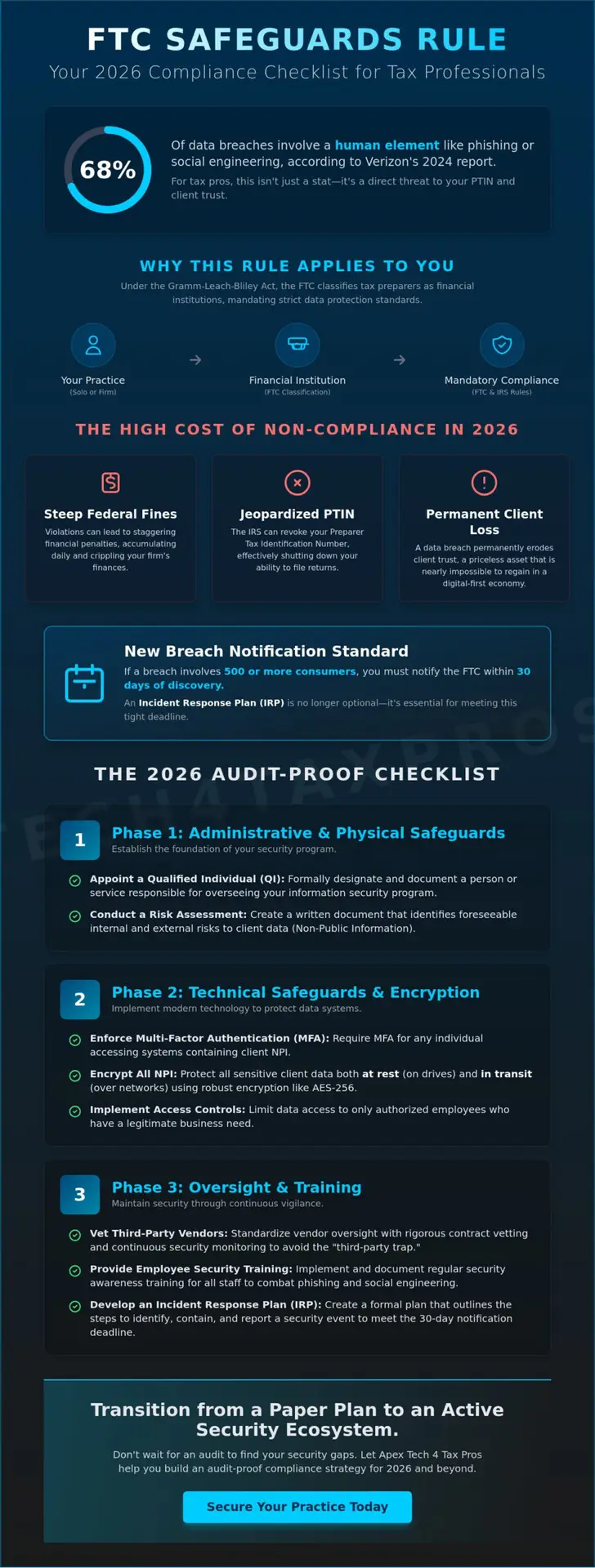
According to the 2024 Verizon Data Breach Investigations Report, 68% of data breaches involve a human element like phishing or social engineering. For tax professionals, this statistic represents more than just a security risk; it’s a direct threat to your regulatory standing. We understand the confusion that often arises when trying to distinguish between IRS WISP requirements and the rigorous technical mandates of the FTC. It’s common to feel overwhelmed by the technical demands of MFA or the difficulty of appointing a Qualified Individual to oversee your security. By following our ftc safeguards rule for tax preparers checklist 2026, you can bridge the gap between basic compliance and a sophisticated, audit-proof security ecosystem.
Our guide provides the roadmap you need to professionalize your cybersecurity posture and avoid the steep penalties associated with FTC enforcement. We’ve prioritized the 2026 requirements to help you implement mandatory encryption and robust access controls without the typical technical friction. This article covers everything from risk assessment protocols to employee training standards, ensuring your practice remains both secure and fully compliant with federal law.
Key Takeaways
- Learn how to transition from a static paper plan to an active security ecosystem that meets the 2026 landscape of stricter regulatory enforcement.
- Identify the specific administrative requirements for appointing a Qualified Individual and conducting a documented risk assessment to ground your compliance strategy.
- Understand the technical shift toward advanced MFA and encryption standards necessary to protect nonpublic personal information both at rest and in transit.
- Protect your practice against the “third-party trap” by standardizing your vendor oversight through rigorous contract vetting and security monitoring.
- Follow our ftc safeguards rule for tax preparers checklist 2026 to bridge the gap between basic IRS mandates and the specialized technical security required for audit-readiness.
Why the 2026 FTC Safeguards Rule is Mandatory for Every Tax Professional
The FTC Safeguards Rule is no longer a distant regulatory goal; it is a current operational reality that dictates how you must handle sensitive data. Under the Gramm-Leach-Bliley Act, the FTC classifies tax preparers as financial institutions. This designation applies to everyone from solo practitioners to large regional firms. It places your practice under the same federal umbrella as banks and credit unions regarding the protection of sensitive information. Understanding the broader context of Financial privacy laws in the United States is essential to recognizing why your firm is now a primary target for federal oversight and why “business as usual” is a liability.
Entering 2026, the era of “good faith” compliance has effectively ended. Regulatory bodies have moved past the initial grace periods that allowed for gradual implementation. Today, enforcement is strict and documentation is mandatory. Your ftc safeguards rule for tax preparers checklist 2026 must reflect a fully active security posture rather than a collection of intentions. You’re required to distinguish between general client data and Non-Public Personal Information (NPI). NPI includes any record containing non-public details like Social Security numbers, bank account info, or tax return data. While general data requires care, NPI demands specific technical safeguards like AES-256 encryption and multi-factor authentication.
There is significant synergy between the FTC Rule and IRS Publication 4557 mandates. While the IRS requires a Written Information Security Plan (WISP), the FTC provides the technical and administrative framework to make that plan legally sufficient. Failing to meet FTC standards often means you are simultaneously out of compliance with IRS requirements, creating a dual-layered risk for your practice.
The Cost of Non-Compliance in 2026
Federal fines for violations can reach staggering amounts per day, but the financial penalty is only the beginning. A documented breach can jeopardize your Preparer Tax Identification Number (PTIN). If the IRS determines your lack of safeguards led to a compromise, your ability to file returns is at immediate risk. This “hidden cost” can effectively shut down your business. Beyond the regulatory fallout, the loss of client trust in our digital-first economy is often permanent. Clients expect their most sensitive financial details to be in safe, capable hands.
New Breach Notification Standards: What Changed?
The landscape changed significantly with the 30-day reporting requirement. If a breach involves the unencrypted information of at least 500 consumers, you must notify the FTC within 30 days of discovery. This notification is handled through the FTC’s electronic reporting portal. To manage this, your 2026 WISP must include a specific Incident Response Plan (IRP). This plan outlines exactly how you will identify, contain, and report an event. Without a predefined process, meeting the 30-day deadline while managing the technical fallout of a breach is nearly impossible for most small to mid-sized firms.
Phase 1 Checklist: Administrative and Physical Safeguards
Administrative safeguards are the structural pillars of your security program. Before implementing technical controls, you must establish the accountability and oversight that the FTC requires. A central component of your ftc safeguards rule for tax preparers checklist 2026 is the formal designation of a Qualified Individual (QI). This requirement often causes hesitation for smaller firms, yet the regulation allows for flexibility as long as the oversight is competent and documented. The FTC provides detailed guidance in their resource, What Your Business Needs to Know, which clarifies that the QI’s expertise should match the complexity of your data environment.
Selecting and Documenting Your Qualified Individual
The QI is responsible for coordinating your information security program and reporting annually to your governing body. While large firms may have an internal CISO, solo practitioners and small partnerships can leverage fractional expert providers to fulfill this role. Documentation is vital; you must be able to prove to an auditor that your QI possesses the technical acumen to evaluate your specific risks. The QI’s mandate includes:
- Overseeing the implementation of technical safeguards.
- Reviewing the results of vulnerability assessments.
- Managing third-party service provider compliance.
If you haven’t yet designated this role, performing a comprehensive risk assessment is the first step toward identifying the technical gaps your QI will need to manage.
The Written Risk Assessment: More Than a Form
A compliant program starts with a documented evaluation of internal and external threats to Non-Public Personal Information (NPI). This isn’t a generic exercise; it involves mapping your entire data lifecycle from client intake to final filing. You must evaluate how current safeguards stand up against evolving 2026 threat vectors like advanced phishing and session hijacking. It’s not enough to identify risks; you must also document the specific controls you’ve implemented to mitigate them. A risk assessment is a living document that must be updated annually or after significant firm changes.
Physical safeguards complement your digital defenses by creating a secure perimeter for your hardware and paper records. This includes securing the office entry points, locking filing cabinets, and ensuring that hardware containing NPI isn’t accessible to unauthorized personnel or visitors. Data retention is equally critical. Keeping client records indefinitely is no longer a best practice; it’s a liability. Your 2026 policy should mandate the secure disposal of data that is no longer required for business or legal purposes, reducing your blast radius in the event of a breach. Proper disposal involves more than just deleting files; it requires cryptographic erasure or physical destruction of media to ensure NPI is unrecoverable.
Phase 2 Checklist: Technical Safeguards and Encryption
Technical controls represent the digital enforcement of your security program. While administrative policies set the expectations, these technical measures provide the actual barriers that protect Non-Public Personal Information (NPI) from unauthorized access. Your ftc safeguards rule for tax preparers checklist 2026 must move beyond basic password protection to incorporate a multi-layered defense strategy. This approach ensures that even if one control fails, your clients’ sensitive financial data remains shielded by secondary and tertiary layers of security.
MFA and Access Control Standards
Multi-factor authentication (MFA) is a non-negotiable requirement for any system containing client NPI. By 2026, SMS-based codes are no longer considered the gold standard because they’re vulnerable to SIM-swapping attacks. Compliance now favors phishing-resistant MFA, such as authenticator apps or physical hardware keys. These tools provide a higher level of assurance that the individual accessing the data is truly authorized. Alongside MFA, you must implement “Least Privilege” protocols. This principle ensures that staff members only have access to the specific files and systems required for their job functions, significantly limiting the internal “blast radius” if an account is compromised.
Effective access control also extends to workstation management. Your workstations should be configured with automatic session timeouts and lockouts to prevent unauthorized access during brief absences. For firms utilizing remote work or hybrid models, secure home-office configurations are essential. This includes the use of encrypted VPNs to create a secure tunnel for data transmission, ensuring that NPI isn’t exposed to the vulnerabilities of public or unsecured home Wi-Fi networks.
Encryption: Securing the Client Journey
Encryption is required for all NPI, whether it’s sitting on your server or moving across the internet. The FTC Safeguards Rule Requirements specify that data must be protected both “at rest” and “in transit.” Sending tax returns or sensitive documents via standard, unencrypted email is a direct violation of these standards. Instead, your 2026 workflow should center on secure client portals that utilize TLS 1.2 or higher for transmission and AES-256 for storage.
Physical hardware also requires robust protection. Every laptop and mobile device used for business must utilize full-disk hardware encryption. This ensures that if a device is physically stolen, the data remains unreadable to the thief. Finally, your technical posture requires regular validation. The rule mandates either annual penetration testing or biannual vulnerability assessments. These tests identify weaknesses in your perimeter before attackers can exploit them, providing the verifiable security evidence that federal auditors expect from a professional tax practice.
Phase 3 Checklist: Service Provider Oversight and Training
Your security perimeter does not end at your office door or your local network. In the 2026 regulatory environment, the FTC holds you directly responsible for the security practices of your third-party software and cloud vendors. This “Third-Party Trap” is a common point of failure during audits. Many tax professionals mistakenly assume that using a well-known tax software provider automatically fulfills their compliance duties. However, a vendor’s security certifications do not substitute for your firm’s own documented oversight. Incorporating vendor management into your ftc safeguards rule for tax preparers checklist 2026 ensures that your data remains protected throughout its entire lifecycle, regardless of where it is stored or processed.
Vetting Your Tax Software and Cloud Vendors
Standardizing your oversight process requires more than a casual review of a vendor’s marketing materials. You must conduct a formal vetting process and maintain records of your findings. When reviewing security addendums in 2026, use this 4-point checklist to evaluate every provider:
- Verify that the vendor utilizes AES-256 encryption for data at rest and TLS 1.2 or higher for data in transit.
- Confirm their breach notification timeline matches or exceeds your 30-day federal reporting requirement.
- Ensure the contract includes a “right to audit” or provides access to annual security summaries.
- Identify all sub-processors the vendor uses to ensure the entire supply chain is secure.
A “SOC 2 Type II” certification should be a non-negotiable requirement for any cloud provider handling client NPI. This report provides independent verification that the vendor’s controls have been tested over a period of time and are operating effectively. It is critical to remember that while your software provider may be compliant, their compliance does not automatically extend to your firm’s internal operations or manual data handling processes.
Building a Culture of Security Training
Technical safeguards can be bypassed if your staff is not prepared for modern threats. Cybersecurity awareness training must move beyond annual “check-box” sessions to become a continuous part of your firm’s culture. In 2026, training topics must evolve to address AI-driven phishing attacks, deepfakes, and sophisticated social engineering tactics that can deceive even experienced professionals. Phishing simulations are an excellent way to evaluate staff readiness in a controlled environment, providing real-world data on where your team may be vulnerable.
Creating a “no-blame” reporting culture is equally vital. Employees should feel confident reporting potential security incidents immediately without fear of retribution. Rapid reporting allows your “Qualified Individual” to trigger your Incident Response Plan before a minor slip becomes a major breach. To meet both FTC and IRS audit requirements, you must maintain detailed logs of training completion for every staff member. If you need a structured program to meet these mandates, our Cybersecurity Awareness Training provides the curriculum and documentation necessary to prove your firm’s commitment to data protection.
Implementing Your 2026 WISP: From Template to Total Compliance
A Written Information Security Plan (WISP) is the operational heart of your compliance program. However, many tax professionals fall into the trap of using a static, generic document that doesn’t reflect their actual technical environment. While a template provides a foundation, it often fails to bridge the gap between IRS Publication 4557 mandates and the specific technical requirements of the FTC. To truly audit-proof your practice, you must move beyond a “paper plan” and transition into active security monitoring. This ensures your ftc safeguards rule for tax preparers checklist 2026 remains a functional guide rather than an abandoned document in a desk drawer.
Transitioning to active compliance means integrating security protocols into your daily tax preparation workflow. It isn’t enough to have a policy on encryption; you must have a verifiable process that ensures every client file is encrypted before it leaves your system. This level of discipline protects your professional license and provides the “protective reassurance” your clients expect in a high-stakes digital environment. We understand that most tax pros lack the internal IT expertise to manage these complex layers, which is why specialized support is essential for maintaining a secure posture.
The Custom WISP Advantage
A customized WISP is engineered to match your firm’s specific size, risk profile, and technology stack. Generic templates lack the granularity required to satisfy federal auditors who want to see evidence of how you specifically protect NPI. Your plan should “live” in a secure cloud environment where it can be updated as your technology evolves. This approach ensures that your administrative policies are perfectly aligned with your technical controls, such as your backup protocols and encryption standards. A personalized plan also makes it easier to meet both FTC Safeguards and IRS standards simultaneously, reducing the administrative burden on your staff.
Your 2026 Compliance Roadmap
Establishing total compliance is a methodical process that can be achieved through a structured 90-day roadmap. This timeline allows you to address vulnerabilities without disrupting your peak filing season operations:
- Month 1: Conduct your mandatory Risk Assessment and formally appoint your Qualified Individual to oversee the program.
- Month 2: Focus on technical implementation, including the rollout of phishing-resistant MFA, hardware encryption, and Secure Cloud Backup.
- Month 3: Finalize staff Cybersecurity Awareness Training and complete the vetting process for all third-party software and cloud vendors.
Apex Tech 4 Tax Pros provides the multi-disciplinary protection required to navigate these federal mandates. We specialize in bridging the gap between high-level regulations and the technical infrastructure of your firm. Whether you choose to download our Free WISP Template or schedule a professional assessment, the goal is to shift your practice from a state of potential vulnerability to a state of verifiable, professional compliance. Don’t leave your firm’s future to a generic checklist when you can build a secure, audit-ready ecosystem today.
Securing Your Firm’s Future in a Regulated Landscape
The transition from basic data handling to a fully compliant security ecosystem is a necessary evolution for the modern tax professional. By prioritizing the appointment of a Qualified Individual and implementing technical controls like AES-256 encryption, you move beyond the limitations of generic templates. Adhering to a comprehensive ftc safeguards rule for tax preparers checklist 2026 ensures that your practice meets the rigorous standards set by both the FTC and the IRS. This methodical approach transforms regulatory burdens into a verifiable professional advantage that protects your clients and your license.
With over 20 years of specialized IT and compliance experience, we understand the unique pressures of your industry. Our team provides comprehensive risk assessments tailored specifically for tax professionals and maintains a proven track record in IRS and FTC audit preparation. Don’t leave your compliance to chance or outdated documentation. Secure Your Practice with a Customized 2026 WISP Today and gain the confidence that your sensitive data is in safe, capable hands. We’re here to help you navigate these complex requirements with precision and professional care.
Frequently Asked Questions
Does the FTC Safeguards Rule apply to solo tax preparers with no employees?
Yes, the FTC Safeguards Rule applies to every tax preparer, including solo practitioners with no employees. The regulation classifies all individuals and entities engaged in tax preparation as financial institutions under the Gramm-Leach-Bliley Act. This means you must develop a written security plan and appoint a Qualified Individual regardless of your firm’s headcount or whether you have a physical office.
What is the difference between a WISP and the FTC Safeguards Rule?
The FTC Safeguards Rule is the overarching federal regulation that mandates data protection for financial institutions. A Written Information Security Plan (WISP) is the specific document that outlines your firm’s unique administrative and technical safeguards. Your WISP serves as the primary evidence that you are adhering to the federal mandate and fulfilling your IRS Publication 4557 requirements.
Who can be designated as the ‘Qualified Individual’ for a small accounting firm?
A Qualified Individual can be an internal staff member or an external cybersecurity service provider. Small accounting firms often choose to outsource this role to ensure they have the technical expertise required by 2026 standards. This approach allows you to meet the oversight requirement without the expense of a full-time security executive on your payroll.
Is multi-factor authentication (MFA) legally required for tax preparers in 2026?
Multi-factor authentication is legally required for all systems that contain nonpublic personal client information. By 2026, the FTC expects robust authentication methods that go beyond simple passwords to protect sensitive data. Implementing phishing-resistant MFA is a critical step in your ftc safeguards rule for tax preparers checklist 2026 to prevent unauthorized access and maintain your professional standing.
What happens if a tax preparer is found to be non-compliant with the FTC Rule?
Enforcement actions include heavy daily fines and the potential loss of your ability to file returns through the IRS. Non-compliant firms are also at higher risk for civil lawsuits and permanent reputational damage following a data breach. The financial fallout of a single incident often far exceeds the cost of implementing a professional security program.
Do I need to update my WISP every year, or only when the law changes?
You must update your WISP at least annually or whenever there is a change to your business that affects the security of client data. Regular reviews ensure your safeguards remain effective against new threats like AI-driven phishing and evolving social engineering tactics. Documenting these updates is essential for proving your commitment to security during an IRS or FTC audit.
Are cloud-based tax software providers responsible for my firm’s FTC compliance?
Cloud providers are responsible for their own infrastructure, but you are responsible for how your firm interacts with those tools. The FTC requires you to oversee your service providers and ensure your internal manual workflows remain secure. Compliance is a shared responsibility that relies on your firm’s internal data management policies and rigorous vendor vetting.
How much does it typically cost to become fully FTC Safeguards Rule compliant?
The total investment for compliance depends on your current security maturity and firm size. Professional firms typically budget for customized risk assessments and specialized training to ensure their ftc safeguards rule for tax preparers checklist 2026 is fully implemented and verifiable. Avoiding the high costs of a data breach or federal enforcement makes proactive compliance a sound and pragmatic business decision.