
With civil penalties for non-compliance now reaching up to $50,120 per violation in 2026, your first interaction with a new client is no longer just a professional greeting; it’s a high-stakes regulatory event. You likely feel the mounting pressure of “document chasing” while simultaneously worrying if a simple email exchange might trigger an FTC audit. It’s a valid concern, as the initial exchange of sensitive nonpublic personal information (NPI) is often where the greatest vulnerabilities lie. Establishing a secure client onboarding process for accountants isn’t just about efficiency anymore; it’s about survival in a landscape governed by the FTC Safeguards Rule and IRS Publication 4557.
I understand the anxiety that comes with managing these federal mandates while trying to maintain a professional first impression. This guide provides a clear roadmap to master the transition from prospect to client through a structured, secure framework. You’ll learn how to implement a repeatable, defensible onboarding process that protects client data and satisfies the requirements of your Written Information Security Plan (WISP). We’ll examine the specific encryption standards, multi-factor authentication requirements, and workflow adjustments needed to signal to your clients that their data is in safe, capable hands.
Key Takeaways
- Align your firm’s intake protocols with 2026 FTC Safeguards and IRS Publication 4557 mandates to mitigate the risk of significant financial penalties.
- Master a secure client onboarding process for accountants that utilizes multi-factor authentication to eliminate the inherent risks of traditional email document exchanges.
- Implement a structured five-step framework that integrates identity verification and encrypted data transmission into your daily workflow.
- Document your specific integration protocols within a Customized Written Information Security Plan (WISP) to create a repeatable and legally defensible security posture.
- Evaluate your existing practice management tools to identify and remediate security gaps that could compromise sensitive nonpublic personal information during the intake phase.
Defining the Secure Onboarding Standard for Modern Accounting Firms
A secure client onboarding process for accountants is a rigorous, multi-step protocol designed to vet new relationships while safeguarding Personally Identifiable Information (PII). Many firms mistake “efficiency”—the speed at which a client signs a stray engagement letter—for professional success. In a high-stakes financial environment, true success is defined by security. The first 72 hours of a new relationship represent the highest risk for data leaks. During this vulnerable window, clients often transmit sensitive files through unverified channels before formal systems are fully established. Adopting a “Security-First” approach transforms this period into a competitive advantage. It signals to high-value clients that your firm is a disciplined protector of their financial legacy.
The Vulnerability of the Initial Data Exchange
Standard email lacks the necessary encryption to handle Social Security numbers, bank records, or tax transcripts safely. When firms rely on these outdated methods, they inadvertently encourage “Shadow IT” behaviors. Clients might use personal, unencrypted file-sharing links or unsecured cloud drives to meet deadlines, creating a fragmented and defenseless data trail. This lack of structure invites credential misuse and phishing attempts. Conversely, providing a secure environment from the first touchpoint has a profound psychological impact. It builds immediate trust. It demonstrates that your technical infrastructure matches your professional expertise, reassuring the client that their regulatory burdens are in capable hands.
Onboarding as a Component of Firm Risk Management
Regulatory compliance requires that intake be treated as a core component of your firm’s annual risk assessment. You must identify the specific types of sensitive data collected, such as nonpublic personal information (NPI) and federal tax records, and govern these interactions through a Written Information Security Plan (WISP). This process begins with Know Your Customer (KYC) guidelines to verify identity and prevent fraudulent intake. By documenting these initial steps within your WISP, you create a defensible audit trail that satisfies both the FTC Safeguards Rule and IRS Publication 4557 standards. This methodical integration ensures that security is never a secondary thought; it becomes a fundamental part of your firm’s operational DNA.
The Regulatory Mandates: FTC Safeguards and IRS Publication 4557
In 2026, the regulatory landscape for tax professionals has moved beyond mere recommendations into a period of aggressive enforcement. Federal authorities no longer view data security as an IT preference; it’s a legal obligation. For small-to-midsize firms, the secure client onboarding process for accountants is the primary defense against civil penalties that can reach $50,120 per violation. Beyond the financial impact, a failure to demonstrate a defensible security posture during a new client intake can lead to the permanent loss of your Electronic Filing Identification Number (EFIN), effectively ending your ability to practice. These mandates require a shift in perspective from simple efficiency to a focus on verifiable compliance.
Understanding the FTC Safeguards Rule in 2026
The amended FTC Safeguards Rule (16 CFR Part 314) defines tax preparers as financial institutions, regardless of firm size. This designation carries specific technical requirements that must be active the moment a prospect becomes a client. All nonpublic personal information (NPI) must be encrypted both at rest, using AES-256 standards, and in transit via TLS 1.2 or higher. Multi-factor authentication (MFA) is now mandatory for any individual accessing systems that house client data. You’re also required to designate a “Qualified Individual” to oversee these protocols. This person is responsible for maintaining logs that monitor who accesses new client files, ensuring that the integration phase doesn’t become a blind spot in your security infrastructure.
IRS Publication 4557: The Tax Pro’s Security Bible
While the FTC provides the broad legal framework, the IRS offers the specific operational requirements for tax practitioners. Adherence to IRS Publication 4557 is not optional. It provides a detailed “Checklist for Safeguarding Taxpayer Data” that specifically targets the data collection phase. Secure onboarding satisfies these requirements by ensuring that the initial intake of Social Security numbers and financial history occurs within a protected environment. The IRS expects these actions to be governed by a Written Information Security Plan (WISP), which acts as the foundation for your firm’s security culture. If you haven’t yet formalized these protocols, you can start by utilizing a FREE WISP Download Template to align your intake process with federal standards.
The goal of these regulations is to create a documented, repeatable system of protection. When you implement a secure client onboarding process for accountants, you aren’t just checking a box for the IRS; you’re building a professional barrier against identity theft and unauthorized access. This disciplined approach ensures that your firm remains compliant while providing the protective reassurance that modern clients expect from their most trusted financial advisor.
Evaluating Onboarding Workflows: Efficiency vs. Security
Accounting firms often face a tension between operational speed and data integrity. While “efficient” onboarding focuses on reducing the time from first contact to signed engagement, a truly secure client onboarding process for accountants prioritizes the protection of sensitive financial data above all else. Many popular practice management tools offer automated intake forms that streamline data entry, yet they frequently lack the dedicated encryption required for federal compliance. This creates a dangerous security gap. Relying on a workflow that prizes convenience over defense leaves your firm vulnerable to the rising tide of Business Email Compromise (BEC) and sophisticated phishing attacks that target the initial exchange of nonpublic personal information (NPI).
The Myth of the “Secure” Email Attachment
For years, many practitioners believed that password-protected PDFs sent via email were the gold standard for security. In 2026, this method is considered insufficient and dangerous. Brute-force tools can now crack simple PDF passwords in seconds, and email itself remains a fundamentally unencrypted medium. Sending onboarding links via standard email also exposes your firm to credential harvesting. Attackers often spoof these messages to trick new clients into entering their login details on fraudulent sites. To protect your practice, you must utilize end-to-end encryption. End-to-end encryption ensures that data is scrambled at the source and can only be decoded by the intended recipient, leaving it unreadable to any unauthorized party, including the service provider, during transit.
Software Alone is Not a Strategy
Purchasing a modern client portal does not automatically grant your firm IRS or FTC compliance. While technical safeguards are essential, the FTC Safeguards Rule mandates that financial institutions also implement administrative and physical safeguards. Software is merely a tool; it is your internal policies that dictate its effectiveness. A firm might have a secure portal but fail an audit because employees still accept Social Security numbers via text message or unencrypted chat apps. This is why a Customized Written Information Security Plan (WISP) is indispensable. Your WISP defines the specific rules for how software is used, ensuring that every staff member follows the same disciplined protocol during the intake phase.
Implementing high-level security protocols may introduce a small amount of friction for the client, but this is a trade-off worth making. Clients today are increasingly aware of data breach risks, with the average cost of a breach reaching $4.88 million in 2024. When you require multi-factor authentication and secure document uploads from day one, you aren’t inconveniencing the client. You are demonstrating a professional commitment to their financial safety. This disciplined approach distinguishes your firm from competitors who continue to use vulnerable, “efficient” methods that put client legacies at risk.
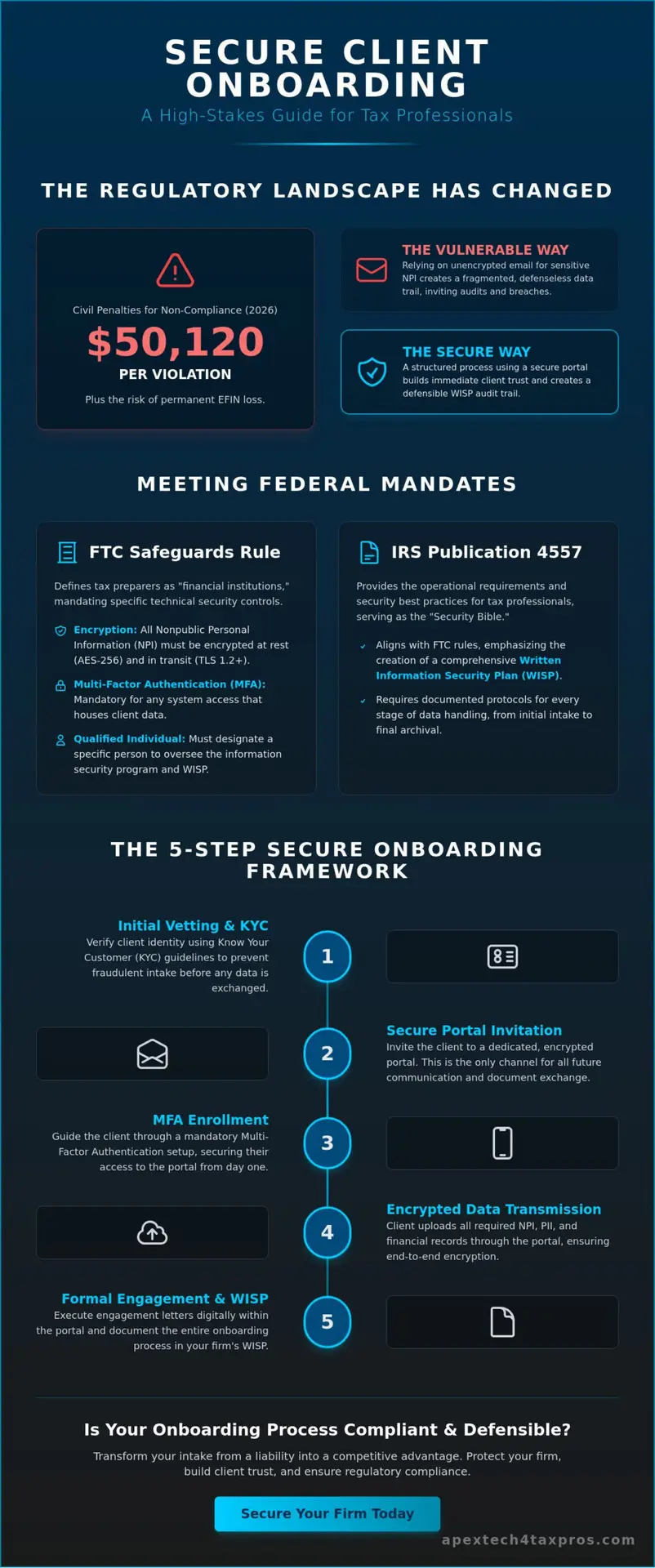
The 5-Step Secure Onboarding Framework for Accountants
Establishing a secure client onboarding process for accountants requires more than a checklist; it demands a repeatable framework that bridges the gap between administrative intake and technical defense. This five-step methodology ensures that every new engagement begins with a posture of compliance rather than a state of vulnerability. By following a disciplined sequence, you can eliminate the “security gaps” that often plague the initial transition from prospect to client.
- Step 1: Identity Verification (KYC) to prevent fraudulent client intake and tax identity theft.
- Step 2: Deployment of a Secure, MFA-Protected Client Portal as the exclusive channel for all document exchanges.
- Step 3: Automated Engagement Letters featuring integrated security disclosures and data handling policies.
- Step 4: Staff Training on the specific security protocols and WISP requirements for the new client’s data.
- Step 5: Integration into Permanent Secure Cloud Backup and the firm’s documented audit trail.
Step 1 & 2: Vetting and Secure Transmission
Tax identity theft has become increasingly sophisticated, often involving fraudulent actors who provide stolen information to generate illicit returns. Your onboarding must include a verification step to confirm identities before you open your systems to their data. Once verified, you should immediately transition the client to a portal that features AES-256 encryption and a full audit trail. I recommend providing a “Security Welcome Kit” during this phase. This brief document educates the client on how to use the portal and explains why you refuse to accept sensitive files via email. It sets a professional tone of vigilance from the very first touchpoint.
Step 4 & 5: The Human Element and Long-Term Integrity
Software cannot protect a firm if the staff doesn’t understand the underlying risks. Since 68% of data breaches in 2024 involved a human element, including phishing or credential misuse, your team must receive specific Cybersecurity Awareness Training tailored to your intake protocols. This training ensures that employees know how to handle new client data without creating unsecured copies on local drives or unverified cloud folders. Finally, Step 5 integrates the new data into your firm’s permanent Secure Cloud Backup. This ensures that if a breach occurs during the onboarding window, you can restore the integrity of the client’s records without interruption. This long-term storage must be governed by your Written Information Security Plan (WISP) to maintain a defensible audit trail for federal regulators.
This framework ensures that your firm’s “front door” is as secure as its vault. By treating onboarding as a technical mission rather than just an administrative task, you protect both your client’s legacy and your firm’s professional reputation.
Bridging the Gap: Integrating Onboarding into Your WISP
The final stage of establishing a secure client onboarding process for accountants is the formal integration of these protocols into your Written Information Security Plan (WISP). A WISP serves as the internal law of your firm, dictating how data is handled from the moment of first contact. Without this documentation, even the most sophisticated technical safeguards lack the legal defensibility required by federal regulators. Apex Tech 4 Tax Pros specializes in bridging this gap by customizing onboarding protocols to fit the specific operational nuances of individual tax practices. This ensures that your technical defenses are matched by administrative policies that hold up under an FTC audit or IRS inquiry.
Why a Template Isn’t Enough for Secure Onboarding
While a FREE WISP Download Template provides a necessary starting point, it cannot account for the unique vulnerabilities of your specific workflow. Professional Risk Assessments are essential to identify where your current intake process deviates from federal standards. For instance, a generic template might suggest using a portal, but it will not detail how your specific staff should verify identity if a client attempts to bypass digital tools. A Customized WISP acts as a legal shield; it provides the specific instructions and accountability measures that a generic document lacks. It transforms a recommended practice into a mandatory, enforceable firm policy that protects both the practitioner and the taxpayer.
Successful integration also relies heavily on the relationship between your written policies and your staff’s daily actions. If your WISP mandates encrypted transmission but your team continues to accept Social Security numbers via unencrypted chat apps, your compliance posture is compromised. This is why onboarding protocols must be explicitly documented and frequently reviewed. This disciplined approach moves your firm away from “ad-hoc” intake methods, which are often inconsistent and risky, toward a “compliance-ready” operation that can withstand the scrutiny of 2026’s aggressive regulatory environment.
Next Steps for Your Firm
Moving toward a more secure posture requires immediate, deliberate action to close existing gaps. I recommend an immediate audit of your current intake process to identify any “hidden” exchanges of nonpublic personal information (NPI). Look for data leaks in email threads, physical mail handling, or unsecured local folders. Once these vulnerabilities are mapped, hold a focused Cybersecurity Awareness Training session. This training should not be a general overview; it must focus specifically on the secure document handling rules outlined in your updated WISP. This ensures every team member understands their role as a protector of client data from the very first interaction.
The transition to a secure framework is a journey from potential vulnerability to professional resilience. By documenting your secure client onboarding process for accountants, you protect your firm’s EFIN and your clients’ financial legacies. Protect your practice with a Customized WISP and Secure Onboarding Strategy from Apex Tech 4 Tax Pros.
Securing Your Firm’s Future through Defensible Intake
Transitioning to a secure client onboarding process for accountants is a fundamental shift that protects your practice from the $50,120 civil penalties and EFIN risks discussed earlier. By implementing a five-step framework and integrating it into your Written Information Security Plan, you transform a vulnerable administrative task into a robust technical defense. This methodical approach ensures that sensitive nonpublic personal information is never left exposed during the critical first 72 hours of a relationship. It’s about building a legacy of trust that starts the moment a prospect says yes.
As IRS and FTC compliance experts, we understand the specific regulatory burdens you face. We provide Customized Written Information Security Plans (WISP) and Cybersecurity Awareness Training engineered specifically for tax professionals. Taking a proactive stance on data protection doesn’t just satisfy federal mandates; it signals to your clients that their sensitive data is in safe, capable hands.
Download Your FREE WISP Template or Schedule a Professional Risk Assessment Today
You don’t have to navigate these complex requirements alone. Establishing a secure foundation today ensures your practice remains disciplined and resilient for years to come.
Frequently Asked Questions
Is a secure client portal enough to satisfy the IRS Publication 4557 requirements?
A secure client portal is an essential technical safeguard, but it’s not a complete compliance solution. IRS Publication 4557 requires a comprehensive program that includes administrative and physical protections alongside technical ones. You must document exactly how your staff uses the portal within your Written Information Security Plan (WISP). Without these documented policies and regular risk assessments, your firm remains vulnerable to regulatory scrutiny regardless of the software you use.
How does the FTC Safeguards Rule affect the way I collect documents from new clients?
The rule requires that all nonpublic personal information (NPI) be encrypted during transmission and while stored. It specifically mandates that your secure client onboarding process for accountants includes multi-factor authentication (MFA) for any system containing client data. Additionally, you must implement robust monitoring and logging to track exactly who accesses new client files. This ensures that the intake phase is as protected as your permanent records.
Can I still use email to communicate with clients if I use a secure portal for documents?
You can use email for routine administrative tasks, such as scheduling meetings or discussing general services, but it’s unsuitable for sensitive data. Your firm’s policies should strictly prohibit the transmission of Social Security numbers, bank records, or tax transcripts via standard email. A disciplined approach uses the secure portal for all PII while reserving email for low-risk communication, ensuring that your firm remains compliant with federal encryption standards.
What is the “Qualified Individual” requirement in the FTC Safeguards Rule for accounting firms?
The FTC Safeguards Rule requires every firm to designate a single “Qualified Individual” to oversee and enforce the information security program. This person can be a firm employee or an outsourced professional service provider. Their role is to coordinate the technical and administrative safeguards, conduct annual risk assessments, and report on the program’s effectiveness. This designation ensures personal accountability for the firm’s overall security posture and regulatory adherence.
Do I need a separate WISP for my onboarding process, or is it part of the firm-wide plan?
Your onboarding protocols should be a dedicated section within your firm-wide Written Information Security Plan (WISP). It’s not a separate document, but rather a core component of your comprehensive security strategy. This section should detail your identity verification steps and secure transmission methods. Having these protocols documented in your WISP provides a defensible audit trail that demonstrates to the IRS and FTC that your firm takes intake security seriously.
How do I explain the need for extra security steps to a new, non-technical client?
Frame these requirements as a protective reassurance rather than a technical hurdle. Explain that your firm utilizes federal-grade security standards to protect their financial legacy from the rising threat of identity theft. Most clients appreciate the extra care when they understand it’s a professional commitment to their safety. Providing a “Security Welcome Kit” can help educate non-technical clients on why these steps are a necessary part of a modern, professional relationship.
What are the most common security mistakes accountants make during client intake?
The most frequent errors involve accepting sensitive documents through unencrypted channels like standard email, SMS, or consumer-grade chat apps. Many practitioners also fail to perform proper identity verification, leaving them open to fraudulent intake schemes. Another common mistake is neglecting to train staff on the specific security protocols required during the intake window. These oversights create significant vulnerabilities that can lead to data breaches and substantial civil penalties from federal regulators.
Does secure cloud backup protect me from breaches that happen during the onboarding phase?
Secure Cloud Backup is a critical tool for data resilience and recovery, but it doesn’t stop a data breach from occurring. If a breach happens during intake, backup ensures you don’t lose the client’s information permanently. However, a truly secure client onboarding process for accountants must prioritize prevention through encryption and MFA. Combining defensive intake protocols with a reliable backup solution creates a comprehensive security posture that protects both data integrity and availability.