
A generic, five-page template isn’t a shield against an IRS audit; it’s a liability that could cost your firm its reputation. You’ve likely felt the growing weight of federal mandates and the persistent fear that a single technical oversight could trigger a compliance failure. We agree that your time is best spent serving clients, not deciphering complex jargon or drafting 50-page manuals from scratch. This guide will help you master the 2026 wisp irs requirements and bridge the gap between tax preparation and ironclad IT security.
Drawing on our 20 years of experience as a family-owned firm, we’ll provide a clear roadmap to ensure your data integrity remains beyond reproach. You’ll gain the confidence that your security plan actually reflects your specific business operations rather than a vague industry standard. We’ll examine the essential components of a compliant plan, common pitfalls in federal safeguards, and the exact steps to secure your practice for the upcoming year.
Key Takeaways
- Understand why the Written Information Security Plan is a federal mandate under the GLBA and how it directly impacts your annual PTIN renewal.
- Learn to avoid the “Generic Template Trap” by ensuring your wisp irs documentation is scaled specifically to the complexity and size of your firm.
- Identify the three mandatory categories of safeguards-Administrative, Physical, and Technical-required to protect sensitive client data in 2026.
- Master the process of operationalizing your security through comprehensive risk assessments and ongoing cybersecurity awareness training for your staff.
- Explore how a dual-expert approach can bridge the gap between tax preparation and high-level IT security to ensure ironclad compliance.
The IRS WISP Mandate: More Than Just a Compliance Checkbox
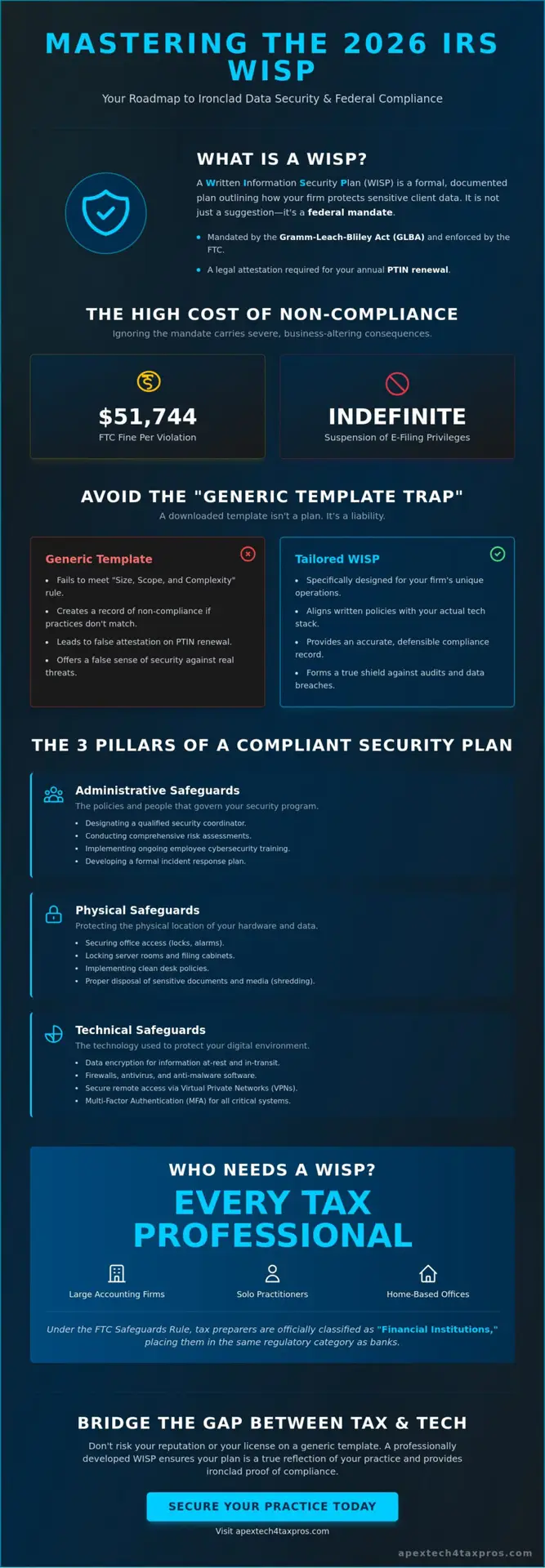
Tax professionals nationwide operate in a high-stakes environment where data integrity is the baseline for client trust. The Written Information Security Plan (WISP) represents a federal requirement mandated by the Gramm-Leach-Bliley Act (GLBA). It’s a living document that outlines exactly how your firm protects sensitive client information from evolving threats. During the annual PTIN renewal process, you’re required to legally attest that your office has a written plan in place. This attestation isn’t a mere formality; it links your professional license directly to your security posture. To understand the depth of these requirements, the IRS points to Publication 4557 as the definitive guide for tax office data protection. This document relies on the core principles of information security to ensure the confidentiality, integrity, and availability of taxpayer records. Ignoring these standards leads to catastrophic legal consequences. As of 2024, FTC fines for non-compliance can reach $51,744 per violation, and the IRS maintains the authority to suspend e-filing privileges indefinitely.
Who is Required to Have a WISP?
A common misconception exists that the wisp irs mandate only applies to large accounting firms with dozens of employees. In reality, the requirement covers every professional tax preparer, including solo practitioners working from a home office. Small firms are often targeted by cybercriminals because they frequently lack robust technical defenses. You aren’t exempt if you run a “paper-only” office; the moment you use a computer to transmit a return or communicate with a client, you’re subject to digital security rules. Under the FTC Safeguards Rule, the government officially classifies tax preparers as “financial institutions.” This classification places you in the same regulatory category as banks and credit unions, requiring a disciplined, documented approach to safeguarding consumer data.
The Role of the Gramm-Leach-Bliley Act (GLBA)
The GLBA was enacted in 1999 to protect consumer financial privacy, but its evolution has significantly tightened the standards for the tax industry over the last two decades. The Safeguards Rule within the GLBA dictates the specific structure of your wisp irs documentation, requiring a written risk assessment and the designation of a qualified security coordinator. It’s no longer enough to have a generic policy. Your plan must be tailored to your specific technical environment and updated as your practice grows. The GLBA mandate stands as the foundational federal law that requires all financial institutions to ensure the security and confidentiality of customer records.
Why Generic WISP Templates Often Fail IRS Scrutiny
Downloading a free PDF template is often the first step Dallas tax professionals take toward compliance. While this feels like progress, it frequently leads to the “Generic Template Trap.” A document that remains unedited is a liability rather than a shield. The IRS doesn’t just want to see a document; they want to see a living protocol that matches your firm’s daily operations. Every practitioner is required by law to have a WISP that actually describes the technical environment they manage.
A “DIY” approach often results in a document filled with security measures the firm doesn’t actually practice. If your plan claims you use biometric scanners but your office relies on simple physical keys, you’ve created a record of non-compliance. A professionally tailored security roadmap bridges this gap by aligning your written policies with your actual hardware and software configurations.
The “Size, Scope, and Complexity” Requirement
The IRS evaluates whether a plan is “reasonable” based on the specific nature of your practice. A three-person boutique firm in North Dallas faces different risks than a fifty-person enterprise. For example, a firm with remote staff must include specific protocols for home Wi-Fi encryption and VPN usage. Conversely, a strictly in-office firm focuses more on physical document shredding and local server locks. Your wisp irs documentation must prove that your safeguards are proportionate to the volume of sensitive data you handle.
The Risk of Inaccurate Attestation
Checking the box during your annual PTIN renewal is a legal attestation. If you confirm you have a plan but your wisp irs documentation is a “copy-paste” job from the internet, you risk being flagged for a false statement. During a data breach investigation, regulators will compare your written policy against your actual security logs. If you haven’t implemented the MFA or encryption your plan promises, the IRS views the unimplemented plan as no plan at all. This disconnect often leads to steeper penalties and potential suspension of filing privileges.
Ensuring your documentation reflects your true security posture is vital for protecting your clients and your license. You can consult with a specialist to verify that your current safeguards meet federal expectations without the guesswork of generic templates.
The Essential Pillars of a 2026-Compliant Security Plan
Modern tax firms face a regulatory environment that demands more than just basic antivirus software. To meet 2026 standards, your security plan must rest on three specific pillars: administrative, physical, and technical safeguards. A critical requirement under the updated Safeguards Rule is the designation of a “Qualified Individual.” This person takes responsibility for coordinating your entire security program. While this individual can be an internal employee or an external partner, their role is to ensure the wisp irs guidelines are actively followed rather than gathering dust on a shelf. They’re tasked with maintaining the integrity of the plan and reporting on its effectiveness to your firm’s leadership.
Administrative and Physical Safeguards
Administrative safeguards focus on the human side of security. This includes mandatory employee training, rigorous background checks, and proactive policy management. You’ve got to address the fact that human error remains the largest threat to tax practices; human elements contributed to 74% of all data breaches according to the 2023 Verizon Data Breach Investigations Report. Training your staff to recognize phishing is as important as the software you install. For those starting from scratch, utilizing an IRS WISP template provides a structured way to document these internal controls and expectations.
Physical safeguards are equally vital for Dallas firms operating in shared office spaces or high-traffic areas. These involve tangible protections like locking file cabinets, clean-desk policies, and secure shredding protocols. You must ensure that unauthorized visitors can’t simply walk past a desk and view a client’s Social Security number on a screen or a printed return. Protecting the physical perimeter is the first line of defense in a comprehensive wisp irs strategy.
Technical Safeguards for Modern Tax Firms
Technical safeguards represent the digital locks and keys of the 2026 tax office. These measures protect data where it lives and how it moves through your network. You must implement encryption for all data at rest and in transit to ensure that intercepted information remains unreadable to unauthorized parties. Multi-factor authentication (MFA) is no longer optional. It’s a mandatory requirement for every system containing taxpayer information, providing a vital layer of protection if a password is compromised.
As we move toward 2026, these technical layers must evolve to counter AI-enhanced social engineering attacks. Cybercriminals now use generative AI to create highly convincing phishing emails that bypass traditional spam filters. Regular risk assessments are the only way to identify these emerging vulnerabilities before they’re exploited. A disciplined firm conducts these assessments at least once every twelve months, ensuring their technical defenses stay ahead of the curve.
Beyond the Document: Operationalizing Your Information Security
Static documents don’t stop cybercriminals; active protocols do. To achieve true compliance with a wisp irs mandate, Dallas tax firms must translate written policies into daily operational habits. This transition involves four decisive steps. First, conduct a comprehensive risk assessment of all hardware and software. This includes scanning devices, mobile phones used for multi-factor authentication, and legacy tax software that might lack modern security patches. Second, implement cybersecurity awareness training for every person with access to your network. Third, establish a secure cloud backup system to ensure data integrity. Finally, create a detailed Incident Response Plan (IRP). This playbook ensures your firm reacts with precision rather than panic during a security event.
The Critical Role of Staff Training
Your security plan fails immediately if the team hasn’t been trained on its contents. Human error remains a primary vulnerability, with the 2023 Verizon Data Breach Investigations Report noting that 74% of all breaches involve a human element. Documented training logs are mandatory for IRS audits. These records prove your firm takes its regulatory burdens seriously and maintains a culture of vigilance. Annual security awareness sessions should include a specific checklist:
- Phishing identification techniques to spot sophisticated email scams.
- Password hygiene and the mandatory use of enterprise-grade password managers.
- Clear protocols for handling physical documents and removable media.
- Immediate reporting procedures for lost devices or suspicious digital activity.
Data Integrity and Secure Cloud Backups
The IRS requires “system failure detection and management” as a core safeguard under Publication 4557. While local backups provide a quick recovery option, they are often vulnerable to the same ransomware that hits your primary server. Encrypted off-site cloud storage provides a “gap” that protects your data integrity from localized disasters or cyberattacks. If a ransomware attack locks your local files, a secure cloud backup utilizing 256-bit encryption allows you to restore operations without negotiating with criminals. This redundancy is a non-negotiable component of a tailored security strategy that bridges the gap between basic IT and federal compliance standards. It ensures that your client’s most sensitive financial data remains available and uncorrupted, regardless of technical failures.
Secure your firm’s future and ensure full compliance by scheduling a WISP operational audit with our expert team today.
Professional WISP Development: Bridging the Gap with Apex Tech 4 Tax Pros
Tax practitioners in Dallas face a unique challenge. Compliance isn’t just about filing forms; it’s about securing the sensitive data behind them. Apex Tech 4 Tax Pros serves as a specialized partner to help you navigate these complex requirements. Our “Dual-Expert” approach is the core of our service. We don’t just understand high-level IT; we understand the specific operational pressures of the tax industry. This means your wisp irs documentation isn’t a generic, bloated template. It’s a precise instrument designed for your firm’s specific workflow and physical office environment.
We focus on creating a tailored WISP that meets federal standards without the unnecessary fluff that slows down your team. Our process involves a deep dive into your current hardware, software, and administrative habits. We identify exactly where the IRS Safeguards Rule applies to your specific office setup. You’ll receive a document that’s both a legal shield and a practical roadmap for your staff. Compliance is achievable when you have a trusted advisor who speaks both the language of federal tax law and the language of cybersecurity.
Our Story: Family-Owned Roots and 20 Years of Expertise
For over 20 years, our team has worked at the intersection of high-stakes data environments. We started in healthcare IT, where HIPAA regulations demand absolute precision and data integrity. We then integrated our deep knowledge of tax preparation to address the growing needs of financial professionals. As a family-owned business, we prioritize personal accountability. We aren’t a faceless corporate entity. We’re a boutique firm dedicated to bridging the gap between complex federal mandates and the practical technology you use every day. Our history ensures that we don’t just fix computers; we protect your professional reputation through vigilant oversight.
Next Steps: From Vulnerability to Secure Compliance
Moving from a state of vulnerability to secure compliance doesn’t have to be overwhelming. You can start today by downloading our free WISP template to see the basic requirements. While this provides a foundation, a professional risk assessment is the most effective way to identify hidden gaps in your network. We’ll look at your encryption, your backup systems, and your employee access protocols to ensure everything aligns with wisp irs mandates. Don’t wait for an audit or a data breach to find out where your firm stands. Secure your practice with a customized WISP from Apex Tech 4 Tax Pros and gain the peace of mind that comes with professional oversight.
Protect Your Practice with a 2026-Ready Security Strategy
Navigating the evolving landscape of federal mandates requires more than a signed document on a shelf. The IRS Publication 4557 and the FTC Safeguards Rule establish strict standards that demand active, operationalized security protocols for every tax office. As we look toward the 2026 filing season, relying on a generic template is a significant risk that often leads to failure during official audits. Apex Tech 4 Tax Pros brings over 20 years of specialized experience in both IT and the tax industry to ensure your firm meets every wisp irs requirement with precision. We serve as a national provider of tailored cybersecurity, helping accounting firms move from vulnerability to total data integrity. Our family-owned roots mean we treat your firm’s compliance with the personal accountability it deserves. It’s time to bridge the gap between technical complexity and professional peace of mind. We’ve spent two decades refining these processes so you don’t have to face regulatory scrutiny alone. Your client data is your most valuable asset, and we’re here to guard it.
Get Your Customized WISP and Compliance Roadmap Today
Frequently Asked Questions
Do I really need a WISP if I am a solo tax preparer?
Yes, you’re legally required to have one. IRS Publication 5293 mandates that every authorized e-file provider, regardless of firm size, must maintain a written security plan. Even for a single-person office in Dallas, federal law requires this document to protect taxpayer data. Failure to maintain one violates the Gramm-Leach-Bliley Act and can lead to the immediate suspension of your Electronic Filing Identification Number.
What is the difference between IRS Publication 4557 and a WISP?
IRS Publication 4557 is a 24-page guide that outlines the seven security groups required to protect taxpayer information, while a wisp irs document is your firm’s specific implementation of those rules. Think of the publication as the federal roadmap and the WISP as your customized operational manual. The WISP details exactly how your Dallas practice executes the safeguards described in the IRS guidelines.
How often do I need to update my Written Information Security Plan?
You must update your WISP at least once every 12 months or whenever a material change occurs in your business operations. According to the FTC Safeguards Rule updated in June 2023, firms must perform periodic risk assessments. If you add new software, hire a contractor, or move your office, your plan needs immediate revision to reflect these new potential vulnerabilities and maintain compliance.
What are the penalties for not having an IRS-compliant WISP?
Non-compliance can result in the immediate suspension of your EFIN and civil penalties of up to $100,000 per violation under the Gramm-Leach-Bliley Act. The FTC also has the authority to levy fines that exceed $50,000 per day for ongoing security failures. Beyond financial costs, the IRS may bar you from the e-file program, effectively ending your ability to process returns for your clients.
Can I just use the IRS WISP template without changing it?
You can’t use the template as-is because the IRS specifically states it’s a starting point that requires customization to your firm’s unique environment. A generic document fails to account for your specific software, hardware, and local Dallas office procedures. To be legally valid, your wisp irs must identify your specific Qualified Individual and the exact technical controls you’ve deployed to mitigate risks.
What is a “Qualified Individual” under the FTC Safeguards Rule?
A Qualified Individual is a designated person responsible for overseeing and enforcing your firm’s information security program. This individual doesn’t need a specific degree but must possess the expertise to manage your security protocols effectively. In a small Dallas practice, this is often the owner or a specialized IT partner who ensures all 16 technical requirements of the Safeguards Rule are met and documented.
Does my WISP need to cover remote employees and home offices?
Yes, your security plan must encompass every location where taxpayer data is accessed, including home offices and remote work sites. The IRS requires that the same level of encryption and physical security applies to a remote laptop as it does to a desktop in your main Dallas office. You must document how you secure home Wi-Fi networks and ensure that unauthorized family members can’t access sensitive client files.
How does a WISP help me in the event of a data breach?
A WISP provides a legally required response framework that limits your liability and guides your recovery steps during the first 24 hours of a breach. Having a documented plan proves to the IRS and FTC that you took reasonable care to protect data, which can significantly reduce regulatory fines. It acts as your defensive shield, demonstrating that you followed federal protocols before the incident occurred.