
What if the IRS Publication 4557 wasn’t just a regulatory hurdle, but actually your most effective marketing tool for the 2026 filing season? Most of us feel a bit overwhelmed when we look at the FTC Safeguards Rule or the $50,120 civil penalties that come with non-compliance. It’s a lot to manage while you’re trying to run a busy office, and it’s even harder to explain these technical layers to a client who just wants their refund. Understanding how to build client trust with data security practices is the key to bridging that gap between technical necessity and client peace of mind.
We agree that compliance often feels like a heavy burden, but it doesn’t have to be a source of constant stress. In this guide, we’ll show you how to transform these mandatory security protocols into your firm’s most powerful asset for long-term loyalty. You’ll learn how to explain your protective measures in plain English and implement a framework that satisfies federal requirements while proving to your clients that their sensitive data is in the safest possible hands. We’re moving beyond simple checklists to show you how security creates a premium client experience.
Key Takeaways
- Discover why shifting your professional identity from a tax preparer to an “identity guardian” is the most effective way to secure client loyalty in the 2026 digital landscape.
- Learn how to build client trust with data security practices by transforming your mandatory Written Information Security Plan (WISP) into a professional “security resume.”
- Identify practical ways to replace vulnerable email attachments with a Secure Virtual Desktop to provide a visible, high-tech handshake of safety for every client.
- Master the art of explaining technical safeguards like the FTC Safeguards Rule using plain language that reassures your clients without overwhelming them with jargon.
Why is data security the new gold standard for client trust in tax preparation?
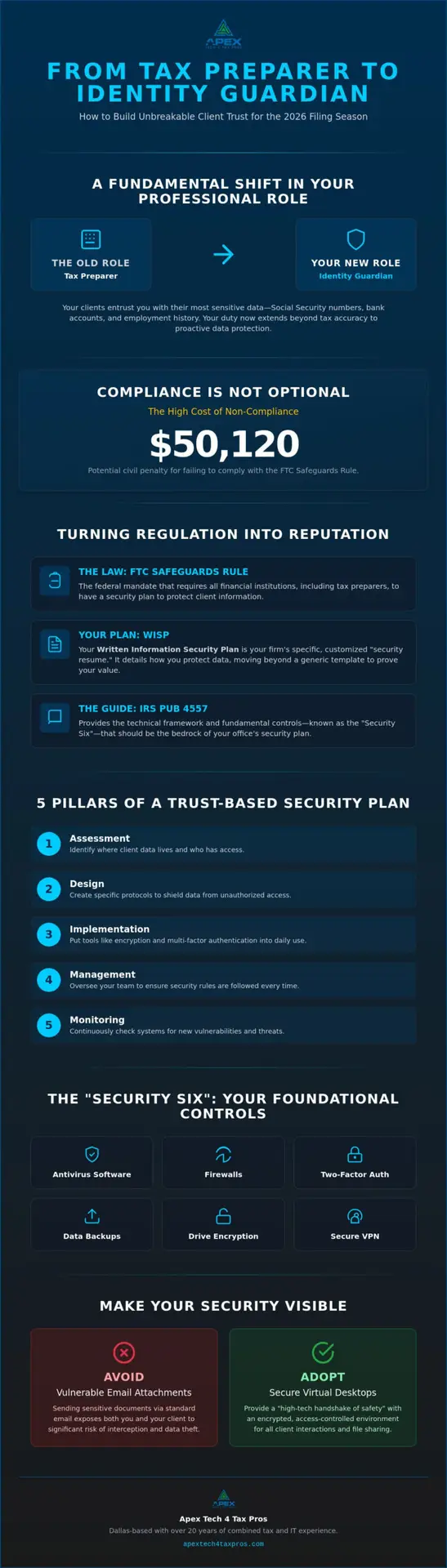
The 2026 digital landscape has fundamentally altered the relationship between tax professionals and their clients. We’re no longer just “tax preparers” who calculate numbers and file forms. We’ve become identity guardians. Your clients are uniquely vulnerable because you hold their most sensitive data: Social Security numbers, bank accounts, and employment history. They’re anxious, and they have every right to be. This is why understanding how to build client trust with data security practices is now more critical than filing accuracy.
Trust isn’t built by reacting to a breach after it happens. It’s built when you’re proactive. You need to distinguish between your requirements: the FTC Safeguards Rule is the federal law you must follow, while your Written Information Security Plan (WISP) is the actual roadmap for how your office protects data. These aren’t just technical tools like firewalls or multi-factor authentication; they’re the foundation of your professional reputation.
The high cost of a “hidden” security strategy
If you don’t talk about your security, your clients might assume you aren’t doing anything. A “hidden” strategy often feels like a lack of care to an anxious taxpayer. As CPAs and EAs, we have an ethical duty to protect privacy that goes beyond simple compliance. This responsibility is rooted in broader financial privacy laws in the United States, which demand that we handle non-public personal information with the highest level of integrity.
Turning IRS Publication 4557 into a client-facing promise
IRS Publication 4557 outlines the “Security Six,” a set of fundamental controls that should be the bedrock of your office. By following these standards, you aren’t just checking a box for the IRS; you’re building a foundation for professional authority. It’s a way to show clients that their safety is your priority. In tax preparation, your security plan is as important as your signature on a return.
How do I comply with the FTC Safeguards Rule while proving my value to clients?
Compliance often feels like another tax season headache, but it’s actually your best opportunity to differentiate your firm. Federal law now mandates that every PTIN holder have a Written Information Security Plan (WISP) in place before the 2026 filing season. While the IRS guide to safeguarding taxpayer data provides the technical framework, your specific implementation is what proves your value. Understanding how to build client trust with data security practices starts with moving beyond the “free template” mindset. A generic checklist might keep you legal, but a Customized WISP acts as a “security resume” that shows clients you’ve tailored your defenses to their specific needs.
A professional, trust-based security plan is built on five essential pillars:
- Assessment: Identifying exactly where your client data lives and who has access to it.
- Design: Creating specific protocols to shield that data from unauthorized eyes.
- Implementation: Putting the actual tools, like encryption and multi-factor authentication, into daily use.
- Management: Overseeing your team to ensure everyone follows the rules every single time.
- Monitoring: Constantly checking your systems for new vulnerabilities or attempted threats.
The role of the WISP in professional credibility
When a client asks how you protect their family’s financial legacy, you don’t want a “deer in the headlights” moment. Having a documented, living plan allows you to answer with confidence. It shows that your commitment to protection is ongoing, not just a one-time setup. This transparency is how to build client trust with data security practices that sustain a firm for decades. Our Dallas-based team has spent over 20 years seeing how this level of professional documentation turns a standard tax office into a trusted institution.
Meeting the FTC Safeguards Rule requirements without the stress
The FTC Safeguards Rule requires you to designate a “Qualified Individual” to oversee your security plan. For many independent pros, this sounds like an expensive new hire, but it’s really about accountability. We’ve designed our services to take this weight off your shoulders. Our Seasonal subscription ($649.99) and our comprehensive Yearly subscription ($1,099.99) both include a free customized WISP to ensure you’re fully compliant without the guesswork. Professional IT assessments can lift the burden of self-auditing off your shoulders. If you’re feeling unsure about your current documentation, you can book a WISP assessment.
What practical security steps can I take to show clients their data is safe?
Implementing security shouldn’t just happen behind the scenes. If you want to know how to build client trust with data security practices, you have to make those practices visible and tangible for the people you serve. It’s about creating a series of “safety handshakes” throughout the tax preparation process that reassure your clients their identity is being guarded with professional-grade tools.
First, stop accepting sensitive documents via standard email. Moving to a Secure Virtual Desktop eliminates the risks of unencrypted attachments while giving clients a professional portal they can trust. Second, make Multi-Factor Authentication (MFA) mandatory for all client-facing logins. While it adds a small step to their process, it serves as a constant reminder that you take their data seriously. Third, ensure your team completes Cybersecurity Awareness Training. A staff that can explain why they use secure methods is your best marketing asset. Finally, configure a Secure Office Network that separates guest Wi-Fi from your tax prep traffic.
Visible vs. invisible security measures
Clients find psychological comfort in things they can interact with. A secure portal or an MFA prompt is visible proof of your care. While invisible measures like encrypted cloud backups are vital for meeting FTC Safeguards Rule requirements, the visible tools are what truly reduce client anxiety and build long-term loyalty.
Training your staff to be “security ambassadors”
Trust begins the moment a client walks in or calls your office. Since industry research indicates that 68% of data breaches involve a human element like phishing or data mishandling, having a receptionist who can confidently explain your secure intake process is vital. Consistent messaging across the firm ensures that every team member acts as a protector of client information. This unified approach is how to build client trust with data security practices that feel seamless and professional.
If you’re ready to evaluate your current setup before the next filing season, you can book a Risk Assessment
How can I communicate my security practices without sounding like a corporate vendor?
Most clients don’t care about “AES-256 encryption” or “end-to-end protocols.” Those terms sound cold and impersonal, and they often lead to more confusion than comfort. If you want to know how to build client trust with data security practices, you need to speak the language of safety, not the language of software. Instead of technical jargon, tell them you use “bank-level protection for your tax records.” This simple shift reframes the conversation from a technical chore to a protective service that they already understand and value.
Positioning compliance as a “relief” for the client is a powerful way to build loyalty. They’re trusting you with their family’s financial legacy. Knowing that data is in professional hands provides them with genuine peace of mind. When a client asks if new security steps will make their life harder, focus on the ultimate benefit. You’re protecting their refund and their identity. A small extra step like using a secure portal is a shield against the rising tide of identity theft, ensuring their sensitive information never falls into the wrong hands.
For firms that require a more tailored approach to managing sensitive information, API Pilot offers custom software development services that can build secure, proprietary systems designed to meet your specific operational needs.
Crafting your security message for engagement letters
Your engagement letter is the perfect place to market your Custom WISP as a premium value-add. You can include a “Our Commitment to Your Privacy” section that highlights your proactive stance. Try a sentence like this: “Our firm’s heritage is built on personal trust, which is why we’ve implemented a comprehensive security plan that meets the highest federal standards to keep your family’s information safe.” This doesn’t sound like a vendor; it sounds like a seasoned advisor who understands high-stakes environments.
The “Knowledgeable Colleague” approach to client questions
When a client feels anxious about news of a recent data breach, give them grounded, pragmatic answers. You don’t need to be a cybersecurity expert to reassure them. There’s immense power in saying: “We follow the same IRS security standards as the biggest firms in the country.” This positions you as an insider who speaks the specific language of your profession while remaining deeply relatable. This is how to build client trust with data security practices that turn a one-time customer into a lifelong client.
Securing Your Firm’s Future Beyond the 2026 Filing Season
Transforming mandatory compliance into a competitive advantage isn’t just about avoiding IRS penalties. It’s about showing your clients that you value their identity as much as their tax refund. By moving from a hidden security strategy to visible, plain-language communication, you’ve learned how to build client trust with data security practices that last. Whether you’re implementing a Secure Virtual Desktop, finalizing your first WISP, or securing your corporate payment processing through p2ezpay.com, these steps prove that your office is a safe harbor in a high-stakes digital world.
Our Dallas-based team brings over 20 years of combined tax and IT experience to help you navigate these complex federal requirements. We specialize in IRS Publication 4557 compliant solutions that lift the technical burden off your shoulders so you can focus on what you do best. You don’t have to navigate the nuances of the FTC Safeguards Rule alone. Our specialized heritage in tax office cybersecurity ensures your practice remains both compliant and credible.
Book a WISP Assessment to secure your practice and build client trust today. You’ve done the hard work of building your firm; now let’s make sure it’s protected for the long haul.
Frequently Asked Questions
How do I comply with the FTC Safeguards Rule in my small tax office?
You comply by implementing a comprehensive information security program that includes a Written Information Security Plan (WISP) and designating a Qualified Individual to oversee your protocols. Even if you operate a solo practice, you must perform regular risk assessments and use professional-grade encryption for all non-public personal information. Partnering with a specialized firm can simplify this process by providing a clear roadmap for both technical and administrative controls.
Do I really need a Written Information Security Plan (WISP) if I work alone?
Yes, the IRS requires all PTIN holders to have a documented WISP regardless of their firm’s size or employee count. This federal mandate is a prerequisite for your annual PTIN renewal and ensures you have a defined strategy for protecting taxpayer data. Having this document is a foundational step in how to build client trust with data security practices because it proves you have a formal, professional process in place. If you’re interested in how other technical sectors handle mandatory record-keeping, you can visit SOCWeld to discover how they automate and manage welding documentation.
What is the difference between IRS Publication 4557 and the Safeguards Rule?
The FTC Safeguards Rule is the federal law that mandates data protection, while IRS Publication 4557 provides the specific “Security Six” guidelines for tax professionals to follow. Think of the Safeguards Rule as the legal requirement and Publication 4557 as the practical manual for achieving compliance within a tax office environment. Both are essential for maintaining your professional standing and protecting your clients from identity theft.
How can I explain Multi-Factor Authentication (MFA) to my older clients?
Explain MFA as a “double-lock” system for their tax records, similar to how a bank might send a text code for a large transaction. Tell them it is an extra layer of bank-level protection that ensures only they can access their sensitive information. Focusing on the outcome of identity protection rather than the technical steps helps them see it as a valuable service rather than a digital inconvenience.
What should I do if a client refuses to use a secure portal for their documents?
You should politely explain that your firm’s security standards are designed to protect their identity and that standard email is not secure for Social Security numbers. If they still refuse, you may need to consider if the risk of a data breach is worth the engagement. Consistently enforcing these standards is how to build client trust with data security practices because it shows you won’t compromise their safety for the sake of convenience.
Is a WISP template enough to satisfy an IRS audit in 2026?
A generic template is rarely sufficient because the IRS requires your WISP to be tailored to your specific office operations and technical environment. During an audit, you must prove that the plan is actually implemented, monitored, and updated as your business grows. A customized plan that reflects your real-world practices, such as your specific backup routines and software tools, is necessary to meet federal scrutiny and avoid penalties.