
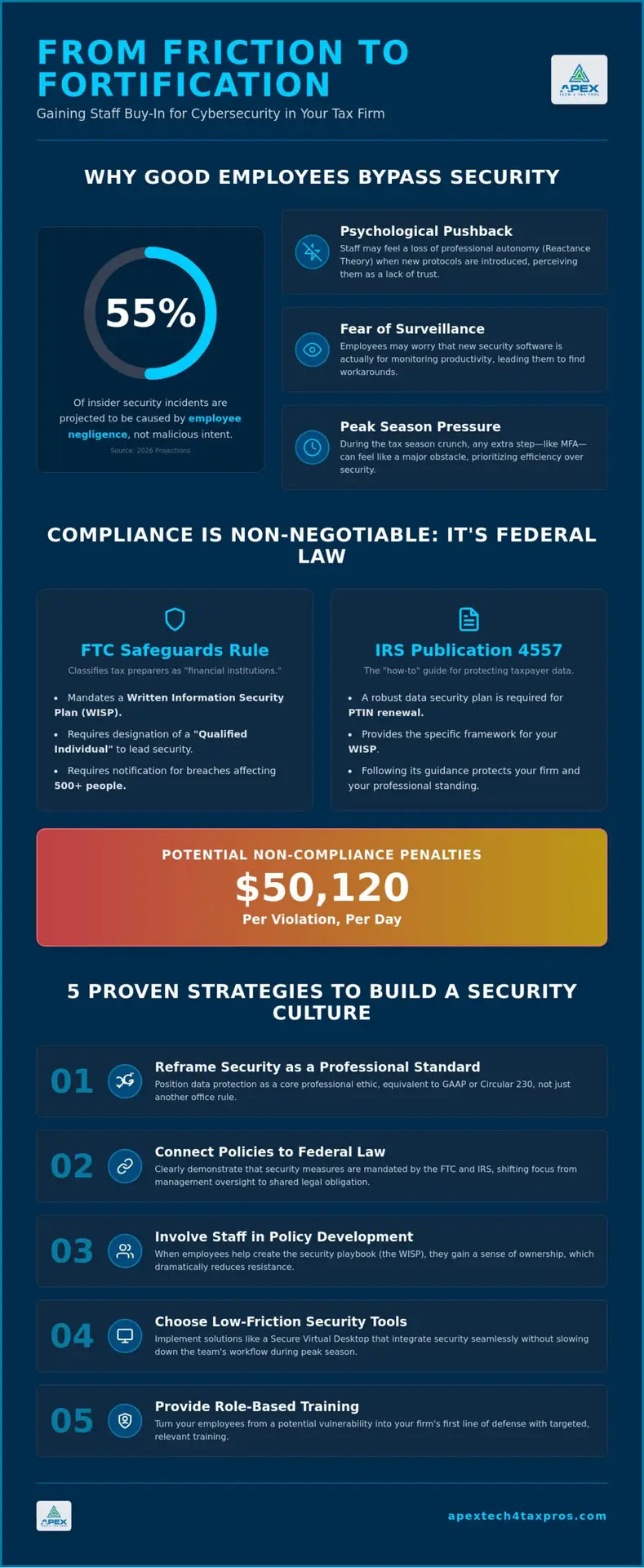
Did you know that 55% of insider security incidents in 2026 are caused by simple employee negligence rather than bad intentions? It usually happens during the height of tax season when a well-meaning staff member bypasses a protocol just to save a few minutes. We understand that managing employee resistance to new security policies feels like an uphill battle. The secret to gaining staff buy-in is reframing compliance as a federal professional standard, similar to the tax code itself, rather than a management whim. This approach removes the friction of micromanagement while keeping your firm safe and compliant.
You likely feel that your team sees every new IT hurdle as a roadblock to their productivity. We agree that a tax practice shouldn’t feel like a high-security prison just to stay compliant with the FTC Safeguards Rule. This article promises to show you how to transform cybersecurity from a perceived burden into a shared professional standard that your staff will actually embrace. We will cover clear communication strategies, ways to simplify IRS Publication 4557 requirements, and how to build a culture where data protection is everyone’s priority.
Key Takeaways
- Understand why resistance often stems from a perceived loss of autonomy and how to reframe security as a professional federal standard.
- Learn how the FTC Safeguards Rule and IRS Publication 4557 mandate a Written Information Security Plan (WISP) for every tax practice.
- Master five proven strategies for managing employee resistance to new security policies by involving your staff in the policy development process.
- Identify low-friction security tools, such as a Secure Virtual Desktop, that protect taxpayer data without slowing down your team during peak season.
- Discover how role-based training turns your employees from a potential vulnerability into your firm’s first line of defense.
Why Do Employees Resist New Security Policies in Accounting Firms?
Resistance to change is a natural human response. When you introduce a new protocol, your team might feel a loss of professional autonomy. Psychologists call this Reactance Theory. It’s the feeling of pushing back when someone tells you how to do a job you’ve mastered over decades. Managing employee resistance to new security policies starts with understanding that your staff isn’t trying to be difficult. They’re simply trying to protect their own productivity and maintain control over their workspace.
There’s also a common fear that security monitoring is actually “gotcha” management. If employees think your new software is just a way to surveil their keystrokes or track their hours, they’ll find workarounds. You have to bridge this gap by applying effective principles of change management. Security isn’t just “IT’s problem” anymore. It’s a core accounting competency that protects the firm’s reputation and the client’s most sensitive life details. When staff realize these rules are about protection rather than surveillance, the tension begins to fade.
The Efficiency vs. Security Conflict in Peak Season
Let’s be honest about the “Tax Season Crunch.” When it’s mid-April and the pressure is on, every extra click feels like an obstacle. Complex logins and multi-factor authentication (MFA) can feel like a burden when cognitive load is already maxed out. We’ve seen staff share passwords or bypass secure file portals just to keep the workflow moving. To fix this, we have to choose tools like a Secure Virtual Desktop that provide a smooth user experience without sacrificing the safety of the data.
Reframing Security as a Professional Standard
We need to shift the conversation from “office rules” to “professional ethics.” You wouldn’t ignore GAAP or Circular 230 requirements just to save five minutes. Cybersecurity protocols are the modern equivalent of those standards. When we frame data protection as a way to honor our duty to the client, it stops being a nuisance. It becomes a badge of professional excellence that every member of the team can take pride in, turning compliance into a shared victory rather than a management hurdle.
How do I connect my firm’s security policies to IRS Publication 4557 and the FTC Safeguards Rule?
The most effective way to start managing employee resistance to new security policies is to show your team that these aren’t just office rules; they’re federal law. The FTC Safeguards Rule formally classifies tax practices as financial institutions, which means we are legally required to have a Written Information Security Plan (WISP) in place. This shifts the focus away from “management oversight” and toward a shared professional obligation to protect taxpayer data.
IRS Publication 4557 (Rev. 6-2024) provides the specific framework for these responsibilities. When your preparers realize that a robust data security plan is now a requirement for their PTIN renewal, the conversation changes. Non-compliance can lead to civil penalties of up to $50,120 per violation, per day. By presenting these facts, you help your staff see that following security protocols is about protecting their own professional standing as much as it is about firm safety.
How do I comply with the FTC Safeguards Rule without losing staff?
The Safeguards Rule requires us to designate a “Qualified Individual” to coordinate the security program. This doesn’t have to be a tech expert; it just needs to be someone who ensures the rules are followed consistently. Transparency is key here. When you explain that the FTC now requires notification of breaches involving 500 or more people within 30 days of discovery, the team understands why we can’t cut corners. If you’re unsure where your practice currently stands, you can book a professional assessment to get a clear picture.
How does a WISP help set clear expectations for my team?
Think of the WISP as your firm’s security playbook. It defines exactly how data is handled, who has access, and what happens if a threat is detected. managing employee resistance to new security policies is much easier when everyone is reading from the same script. By using a Custom WISP Template, you can create a document that fits your specific workflow. This makes the “rules” feel like a custom-fit tool that supports their work, rather than a generic burden that gets in the way of filing returns.
What are the most effective strategies for managing employee resistance to new security policies?
Successfully navigating these changes requires moving away from top-down mandates toward collaborative ownership. It’s a matter of social dynamics. According to foundational research on resistance to change, people don’t resist the change itself as much as they resist the disruption of their social arrangements and established routines. In a busy tax office, this means leading with the “Why” before the “How.” Instead of just handing down a list of rules, lead with a specific threat scenario. When you explain how a single phishing link can compromise the entire firm’s database, the staff member sees the policy as a protective shield rather than a hurdle.
Incentivizing compliance through positive reinforcement often works better than punitive measures. Instead of only highlighting mistakes, celebrate the staff member who flags a suspicious attachment during your morning huddle. This simple shift builds a culture of collective vigilance where every person feels like a protector of the firm’s reputation. Implementing role-based training also ensures that security measures feel relevant to each person’s specific daily tasks, reducing the feeling that these rules are just “extra work.”
How can a collaborative WISP process improve staff buy-in?
Don’t write your Written Information Security Plan in a vacuum. Ask your senior preparers and administrative staff for feedback on security tools before they are fully deployed. If a tool is too clunky for your front-desk staff, they’ll find a way around it. Identifying “Security Champions” within your firm, those who are naturally tech-savvy, helps lead peer-to-peer adoption. When a colleague shows them a shortcut within a secure system, it carries more weight than a corporate memo.
Why is tax-specific cybersecurity awareness training more effective than generic programs?
Generic training videos usually fall flat in our industry because they don’t address our specific risks. Your team needs to see scenarios that actually happen to them, like a “client” emailing a link to a “missing tax document” that is actually a credential harvester. Managing employee resistance to new security policies is much easier when training shows exactly how security protects their specific daily workflow. To get started, you can sign up for our specialized Cyber Security Training. If you’re ready to turn your staff into your firm’s first line of defense, book a WISP assessment today.
Choosing Security Tools That Reduce Friction and Compliance Burdens
The most effective security strategy is one that stays out of your way. When evaluating new software, you should treat “Ease of Use” as a primary security metric. If a tool is difficult to navigate, your staff will find a workaround. Managing employee resistance to new security policies becomes much simpler when the tools you choose actually make their lives easier. Automated compliance monitoring is a great example. It takes the burden of “policing” off your plate by handling the routine checks in the background.
Why does a Secure Virtual Desktop win over traditional VPNs?
Traditional VPNs are often clunky and slow, leading to frustration during the busy season. A Secure Virtual Desktop offers a far better user experience. It allows your remote and seasonal workers to access their tax software from anywhere without the lag of old-school remote access. By offering the flexibility to work from home as a trade-off for stricter security protocols, you turn a compliance requirement into a valuable employee perk.
How do I simplify compliance for my whole firm?
We’ve designed our service tiers to remove the guesswork from managing employee resistance to new security policies. Our Seasonal subscription ($649.99) provides focused protection during the peak months, while our Yearly subscription ($1,099.99) offers comprehensive, year-round security for your practice. Both subscriptions include a free customized WISP, ensuring your firm meets federal standards without a massive administrative hurdle. If you’re ready to see which path fits your office, you can book a WISP assessment today or reach out to us at info@at4tp.com.
Build a Resilient Culture of Security Today
Reframing security as a professional standard rather than a set of arbitrary rules is the first step toward a more resilient practice. By involving your team in the WISP development process and choosing tools that reduce friction, you turn potential vulnerabilities into your strongest line of defense. Managing employee resistance to new security policies isn’t about rigid enforcement; it’s about leading your staff toward a shared goal of client protection and regulatory peace of mind.
At Apex Tech 4 Tax Pros, we bring over 20 years of combined tax and IT expertise to help you navigate these complex federal mandates. We provide IRS Pub 4557 compliant solutions and customized plans for firms of all sizes. Book Your WISP Assessment Today to move from a state of vulnerability to secure compliance. You don’t have to carry the burden of data protection alone. We’re ready to help your firm thrive in a secure and professional environment.
Frequently Asked Questions
How do I explain the FTC Safeguards Rule to my tax staff?
You should explain that the FTC classifies tax practices as financial institutions, which puts our office in the same regulatory category as a bank. This rule isn’t just a suggestion from management; it’s a federal legal mandate to protect taxpayer data through a formal security program. Frame it as a professional standard of care that ensures our clients can trust us with their most sensitive life details while we meet our professional obligations.
What is the best way to handle an employee who refuses to use MFA?
Multi-Factor Authentication (MFA) is a non-negotiable requirement under the FTC Safeguards Rule for anyone accessing systems with customer information. If an employee pushes back, try to identify the specific friction point, such as a reluctance to use a personal cell phone for work codes. Offering a dedicated hardware security key is an excellent strategy for managing employee resistance to new security policies while ensuring the firm remains fully compliant with federal law.
Does IRS Publication 4557 require me to train my seasonal employees?
Yes, IRS Publication 4557 (Rev. 6-2024) specifically requires that all employees, including seasonal, part-time, and temporary staff, receive regular security awareness training. Because seasonal workers often handle high volumes of sensitive data during the highest pressure weeks of the year, they are frequently targeted by AI-driven phishing attacks. Training ensures that every person in your office understands their role as a primary defender of the firm’s data and reputation.
Can a WISP template really help reduce employee resistance?
A professional WISP template reduces resistance by providing a clear, structured roadmap that removes the guesswork from daily operations. When security policies are clearly documented and easy to follow, staff members feel less overwhelmed by new technical requirements. It transforms vague security concepts into a concrete playbook that every team member can understand and execute. This clarity is a fundamental component of managing employee resistance to new security policies during busy season.
What are the penalties for a tax firm that fails to follow its own security policies?
Failing to adhere to your own documented security policies can lead to severe federal consequences and professional liability. As of 2026, the FTC can impose civil penalties of up to $50,120 per violation, per day. Beyond these heavy fines, a documented failure to follow your WISP can result in the suspension of your EFIN or PTIN. This effectively prevents you from practicing and can lead to a total loss of client trust following a breach.