
What if the biggest threat to your firm’s growth isn’t a lack of new clients, but a missing document that could trigger a $10,000 civil penalty per person under IRC Section 6713? It’s often difficult to talk about tech spend when leadership views IT as nothing more than a cost center. You might feel like the person always crying wolf, but the regulatory ground has shifted for the 2026 filing season. To understand how to convince partners to invest in cybersecurity, you have to move the conversation away from “buying software” and toward “meeting federal mandates.”
We’ve spent over 20 years at the intersection of tax and technology, so we know that partners respond best to facts and fiscal responsibility. By framing security as a mandatory requirement for PTIN renewals and IRS compliance, you turn a technical expense into a vital business asset. You’ll learn how to transform cybersecurity from a technical burden into a mandatory regulatory asset that protects your firm’s PTINs and client trust. This guide provides a clear roadmap to align your spend with the 2026 FTC Safeguards Rule and IRS Publication 4557, giving you the peace of mind that your firm is legally protected.
Key Takeaways
- Learn how to shift the conversation from technical “costs” to business protection by reframing security as a mandatory regulatory asset.
- Discover a step-by-step roadmap on how to convince partners to invest in cybersecurity by highlighting the direct link between data protection and your firm’s professional licensure.
- Understand the “Professional Death Penalty” and how failing to meet IRS Publication 4557 standards can jeopardize your ability to keep PTINs and EFINs active.
- See why a professional IT assessment is the most effective tool to turn vague technical fears into a clear, financially-driven business case for leadership.
- Find out how a customized Written Information Security Plan (WISP) provides the necessary peace of mind to focus on high-value client work during the tax season.
Why Do Accounting Partners Hesitate to Invest in Cyber Security?
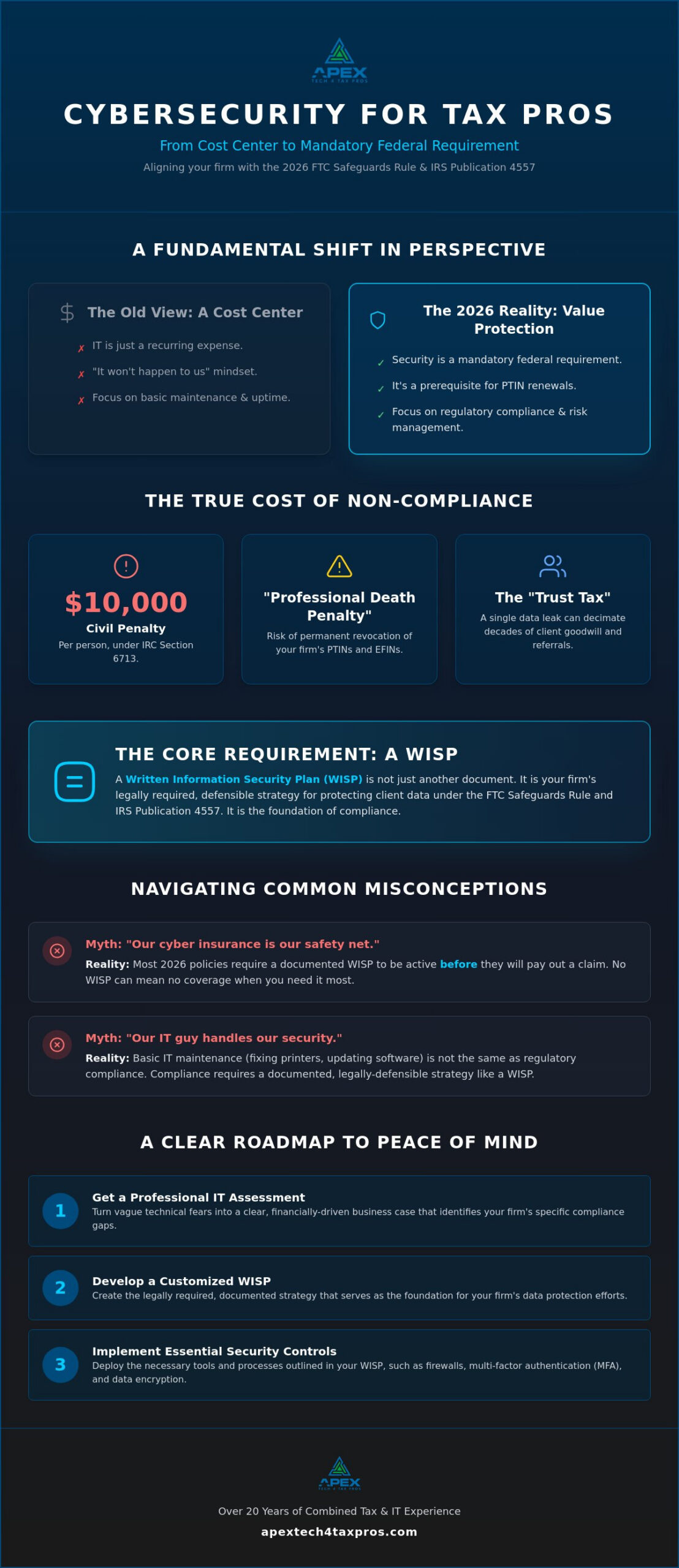
Most partners view the IT budget through a narrow lens. They see a cost center, a recurring line item on the P&L that seems to grow every year without directly generating revenue. To understand how to convince partners to invest in cybersecurity, you have to pivot the discussion toward “Value Protection.” In the 2026 regulatory environment, security isn’t a luxury or a tech upgrade; it’s a mandatory prerequisite for maintaining your professional licensure and client trust.
Senior leadership often relies on the “Legacy Shield,” the comforting belief that because the firm hasn’t suffered a breach in twenty years, the current methods are sufficient. This is a statistical outlier, not a viable strategy. Relying on past luck in a world of evolving threats is dangerous. Utilizing a formal IT risk management framework helps translate these abstract technical fears into concrete business risks that partners can actually quantify and address. The core question for leadership has shifted from “What does this cost?” to “How do I protect my firm from federal non-compliance?”
Moving Beyond the ‘It Won’t Happen to Us’ Mindset
Hackers today are incredibly sophisticated. They use deepfake-based attacks and highly targeted phishing campaigns aimed specifically at tax preparers. They know you hold the “keys to the kingdom,” including social security numbers and sensitive financial records. Small and mid-sized firms are often the preferred “soft path” for criminals because they typically lack the robust defenses of larger institutions. It’s not a matter of if a firm is targeted, but how well it’s prepared when the attempt occurs.
The Difference Between IT Maintenance and Regulatory Compliance
There’s a massive gap between keeping your computers running and meeting IRS Publication 4557 standards. Basic IT maintenance ensures your software updates and your printer works. Regulatory compliance, however, requires a documented, defensible strategy. A firewall is just a tool, but a Written Information Security Plan (WISP) is the legally required strategy. If you’re looking for how to convince partners to invest in cybersecurity, start by showing them how an IT assessment reveals compliance gaps that a simple antivirus program can’t fix.
How do I translate technical risk into regulatory and financial reality for my partners?
When you’re sitting down with leadership, it’s helpful to discuss the “Professional Death Penalty.” A major breach doesn’t just mean a weekend of downtime; it can result in the permanent revocation of your PTINs and EFINs. The IRS and FTC have made it clear that cybersecurity isn’t optional for maintaining your professional standing. For a deeper look at these industry-specific responsibilities, the AICPA’s introduction to cybersecurity provides a solid foundation for understanding why these risks are now non-negotiable business threats.
The financial fallout of an incident reaches far beyond the initial recovery. You’ll likely face mandatory forensic audits, legal fees, and a “Trust Tax” that hits your referral network hard. While the cost of a Yearly Subscription is a predictable, manageable line item, the average cost of a breach for a local firm is often catastrophic. Part of how to convince partners to invest in cybersecurity is showing them the math on loss avoidance. One headline about a client data leak can decimate decades of goodwill in a single afternoon.
What is the true cost of non-compliance with the FTC Safeguards Rule?
For the 2026 filing season, the IRS has emphasized that civil penalties under IRC Section 6713 can reach $10,000 per person. Claiming you didn’t know about the rules isn’t a valid defense during an audit. Without a Written Information Security Plan (WISP) in place, your firm is effectively operating without a valid license in the eyes of federal regulators. Proactively closing these gaps is the only way to ensure your office stays on the right side of the law.
Why isn’t cyber insurance a substitute for actual security?
Many partners assume insurance will be their safety net. However, most 2026 policies require a documented WISP to be active before they’ll pay out a single cent on a claim. You can actually reduce firm overhead by implementing Cybersecurity Awareness Training, as many carriers offer premium discounts for firms that educate their staff. If you’re ready to move toward secure compliance, it’s a good idea to start with a professional assessment to see where you truly stand.
What are the steps to presenting a compelling cybersecurity case to leadership?
Success in this conversation requires moving away from technical jargon and focusing on business outcomes. If you’re trying to figure out how to convince partners to invest in cybersecurity, you need to present a plan that feels like a solution to a problem they already have. We recommend a structured four-step approach that turns abstract risks into a clear, actionable business decision.
- Step 1: Get the facts. Start by conducting a Professional IT Assessment. This provides an objective look at your firm’s current gaps, moving the discussion from “I think we need this” to “Here is where we are vulnerable.”
- Step 2: Focus on the human element. Connect the investment to the relief of a lighter burden during the high-stress tax season. Partners want to know that a tech glitch or a data scare won’t derail their busiest months.
- Step 3: Rebrand the WISP. Present the Written Information Security Plan as a mandatory compliance document, similar to an engagement letter or a tax return. It’s a business asset required for your license to practice.
- Step 4: Provide budget flexibility. Offer a choice between a Seasonal subscription ($649.99) or a Yearly subscription ($1,099.99). Both include a free customized WISP, making it easy for partners to choose a path that fits the firm’s cash flow.
How can I frame cybersecurity as a competitive advantage for our clients?
High-net-worth clients are increasingly concerned about their data privacy. You can show partners how to market the firm’s “Secure Office” status as a premium feature. Utilizing a Secure Virtual Desktop allows your team to work from anywhere without the risk of sensitive data ever leaving a protected environment. This doesn’t just satisfy regulators; it builds a level of trust that keeps clients coming back year after year.
How do I use the IRS checklist to gain partner buy-in?
Sometimes the most effective tool is a simple gap analysis. Walk your partners through the specific requirements of IRS Publication 4557 to show what’s currently missing. The FTC guidance on cybersecurity reinforces that these aren’t just suggestions; they’re the baseline for any financial institution. Positioning the WISP as the “relief from the burden” of regulatory anxiety helps partners see the value in staying proactive. If you’re ready to start this conversation with data, you can book your assessment here.
How does Apex Tech 4 Tax Pros simplify compliance for my partners?
We bridge the gap between technical complexity and the daily reality of running a tax office. Our Dallas-based team brings over 20 years of combined tax and IT experience to your firm. This “knowledgeable colleague” approach ensures that we don’t just talk about bits and bytes; we talk about your EFIN, your PTIN, and your seasonal workflow. When you’re figuring out how to convince partners to invest in cybersecurity, having a partner who understands your specific industry makes the business case much more relatable to leadership.
We provide a sense of relief by acting as a specialized extension of your firm. Instead of your partners having to become experts in federal data regulations, we handle the heavy lifting of risk assessments and training. Our goal is to move your firm from a state of potential vulnerability to a state of secure compliance without disrupting your billable hours. We speak both tax and IT fluently, which helps translate technical needs into the professional language your leadership team trusts.
How does a customized WISP create a turnkey solution for our office?
Our Yearly subscription ($1,099.99) is designed to take the guesswork out of federal mandates. It includes a free, fully Customized WISP Template that aligns with IRS Publication 4557 and 5708. Our heritage with our sister company, APEX Tax Solutions, means we’ve already vetted these security processes in a real-world tax environment. We turn a complex legal requirement into a turnkey business asset that secures your firm’s future and protects your professional standing.
What is the first step to gathering the objective data my partners require?
The most effective way to start is with an IT Assessment. This isn’t a high-pressure sales pitch; it’s a professional diagnostic that provides the objective data your partners need to make an informed decision. Proactive compliance is always more affordable than reactive breach recovery. We invite you to book your assessment today or reach out to info@at4tp.com to see how we can support your firm’s specific needs.
Securing Your Firm’s License to Practice
Transitioning your firm from a state of vulnerability to secure compliance doesn’t have to be a technical battle. By reframing cybersecurity as a mandatory regulatory asset rather than a discretionary expense, you protect your professional standing and the trust of your clients. You’ve seen how the 2026 regulatory landscape demands a documented Written Information Security Plan (WISP) and how the risk of losing your PTIN is a reality no partner should ignore.
Understanding how to convince partners to invest in cybersecurity is about presenting objective data and clear, IRS-compliant solutions. With over 20 years of combined tax and IT expertise, we provide the tools needed to satisfy IRS Publication 4557 and the FTC Safeguards Rule. Our solutions are trusted by independent tax preparers nationwide, ensuring your office remains resilient against modern threats. Book a WISP Assessment today to secure your firm’s future. Taking this first step is the best way to ensure your firm is protected for the upcoming tax season and beyond.
Frequently Asked Questions
How do I explain the ROI of cybersecurity to a partner who only sees costs?
The ROI of cybersecurity in a tax firm is measured through loss avoidance and the preservation of your reputation. Providing a roadmap on how to convince partners to invest in cybersecurity involves shifting the focus from revenue gains to protecting the revenue you already have. A single data breach can cost a small firm hundreds of thousands in forensic fees and legal expenses. By securing your systems, you’re ensuring the business remains operational during the peak of tax season.
Is a WISP really mandatory for a small tax office with only two employees?
Yes, a Written Information Security Plan is mandatory for every tax professional, regardless of your firm’s size. IRS Publication 4557 doesn’t have a minimum employee count for compliance. The IRS and FTC regulations apply to all “financial institutions,” which includes anyone in the business of preparing tax returns. Having this document isn’t just a best practice; it’s a baseline requirement for your annual PTIN renewal and your legal right to handle taxpayer data.
What are the specific IRS penalties for not having a security plan in 2026?
For the 2026 filing season, the IRS has the authority to levy significant civil penalties under IRC Section 6713. If a data breach occurs and it’s discovered you lacked a WISP, the maximum annual civil penalty is $10,000 per person. These fines are designed to ensure compliance with federal data protection standards. Beyond the financial sting, non-compliance can lead to the suspension of your EFIN, which would effectively shut down your practice.
Can we just use a free WISP template instead of a professional service?
While a free template provides a basic outline, it often fails to meet the “customized” requirement mandated by the FTC Safeguards Rule. A professional service ensures that the plan actually reflects your firm’s specific hardware, software, and staff workflows. If you’re looking for how to convince partners to invest in cybersecurity, remind them that a generic document won’t hold up during a regulatory audit. A professional WISP is a living strategy, not a static piece of paper.
How does cybersecurity investment affect our professional liability insurance?
Investing in robust cybersecurity directly impacts your firm’s insurability and your premium costs. Many professional liability and cyber insurance carriers now require proof of a WISP and multi-factor authentication before they’ll issue a policy. Firms that demonstrate active compliance and staff training can see a 30 to 50 percent reduction in their premiums. Having these controls in place ensures your carrier won’t deny a claim based on a failure to maintain reasonable security standards.
What happens if our firm is audited by the IRS and we don’t have a WISP?
If the IRS audits your firm and you can’t produce a current WISP, you’ll face immediate regulatory scrutiny. The auditor will check for the “Security Six” controls as outlined in Publication 4557. Failing this check can lead to fines, the loss of your electronic filing privileges, and a mandatory reporting requirement to the FTC. It’s much easier to present a professional, customized plan upfront than to deal with the fallout of being labeled a non-compliant firm.