
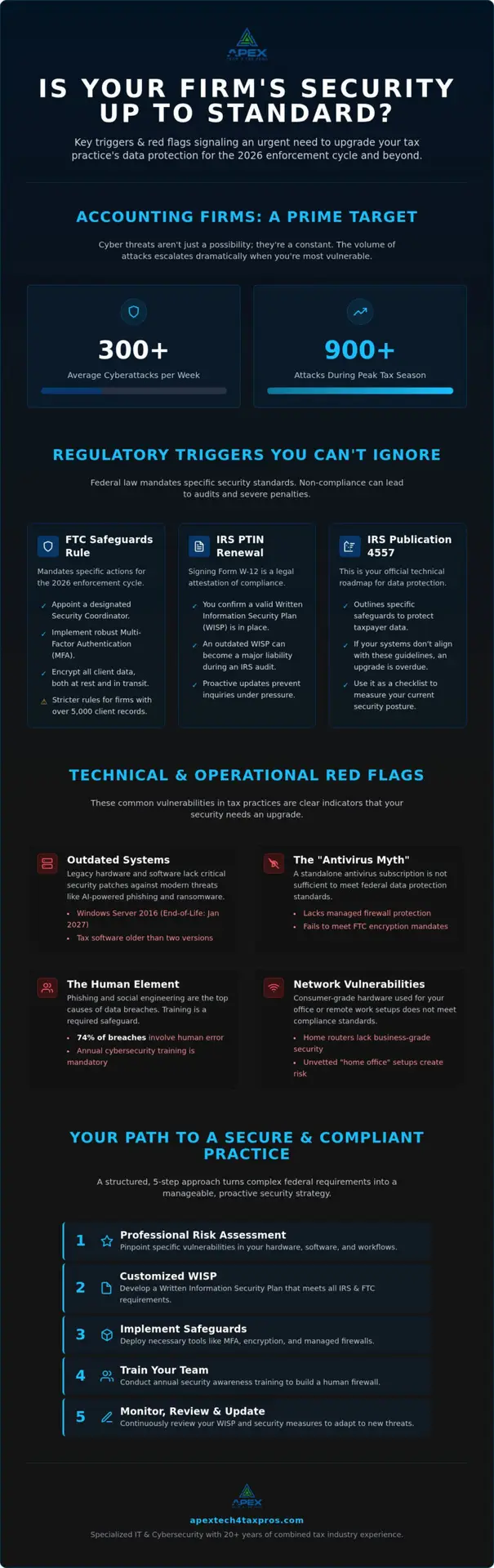
Did you know that accounting firms now face an average of 300 cyberattacks every single week? That number often spikes to over 900 during the height of tax season. Knowing when to upgrade your accounting firm’s security isn’t just about better software; it’s a legal necessity triggered by reaching 5,000 client records, the end of life for systems like Windows Server 2016, or new state privacy laws in places like Texas. If your current Written Information Security Plan (WISP) hasn’t been updated to reflect the 2026 FTC Safeguards Rule enforcement cycle, you’re likely already due for an evolution.
We understand that deciphering federal jargon feels like a full time job you didn’t sign up for. It’s frustrating to balance client deadlines with the fear of an IRS non-compliance penalty. This guide promises to clarify those technical and regulatory triggers so you can maintain a compliant WISP and enjoy true peace of mind. We’ll walk through the specific benchmarks that signal it’s time to move from a reactive posture to a proactive, secure environment that protects both your reputation and your bottom line.
Key Takeaways
- Identify the specific federal benchmarks, such as the 2026 FTC Safeguards Rule enforcement cycle, that signal exactly when to upgrade your accounting firm’s security to remain compliant.
- Move beyond the “antivirus myth” by recognizing why legacy hardware and standalone software are insufficient for modern IRS data protection standards.
- Learn how to use a professional risk assessment to pinpoint vulnerabilities before they lead to an audit or a reported data breach.
- Simplify your compliance journey with a 5-step implementation plan that centers on a customized Written Information Security Plan (WISP).
- Discover the value of partnering with specialized experts who bring over 20 years of combined tax and IT experience to your firm’s growth.
Recognizing the Regulatory Triggers for a Security Upgrade
The days of “set it and forget it” for office technology are officially over. In the current regulatory environment, understanding exactly when to upgrade your accounting firm’s security is a matter of legal survival. As we enter the 2026 enforcement cycle, the Federal Trade Commission (FTC) has made it clear that passive security measures are no longer acceptable. While you might consider a faster processor an optional luxury, updating your encryption protocols is a mandatory requirement under federal law. We see these regulations not as obstacles, but as a protective shield for the practice you’ve worked hard to build.
The most significant trigger for an upgrade often arrives during your annual PTIN renewal. When you sign Form W-12, you aren’t just renewing a number; you’re attesting to the IRS that you have a Written Information Security Plan (WISP) in place. If your plan hasn’t been reviewed to account for recent changes in the Information Security Audit standards, that attestation could become a liability during an IRS audit. This isn’t about fear; it’s about the relief that comes from knowing your firm meets the benchmarks set by the IRS and FTC. It’s much easier to upgrade on your own terms than under the pressure of a federal inquiry.
How do I comply with the FTC Safeguards Rule in 2026?
Compliance requires more than just installing software. You must appoint a designated security coordinator, implement robust multi-factor authentication (MFA) across all platforms, and ensure all client data is encrypted at rest and in transit. For firms handling more than 5,000 consumer records, these requirements are even stricter. We view these mandates as a framework for protection rather than a hurdle. By documenting these steps, you turn a complex federal burden into a structured, manageable process that protects your clients’ sensitive information.
The Role of IRS Publication 4557 in Your Upgrade Strategy
IRS Publication 4557 serves as your technical roadmap. It outlines the specific safeguards needed to protect taxpayer information from unauthorized access. If your current systems don’t align with these guidelines, it’s a clear signal that an upgrade is overdue. You can start by reviewing the WISP IRS Requirements to see how your current documentation measures up against the latest 2026 standards. This proactive approach ensures you’re never caught off guard during tax season.
Technical and Operational Red Flags in Your Tax Practice
Identifying technical debt is the first step toward securing your firm’s future. If your practice is still running Windows Server 2016 for software like QuickBooks or Sage, you’re facing a hard deadline. That system reaches its end of life in January 2027. Relying on outdated operating systems or tax software older than two years is a primary indicator of when to upgrade your accounting firm’s security. These legacy systems lack the modern patches required to defend against AI powered phishing and sophisticated ransomware attacks.
Many tax professionals fall for the “Antivirus Myth,” believing that a standard software subscription is enough. It isn’t. Standalone software cannot replace a managed firewall or the robust encryption standards mandated by the FTC Safeguards Rule. Operational gaps, such as using consumer grade routers for remote work, also create significant vulnerabilities. If your “home office” setup hasn’t been vetted against IRS Publication 4557 and 5708 benchmarks, you’re likely operating outside of federal compliance. If you’re unsure where your practice stands, a professional IT assessment can provide the clarity you need.
Is Your Staff Your Weakest Link?
Recent data shows that 74% of all data breaches involve a human element. Phishing attempts have become incredibly realistic, often mimicking legitimate tax software portals. This is why Cybersecurity Awareness Training is now a required annual upgrade rather than a one-time task. Keeping your team educated on deepfake audio and malicious document links is the only way to build a human firewall around your client data.
Hardware and Network Vulnerabilities
Your network hardware should be as professional as your tax advice. If you’re using the same router for your office that you’d use for a home gaming setup, it’s time for a change. A Secure Office Network requires enterprise grade equipment that can handle encrypted data at rest and in transit. Signs of trouble include frequent connection drops, slow software performance, or a lack of administrative control over who accesses your Wi-Fi.
How to Implement a Seamless Security Upgrade in 5 Steps
Implementing a security overhaul doesn’t have to disrupt your workflow or your client relationships. By following a structured timeline, you can move from vulnerability to compliance without the typical tax season stress. The first step is always a professional risk assessment, which is a legal requirement under the Safeguards Rule. This process creates a baseline for your practice, helping you decide exactly when to upgrade your accounting firm’s security based on real data rather than guesswork. You can use resources like the AICPA’s cybersecurity checklist to help organize your initial thoughts, but a professional eye ensures no technical gaps are missed.
Once you have your assessment, move through these critical implementation stages to ensure your firm is protected:
- Develop a Customized WISP: Shift from a generic document to a plan that reflects your actual office layout and specific software stack.
- Technical Deployment: Active multi-factor authentication on every login and automated, encrypted cloud backups are your primary lines of defense.
- Team Education: Turn your staff into a human firewall by walking them through new protocols and phishing red flags.
- Annual Maintenance: Schedule a review for next year to account for any new IRS or state level regulatory changes that might impact your practice.
Conducting an IT Assessment Without the Stress
We believe compliance should feel like a relief, not a burden. An IT assessment isn’t an interrogation of your past choices; it’s a peer-to-peer collaboration to protect your future. We’re in this together. Our goal is to identify exactly where your current systems might fall short of 2026 standards so you can upgrade with confidence and clarity.
Building Your WISP: Template vs. Customized
While a generic download might seem like a quick fix, it often fails to meet the specific IRS Publication 5708 standards required for a successful audit. A Custom WISP Template is superior because it’s specifically engineered for the tax niche. It documents your unique technical controls and administrative safeguards, ensuring your firm is fully protected under federal law. If you’re ready to secure your practice, book a WISP assessment today to get started on your path to compliance.
Choosing the Right Security Partner for Your Firm’s Growth
General IT providers are excellent at troubleshooting printers or setting up email accounts, but they often lack the specialized knowledge required for tax specific compliance. When you’re deciding when to upgrade your accounting firm’s security, you need a partner who understands the difference between a standard data backup and the specific documentation requirements of IRS Publication 4557. We bring over 20 years of combined experience in both the tax industry and information technology, allowing us to bridge the gap between technical infrastructure and federal mandates.
One of the most efficient ways to handle a security evolution is through a Secure Virtual Desktop. This solution can solve the problem of aging hardware instantly, providing a compliant, encrypted environment without the need for a massive capital investment in new office servers. Our goal is to offer a “relief from the burden” approach. We want you to focus on your clients and your growth while we handle the complexities of the IRS and FTC Safeguards Rule.
Apex Tech 4 Tax Pros: Built by Pros, for Pros
We’ve designed our services to fit the unique rhythm of the tax year. Our Seasonal subscription ($649.99) and Yearly subscription ($1,099.99) both include a free customized WISP, ensuring you have the foundational documentation needed for your PTIN renewal. As a Dallas based firm, we’re deeply committed to the success of independent preparers and CPAs. For those who need holistic practice support beyond technology, we often cross reference our sister company, APEX Tax Solutions, to ensure your business is supported from every angle.
Your Next Steps Toward Compliance
The path to peace of mind is straightforward. It begins with a professional assessment to identify your specific needs, followed by the implementation of a customized WISP. We provide full bilingual support to serve our diverse community of tax professionals. If you’re ready to move from vulnerability to secure compliance, we invite you to book a WISP Assessment or email us at info@at4tp.com. Let’s work together to ensure your firm is ready for the 2026 tax season and beyond.
Secure Your Practice for the 2026 Tax Season
Determining when to upgrade your accounting firm’s security doesn’t have to be a source of anxiety; it’s a strategic move to build a more resilient practice. By recognizing regulatory triggers like the 2026 FTC Safeguards Rule updates and technical red flags like legacy software, you can stay ahead of the curve. We understand that your time is best spent with clients, not deciphering federal jargon. Whether you’re looking for Secure Virtual Desktop solutions or need a plan that meets IRS Publication 4557 and 5708 standards, we’re here to help.
With over 20 years of combined tax and IT experience, we specialize in turning complex federal requirements into a structured path toward peace of mind. Book a WISP Assessment with our expert team today or email info@at4tp.com to get started. Our bilingual team is ready to provide the professional reassurance you need to navigate this tax season with confidence. You’ve worked hard to build your practice, and we’re dedicated to helping you protect it so you can focus on your firm’s growth.
Frequently Asked Questions
What is the difference between a WISP and the FTC Safeguards Rule?
The FTC Safeguards Rule is the federal regulation that governs how financial institutions protect client data, while the Written Information Security Plan (WISP) is the actual document that describes your firm’s specific compliance strategy. You can think of the Rule as the law itself and the WISP as your internal manual for following that law. Both are essential for maintaining your standing with the IRS and protecting your professional reputation.
How often am I required to update my firm’s security plan according to the IRS?
You’re required to update your security plan annually or whenever your business undergoes a major technical or operational change. The IRS expects this regular maintenance to ensure your safeguards stay relevant against evolving cyber threats. Regular updates also allow you to confidently attest to your compliance on Form W-12 during your yearly PTIN renewal process, providing you with much-needed peace of mind during the busy season.
Does a small, one-person tax office really need a full security upgrade?
Yes, even a solo tax preparer must have a WISP because the IRS mandate applies to everyone with a Preparer Tax Identification Number (PTIN). While firms managing data for fewer than 5,000 consumers are exempt from a few specific administrative requirements, the core obligation to protect taxpayer information remains. Small offices are often targeted because attackers assume their security is weaker, making a robust, updated plan even more critical for your survival.
What are the specific penalties for not having a WISP in 2026?
Failing to maintain a WISP can result in the FTC imposing penalties of up to $50,120 per violation as of 2025. In addition to these heavy fines, the IRS can revoke your EFIN or PTIN, which would prevent you from filing returns for your clients. These consequences are designed to ensure that every firm takes the protection of sensitive financial data as seriously as the accuracy of the tax returns themselves.
Can I use a free WISP template for my accounting firm’s security upgrade?
You can use a free template as a starting point, but it’s rarely enough to meet the specific documentation requirements of a modern IRS audit. Deciding when to upgrade your accounting firm’s security often means moving to a customized plan that details your specific encryption, MFA protocols, and vendor management. A professional upgrade ensures your WISP is a living document that actually protects your practice rather than just a checked box on a form.