
Title Tag: Implement a WISP in a Small Accounting Firm: 2026 Guide
Key Takeaways
- Understand the critical legal link between the FTC Safeguards Rule and IRS Publication 4557 to ensure your practice meets all 2026 federal mandates.
- Discover how to implement a wisp in a small accounting firm using a practical, five-step framework that prioritizes security without the technical overwhelm.
- Identify the six essential components of a compliant plan, including the role of a designated “Qualified Individual” and the necessity of a formal risk assessment.
- Learn why annual WISP reviews are vital for defending against modern threats like AI-driven phishing and maintaining your PTIN renewal eligibility.
- Recognize the difference between generic templates and a customized security roadmap that offers long-term relief from regulatory burdens.
What Is a WISP and Why Is It Mandatory for Small Firms?
A Written Information Security Plan (WISP) is much more than a compliance checkbox. It’s a comprehensive document that details how your firm protects sensitive taxpayer data through specific administrative, technical, and physical safeguards. For small practices, this is the operational manual for your security culture. It’s essential to understand that a custom WISP isn’t a generic template; it’s a tailored roadmap that reflects your unique office environment and technology stack.
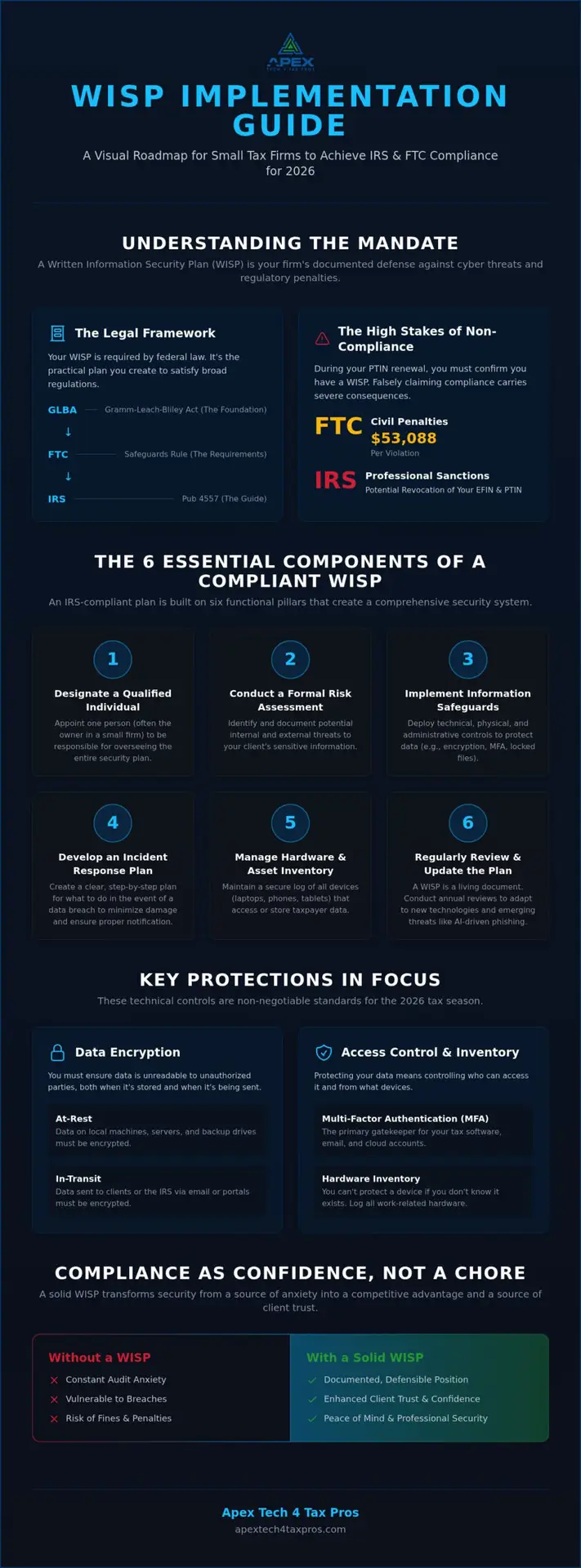
Federal law makes this document mandatory for every tax professional. The Gramm-Leach-Bliley Act (GLBA) provides the legal foundation, while the FTC Safeguards Rule establishes the specific requirements you must follow. IRS Publication 4557 serves as your primary guide for meeting these standards. When you’re looking at how to implement a wisp in a small accounting firm, you’re essentially building a bridge between these federal regulations and your daily workflows.
The stakes are high for the 2026 tax season. During your PTIN renewal, the IRS asks if you have a WISP in place. Checking “yes” without a physical, documented plan is a significant liability that could lead to the revocation of your EFIN or civil penalties of up to $53,088 per violation from the FTC. Having a plan on paper is the only way to protect your professional standing.
How do I comply with the FTC Safeguards Rule?
Compliance starts with designating a “Qualified Individual” to oversee your program. This doesn’t have to be a high-end IT consultant; in many small firms, it’s the owner or a senior staff member. Your WISP is the specific plan you write to satisfy the broader Safeguards Rule. This process relies on foundational Information security principles like confidentiality and integrity to ensure every piece of client data remains locked down and encrypted.
The ‘Relief from Burden’ approach to compliance
We see compliance as a way to trade anxiety for confidence. Instead of dreading a potential IRS audit or a data breach, a solid WISP gives you a documented defense. It transforms security from a technical chore into a competitive advantage. When you can tell your clients exactly how you protect their family’s financial future, you build a level of trust that generic practices simply can’t match. It’s about feeling secure in your own office.
The 6 Essential Components of an IRS-Compliant Security Plan
When we look at the architecture of a secure office, we lean on our 20 years of combined tax and IT experience right here in Dallas. Understanding this framework is key to knowing how to implement a wisp in a small accounting firm without getting lost in technical jargon. The IRS doesn’t just want a signed paper; they want a functional system that follows specific IRS data security plan requirements.
The first four components of your plan create the foundation. You’ll need a designated employee to run the show and a formal risk assessment that looks at both internal and external threats. From there, you implement specific information safeguards and an incident response plan. This response plan is your firm’s safety net, ensuring you know exactly what to do if a breach occurs.
How do I manage data encryption and access control in 2026?
Encryption is a non-negotiable standard for the 2026 tax season. You’ve got to ensure data is encrypted both at-rest on your local machines and in-transit when sending files to clients. Multi-Factor Authentication (MFA) is the primary gatekeeper for your accounting software and email accounts. If the technical setup feels like a distraction from your client meetings, you can learn more about our Secure Virtual Desktop solutions which automate these protections for you.
How should a small firm handle hardware inventory and asset management?
You can’t protect a device if you don’t know it’s being used for work. Every laptop, phone, and tablet that touches taxpayer data needs to be on your inventory list. For a small office, you don’t need expensive software; a simple, secure log with serial numbers and assigned staff members works perfectly. This simple habit makes your annual review much easier. If you’re unsure where to start with your inventory, booking a WISP Assessment is a great way to identify exactly what hardware needs to be secured.
Los 6 Componentes Esenciales de un Plan de Seguridad que Cumple con el IRS
Cuando analizamos la arquitectura de una oficina segura, nos apoyamos en nuestros 20 años de experiencia combinada en impuestos y tecnología aquí en Dallas. Comprender este marco de trabajo es clave para saber cómo implementar un WISP en una pequeña firma de contabilidad sin perderse en el lenguaje técnico. El IRS no solo quiere un papel firmado; quieren un sistema funcional que siga los requisitos específicos de seguridad de datos del IRS.
Los primeros cuatro componentes de su plan crean la base. Necesitará un empleado designado para dirigir el programa y una evaluación de riesgos formal que analice las amenazas internas y externas. A partir de ahí, implementa salvaguardas de información específicas y un plan de respuesta a incidentes. Este plan de respuesta es la red de seguridad de su firma, lo que garantiza que sepa exactamente qué hacer si ocurre una brecha.
¿Cómo gestiono el cifrado de datos y el control de acceso en 2026?
El cifrado es un estándar no negociable para la temporada de impuestos de 2026. Debe asegurarse de que los datos estén cifrados tanto en reposo en sus máquinas locales como en tránsito al enviar archivos a los clientes. La autenticación de múltiples factores (MFA) es ahora el guardián principal para su software de contabilidad y cuentas de correo electrónico. Si la configuración técnica le distrae de sus reuniones con clientes, puede obtener más información sobre nuestras soluciones de Escritorio Virtual Seguro que automatizan estas protecciones por usted.
¿Cómo debe manejar una pequeña firma el inventario de hardware y la gestión de activos?
No puede proteger un dispositivo si no sabe que se está utilizando para el trabajo. Cada computadora portátil, teléfono y tableta que toque los datos de los contribuyentes debe estar en su lista de inventario. Para una oficina pequeña, no necesita un software costoso; un registro simple y seguro con números de serie y miembros del personal asignados funciona perfectamente. Este hábito sencillo facilita mucho su revisión anual. Si no está seguro de por dónde empezar con su inventario, reservar una evaluación de WISP es una excelente manera de identificar exactamente qué hardware debe protegerse.
How to Implement a WISP in 5 Practical Steps for Small Practices
Moving from theory to practice, let’s look at how to implement a wisp in a small accounting firm through a manageable, five-step process. Compliance doesn’t have to be a mystery. By following this structured path, you transform a vague regulatory requirement into a concrete operational strength for your practice.
- Step 1: Designate your Qualified Individual. Every firm must name a coordinator to oversee the program. Even if you’re a solo practitioner, you are the person responsible for the FTC Safeguards Rule requirements in your office.
- Step 2: Conduct an IT Assessment. You need a baseline of your current security posture. Conducting a thorough IT Assessment allows you to find gaps in your encryption or hardware tracking before they become liabilities.
- Step 3: Customize your document. Use IRS Pub 5708 as a foundational template. Avoid the temptation to just sign a generic form. You must tailor the language to reflect how your specific firm handles data.
- Step 4: Implement technical controls. This is where you activate Multi-Factor Authentication (MFA), configure your firewalls, and ensure your secure cloud backups are running daily.
- Step 5: Review and Update. A WISP is a living document. You must revisit it annually or whenever you change your software or add new staff members.
Conducting a meaningful Risk Assessment
A risk assessment is more than a checklist; it’s an honest look at your vulnerabilities. Identify exactly where your client data lives. Is it sitting in unencrypted email folders or on a local drive that isn’t backed up? You should test these safeguards annually to ensure they still stand up to evolving 2026 threats. This proactive testing provides a sense of relief, knowing your defenses are actually working.
Employee Training and Security Culture
Your WISP is only as strong as the person with the keyboard. Phishing and social engineering remain the top methods for data breaches in accounting firms. Explore our Cybersecurity Awareness Training to ensure your staff can spot a deepfake or a fraudulent email before it’s too late. Building this culture of vigilance is the final piece of the compliance puzzle.
Ready to secure your firm before the next tax season? Book a WISP Assessment today to see where you stand.
Maintaining Compliance: Annual Reviews and Professional Support
Creating your initial document is just the start of the journey. Learning how to implement a wisp in a small accounting firm also means committing to a methodical annual review process. Technology moves fast, and your 2026 plan must account for the latest software updates and any new hires who joined your team since the last tax season. If you’ve switched your tax software or moved more data to the cloud, your WISP needs to reflect those changes immediately to remain valid under the FTC Safeguards Rule.
Many owners feel overwhelmed by the technical maintenance required to stay compliant. This is where our Seasonal ($649.99) and Yearly ($1,099.99) subscriptions offer a path to genuine relief. These plans don’t just provide a document; they offer ongoing support and a free customized WISP that evolves with your practice. By offloading this burden to a specialized partner, you can focus on your clients while we handle the regulatory heavy lifting and technical documentation.
Templates vs. Professional WISP Solutions
A generic “free template” often creates a false sense of security that can backfire during an inspection. If the procedures in your document don’t match your actual office workflows, an auditor might view the plan as non-existent. Choosing a Custom WISP Template serves as the ideal middle ground for small firms. It provides a professional framework you can actually follow without the high costs of a dedicated IT department.
Preparing for an IRS Security Audit
If the IRS or FTC conducts a review, they’ll ask for specific evidence of your security program. You’ll need to produce your written plan, your hardware inventory, and your risk assessment results. A timestamped, reviewed WISP is your best defense against unintentional non-compliance. When you understand how to implement a wisp in a small accounting firm correctly, you aren’t just checking a box; you’re building a legal shield. Showing that you’ve consistently updated your plan demonstrates a culture of vigilance that protects both your clients and your professional license.
Secure Your Practice for the 2026 Tax Season
Securing your firm’s future doesn’t have to be a source of stress. By now, you understand that a WISP is more than just a legal requirement; it’s a strategic roadmap that protects your professional reputation and your clients’ most sensitive data. We’ve covered the essential components, from designating a coordinator to performing deep-dive risk assessments. Learning how to implement a wisp in a small accounting firm is ultimately about shifting from a state of vulnerability to a position of strength.
Our team brings over 20 years of combined tax and IT expertise to help you bridge this gap. We’re trusted by independent tax offices nationwide to turn complex regulations into simple, actionable steps. Whether you choose our Seasonal or Yearly subscriptions, you’ll receive a free customized WISP that fits your specific needs. This allows you to offload the technical overwhelm and focus on what you do best.
Take the first step toward a worry-free tax season. Book a WISP Assessment with our expert team today and feel the relief that comes with true compliance. You’ve got the tools and the plan; now it’s time to put them into action.
Frequently Asked Questions
Is a WISP required for solo tax preparers with no employees?
Yes, a WISP is mandatory for every professional tax preparer, including solo practitioners with no employees. Federal law under the FTC Safeguards Rule makes no exceptions based on firm size or client volume. If you have a PTIN and handle taxpayer information, you must have a documented plan in place to protect that data from unauthorized access.
What is the penalty for not having a WISP in 2026?
Non-compliance in 2026 carries heavy financial and professional consequences. The FTC can levy civil penalties of up to $53,088 per violation, per day. Additionally, the IRS may revoke your Electronic Filing Identification Number (EFIN) or your PTIN, which effectively shuts down your ability to file returns and run your business.
Can I just use a free WISP template from the IRS website?
You can use IRS Publication 5708 as a starting point, but you shouldn’t rely on it as a finished product. A generic template doesn’t account for your specific office software, hardware inventory, or unique workflows. Learning how to implement a wisp in a small accounting firm correctly requires tailoring the document to reflect your actual security practices and controls.
How often do I need to update my Written Information Security Plan?
You must review and update your Written Information Security Plan at least once a year. However, you should also update it immediately whenever your business undergoes significant changes. This includes hiring new staff, implementing new tax software, or adopting new hardware like tablets or remote servers to ensure your safeguards remain effective against modern threats.
What is the difference between IRS Publication 4557 and Publication 5708?
IRS Publication 4557 provides the broad foundational guidance and standards for safeguarding taxpayer data. In contrast, Publication 5708 is a specific, step-by-step guide designed to help you create the actual WISP document. Think of 4557 as the “what” and “why” of security, while 5708 provides the “how” for your written plan.
Does a WISP cover my remote employees or contractors?
Yes, your WISP must explicitly cover every individual who has access to sensitive client information, including remote employees and independent contractors. Your plan should detail the specific security protocols these workers must follow, such as using Multi-Factor Authentication and encrypted connections, to ensure data stays protected regardless of where the work is performed.