
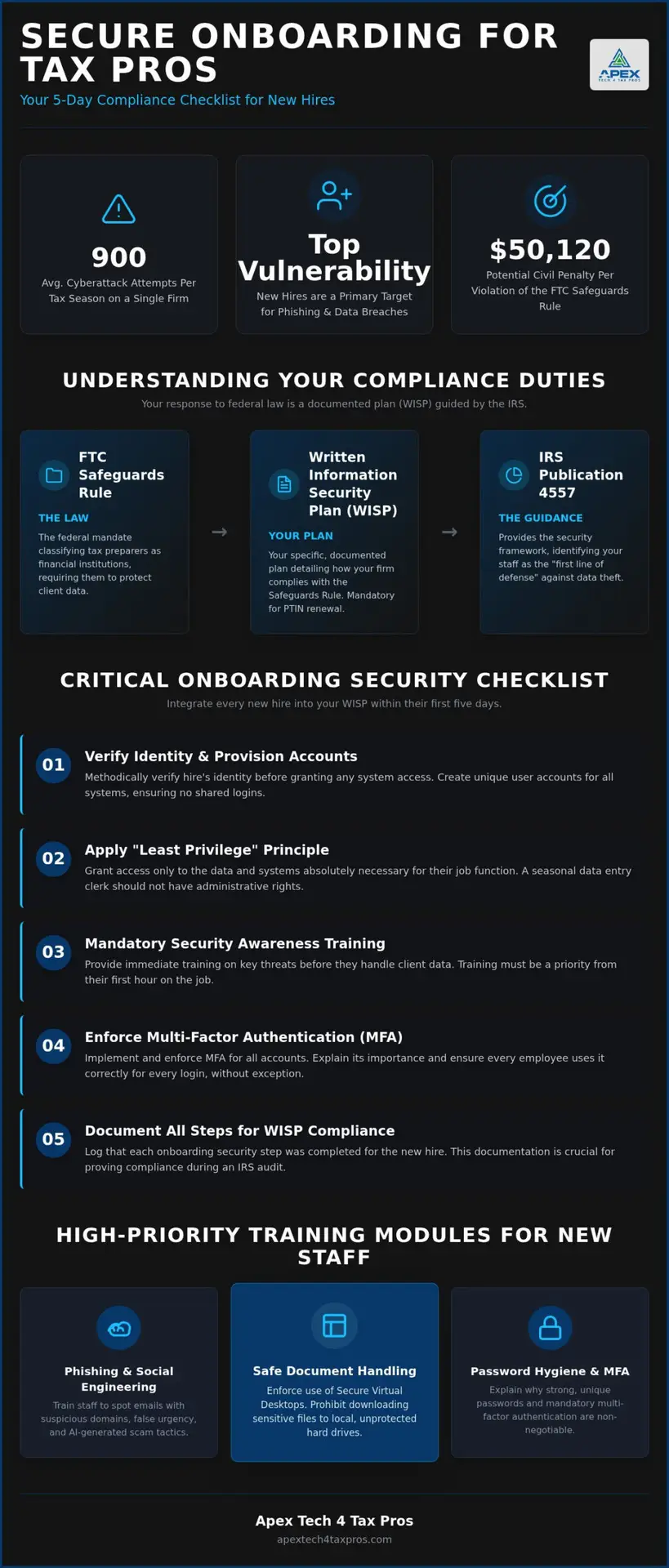
Accounting firms face an average of 900 cyberattack attempts during a single tax season, and often, a new hire is the most vulnerable link. When you’re busy scaling your team, onboarding new employees to your security plan can feel like a technical burden rather than a priority. To ensure compliance, you must immediately integrate every hire into your Written Information Security Plan (WISP) by implementing multi-factor authentication, data encryption, and security awareness training within their first five days. This proactive approach satisfies the FTC Safeguards Rule and protects your firm from civil penalties that can reach $50,120 per violation.
We know how overwhelming it feels to balance IRS Publication 4557 requirements with a ticking clock during peak season. You deserve to feel confident that your staff won’t accidentally compromise sensitive data or fall for an AI-generated phishing scam. This guide will show you how to create a repeatable onboarding process that turns mandatory compliance into a professional safety net. We’ll help you move past the technical jargon so you can get back to serving your clients with total peace of mind.
Key Takeaways
- Learn how to align your hiring process with IRS Publication 4557 by applying the “least privilege” principle to all new staff accounts.
- Master the specific cybersecurity training requirements mandated by the FTC Safeguards Rule to ensure your team can spot evolving phishing threats.
- Follow a practical, step-by-step checklist for onboarding new employees to your security plan, covering everything from identity verification to unique login provisioning.
- Discover how a customized WISP template automates your compliance documentation and provides a scalable framework for your firm’s growth.
- Transform mandatory security protocols into a repeatable professional safety net that protects your clients and provides you with lasting peace of mind.
Why Is Secure Onboarding Critical for IRS Publication 4557 Compliance?
Secure onboarding is the methodical process of verifying a new hire’s identity and granting system access based on the “least privilege” principle. This means a seasonal data entry clerk shouldn’t have the same administrative rights as your senior partner. By effectively managing the employee onboarding process, you ensure that every person entering your firm understands their role in protecting taxpayer data. IRS Publication 4557 explicitly identifies your staff as the first line of defense against identity theft. If they aren’t properly integrated into your security protocols from day one, your firm remains vulnerable to preventable breaches.
Successfully onboarding new employees to your security plan isn’t just a best practice; it’s a core component of your mandatory Written Information Security Plan (WISP). Think of it as moving from a state of reactive stress to proactive control. When you have a clear, documented system for new hires, you eliminate the “midnight panic” of wondering if a temporary staffer accidentally left a portal open or clicked a suspicious link. It turns compliance from a nagging checklist into a professional safety net for your entire team.
Understanding the Legal Mandates: WISP vs. Safeguards Rule
It’s helpful to distinguish between the law and your response to it. The FTC Safeguards Rule is the federal mandate that classifies tax preparers as financial institutions. Your Custom WISP is the specific document that proves how your firm complies with that law. Under these rules, you must designate a “Qualified Individual” to oversee these security measures, ensuring that every new hire is vetted and monitored according to your internal standards. This oversight ensures that onboarding new employees to your security plan is handled with professional precision rather than as an afterthought.
The Cost of Non-Compliance During the Hiring Phase
Skipping security steps during a busy hiring cycle carries heavy risks. As of January 2025, civil penalties for violating the FTC Safeguards Rule can reach $50,120 per violation. Additionally, the IRS now requires you to attest that you have a WISP in place during your annual PTIN renewal. Beyond the fines, CPAs have an ethical duty to protect client data. A breach during the onboarding phase doesn’t just hurt your wallet; it damages the trust you’ve spent years building with your clients.
What Are the Mandatory Security Training Requirements Under the FTC Safeguards Rule?
Compliance with the FTC Safeguards Rule involves more than just installing a firewall. It mandates that your firm provide regular and updated cybersecurity awareness training for every member of your team. When you’re onboarding new employees to your security plan, this training needs to be a priority from their first hour on the job. You can’t just hand them a manual and hope they read it; you must actively verify their understanding and document that the training took place to satisfy an IRS auditor.
We’ve found that a “knowledgeable colleague” approach works best. Instead of bombarding new hires with a dry list of technical “don’ts,” try making the training relatable. Explain that these protocols aren’t just red tape. They’re the tools we use to protect our clients’ livelihoods. When staff members see themselves as defenders of sensitive data rather than just data entry clerks, they’re far more likely to follow your protocols even when they’re time-crunched during peak season.
Key Training Modules for New Tax Staff
Your orientation should focus on the specific threats tax professionals face. High-priority modules include:
- Phishing and Social Engineering: Teach new hires how to spot an email that looks like it’s from the IRS but uses a suspicious domain or creates a false sense of urgency.
- Safe Document Handling: Discourage downloading files to local hard drives. Show them how to use Secure Virtual Desktops to keep sensitive data in a controlled cloud environment.
- Password Hygiene and MFA: Explain why multi-factor authentication is mandatory and how to use it correctly every time they log in.
NIST Guidance for Small Firm Training
NIST standards emphasize building a “culture of security” rather than treating compliance as a one-time checkmark. This means security should be a regular topic in your staff meetings. If building this curriculum feels like a burden, our Cyber Security Training can help you automate the most difficult parts of the process. Starting these habits on day one ensures your firm remains resilient even as cyberattacks on tax practices spike by 300% during the spring. You might find that a quick IT assessment is the best way to see where your current training plan needs a boost.
How Do I Create a Step-by-Step Security Onboarding Checklist for New Tax Staff?
A structured checklist transforms a chaotic hiring week into a disciplined security operation. When you’re onboarding new employees to your security plan, you can’t rely on memory alone. Start with identity verification and comprehensive background checks; this is essential for anyone who will handle sensitive Social Security Numbers or bank details. Once cleared, move to provisioning access by setting up unique user IDs for every piece of tax software. Never allow shared logins, as they destroy the audit trail required for compliance.
Your hardware assignment should include laptops equipped with full-disk encryption and remote-wipe capabilities. Finally, give the new hire a physical “tour” of your security plan. Show them exactly where the WISP document lives on your server or in the office. IRS Publication 4557 emphasizes that employees who understand the “why” behind security protocols are much more effective at following them.
Technical Setup: From Firewalls to Secure Portals
Every workstation used by a new hire must sit behind a Secure Office Network to prevent unauthorized intrusions. It’s vital to prohibit the use of personal USB drives or unencrypted personal email for any client business. These small gaps are often where data leaks begin. By standardizing the technical environment from day one, you ensure that onboarding new employees to your security plan isn’t just a lecture, but a built-in part of their daily workflow.
The First 48 Hours: A Security-First Schedule
The most critical rule for any tax office is that security training must happen before the first tax return is ever opened. Use those first 48 hours to establish habits like locking screens when walking away and using secure portals for document exchange. If you aren’t sure if your current setup is ready for a new team member, you can book an IT Assessment to verify your office infrastructure. This proactive step provides a relief from the burden of technical oversight during your busiest months.
How Can Professional WISP Management Simplify My Employee Onboarding Process?
Managing the security of a growing firm doesn’t have to be a manual chore. When you use a Custom WISP Template, you aren’t just getting a document; you’re getting a professional blueprint. It includes pre-written policies specifically designed for onboarding new employees to your security plan. This means you don’t have to spend hours drafting acceptable use policies or workstation standards from scratch. We’ve already done the heavy lifting by aligning these documents with the high standards of the IRS and FTC.
Partnering with a dedicated IT specialist allows you to automate the most complex parts of team expansion. Instead of worrying if you missed a step in Publication 4557, you can rely on a proven system that scales with your hiring needs. This turns compliance into a “set it and forget it” foundation for your firm’s growth, giving you the relief from the burden of constant technical oversight.
Seasonal vs. Yearly: Choosing the Right Support Level
Every tax office has different rhythms, and your security should reflect that. Our Seasonal Subscription ($649.99) is ideal for firms that scale up rapidly between January and April and need focused protection during the peak. If you run a year-round accounting practice, the Yearly Subscription ($1,099.99) offers comprehensive, ongoing security. Both options include a free customized WISP, ensuring that onboarding new employees to your security plan remains a seamless part of your firm’s expansion.
Leveraging 20 Years of Tax-IT Expertise
General IT firms often struggle to understand the nuances of tax-specific compliance. They might know how to manage a network, but they rarely understand the strict documentation requirements of the FTC Safeguards Rule. We bring over 20 years of combined tax and IT experience to the table. This deep specialization, coupled with our synergy with APEX Tax Solutions, allows us to offer a holistic approach to your business. We handle the technical complexities so you can focus on your clients.
Ready to simplify your compliance and protect your firm? Email us at info@at4tp.com or book a WISP assessment today to get started.
Secure Your Firm’s Growth with a Compliant Team
Integrating security into your hiring process is no longer just a recommendation; it’s a foundational requirement for any modern tax practice. By prioritizing the process of onboarding new employees to your security plan, you protect your clients’ sensitive data while meeting the strict mandates of IRS Publication 4557. You’ve seen how a structured approach, combining identity verification, unique access controls, and mandatory training, turns compliance from a stressful hurdle into a professional safety net. This methodical preparation ensures your firm remains resilient even during the most demanding months of the year.
You don’t have to navigate these complex technical requirements alone. With over 20 years of combined Tax and IT experience, we’re proud to be trusted by independent tax preparers nationwide. Every subscription includes a free customized WISP to ensure you have the specific documentation that IRS and FTC auditors require. Ready to simplify your firm’s compliance? Book a WISP Assessment today or email us at info@at4tp.com to start building a more secure office. Taking these steps today provides the lasting peace of mind that your practice and your clients deserve.
Frequently Asked Questions
Does the IRS require background checks for all new tax office employees?
While IRS Publication 4557 doesn’t explicitly mandate a specific type of background check for every hire, it strongly recommends vetting anyone who handles sensitive taxpayer information. The FTC Safeguards Rule requires you to implement procedures to verify the identity of your staff and assess the risks they might pose to your data. Performing these checks is a critical first step in protecting your firm’s professional integrity and ensuring you aren’t introducing unnecessary vulnerabilities into your office environment.
Can I let a seasonal employee use their personal laptop if they use a VPN?
Allowing personal devices, even with a VPN, is highly discouraged because it often fails to meet the encryption and remote-wipe standards required by the FTC Safeguards Rule. Personal laptops usually lack the centralized security management that a firm-owned device provides. If a seasonal hire’s personal computer is compromised by malware, a VPN won’t prevent that threat from reaching your network. It’s much safer to provide encrypted hardware that your firm fully controls and monitors.
What is the minimum cybersecurity training required by the FTC Safeguards Rule?
The FTC Safeguards Rule requires that your firm provide regular and updated cybersecurity awareness training to all employees. There isn’t a specific “hourly” minimum, but the training must be frequent enough to address evolving threats like AI-generated phishing and social engineering scams. NIST standards suggest that this training should occur at least annually, with supplemental updates whenever you introduce new software or when the threat landscape shifts significantly for tax professionals.
Do I need to update my WISP every time I hire a new person?
You don’t need to rewrite your entire WISP for every hire, but you must update your internal documentation as part of onboarding new employees to your security plan. This includes updating your access control logs, designating their specific user permissions, and recording their completion of mandatory security training. Your WISP should already contain the repeatable policy that governs how new staff members are integrated, so you’re simply following the plan you already have in place.
What happens if a new hire causes a data breach before they finish training?
If a breach occurs, your firm is legally responsible for the disclosure, regardless of the employee’s tenure or training status. As of January 2025, civil penalties for non-compliance with the FTC Safeguards Rule can reach $50,120 per violation. This is why we recommend that security training happens within the first 48 hours of employment. Ensuring that onboarding new employees to your security plan is completed before they access client files is the only way to effectively mitigate this risk.