
How to Build a Data Restoration Plan for Accountants to Meet 2026 IRS Standards
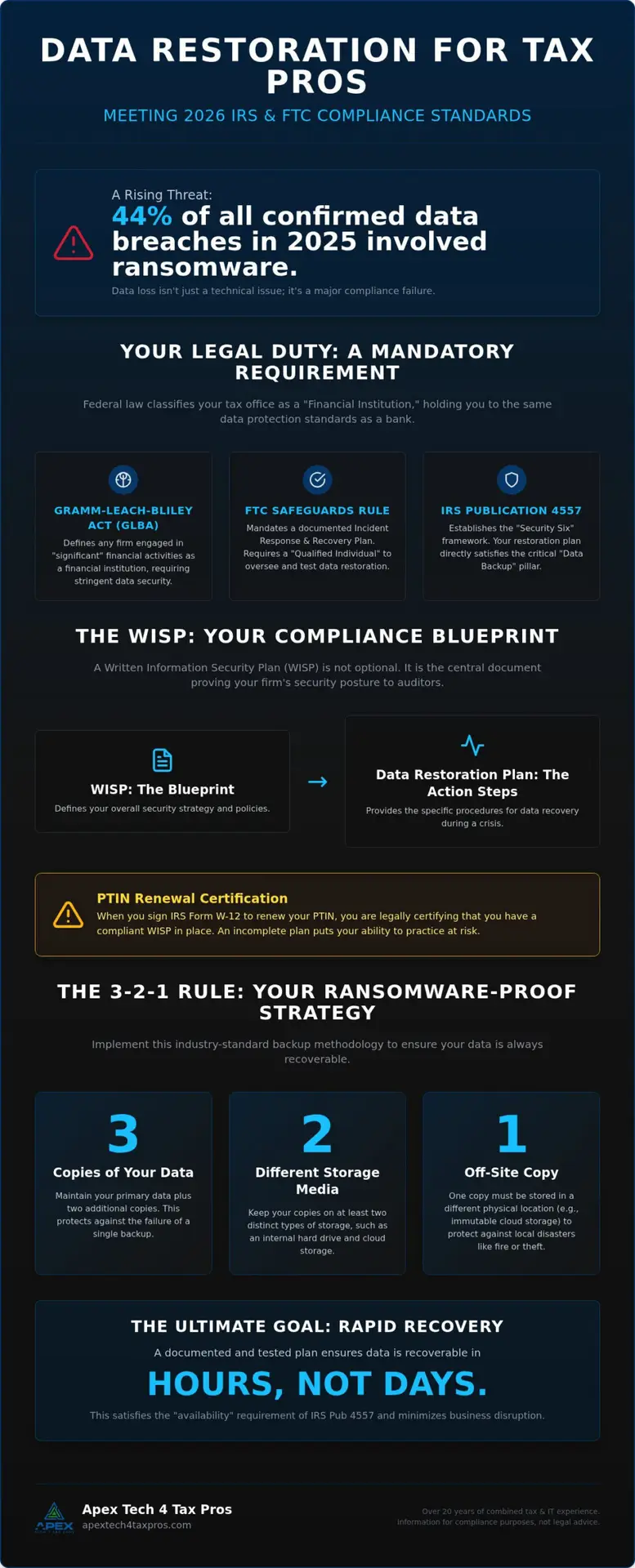
Ransomware was a factor in 44% of all confirmed data breaches in 2025, according to the Verizon DBIR, and that number continues to climb in 2026. For a tax professional, the threat of data loss during peak season isn’t just a technical worry; it’s a major compliance hurdle. To create a data restoration plan for accountants that satisfies IRS and FTC auditors, you must document specific recovery procedures for encrypted off-site backups and integrate them into your Written Information Security Plan (WISP). This ensures your client data is recoverable in hours, not days, while satisfying the availability requirement of IRS Publication 4557.
With over 20 years of combined tax and IT experience across our firm and our sister company, APEX Tax Solutions, we know documenting procedures feels like a heavy burden. It’s a lot to manage, but a clear strategy provides immense relief. This guide offers a straightforward path to compliance that takes the stress out of your annual PTIN renewal. We’ll show you how to move from vulnerability to confidence by building a recovery strategy that actually works when you need it most.
Key Takeaways
- Understand why federal law classifies your tax office as a financial institution and how to meet the technical standards required by the FTC Safeguards Rule.
- Learn how to build a data restoration plan for accountants that integrates directly into your WISP to ensure you meet IRS Form W-12 requirements for PTIN renewal.
- Identify the critical roles of annual risk assessments and multi-factor authentication in stopping ransomware before it can reach your sensitive client files.
- Discover how to implement the 3-2-1 backup rule using immutable cloud storage to guarantee your data is recoverable in hours rather than days.
Why is a data restoration plan for accountants a legal requirement in 2026?
The Gramm-Leach-Bliley Act (GLBA) defines any professional engaged in “significantly” financial activities as a financial institution. This means your tax office shares the same legal classification as a local bank. Under the FTC Safeguards Rule, you’re required to maintain administrative, technical, and physical safeguards. We’ve seen this evolution firsthand over our 20 years of combined tax and IT experience. By 2026, the standard for these safeguards has shifted from simple “best practices” to mandatory requirements. Specifically, a data restoration plan for accountants is now necessary to ensure the “availability” of taxpayer data as outlined in IRS Publication 4557. If you can’t restore your data quickly, you’re not just facing downtime; you’re facing a compliance failure.
The FTC Safeguards Rule: Beyond just passwords
The FTC requires a documented incident response and recovery strategy. It isn’t enough to have a backup drive plugged into your server. You must have a formal Disaster Recovery Plan (DRP) that your team actually knows how to use. The rule also mandates that a “Qualified Individual” oversees these restoration tests. This person ensures that your backups aren’t just running, but are actually viable when you need them most. Documenting these tests provides the technical “proof” that auditors look for during an investigation.
IRS Publication 4557 and the Security Six
The IRS “Security Six” serves as the foundation for your office security. While many focus on firewalls or anti-virus, the “Data Backup” pillar is what keeps you in a defensible position during an audit. A comprehensive data restoration plan for accountants ensures you satisfy this requirement. To stay compliant, your restoration plan must be part of your Written Information Security Plan. If you don’t have one yet, using a custom WISP template can help you document these steps clearly. The goal is to prove to the IRS that you have a proactive system for data recovery.
How do I integrate data restoration into my Written Information Security Plan (WISP)?
Your Written Information Security Plan (WISP) acts as the high-level blueprint for your firm’s security posture. While the WISP defines your overall strategy, a data restoration plan for accountants provides the specific action steps to take when a crisis hits. You shouldn’t confuse having a backup tool with having a plan. A tool is just software; a plan is a documented process that ensures you can actually use that software to recover client files under pressure.
The IRS and Security Summit partners have made it clear that a WISP isn’t optional. When you sign your IRS Form W-12 for your annual PTIN renewal, you’re certifying that you have this plan in place. Failing to document your restoration procedures means your WISP is incomplete, which could jeopardize your ability to practice. If you’re starting from scratch, a Custom WISP Template can bridge the gap between technical tools and regulatory requirements.
What a “ransomware-ready” WISP must include
A compliant plan must detail the “how, who, and when” of data recovery. Federal auditors want to see that you’ve assigned specific roles. Who initiates the recovery? How do you verify the integrity of the restored files? Your WISP should also include an Incident Response Plan (IRP). This document guides your team through the first critical hours after a breach, helping you avoid the panic that often leads to costly mistakes. It’s about having a clear path forward when the screen goes dark.
The risk of generic WISP templates
Generic, fill-in-the-blank templates often fail because they don’t account for your specific tax software stack. Your restoration workflow for Drake Tax might look very different from a cloud-based ProConnect setup. A customized plan reflects your actual environment. It ensures that your recovery steps are practical and tested against the real-world scenarios your office faces. For a truly effective approach, you might consider a professional IT assessment to identify where your current documentation falls short.
What are the best practices for stopping ransomware and ensuring rapid recovery?
Prevention and recovery are two sides of the same coin. Your data restoration plan for accountants is only effective if you’ve hardened your environment first to minimize the chances of a breach. We recommend following these four essential steps to protect your practice:
- Step 1: Conduct an annual risk assessment to identify vulnerabilities in your tax software and hardware.
- Step 2: Implement Multi-Factor Authentication (MFA) on all client portals and email accounts.
- Step 3: Deploy cybersecurity awareness training for all staff members to prevent phishing.
- Step 4: Use a Secure Virtual Desktop to isolate sensitive tax data from personal browsing.
Why staff training is your strongest restoration defense
Technology alone isn’t a silver bullet. Industry research shows that a significant majority of security breaches involve a human element, often through sophisticated phishing emails. Teaching your team to spot these threats is a core requirement of the FTC’s Safeguards Rule. When staff members know how to report a threat before clicking, you might never need to trigger your full restoration protocol. Our Cybersecurity Awareness Training is specifically designed for the unique workflows of a busy tax office.
Securing the network for remote tax work
Tax professionals are no longer tied to a single desk. Whether you’re working from home or at a client’s site, your connection must be encrypted to keep your data restoration plan for accountants viable. Using a Secure Office Network setup ensures that data in transit remains protected from prying eyes. This is especially critical during peak season when the volume of sensitive transmissions is at its highest. Don’t leave your firm’s reputation to chance. If you’re ready to harden your defenses, you can book a WISP assessment today to identify your specific needs.
How can secure cloud backup and specialized subscriptions simplify your recovery?
A reliable data restoration plan for accountants relies on the 3-2-1 backup rule. This industry standard requires you to maintain three copies of your data on two different media types, with one copy stored off-site. For tax professionals, that off-site copy must be “immutable.” Immutable backups are specifically engineered so that ransomware cannot delete or alter them, even if an attacker gains administrative access to your network. This ensures your client files remain untouched and ready for recovery when you need them most.
We’ve designed our subscriptions to act as a turnkey solution for busy practitioners who don’t have time to manage complex IT infrastructure. Our Seasonal subscription ($649.99) and Yearly subscription ($1,099.99) both include a free customized WISP to ensure you’re compliant from day one. These packages help you maintain a comprehensive data restoration plan for accountants without constant manual oversight. By integrating professional-grade tools into your daily workflow, you can focus on your clients while we handle the technical heavy lifting.
Recovery vs. Ransom: Why paying is a malpractice risk
Paying a ransom is never a guaranteed solution; it’s a significant malpractice risk. Cybercriminals often fail to provide decryption keys, and paying them can lead to ethical and legal complications with federal authorities. Relying on a “wipe and restore” strategy is the only way to stay operational and protect your firm’s reputation. With secure backups, you can bypass the extortion attempt entirely and get back to work within hours. This approach ensures you never miss a critical tax deadline or face the fallout of lost client trust.
Next steps: Moving from vulnerability to secure compliance
Compliance shouldn’t feel like a burden that keeps you up at night. Moving from a state of vulnerability to secure compliance starts with identifying your specific security gaps. We’re here to help you navigate these requirements with the confidence that your client data is protected. You can Book a WISP Assessment today or reach out to us at info@at4tp.com to start building a defensible security posture for your practice.
Securing Your Practice for the 2026 Tax Season
Building a data restoration plan for accountants isn’t just about technical safety; it’s about fulfilling your legal obligations as a financial institution. By integrating recovery steps into your Written Information Security Plan and utilizing immutable backups, you protect your clients and your professional standing. We bring over 20 years of combined tax and IT expertise to ensure your firm meets NIST-aligned security protocols without the usual stress. Our subscriptions include a customized WISP to simplify this process for you.
You don’t have to navigate these complex federal standards alone. Taking these steps now ensures that if a crisis hits, you’re back to serving clients in hours rather than days. We’re here to turn your regulatory burden into a source of confidence. Book your WISP Assessment today to secure your firm for the 2026 tax season or email us at info@at4tp.com to get started.
Frequently Asked Questions
Is a data restoration plan mandatory for small accounting firms?
Yes, it’s mandatory. Federal law classifies all tax preparers as financial institutions under the Gramm-Leach-Bliley Act. This means you must follow the FTC Safeguards Rule regardless of your firm’s size. A data restoration plan for accountants is a required component of your security strategy to ensure client data remains available. Documenting these procedures is essential for signing your IRS Form W-12 and successfully completing your annual PTIN renewal process.
What is the difference between a WISP and the FTC Safeguards Rule?
The FTC Safeguards Rule is the federal law that mandates how financial institutions protect consumer data. Your Written Information Security Plan (WISP) is the specific document that proves your firm is following that law. While the Safeguards Rule provides the legal framework, your WISP serves as your office’s unique blueprint. It details the administrative and technical steps you take to keep sensitive taxpayer information secure and recoverable during an emergency.
Can I use a free WISP template for my data restoration plan?
You can use a free template as a starting point, but it usually requires heavy customization to be effective. Most generic templates don’t include the specific restoration steps for the tax software you use every day. To meet 2026 standards, your plan must be a living document that reflects your actual office environment. A data restoration plan for accountants is only useful if it provides a clear, actionable path for your specific team.
What happens if my firm is hit by ransomware and I am not compliant?
Non-compliance during a ransomware attack can lead to severe consequences. For 2026, the FTC civil penalty for Safeguards Rule violations can reach $51,744 per violation, per day. You also risk losing your PTIN eligibility and facing scrutiny from the IRS. Having a documented plan in place provides a defensible position. It shows regulators that you acted in good faith to protect client data, which can help mitigate the impact of an audit.
How much does it cost to implement a professional ransomware protection plan?
We provide professional protection through our specialized subscription models. Our Seasonal subscription is $649.99, and our Yearly subscription is $1,099.99. Both options include a free customized WISP and secure cloud backup features to simplify your compliance journey. These subscriptions are designed to take the guesswork out of cybersecurity, allowing you to focus on your clients while we ensure your practice meets the latest federal data protection standards.