
Imagine sitting down for your 2026 PTIN renewal and realizing that your certification of IRS compliance requires more than just a signature. To meet federal standards this year, you must implement a Written Information Security Plan (WISP) and adhere to the FTC Safeguards Rule. Achieving cybersecurity compliance for accounting firms often feels like a technical hurdle, but it’s actually a professional foundation that protects your firm’s legacy. We know that the jargon surrounding tax office data security can be confusing, and the pressure of potential audits is a burden no practitioner wants to carry alone.
This guide provides a clear, step-by-step framework to turn these mandates into a professional relief. We’ll show you how to use WISP templates effectively and move toward a secure, audit-ready practice. By the end of this article, you’ll have a roadmap to complete your documentation with confidence and ensure your client data remains protected under the latest federal guidelines. Protecting your hard work shouldn’t be a second job, so let’s simplify the process together.
Key Takeaways
- Identify the specific documentation you’ll need to satisfy the IRS and secure your 2026 PTIN renewal without the stress.
- Build a reliable foundation for cybersecurity compliance for accounting firms using the IRS “Security Six” as your professional roadmap.
- Navigate the complexities of the FTC Safeguards Rule, including the mandatory 30-day breach notification and modern encryption requirements.
- Learn how to offload the technical burden of WISP creation through a structured framework that protects your firm’s reputation and client data.
What are the current cybersecurity compliance requirements for accounting firms in 2026?
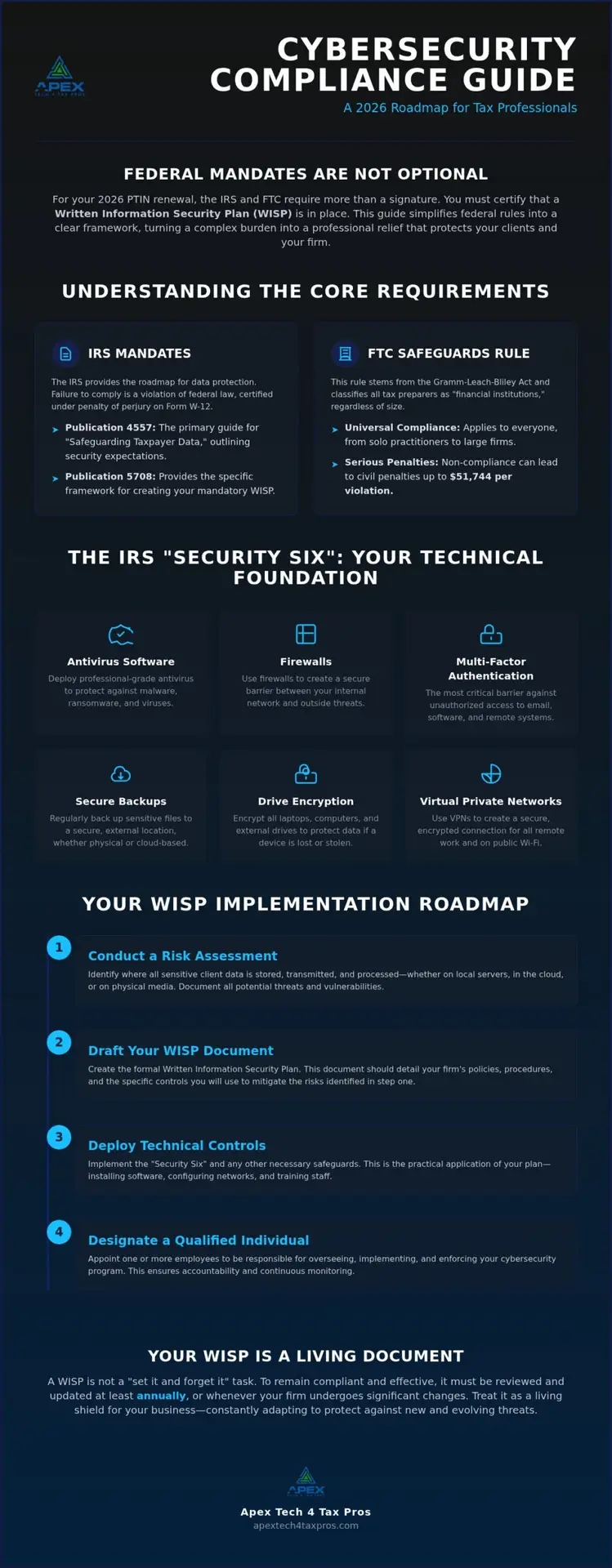
In 2026, the regulatory landscape demands that cybersecurity compliance for accounting firms is no longer optional but a central pillar of professional practice. The IRS requires every paid tax preparer to create and maintain a Written Information Security Plan (WISP). This isn’t just a best practice; it’s a federal mandate. When you renew your credentials using Form W-12, you’re legally certifying that you have this plan in place. We’re providing these compliance facts to help you navigate these rules, but this information doesn’t constitute legal advice. You should always confirm specific requirements for your practice with a qualified legal professional.
Failing to meet these standards carries significant risks, including civil penalties that can reach $51,744 per violation under FTC authority. However, viewing these rules as a professional relief helps you see them as a shield for your business. Implementing a WISP protects you from the catastrophic financial and reputational costs of a data breach, which often far exceed the cost of compliance. It’s about ensuring that your firm remains a trusted environment for sensitive taxpayer data.
Understanding IRS Publication 4557 and 5708
IRS Publication 4557 serves as the primary roadmap for “Safeguarding Taxpayer Data.” It outlines the specific expectations the IRS has for your office’s digital and physical security. To help you translate these expectations into a formal document, the IRS issued Publication 5708, which provides the framework for your mandatory WISP. Together, these documents ensure your practice meets the rigorous standards required to handle sensitive financial information in a modern threat environment.
The FTC Safeguards Rule: Who does it apply to?
The FTC Safeguards Rule (16 CFR Part 314) stems from the Gramm-Leach-Bliley Act, which classifies tax preparers as “financial institutions.” This classification applies regardless of your firm’s size; even a solo practitioner must comply. While larger firms with over 5,000 consumers have additional reporting duties, the core requirement to maintain a WISP and protect data remains universal for everyone in our industry. We’ve spent years helping firms of all sizes navigate these technical requirements with ease.
How do I implement the IRS “Security Six” and a Written Information Security Plan?
Implementing a robust security framework starts with four practical steps. First, you must conduct a thorough risk assessment to identify exactly where sensitive client data lives, whether it’s on a local server or in the cloud. Second, you’ll draft your WISP using a customized template that matches your firm’s specific operational needs. Third, you’ll deploy the technical controls known as the “Security Six.” Finally, you must designate a “Qualified Individual” to coordinate and oversee your security program, a role that ensures accountability and continuous monitoring.
The Security Six: Your technical baseline
The IRS “Security Six” provides a foundational layer of protection for every tax office. This includes professional-grade antivirus software and firewalls to stop external threats. Multi-factor authentication (MFA) is the most critical barrier against unauthorized access. You also need secure backups, drive encryption, and Virtual Private Networks (VPNs) for remote work. These tools work together to create a “defense in depth” strategy that keeps hackers out and client data in.
Creating a living WISP document
A WISP isn’t a “set it and forget it” document. A static PDF sitting in a drawer won’t help during an audit or a breach. Instead, the WISP must be a living document that you review and update at least once a year or whenever your firm undergoes a significant change. This ensures your cybersecurity compliance for accounting firms stays current with evolving threats like AI-driven phishing. If you want to ensure your plan is truly effective, you can book a WISP assessment to identify and remediate any hidden vulnerabilities before they become liabilities.
What additional steps does the FTC Safeguards Rule require for my tax practice?
Beyond the primary WISP document, the FTC Safeguards Rule mandates specific operational behaviors that go deeper than technical checklists. A critical requirement is the 30-day breach notification rule. If you discover a security event where unencrypted customer information involving at least 500 consumers is acquired without authorization, you must notify the FTC through their online portal. This timeline is strict. It makes cybersecurity compliance for accounting firms a matter of daily vigilance rather than an annual task.
Encryption is another non-negotiable pillar. You’re required to protect data at rest on your local drives and data in transit when communicating with clients or the IRS. You must also exercise vendor oversight. This means ensuring your software providers, such as Drake or UltraTax, adhere to the same rigorous standards you do. Utilizing a Secure Virtual Desktop can help you centralize these controls, ensuring your entire digital workspace is shielded from one managed point.
Mandatory staff cybersecurity awareness training
Technology alone can’t stop a breach if a staff member clicks a malicious link. Phishing and social engineering attacks are increasingly sophisticated, often using AI to mimic trusted colleagues. This education is vital for cybersecurity compliance for accounting firms because the “human factor” is frequently the weakest link in a firm’s defense. Providing regular Cybersecurity Training to all employees turns your team into an active layer of protection.
Incident response and disaster recovery
What you do in the first 24 hours of a ransomware attack determines if your firm survives. Isolation is key. Your incident response plan should outline how to isolate affected hardware and communicate with authorities. Secure cloud backups are your ultimate safety net, allowing you to restore operations without paying a ransom. Practice continuity depends on how fast you can get back to work. If you’re unsure about your recovery speed, book a WISP assessment today to verify your firm’s resilience.
How can Apex Tech 4 Tax Pros simplify your firm’s compliance journey?
Navigating cybersecurity compliance for accounting firms shouldn’t feel like you’re learning a second career. We’ve designed our services to act as a professional relief, allowing you to offload the technical burden to a team that understands your specific workflow. Our Seasonal ($649.99) and Yearly ($1,099.99) subscriptions provide the essential tools you need to satisfy federal mandates while you focus on your clients. The Yearly subscription is particularly helpful because it includes a free, customized WISP, ensuring your documentation is audit-ready and compliant.
With over 20 years of combined experience in both tax preparation and information technology, we approach every client as a knowledgeable colleague. We speak your language and offer bilingual support in both English and Spanish to ensure your whole team stays informed. While our sister company, APEX Tax Solutions, handles the intricacies of tax resolution, we focus on the technical infrastructure that protects your firm’s reputation. This dual expertise allows us to bridge the gap between complex federal regulations and your daily operations.
Why a customized WISP beats a generic template
Many firms fall into the trap of using a generic WISP template, but these often fail IRS audits because they lack the firm-specific detail required by Publication 5708. A plan that doesn’t reflect your actual data flow provides a false sense of security. Our process involves tailoring the documentation to your firm’s unique footprint, ensuring that every policy is actionable and relevant. For those looking to harden their physical workspace, our Secure Office Network integration ensures your hardware and documentation work in perfect harmony.
Ready to turn your compliance requirements into a foundation of trust? You can email us at info@at4tp.com or visit our homepage to start your journey toward secure, worry-free operations today. We’re here to help you protect your legacy and your clients’ most sensitive data.
Secure Your Practice for the 2026 Filing Season
Securing your firm’s future starts with moving beyond the anxiety of federal audits. We’ve explored how a living Written Information Security Plan and the implementation of the “Security Six” create a professional foundation that satisfies both the IRS and FTC. By addressing these mandates now, you’re not just checking a box for your 2026 PTIN renewal; you’re actively safeguarding your clients’ trust and your practice’s legacy.
Navigating cybersecurity compliance for accounting firms shouldn’t be a solitary effort. At Apex Tech 4 Tax Pros, we bring over 20 years of combined tax and IT experience to your corner, offering bilingual support in English and Spanish. Our Yearly subscription for $1,099.99 provides a free, customized WISP to lift the technical burden off your shoulders. We’re here to ensure your firm is resilient, compliant, and ready for whatever the next tax season brings.
Book a WISP Assessment with Apex Tech 4 Tax Pros today to secure your office with a partner who truly understands your niche. You’ve built a great practice, and we’re ready to help you protect it.
Frequently Asked Questions
Is a Written Information Security Plan (WISP) legally required for solo tax preparers?
Yes, a Written Information Security Plan is legally required for all paid tax preparers, including solo practitioners. The FTC Safeguards Rule classifies any individual or business significantly engaged in financial activities as a financial institution. This means firm size doesn’t matter. Having a WISP is a mandatory part of cybersecurity compliance for accounting firms and must be acknowledged during your annual PTIN renewal process.
What are the penalties for non-compliance with the FTC Safeguards Rule?
Non-compliance with the FTC Safeguards Rule can lead to severe civil penalties of up to $51,744 per violation. These amounts are adjusted periodically for inflation and can accumulate quickly if multiple security gaps are found. Beyond federal fines, firms face the risk of state-level lawsuits, lost professional licenses, and the significant cost of notifying clients. Proper documentation and technical controls are essential to avoid these devastating financial consequences.
How often should an accounting firm update its cybersecurity risk assessment?
You should update your cybersecurity risk assessment at least once a year or whenever your firm undergoes a significant operational change. This includes hiring new staff, moving to a new office, or adopting new tax software. Regular reviews ensure that your cybersecurity compliance for accounting firms stays current with evolving threats like AI-driven phishing. Staying proactive helps you identify new vulnerabilities before hackers can exploit them.
Does the IRS Security Six apply to MAC or only Windows-based accounting offices?
The IRS Security Six applies to every tax office, regardless of whether you use Windows, macOS, or Linux. The requirement is technology-neutral, meaning the focus is on the security outcomes rather than the specific brand of your hardware. Every firm must implement firewalls, antivirus software, multi-factor authentication, secure backups, drive encryption, and VPNs. If your practice handles sensitive taxpayer information, these fundamental protections are mandatory for all your devices.
How do I report a data breach to the IRS and FTC?
You must report a data breach to the IRS by contacting your local Stakeholder Liaison immediately. They’ll help coordinate with the appropriate teams to protect your clients from identity theft. For the FTC, you’re required to use their online portal within 30 days of discovery if the breach involves the unencrypted records of at least 500 consumers. Having a clear incident response plan ensures you meet these strict reporting timelines.