
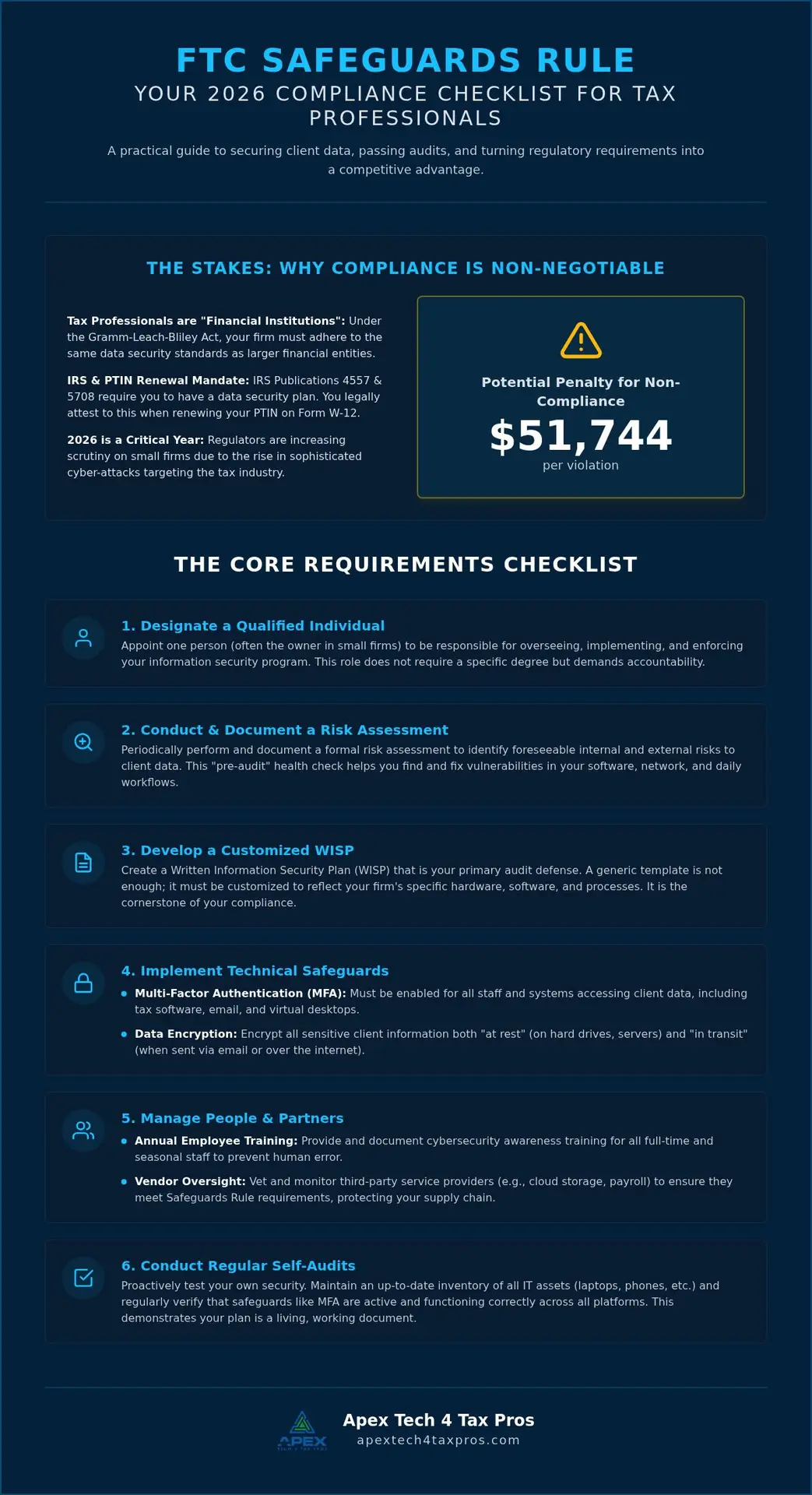
What if the next FTC audit notice landing on your desk wasn’t a source of panic, but a chance to demonstrate your firm’s top-tier security standards? An FTC compliance audit is a formal review of your data protection measures. To pass in 2026, your office must follow a specific ftc safeguards rule checklist that includes a Written Information Security Plan (WISP), multi-factor authentication for all system access, and regular risk assessments. These requirements, reinforced by IRS Publication 4557 and Publication 5708, are mandatory for every tax professional.
We understand that during the heat of tax season, managing technical audits feels like an impossible addition to an already overflowing plate. You’re likely more concerned with PTIN renewals and client deadlines than encryption protocols. This guide turns that regulatory stress into a secure competitive advantage by providing a practical roadmap. We’ll break down federal mandates into a clear framework that satisfies both the IRS and FTC, giving you peace of mind while protecting your practice from penalties that can reach $51,744 per violation.
Key Takeaways
- Learn why your tax office is classified as a financial institution and how this status dictates your 2026 data security protocols.
- Discover how to implement a comprehensive ftc safeguards rule checklist to manage mandatory risk assessments and designate a Qualified Individual.
- Gain a practical roadmap for auditing your office IT assets and verifying that multi-factor authentication is properly securing your sensitive client data.
- Understand how a professional compliance framework can turn regulatory requirements into a competitive advantage while simplifying your IRS and FTC audit defense.
What is an FTC Compliance Audit for Tax Professionals?
An FTC compliance audit is a formal review of your firm’s data security protocols to ensure they meet the standards set by the Safeguards Rule. Under Financial privacy laws in the United States, specifically the Gramm-Leach-Bliley Act, tax preparers are classified as “financial institutions.” This isn’t just for big banks; in 2026, even independent preparers significantly engaged in financial services fall under this umbrella. Passing an audit means proving you’ve designated a “Qualified Individual” to oversee your security and that you maintain a living Written Information Security Plan (WISP). Using a comprehensive ftc safeguards rule checklist ensures these requirements aren’t just checked boxes, but active shields for your practice.
The Connection Between FTC Rules and IRS Publication 4557
The IRS doesn’t create these security laws in a vacuum. They leverage the FTC Safeguards Rule as the primary legal framework for tax professional data security. When you renew your PTIN using Form W-12, you’re legally testifying that you have a WISP in place. IRS Publication 4557 outlines what you need to protect, while IRS Publication 5708 provides the implementation roadmap. These documents work together to define your federal compliance obligations.
Why 2026 is a Critical Year for Compliance
This year marks a turning point as sophisticated phishing attacks increasingly target small firms. Federal regulators have noticed, and the 2026 updates to NIST guidance now inform what constitutes “reasonable” security for independent preparers. Staying prepared is a relief, not a burden. It ensures your practice remains uninterrupted by regulatory inquiries or data breaches. Following an ftc safeguards rule checklist helps you stay ahead of these evolving threats while protecting your clients’ trust.
Core Requirements of the FTC Safeguards Rule Checklist
Building a compliant tax office starts with designating a “Qualified Individual.” For most independent firms, this is the owner. You don’t need a degree in computer science; you just need to be responsible for overseeing and documenting your security program. Integrating a formal Risk Assessment into your ftc safeguards rule checklist identifies vulnerabilities in your tax software and office network before a breach occurs. It’s the “pre-audit” health check that keeps your practice safe.
Your technical defenses must be robust. Multi-factor authentication (MFA) is now required for all staff accessing sensitive data, not just remote users. Additionally, you must encrypt customer data both at rest on your hard drives and in transit when emailing clients. These layers of protection ensure that even if a device is lost, the data remains unreadable to unauthorized parties.
The Customized WISP: Your Primary Audit Defense
A generic template often fails an audit because it doesn’t reflect your actual office workflow. A Customized WISP serves as a narrative that proves your firm’s “good faith” effort. It is the cornerstone of any ftc safeguards rule checklist, addressing the specific software and hardware you use daily. If you’re feeling overwhelmed by the paperwork, we can help you develop a WISP that actually fits your business.
Employee Training and Vendor Oversight
Security is a team effort. You’re required to provide annual cybersecurity awareness training for all full-time and seasonal staff. Beyond your walls, you have a duty to vet third-party service providers, like cloud storage or payroll vendors, to ensure they follow their own Safeguards compliance. This oversight prevents a weak link in your supply chain from becoming your biggest liability.
How to Conduct a Self-Audit: A Step-by-Step Preparation Guide
Conducting a self-audit is the bridge between simply owning a security plan and actually being prepared for federal scrutiny. It’s a proactive exercise that proves your controls are functional. To start, update your IT asset inventory. You must account for every laptop, tablet, and mobile device used for tax work. Next, verify that multi-factor authentication (MFA) is active across your entire stack. This includes your tax software, email, and any Secure Virtual Desktop environments you use to manage client files.
Your ftc safeguards rule checklist should then move to a deep review of your WISP against the latest IRS Publication 5708 standards. Ensure no gaps exist between your written policy and your daily office habits. Finally, document your security testing. Whether it’s an annual vulnerability scan or a health check of your Secure Office Network, having a paper trail is essential for audit defense.
Testing and Monitoring Your Security Controls
Vulnerability scanning acts as a proactive health check for your tax preparation software by identifying weaknesses before hackers do. Penetration testing is a simulated attack designed to verify your firewall’s strength and overall network resilience. Store the results of these tests in a dedicated “Compliance Folder.” This folder serves as primary evidence for auditors, showing that you don’t just have a plan; you actively monitor it.
Common Pitfalls in Small Office Audits
One of the biggest dangers in your ftc safeguards rule checklist is “stale” documentation. If you’ve changed tax software or added new remote staff but haven’t updated your WISP, your compliance is at risk. Another frequent error is using unencrypted backups. Ensure you’re utilizing a Secure Cloud Backup solution to protect data from hardware failure or ransomware. If you’re ready to secure your practice, book a WISP Assessment to ensure your audit defense is airtight.
Simplifying Your 2026 Compliance with Apex Tech 4 Tax Pros
Think of Apex Tech 4 Tax Pros as your knowledgeable colleague. We understand the high-stakes environment of a busy tax office because we’ve spent over 20 years navigating both the tax preparation and IT industries. Our team removes the technical weight from your shoulders, allowing you to focus on client returns while we handle the complexities of federal data security. Our Seasonal ($649.99) and Yearly ($1,099.99) subscriptions offer professional oversight and include a free customized WISP. This ensures your ftc safeguards rule checklist is managed by experts who speak your language.
Professional Risk Assessments and Tailored Plans
A professional IT Assessment identifies the subtle gaps that generic checklists often miss. Many practitioners start with a basic template, but these rarely reflect actual office workflows or specific software vulnerabilities. We guide you through the transition from a simple document to a professional, defensible security framework. This shift provides the relief of knowing your practice is audit-ready at all times, satisfying the requirements of IRS Publication 4557 and the FTC Safeguards Rule.
Moving from Anxiety to Action
Securing your practice shouldn’t be a source of dread. Booking a WISP assessment now ensures your office is protected before the next tax season peak hits. It’s the most effective way to protect your reputation and your clients’ sensitive data from sophisticated cyber threats. We’re ready to help you turn regulatory stress into a secure competitive advantage. Take a clear next step and email info@at4tp.com to start your 2026 compliance journey today.
Securing Your Firm’s Future Beyond 2026
Navigating federal data security requirements doesn’t have to be a solo mission that pulls you away from your clients. By following a structured ftc safeguards rule checklist, you’ve already taken the first step toward transforming regulatory pressure into a professional advantage. Remember that true compliance is a living process. It requires the clear designation of a Qualified Individual and the maintenance of a WISP that matches your actual office workflow. With over 20 years of combined tax and IT infrastructure experience, we specialize in aligning your practice with IRS Publication 4557 and 5708 standards.
Our Seasonal ($649.99) and Yearly ($1,099.99) subscriptions include a free customized WISP to ensure you’re never starting from scratch. This professional oversight provides the relief of knowing your office is audit-ready while you focus on the busy filing season ahead. You’ve worked hard to build your practice; let’s work together to protect it. Book a WISP Assessment with Apex Tech 4 Tax Pros today to secure your firm’s legacy. You’ve got this, and we’re here to help every step of the way.
Common Questions About FTC Compliance
Is an FTC compliance audit mandatory for a one-person tax practice?
Yes, the FTC Safeguards Rule applies to all tax professionals regardless of the size of their practice. There is no exemption for sole practitioners or one-person offices. Because the law classifies you as a financial institution, you must maintain a documented security program. This includes having a WISP and following an ftc safeguards rule checklist to ensure your client data remains protected from unauthorized access.
What are the specific penalties for FTC Safeguards Rule non-compliance in 2026?
Violations of the FTC Safeguards Rule can result in significant civil penalties of up to $51,744 per violation. It’s important to realize that each day of non-compliance can potentially be treated as a separate violation. Beyond these federal fines, the IRS can also impose civil penalties under IRC Section 6713 for unauthorized disclosures, which can reach a maximum annual penalty of $10,000 for your firm.
How does IRS Publication 4557 differ from the FTC Safeguards Rule?
IRS Publication 4557 provides the “what” of data security by outlining the specific safeguards you should implement to protect taxpayer data. In contrast, the FTC Safeguards Rule is the actual federal law that mandates these protections. While the IRS publication serves as a helpful guide for compliance, the Safeguards Rule establishes the legal requirements you must meet to avoid federal penalties and pass a formal audit.
Do I need to update my WISP every year to pass an audit?
You should review and update your Written Information Security Plan (WISP) at least annually or whenever there’s a significant change to your business operations. This includes hiring new staff, adopting new tax software, or moving to a cloud-based network. Keeping your documentation current is a core part of any ftc safeguards rule checklist, as auditors look for evidence that your security plan reflects your current office environment.
Can a WISP template protect me during a formal federal audit?
A generic template is a starting point, but it rarely provides full protection during a formal federal audit. Auditors require a plan that accurately describes your firm’s unique workflows, specific software, and actual security controls. While a template provides the structure, you must customize the narrative to prove you’ve implemented the required safeguards. A professional, tailored plan demonstrates a “good faith” effort that generic documents simply cannot match.
What is the role of a ‘Qualified Individual’ in a small accounting firm?
The Qualified Individual is responsible for overseeing, implementing, and documenting your firm’s information security program. In a small accounting firm, this role is often filled by the owner or a senior partner. You don’t need to be an IT expert, but you must take accountability for the program’s effectiveness. This includes coordinating risk assessments and ensuring that all staff members follow the security protocols outlined in your WISP.