
Checking the box on Form W-12 Line 11 isn’t just a formality; it’s a legal attestation that could cost your practice $50,685 per violation if you lack a proper data security policy for accounting firm standards. You likely started your tax practice to help clients navigate complex codes, not to become an overnight IT security expert. It’s exhausting to face technical jargon and regulatory pressure when you’re just trying to keep your PTIN active and your office running smoothly during the busy season.
We understand that burden. This guide will show you exactly how to build a Written Information Security Plan (WISP) that satisfies both the IRS and the FTC. You’ll learn how to protect your clients from ransomware while securing your own professional standing. We will break down the 2026 updates to Publication 4557 and provide a clear roadmap to keep your firm compliant, secure, and ready for the upcoming filing year.
Key Takeaways
- Identify the federal requirements under the FTC Safeguards Rule and IRS Publication 4557 that mandate a formal security plan for every tax practice.
- Learn how to build a robust data security policy for accounting firm standards by integrating the IRS “Security Six” technical safeguards into your daily workflow.
- Follow a structured, two-step process to conduct a professional risk assessment and draft a Written Information Security Plan (WISP) tailored to your specific hardware.
- Prepare for a smooth PTIN renewal by understanding the legal implications of Form W-12 Line 11 and the necessity of having physical documentation ready for inspection.
What is a Data Security Policy for Accounting Firms in 2026?
A data security policy for accounting firm operations serves as the operational heart of your Written Information Security Plan (WISP). It isn’t merely a collection of software tools; it’s a living document that defines how your practice protects sensitive taxpayer data. Federal law distinguishes between having security tools and having a documented policy. You might have the best encryption in the world, but without a written plan that dictates its use, you remain non-compliant in the eyes of the IRS. The policy acts as the master blueprint for your firm’s administrative and technical defenses.
The Legal Mandate: FTC Safeguards Rule and IRS Pub 4557
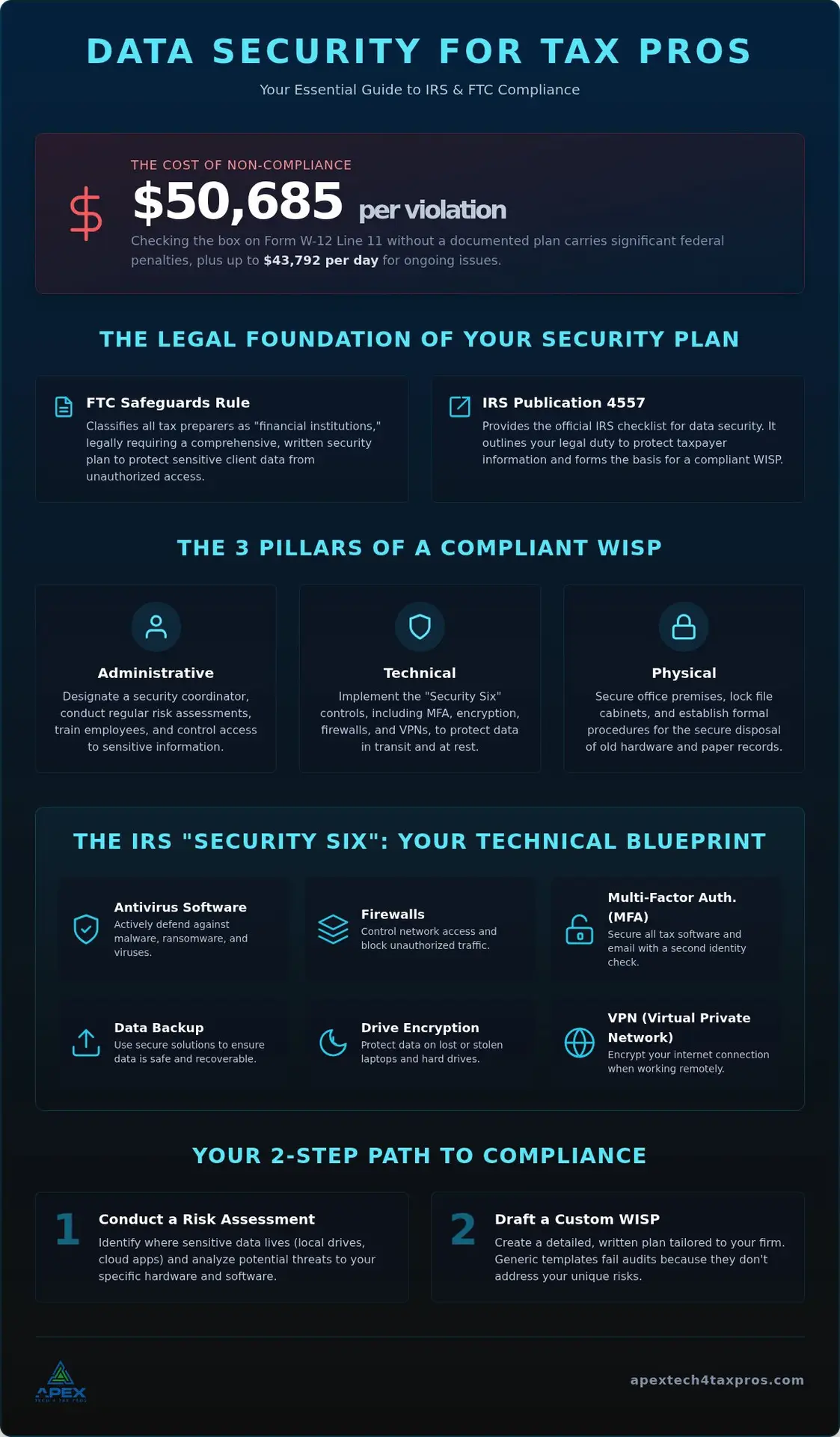
The regulatory landscape for tax professionals is governed by two primary pillars: IRS Publication 4557 and the FTC Safeguards Rule (16 CFR Part 314). In 2026, the federal government classifies all tax preparers as non-banking financial institutions. This classification includes everyone from large service bureaus to home-based solo practitioners. The financial stakes are immense. Current penalties for violations have climbed to $50,685 per violation, with additional fines of up to $43,792 per day for ongoing non-compliance. These mandates require you to maintain a Core Components of an IRS-Compliant Security Plan that covers administrative, technical, and physical safeguards.
Why ‘Generic’ IT Policies Fail Tax Professionals
Standard business security policies often fall short because they don’t address the specific standards outlined in IRS Publication 5708. A generic policy might mention “data protection,” but it won’t satisfy an auditor looking for the IRS Security Six or a designated security coordinator. Tax professionals need a strategy that mirrors the meticulous nature of their profession. Using a Custom WISP Document ensures that your data security policy for accounting firm needs isn’t just a placeholder but a defensible shield. Generic templates lack the industry-specific context required to protect against modern threats like AI-driven phishing campaigns that target taxpayer identities.
Core Components of an IRS-Compliant Security Plan
An IRS-Compliant Security Plan is built on three distinct pillars: administrative, technical, and physical safeguards. Administrative duties require you to designate a specific security coordinator to oversee your data security policy for accounting firm compliance and perform regular IT assessments. Physical safeguards involve securing office premises, locking file cabinets, and managing the secure disposal of old hardware. Your policy must also detail an incident response plan. This plan dictates contacting the IRS Stakeholder Liaison immediately if a breach occurs to mitigate potential damage to your clients and your professional reputation.
The IRS Security Six: Non-Negotiable Technical Standards
The IRS Security Summit mandates six specific technical controls to protect sensitive taxpayer data. Multi-factor authentication (MFA) is the most critical; it must be active on all tax software and business email accounts to verify identity. A Secure Office Network with a managed firewall is equally vital to control access routes into your system. These tools, combined with antivirus, drive encryption, and a VPN, form the technical wall required by Publication 4557. A robust data security policy for accounting firm environments ensures that these six tools work in harmony rather than as isolated products.
Data Retention and Disposal Policies
Your policy should clearly state how long you retain tax records and the exact methods for their destruction. Securely wiping hard drives and shredding paper documents prevents identity theft after the records are no longer needed. Integrating a Secure Cloud Backup solution ensures that your data remains intact and recoverable even if local hardware fails. If you’re feeling overwhelmed by these technical requirements, you can book a WISP IT System Assessment to identify potential gaps before the next filing season begins.
Policy Implementation: Risk Assessment and Training
Implementing a data security policy for accounting firm compliance requires a methodical approach that goes beyond just writing words on paper. You must first conduct a thorough risk assessment to identify where sensitive taxpayer data resides, whether it’s on local hard drives, encrypted servers, or cloud-based applications. Once these vulnerabilities are mapped, you can draft a Custom WISP Document tailored specifically to your hardware and firm size. This document shouldn’t be a generic template but a precise reflection of your firm’s unique operational footprint.
Conducting the Annual Risk Assessment
A reliable hardware and software inventory is the foundation of your security strategy. You need a checklist that accounts for every device, including employee-owned mobile phones and remote work laptops, that accesses taxpayer information. Identifying these endpoints is a key requirement of the FTC Guide on protecting customer data. NIST standards suggest that this assessment and your subsequent policy updates happen at least once a year. This regular review ensures your data security policy for accounting firm standards keeps pace with evolving digital threats and hardware changes.
Training Your Staff to Be Your Best Defense
The human element is often the weakest link in any security chain. In 2026, phishing campaigns have become more sophisticated, frequently using fake EFIN verification emails or AI-generated voice clones to trick seasoned professionals. The Safeguards Rule explicitly mandates staff training and the oversight of service providers. Rolling out Cybersecurity Awareness Training ensures that your full-time and seasonal staff can recognize these scams before a breach occurs. Regular testing of your team’s readiness is just as important as testing your firewall. If you’re ready to move from vulnerability to secure compliance, you can start building your custom security plan today.
PTIN Renewal and Form W-12: The Final Compliance Check
Every year between mid-October and December 31, tax professionals nationwide begin the PTIN renewal process. This isn’t just about paying the $18.75 fee; it’s a critical moment of legal accountability. Form W-12 requires you to attest to your data security responsibilities. Checking the box on Line 11 without a physical data security policy for accounting firm standards is a gamble you don’t want to take. If you’re audited and can’t produce the document you claimed to have, you face the full weight of federal penalties and potential loss of your ability to file returns.
Form W-12 Line 11: What It Actually Means
Line 11 is a federal declaration of compliance subject to audit that confirms you’re aware of your legal obligation to have a Written Information Security Plan. Solo practitioners certify their personal adherence to these rules. In a multi-preparer firm, the principal officer certifies that the entire office follows a unified data security policy for accounting firm operations. Using a Custom WISP Template provides the professional relief needed to navigate the busy renewal window with absolute certainty and peace of mind.
Preparing for an IRS Security Audit
When an auditor visits, they’ll ask for your WISP before anything else. They’ll also scrutinize your Cybersecurity Awareness Training logs and the results of your annual IT assessment. You must demonstrate that your security measures are active and regularly monitored. Compliance is a year-round process, not a once-a-year checkbox. Keeping your documentation current protects your PTIN and shields you from the current $50,685 per violation fines and $43,792 per day penalties. It’s the only way to prove you’ve done your due diligence in safeguarding taxpayer data.
Secure Your Practice and Simplify Your Compliance Journey
Securing your firm for 2026 requires more than just checking a box on Form W-12; it demands a living document that reflects your actual office operations. By implementing the IRS Security Six and conducting an annual risk assessment, you move from a state of vulnerability to a state of defensible compliance. A robust data security policy for accounting firm success is your best defense against identity theft and the high costs of federal penalties. At Apex Tech 4 Tax Pros, we leverage over 20 years of combined tax and IT expertise to provide the professional relief you need. Our bilingual support team is ready to help you build a plan that passes any audit. Remember that a customized WISP is included free with our yearly subscriptions.
Book a Professional WISP Assessment and Get Compliant Today. You’ve worked hard to build your practice; let’s work together to make sure it’s protected for years to come.
Frequently Asked Questions
Do small or home-based tax preparers really need a data security policy?
Yes, the FTC Safeguards Rule and IRS Publication 4557 apply to all tax professionals regardless of firm size. Federal law classifies your practice as a financial institution. Even if you work alone from a home office, you must maintain a documented data security policy for accounting firm standards to legally renew your PTIN. It’s a non-negotiable requirement for anyone handling sensitive taxpayer information and protecting it from unauthorized access.
What is the difference between a WISP and a general IT security policy?
A general IT policy focuses on broad hardware and software usage, while a WISP is specifically engineered to meet IRS and FTC regulatory standards. A Written Information Security Plan (WISP) includes administrative, physical, and technical safeguards tailored to protecting taxpayer data. It must also designate a security coordinator and outline incident response steps. Generic policies usually lack the specific Security Six controls and the documentation required during an official IRS audit.
What are the IRS penalties for not having a Written Information Security Plan in 2026?
Non-compliance can lead to severe financial consequences and professional sanctions. For 2026, the FTC Safeguards Rule allows for civil penalties up to $50,685 per violation. Additionally, the IRS may levy fines of up to $43,792 per day for ongoing failures to protect data. Beyond the money, you risk losing your EFIN or being unable to complete the mandatory Form W-12 Line 11 certification during your annual PTIN renewal season.
How often should an accounting firm update its data security policy?
You should review and update your data security policy for accounting firm compliance at least once a year. NIST standards and IRS guidance recommend an annual check to account for new hardware, seasonal staff changes, or emerging digital threats. Significant changes to your IT infrastructure or a potential data breach should also trigger an immediate update. Keeping your plan current ensures you can honestly attest to your security readiness during the renewal window.
Does my tax software provider’s security count as my firm’s WISP?
No, your software provider’s security only covers their platform, not your entire office environment. You’re responsible for securing your own local network, hardware, and staff workflows. While your provider protects data within their cloud, you must have your own Written Information Security Plan to address how you handle that data on your devices. A WISP is your firm’s specific roadmap for total data protection, separate from any third-party vendor’s security protocols.