
What if checking “Yes” on Form W-12 was the highest legal risk your firm faced this year? To meet mandatory IRS standards and avoid 2026 penalties of $50,685 per violation, you need a comprehensive stack including a Written Information Security Plan (WISP), Multi-Factor Authentication (MFA), professional firewalls, drive encryption, secure backups, and a VPN. Securing reliable it security for dallas tax professionals is the only way to ensure these safeguards are operational before the December 31 PTIN expiration.
We understand that navigating federal mandates feels like an overwhelming burden during your busiest season. This guide will help you choose the right IT infrastructure to protect your practice and meet every mandatory IRS standard with confidence. We’ll explore the legal reality of the FTC Safeguards Rule, define the “Security Six” technical baseline, and compare the risks of DIY templates against professional managed solutions that provide lasting peace of mind.
Key Takeaways
- Learn the critical distinctions between the FTC Safeguards Rule and your WISP to ensure you accurately certify compliance on Form W-12.
- Upgrade your defensive posture by implementing professional it security for dallas tax professionals that replaces vulnerable consumer-grade routers with a secure office network.
- Protect taxpayer data from local device theft or malware by migrating your workflow to a secure virtual desktop and encrypted cloud storage.
- Evaluate the long-term value of managed security subscriptions that include staff training and a customized WISP to eliminate the stress of annual audits.
Navigating Federal Security Mandates: Why Tax Office IT Security is Mandatory in 2026
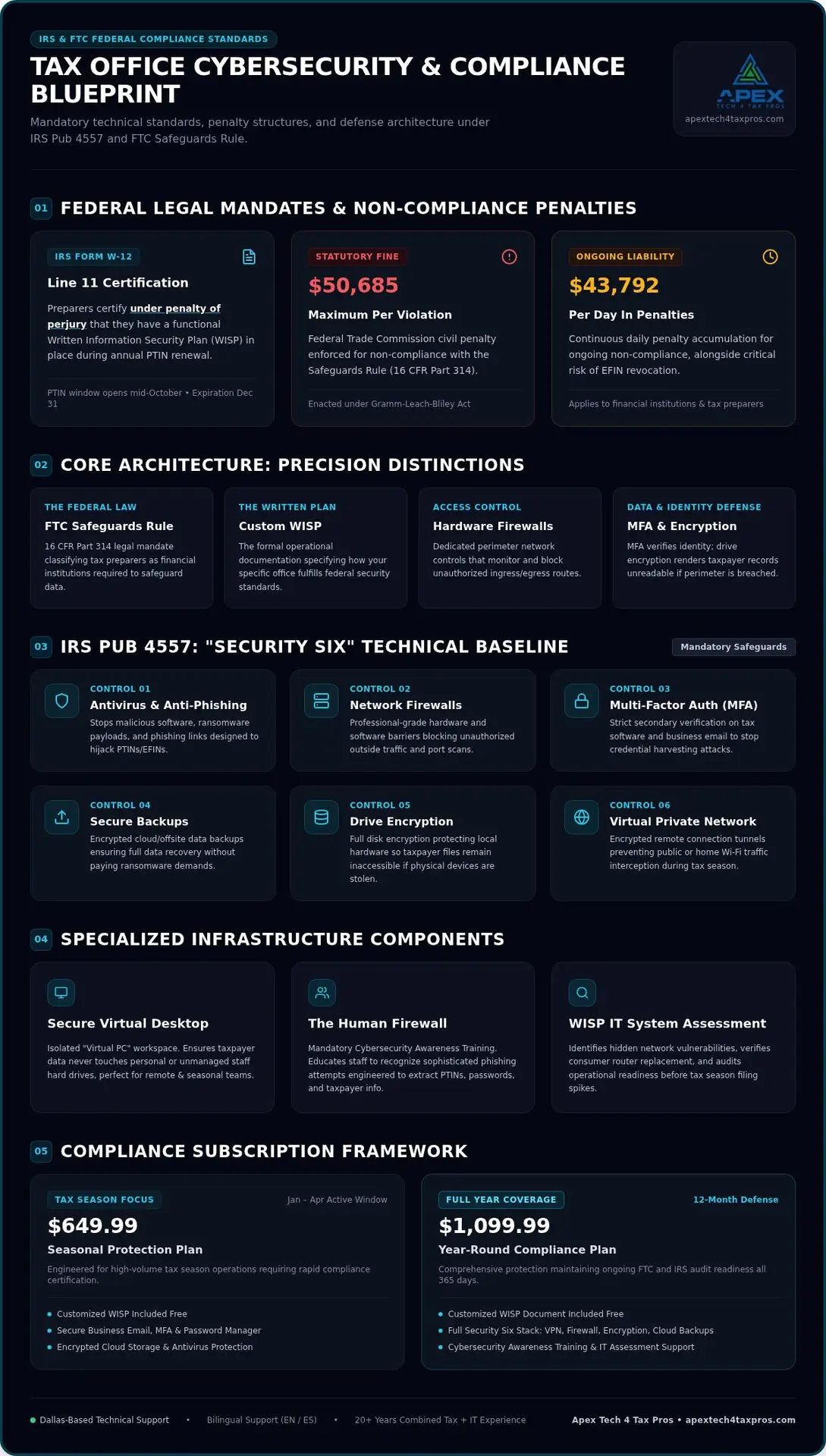
The 2026 PTIN renewal window, which opens in mid-October, brings a serious legal obligation to the forefront of your practice. When you sign Form W-12, specifically Line 11, you’re certifying under penalty of perjury that you have a Written Information Security Plan (WISP) in place. This isn’t just a suggestion; it’s a federal mandate. For those managing it security for dallas tax professionals, the stakes have never been higher. Non-compliance with these standards can result in staggering civil penalties of up to $50,685 per violation and $43,792 per day. Beyond the financial impact, failing to protect taxpayer data risks your EFIN and your professional reputation.
The Legal Reality of the FTC Safeguards Rule
The FTC Safeguards Rule (16 CFR Part 314) stems from the Gramm-Leach-Bliley Act (GLBA), which classifies tax preparers as financial institutions. It’s vital to distinguish between the law and your response to it. The Safeguards Rule is the federal law that requires protection, while the WISP is the formal, documented plan your office uses to meet those legal requirements. You can’t have one without the other and remain compliant. You should confirm the specific documentation requirements for your firm size.
IRS Publication 4557 and the Security Six
IRS Publication 4557 provides the roadmap for safeguarding taxpayer data. It highlights the “Security Six,” a baseline of technical controls that every firm needs to function securely:
- Antivirus protection to stop malicious software.
- Firewalls to block unauthorized network access.
- Multi-Factor Authentication (MFA) for identity verification.
- Secure backup software for reliable data recovery.
- Drive encryption to protect data on hardware.
- Virtual Private Networks (VPNs) for secure remote connections.
Implementing these tools isn’t just about checking a box; it’s about building a robust infrastructure. Investing in specialized it security for dallas tax professionals ensures your firm remains operational and trusted by the North Texas community.
Key Components of a Compliant IT Security Infrastructure
Implementing robust it security for dallas tax professionals requires moving beyond basic software fixes to a comprehensive infrastructure. The foundation of this defense begins with a Secure Office Network. Many practitioners mistakenly rely on consumer-grade routers, but these devices lack the advanced traffic filtering and intrusion prevention required by the FTC Safeguards Rule compliance guide. A professional-grade firewall acts as a digital gatekeeper, while Multi-Factor Authentication (MFA) stands as your most critical barrier against credential harvesting.
Data protection must also extend beyond the physical office walls. Encrypted cloud storage ensures that taxpayer documents remain unreadable even if a breach occurs. For firms utilizing seasonal help, a Secure Virtual Desktop provides a “Virtual PC” environment. This ensures sensitive data never touches a staff member’s personal hard drive, which is a key advantage of specialized it security for dallas tax professionals. It keeps your practice compliant regardless of where the work happens.
Hardware vs. Software Security
Technical defense is a two-part system. Firewalls and secure routers control the access routes into your network, preventing unauthorized entry. Conversely, encryption and password managers protect the data itself if an intruder somehow bypasses the perimeter. You can’t rely on one without the other. If you’re unsure about your current setup, a WISP IT system assessment can identify hidden vulnerabilities.
Staff Training: The Human Firewall
Your technical stack is only as strong as the people using it. The IRS and FTC mandate cybersecurity awareness training as a core component of your Written Information Security Plan. This education helps your team recognize phishing attempts that aim to hijack EFINs or PTINs. Building a “human firewall” is just as vital as any hardware installation. Every employee must understand their role in maintaining the security of the firm’s digital assets.
Evaluating Security Providers: DIY Templates vs. Managed Compliance Solutions
Selecting the right partner for it security for dallas tax professionals requires looking beyond basic technical support. While many general IT firms offer managed services, they often lack the specialized knowledge of IRS Publication 4557 and the FTC Safeguards Rule compliance requirements. A generic approach leaves gaps in your administrative safeguards that could be exposed during a federal audit. Professional risk assessments are essential to identify these vulnerabilities before they lead to a data breach. You need a provider that understands the unique operational rhythm and high stakes of a tax office.
The Hidden Cost of Free WISP Templates
A free template might seem like a shortcut to compliance, but it often creates a false sense of security. In a professional audit, regulators look for evidence that your security plan is active and specifically tailored to your firm’s environment. If your documentation doesn’t match your actual hardware and software controls, the IRS may view your certification on Form W-12 as invalid. Investing in a Custom WISP Document provides the verifiable proof needed to protect your practice during an investigation.
What to Look for in an IT Security Partner
Your security partner should act as a multi-disciplinary protector who speaks the language of both tax and technology. Verify that they have at least 20 years of experience specifically serving the tax industry and can provide bilingual support for your entire team. They must include the complete “Security Six” stack in their managed offerings to meet mandatory federal standards. When you are ready to move from a state of vulnerability to secure compliance, book a WISP assessment to ensure your it security for dallas tax professionals meets every mandatory standard.
Securing Your Practice with Apex Tech 4 Tax Pros Solutions
Apex Tech 4 Tax Pros provides a clear path to relief, taking the technical and administrative weight off your shoulders. We understand that your priority is serving clients, not troubleshooting firewalls or drafting 30-page security manuals. Our subscriptions are engineered specifically for the tax industry, offering a turnkey stack for it security for dallas tax professionals. Whether you choose the Seasonal subscription at $649.99 (January through April) or the comprehensive Yearly subscription at $1,099.99, you receive a Customized WISP Document at no additional charge.
A standout feature of our managed stack is the Secure Virtual Desktop, often referred to as a “Virtual PC.” This solution isolates taxpayer data within a protected cloud environment, ensuring that even if a staff member uses a personal laptop, the sensitive financial records never reside on that local device. This level of isolation is a hallmark of sophisticated it security for dallas tax professionals, providing peace of mind during the high-pressure tax season.
The Apex IT Assessment Process
The journey to full compliance begins with our WISP IT System Assessment. We don’t believe in generic solutions; instead, we analyze your firm’s specific network architecture and data flow. This evaluation identifies existing gaps and serves as the technical foundation for your customized security plan. By documenting your actual hardware and software controls, we ensure your WISP is a living, operational defense rather than just a stack of paper.
Getting Started: Your Path to Compliance
Our onboarding process is designed to be efficient and non-disruptive. Our Dallas-based team, backed by 20+ years of combined tax and IT experience, handles the configuration of your secure business email, MFA, and encrypted storage. We offer full bilingual support in English and Spanish, ensuring your entire staff understands the new protocols. By partnering with us, you gain the protection of a national firm with the personal accountability of a local specialist.
Secure Your Practice for the 2026 Season and Beyond
The 2026 tax year requires a shift from passive compliance to active, verifiable protection. As we’ve explored, your security posture is no longer just a technical detail; it’s a core component of your professional license. Moving beyond the anxiety of potential data breaches or federal audits requires a dedicated partner who understands the intersection of IRS mandates and technical infrastructure. Choosing specialized it security for dallas tax professionals provides the clarity you need to serve your clients without fear.
Our team offers the relief of a fully managed compliance stack, backed by 20+ years of combined experience in both tax and IT. With bilingual support and a free customized WISP included in every subscription, we ensure your firm stays protected and audit-ready. You don’t have to navigate these complex federal requirements alone. We invite you to get protected today. Please email us at info@at4tp.com or book a WISP assessment with our Dallas-based specialists. We’re ready to help you secure your practice and protect your hard-earned legacy.
Frequently Asked Questions
Do tax preparers really need a WISP by law?
Yes. Federal law, specifically the FTC Safeguards Rule (16 CFR Part 314), mandates that all financial institutions create a Written Information Security Plan. The IRS explicitly includes tax preparers in this definition. IRS Publication 5708 provides the framework for this requirement. Without a WISP, you’re unable to legally certify your compliance during the annual PTIN renewal process, which leaves your firm vulnerable to federal audits and license scrutiny.
How do I comply with the FTC Safeguards Rule as a solo practitioner?
Solo practitioners must implement the same core safeguards as larger firms, though the scale of the implementation may differ. You’ll need a customized WISP that identifies your specific risks and the technical tools you use to mitigate them. This includes the “Security Six” measures like multi-factor authentication and drive encryption. Obtaining professional it security for dallas tax professionals helps solo EROs automate these complex requirements without needing a dedicated IT department.
What is Form W-12 Line 11 and why does it mention security?
Form W-12 is the application used for PTIN renewal. Line 11 requires you to certify, under penalty of perjury, that you’re aware of your legal obligation to maintain a WISP. This acknowledgment connects your professional license directly to your data protection practices. If a data breach occurs and you haven’t implemented a plan, the IRS can use this certification as evidence of non-compliance, leading to potential license revocation or federal investigation.
What are the current IRS non-compliance fines for 2026?
The financial stakes for non-compliance are substantial in 2026. The FTC can impose civil penalties of up to $50,685 per violation for failures to follow Safeguards Rule mandates. Additionally, if you’re under a consent order, fines can reach $43,792 per day for ongoing violations. These amounts are adjusted annually for inflation. Effective it security for dallas tax professionals helps you avoid these costs by ensuring every mandatory safeguard is active and documented.
Can I use a free WISP template for my tax office?
You can use a free template as a starting point, but it isn’t a complete solution. IRS Publication 5708 warns that a WISP must be tailored to your specific office environment to be effective. A generic document that hasn’t been operationalized won’t protect you during a professional audit. You must perform a risk assessment and update the plan regularly to reflect changes in your hardware, software, and staff training procedures.