
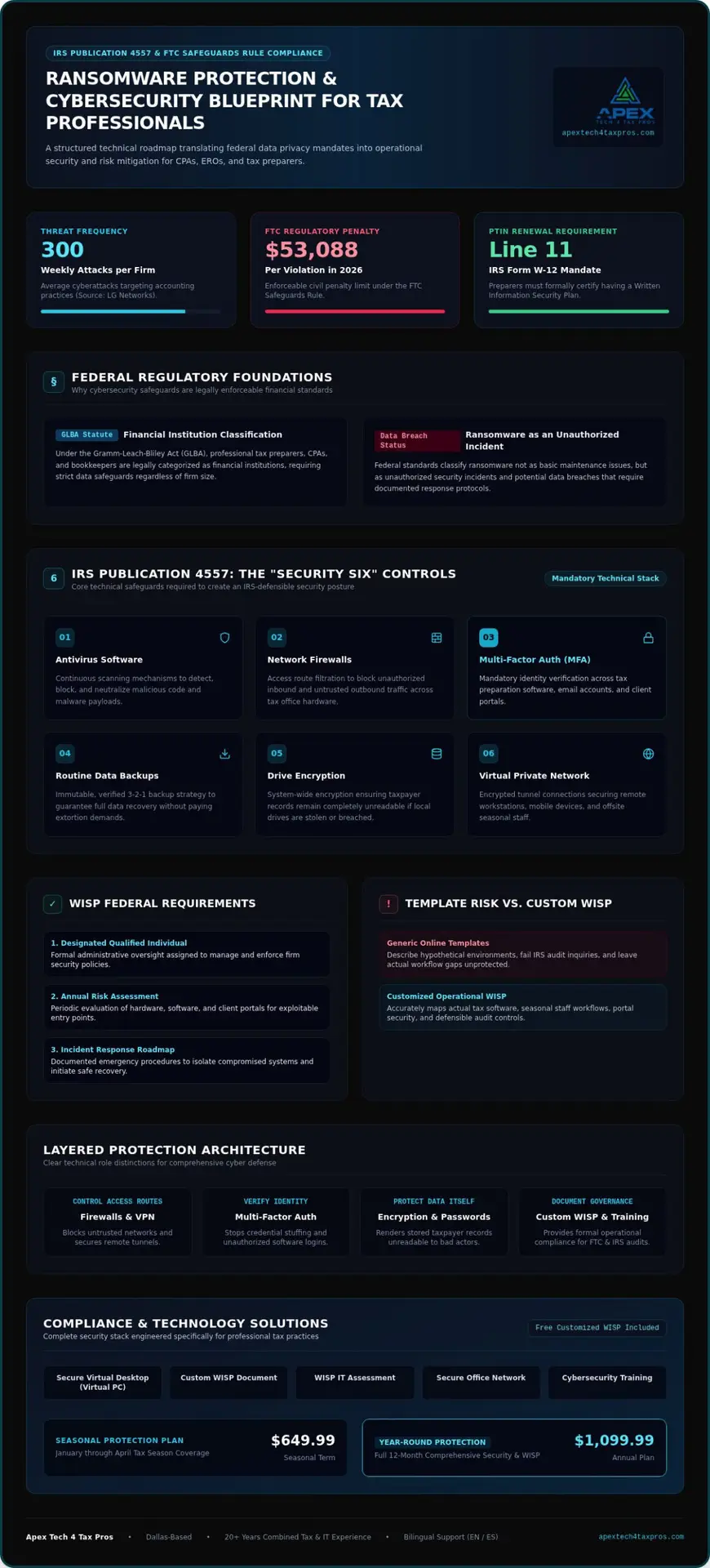
Accounting firms face an average of 300 cyberattacks every week according to LG Networks, proving that robust ransomware protection for accountants is no longer routine IT maintenance; it is the technical foundation of federal compliance. To safeguard taxpayer data and satisfy IRS mandates, your firm must bridge the gap between daily tools like firewalls and a formal Written Information Security Plan (WISP) required by the FTC Safeguards Rule.
You already shoulder immense pressure managing seasonal deadlines, so untangling complex security regulations while worrying about tax season downtime feels like an exhausting burden. Staying compliant shouldn’t feel like an impossible hurdle. In this guide, you’ll discover how to insulate your practice from extortion schemes, keep your critical data recoverable, and effortlessly satisfy IRS Publication 4557 standards. Here is your practical roadmap to turning federal security requirements into reliable operational relief and lasting peace of mind.
Key Takeaways
- Learn why comprehensive ransomware protection for accountants is an enforceable federal standard under IRS Publication 4557 and the FTC Safeguards Rule rather than basic IT maintenance.
- Discover how implementing a customized Written Information Security Plan (WISP) satisfies Form W-12 PTIN renewal requirements and turns compliance into operational relief.
- Identify how annual risk assessments and multi-factor authentication neutralize sophisticated phishing attempts before tax software vulnerabilities can be exploited.
- Explore how immutable, secure cloud backups following the 3-2-1 rule guarantee total data recovery and shield your practice from extortion demands.
Why is ransomware protection for accountants a legal requirement in 2026?
Many tax preparers still view malicious software as a routine operational headache. Under federal guidelines, however, ransomware is legally classified as an unauthorized security incident and a potential data breach. Because the Gramm-Leach-Bliley Act (GLBA) defines professional tax preparers, CPAs, and bookkeepers as financial institutions, implementing dedicated ransomware protection for accountants has shifted from a basic IT suggestion to a strict federal mandate. Meeting these standards insulates your practice from steep liabilities while transforming complex compliance into genuine operational relief.
How does the FTC Safeguards Rule apply to my tax practice?
The FTC Safeguards Rule obligates tax offices to maintain documented administrative, technical, and physical protections for client records. With civil penalties reaching up to $53,088 per violation in 2026, the Federal Trade Commission expects practices of every size to actively secure sensitive records. Modern extortion schemes often steal data before locking local systems. Robust access controls and system-wide encryption neutralize these threats by ensuring unauthorized parties cannot read taxpayer files, even if network boundaries are breached. Be sure to confirm specific regulatory requirements for your firm with a qualified legal professional.
What are the IRS Publication 4557 security standards?
IRS Publication 4557 translates federal privacy statutes into practical requirements, centering on the IRS Security Six framework:
- Antivirus software to detect malicious code
- Firewalls to block untrusted incoming traffic
- Multi-factor authentication (MFA) across all tax programs and email accounts
- Routine, verified data backups
- Drive encryption to safeguard stored taxpayer data
- Virtual private networks (VPNs) for secure remote connections
Adopting these technical safeguards creates a verifiable, defensible position during an IRS inquiry, proving your office took every necessary step to protect taxpayer information.
How do I comply with the FTC Safeguards Rule using a WISP?
Security software stops malicious code, but a Written Information Security Plan (WISP) provides the documented governance federal regulators demand. Antivirus programs and firewalls secure access routes, yet the FTC Safeguards Rule requires a formal operational blueprint. During annual PTIN renewal, Form W-12 Line 11 requires preparers to certify that this written plan exists. Effective ransomware protection for accountants connects technical defenses directly to regulatory compliance, turning a stressful mandate into straightforward relief.
What must be included in a ransomware-ready WISP?
A compliant plan establishes clear protocols before an emergency strikes. Federal guidelines mandate designating a Qualified Individual to oversee your security posture, whether handled internally or managed through a trusted partner. Crucially, your plan must feature an incident response roadmap. If an attack occurs, your team needs clear instructions on isolating compromised hardware, documenting the event, and initiating safe recovery workflows without paying extortion fees.
The danger of using generic WISP templates
Generic, fill-in-the-blank templates downloaded online often fail during an IRS inquiry. Boilerplate paperwork describes hypothetical IT environments rather than your actual tax preparation software, client portal methods, and seasonal staffing workflows. Implementing a tailored Custom WISP Template aligns administrative controls with your true operational reality. Reviewing your specific firm policies with a specialist ensures you remain fully defensible against both audit inquiries and modern cyber threats.
What are the best practices for accounting firms to stop ransomware before it starts?
Stopping malicious intrusions requires a layered defense that pairs active technology with human vigilance. Effective ransomware protection for accountants treats cybersecurity as an ongoing process rather than a one-time software installation. To shield client records and uphold federal standards, tax practices should deploy four fundamental safeguards:
- Conduct an annual Risk Assessment: Evaluate your hardware, client portal workflows, and software configurations to discover hidden entry points before bad actors do.
- Enforce Multi-Factor Authentication (MFA): Require secondary verification across tax preparation platforms, remote portals, and firm email accounts. Passwords alone cannot withstand modern credential stuffing.
- Isolate core processing: Utilize a dedicated Secure Virtual Desktop to separate sensitive tax filing environments from routine internet browsing and personal downloads.
- Formalize the workflow: Align these operational protections within your documented Written Information Security Plan (WISP).
Why is staff training the most effective ransomware defense?
Cybercriminals frequently bypass perimeter firewalls by exploiting human trust through deceptive emails, fake client invoices, or spoofed IRS notices. Routine Cyber Security Training teaches seasonal and permanent staff how to spot social engineering traps before clicking a toxic attachment. Educated employees serve as your first and most reliable security barrier.
Securing your office network and remote work
Hybrid and home-based tax preparation introduces significant vulnerabilities, particularly when staff access taxpayer files over unprotected home Wi-Fi networks. Setting up a dedicated Secure Office Network featuring business-grade VPN encryption keeps data traffic invisible to outsiders. If you want to identify hidden network risks and ensure complete compliance, schedule an IT assessment with our team to safeguard your firm.
How can secure cloud backup and subscriptions simplify your firm’s recovery?
Standard backups connected directly to your office network offer little defense because modern malware actively hunts down and encrypts attached drives. True ransomware protection for accountants relies on immutable cloud backups and the proven 3-2-1 backup strategy: maintain three copies of your records across two different media types, with one stored off-site in an unalterable format. An immutable archive prevents unauthorized modification, ensuring your client tax files remain intact and restorable.
Managing these technical measures alongside peak filing deadlines can easily stretch your practice thin. Apex Tech 4 Tax Pros eliminates this operational burden through turnkey subscriptions. Whether you select the Seasonal plan ($649.99 for January through April) or the comprehensive Yearly plan ($1,099.99 for 12 months of coverage), both options include a customized WISP document to deliver complete regulatory and technical protection.
Recovery vs. Ransom: Why you should never pay
Paying cyber extortionists creates severe ethical and legal risks, and it never guarantees you will actually unlock your files. Extortion groups routinely demand second payments or leak stolen taxpayer records anyway. Secure cloud backups shift the dynamic entirely. Instead of negotiating with criminals, your practice can simply wipe infected devices and restore authenticated data within hours, keeping your client relationships intact.
Next steps: Moving from vulnerability to secure compliance
Transitioning from regulatory uncertainty to total data security doesn’t have to disrupt your ongoing workflow. Discovering vulnerabilities early protects your practice from devastating downtime when it matters most. Take control of your firm’s security posture today: Book a WISP Assessment or email our team at info@at4tp.com to evaluate your safeguards and achieve seamless compliance.
Secure Your Practice and Safeguard Your Tax Season
Navigating federal cybersecurity standards doesn’t have to drain your focus or complicate your busy season. Comprehensive ransomware protection for accountants blends mandatory administrative documentation with active technical defense, ensuring your practice satisfies IRS Publication 4557 and the FTC Safeguards Rule. Documenting your security controls with a tailored WISP fulfills Form W-12 responsibilities, while immutable backups guarantee that extortion threats never disrupt your tax filing operations.
Backed by over 20 years of IRS compliance expertise and NIST-aligned security protocols, Apex Tech 4 Tax Pros provides turnkey solutions that turn regulatory obligations into lasting operational relief. Every subscription includes a customized WISP to keep your office audit-ready and fully defensible. Don’t leave your practice open to unexpected downtime or costly federal fines. Take the next step to protect your reputation and client trust: Book your WISP Assessment today to secure your firm for the 2026 tax season and operate with true peace of mind.
Frequently Asked Questions
Is ransomware protection mandatory for small accounting firms?
Yes, it is mandatory regardless of firm size. Under the Gramm-Leach-Bliley Act and the FTC Safeguards Rule, solo preparers and small practices are legally defined as financial institutions. IRS Publication 4557 requires all professional tax preparers to protect taxpayer data through specific administrative and technical controls. Maintaining dedicated ransomware protection for accountants ensures your firm satisfies federal mandates, prevents devastating downtime, and avoids potential non-compliance penalties.
What is the difference between a WISP and the FTC Safeguards Rule?
The FTC Safeguards Rule is the federal law, while a Written Information Security Plan (WISP) is your documented blueprint for compliance. The Safeguards Rule legally requires tax professionals to protect client records through administrative, physical, and technical controls. Your WISP details exactly how your firm implements those safeguards, outlining specific policies for encryption, staff training, and data recovery to demonstrate your active compliance during an audit.
Can I use a free WISP template for my accounting practice?
Yes, you can begin with a free WISP download template, but you must customize it thoroughly to match your practice. Regulators routinely reject generic, unedited templates during an IRS review because they fail to reflect your actual software configurations, physical office layout, or remote work policies. A free template provides a strong foundational starting point, provided you adapt each section to document your firm’s real-world security practices.
What happens if my accounting firm is hit by ransomware and I am not compliant?
Non-compliant firms face severe federal fines, potential loss of their Electronic Filing Identification Number (EFIN), and extended operational shutdown. The FTC can assess civil penalties reaching up to $53,088 per violation if required safeguards are missing. Without a documented security plan or immutable cloud backups, you risk losing client records permanently, exposing your practice to client lawsuits, and suffering devastating reputational damage during peak filing season.
How much does it cost to implement a professional ransomware protection plan?
Costs vary depending on your operational schedule, but robust ransomware protection for accountants is accessible and structured to fit firm budgets. Apex Tech 4 Tax Pros offers transparent turnkey subscriptions, including a Seasonal plan at $649.99 covering January through April and a Yearly plan at $1,099.99 for 12 months. Both options include a fully customized WISP, making complete technical and regulatory compliance an affordable relief rather than an expensive hassle.