
Could your tax practice show who owns each security task and how the work is documented? The irs pub 4557 compliance checklist helps turn IRS guidance into practical steps you can review and track.
Use it to connect your firm’s day-to-day safeguards with clear responsibilities and follow-up actions, rather than relying on a generic list that may not reflect your practice.
¿Puede su despacho identificar quién es responsable de cada tarea de seguridad y cómo queda documentada? La lista de verificación de la Publicación 4557 del IRS ayuda a convertir las pautas del IRS en pasos prácticos que puede revisar y registrar.
Úsela para relacionar las medidas de seguridad cotidianas de su despacho con responsabilidades claras y acciones de seguimiento, en lugar de depender de una lista genérica que quizá no refleje las necesidades de su práctica.
Key Takeaways
- Use the irs pub 4557 compliance checklist to review how your practice protects taxpayer data across everyday operations.
- Separate IRS guidance, applicable FTC Safeguards Rule requirements, and your WISP so each has a clear role in your security program.
- For each safeguard, document its status, evidence, responsible role, and next action to make gaps easier to address.
- Keep your checklist and WISP aligned with current practices, firm responsibilities, and relevant official guidance.
What does IRS Publication 4557 ask tax professionals to protect?
Use IRS Publication 4557 to review safeguards for taxpayer information, then compare its guidance with your firm’s actual practices. An irs pub 4557 compliance checklist can make that review easier to organize, but completing a checklist alone doesn’t establish compliance. It helps identify areas that need attention and provides a place to document how your practice addresses them.
Is IRS Publication 4557 a law or a security guide?
Publication 4557 is IRS guidance for tax professionals, not a statute. It helps explain data protection practices, while the FTC Safeguards Rule is a separate regulation under 16 CFR Part 314. Consult the current publication on IRS.gov and the Rule’s text and applicability information on FTC.gov. Confirm which obligations apply to your firm, since the relevant scope may differ based on your circumstances.
How does the checklist relate to a WISP?
A Written Information Security Plan (WISP) is the firm’s written plan for its security program. It isn’t a security tool, and it’s distinct from both IRS guidance and legal requirements. Checklist findings can show where the plan needs updating and help identify who should handle each follow-up. For example, if a documented responsibility no longer matches office procedures, record the gap and assign an update. A customized WISP document can help organize firm-specific responsibilities and documentation.
Which taxpayer-data safeguards should your IRS Pub 4557 checklist review?
Organize your review around administrative, physical, and technical safeguards, then verify specific items against current IRS Publication 4557 and applicable FTC Safeguards Rule requirements. Treat these categories as a practical structure, not a substitute for checking the source wording or determining whether an item applies to your firm.
Administrative safeguards guide people and procedures, physical safeguards address access to spaces and records, and technical safeguards help protect information in digital systems. Reviewing all three helps your practice consider taxpayer information across its day-to-day operations.
What administrative and physical safeguards belong on the review?
Consider whether written responsibilities reflect how work is done, whether staff receive security awareness guidance, and how access to taxpayer information is managed. Where relevant, include procedures for vendors who handle information. For physical practices, review office access, paper files, devices left unattended, and how records are securely disposed of when no longer needed. These are review prompts, not a claim that every measure applies identically to every practice.
For each item, note the source you consulted and whether it appears relevant to your firm. This helps distinguish a possible gap from an item that needs further applicability review.
Which technical safeguards should tax professionals check?
Review how your practice manages user access and identity, protects computers and mobile devices, and safeguards stored or transmitted data. Keep each control’s purpose clear: firewalls control network access routes, encryption protects data by making it unreadable without the appropriate key, and multi-factor authentication (MFA) verifies identity through more than one method. Backups support recovery, while secure connections help protect data as it moves across networks. No single control replaces the others.
Consider how secure office network protections fit with your firm’s device and data safeguards. Then use the review to identify which areas need closer examination in your own operating environment.
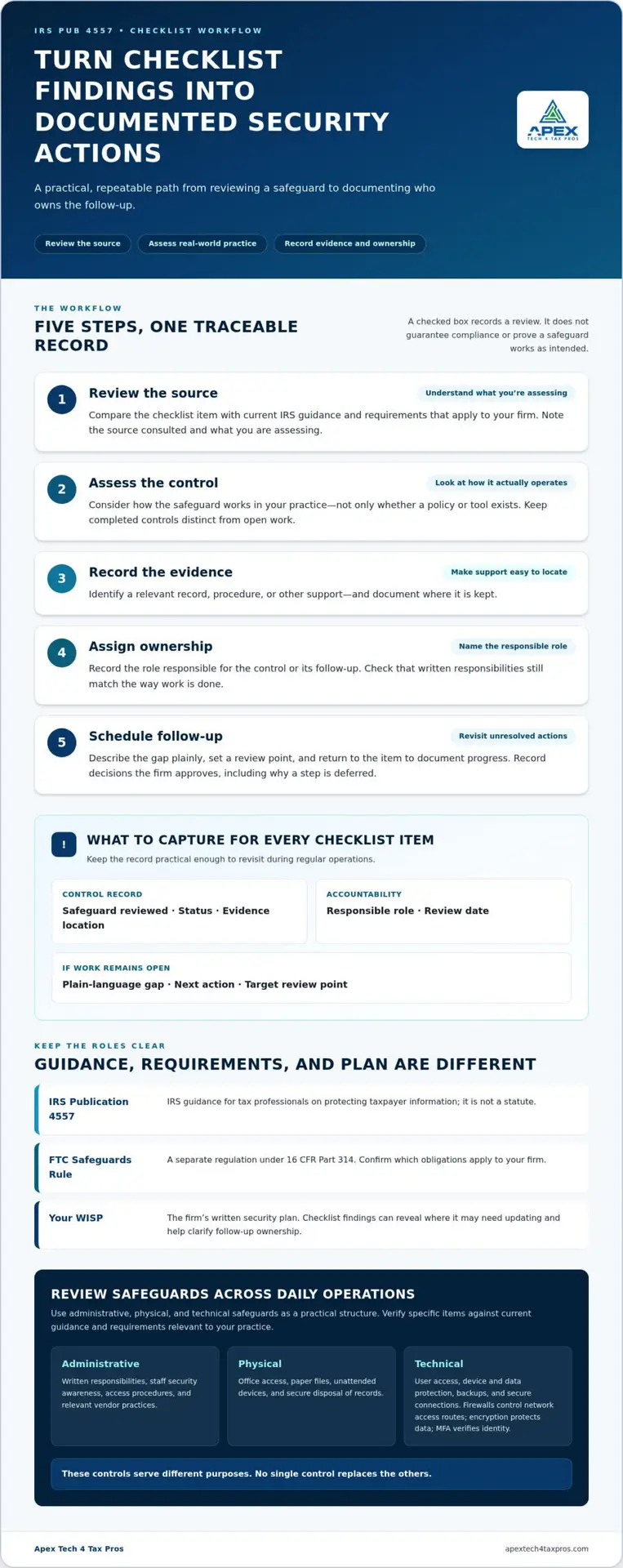
How can you turn checklist findings into documented security actions?
An irs pub 4557 compliance checklist becomes useful when each finding leads to a documented decision or next step. Use a repeatable workflow, and keep completed controls separate from open work. A checked box records a review; it doesn’t guarantee compliance or prove that a safeguard works as intended.
- Review the source. Compare the item with current IRS guidance and applicable requirements, and note what you’re assessing.
- Assess the control. Consider how the safeguard operates in your practice, not just whether a policy or tool exists.
- Record evidence. Identify a relevant record, procedure, or other support and where it’s kept.
- Assign ownership. Name the role responsible for the control or follow-up.
- Schedule follow-up. Set a review point for unresolved actions and revisit the item to document progress.
What should a useful checklist record for each item?
Capture the safeguard reviewed, its status, evidence location, responsible role, and review date. If work remains, describe the gap plainly and record the next action and target review point. For example, “staff procedure needs review” is more actionable when paired with who will update it and when the firm will check the change. A WISP IT system assessment can help structure a firm-specific gap review, but it doesn’t promise a legal outcome.
How can a small tax practice handle open items?
Prioritize based on potential exposure of taxpayer data and operational importance, without relying on an unsupported scoring formula. Assign each task to a role that can act, and document decisions the firm approves, including why a step is deferred. If a gap involves staff practices, consider whether cybersecurity awareness training could address it. Keep the record practical enough to revisit during regular operations.
For help organizing findings into a security action plan, start a firm-specific security review.
How should you maintain your IRS Publication 4557 checklist and WISP?
Keep the irs pub 4557 compliance checklist and your WISP aligned with how the practice actually works. If staff responsibilities, systems, vendors, or work practices change, review whether the documented safeguards and assigned owners still reflect those operations. A useful checklist records what was reviewed, what evidence exists, and what happens next.
Revisit open actions on a schedule that fits your firm, and review them sooner when a meaningful change could affect taxpayer-data handling. Check current IRS guidance, including Publication 4557, relevant FTC Safeguards Rule information, and NIST guidance. Verify source updates and any regulatory timing statements against current primary sources, and confirm which requirements apply to your firm.
When should a firm revisit checklist findings?
Use operational changes as prompts to reopen relevant findings. A new system, vendor relationship, staff role, or way of handling records may affect who has access, which procedures staff follow, or where evidence is kept. Update the associated documentation and record the review. Set a recurring review schedule appropriate to your practice, but don’t treat an arbitrary interval as a legal deadline.
How can expert support make the process manageable?
A customized WISP can organize responsibilities and safeguards around your firm’s operations and identified risks. Apex Tech 4 Tax Pros brings bilingual support and 20+ years of combined tax and IT experience to this work, helping tax professionals connect security documentation with practical operations.
If you’d like support turning findings into a firm-specific plan, book a WISP assessment or email info@at4tp.com. The goal is a clear, maintainable process your team can return to as the practice changes.
Make security review part of how your practice moves forward
Security documentation is most useful when it reflects the way your firm works now, not simply the way it operated when a plan was first written. Treat the irs pub 4557 compliance checklist as a practical reference point as your practice changes, and use each review to keep decisions and responsibilities connected to day-to-day operations.
You don’t need to resolve every open item at once. A clear next step, an accountable owner, and a plan to revisit the issue can help turn a broad security concern into manageable work. For requirements that may apply differently across firms, confirm your obligations with the appropriate official guidance or a qualified adviser.
If you’d like a knowledgeable partner to help shape a WISP and assessment around your tax practice, explore support for your firm’s security planning. A thoughtful next step can make ongoing protection feel more organized and achievable.
Frequently Asked Questions
Is IRS Publication 4557 itself a legal requirement?
No. IRS Publication 4557 is guidance, not a statute or regulation. It explains security practices for tax professionals, while legal duties come from applicable laws and rules, including the FTC Safeguards Rule for firms within its scope. Use the publication to understand safeguards, then consult current IRS and FTC materials to determine which requirements apply to your practice.
Does every tax preparer need a WISP?
Tax professionals subject to the FTC Safeguards Rule must maintain a written information security program. Whether a specific firm falls within the Rule’s scope depends on its circumstances, so don’t rely on a general checklist alone to decide. Review the FTC’s current guidance and confirm the requirements that apply to your practice. A WISP gives the firm a written framework for its security program.
What should an IRS Publication 4557 checklist include?
An irs pub 4557 compliance checklist should help you assess how taxpayer information is handled across your practice. Include review prompts for information collection and storage, who can access records, staff and vendor practices, devices, and incident response. For each prompt, identify the source you’re checking and capture enough context to explain why the item matters to your firm.
How often should a tax practice update its WISP?
There isn’t one review interval that fits every practice. Choose a schedule that suits your operations, and revisit the plan after a meaningful change, such as adopting a new tax platform or changing how staff work remotely. Keep version dates and approval records so your firm can distinguish the current plan from earlier copies and understand when updates were made.