
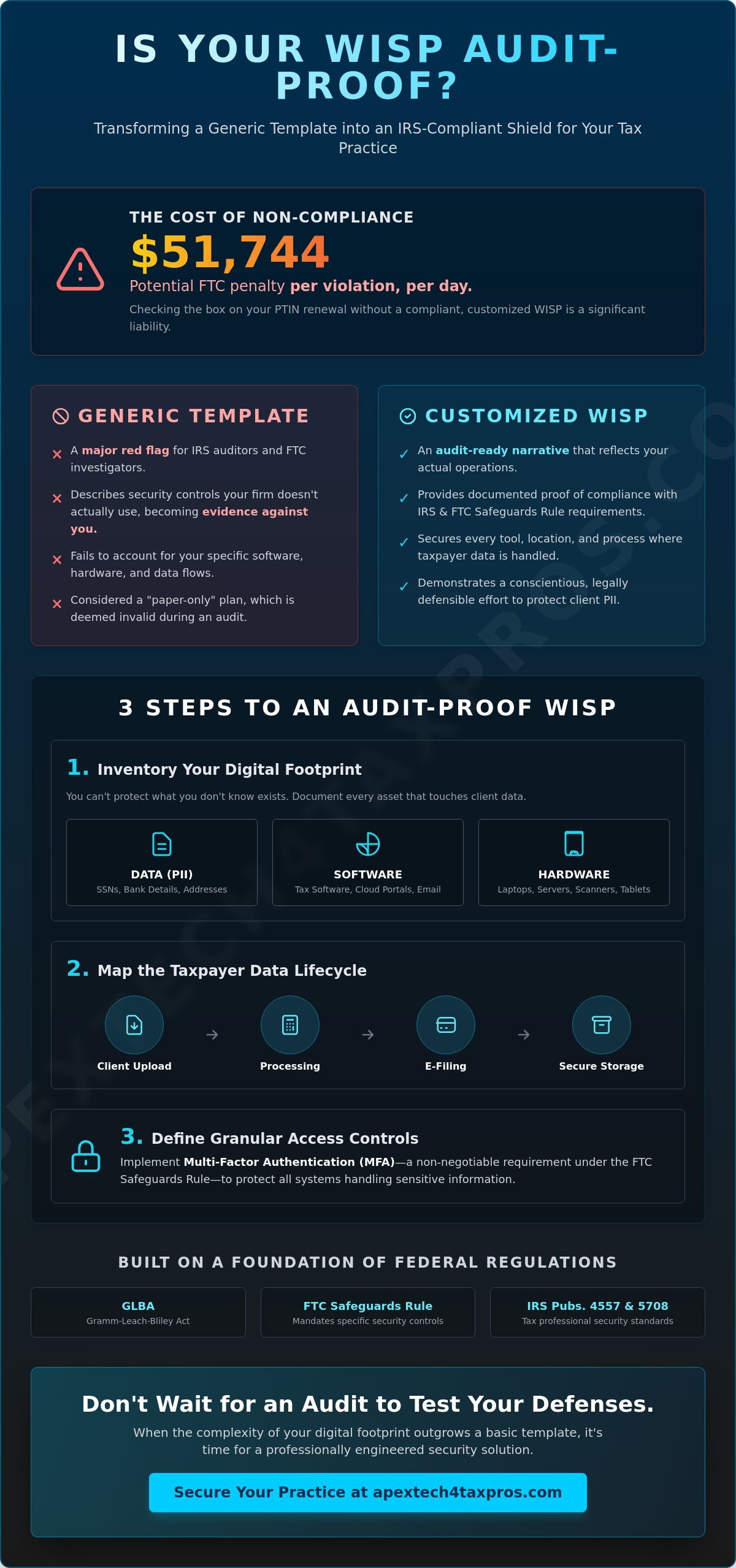
With the FTC now authorized to issue civil penalties of up to $51,744 per violation per day, a generic security plan is no longer a safety net. It’s a liability. You’ve likely felt the pressure of the annual PTIN renewal period, where the IRS mandates an attestation that you have a data security plan in place. It’s frustrating to face technical jargon like “multi-factor authentication” or “encryption at rest” when your primary focus is serving your clients. You shouldn’t have to be a cybersecurity expert to protect your practice, yet the requirement to document your specific digital footprint remains non-negotiable.
We understand the weight of these regulatory burdens and the confusion that arises when trying to figure out how to customize a wisp template for my firm. This guide provides the exact steps to transform a standard template into a robust, IRS-compliant document tailored to your unique operations. You’ll learn how to move beyond basic checklists to create an audit-ready narrative that secures your client data and satisfies the latest requirements of IRS Publication 5708. We will bridge the gap between technical infrastructure and federal compliance, ensuring your firm is prepared for any scrutiny.
Key Takeaways
- Understand why an unedited template is a significant red flag for auditors and how to align your documentation with 2026 IRS standards.
- Follow a structured process for how to customize a wisp template for my firm, moving from generic language to specific, enforceable security policies.
- Map the lifecycle of taxpayer data within your practice to ensure every software tool and storage location is properly documented and secured.
- Define granular access controls that protect sensitive information while meeting the strict multi-factor authentication requirements for tax professionals.
- Recognize when the complexity of your digital footprint requires transitioning from a basic template to a professionally engineered security solution for better audit defense.
Beyond the Template: Why Customization is Mandatory for IRS Compliance
In the 2026 regulatory environment, a Written Information Security Plan (WISP) is far more than a simple document stored in a desk drawer. It’s a legally required framework mandated by the FTC Safeguards Rule under the Gramm-Leach-Bliley Act (GLBA). For tax professionals, this plan serves as a definitive narrative of how your firm protects sensitive taxpayer data. The IRS has moved beyond merely suggesting security practices; they now require a formal, written commitment that is reviewed and updated at least annually. When you sign your annual PTIN renewal on Form W-12, you’re explicitly attesting that you have a WISP in place. Checking that box without a plan that reflects your actual operations can be viewed as a false statement to a federal agency.
A generic, unedited template is often the first red flag during an IRS audit or an FTC investigation. If your WISP describes security controls that don’t exist in your office, the document becomes evidence of non-compliance rather than a defense. Knowing how to customize a wisp template for my firm is the difference between a compliant document and a significant legal liability. The FTC Safeguards Rule dictates that your plan must be appropriate to the size and complexity of your firm, the nature and scope of your activities, and the sensitivity of the customer information you handle. A one-size-fits-all approach fails because it cannot account for your specific software stack, hardware inventory, or employee access levels.
The “Paper-Only” Trap: Why Templates Fail Audits
Auditors today look for evidence of implementation, not just a signed piece of paper. If your plan claims you use encrypted email but your staff regularly sends unencrypted documents, the plan is considered “paper-only” and invalid. Claiming security controls in a template that your firm doesn’t actually use is a dangerous oversight that suggests a lack of oversight. Tax preparers must demonstrate a conscientious effort to safeguard taxpayer information through a document that accurately reflects their actual administrative, technical, and physical safeguards as outlined in IRS Publication 4557.
Regulatory Anchors: GLBA and the Safeguards Rule
The Gramm-Leach-Bliley Act (GLBA) forms the legal backbone of your WISP, classifying tax preparers as financial institutions. Recent updates to the FTC Safeguards Rule have introduced stricter requirements, including the mandatory implementation of multi-factor authentication (MFA) and specific breach notification protocols. If you experience a breach involving 500 or more consumers, you must notify the FTC within 30 days. These requirements are rooted in broader information security standards that prioritize the confidentiality and integrity of data. When you begin the process of learning how to customize a wisp template for my firm, you’re aligning your practice with these federal mandates. Remember that “reasonable” security is a sliding scale; a solo practitioner has different requirements than a multi-state firm, but both must have a plan that is technically accurate and consistently followed.
Inventorying Your Firm’s Digital Footprint (The “Information” in WISP)
Inventorying your digital footprint is the foundational labor of any security plan. You can’t secure data that remains invisible to your oversight. When you begin evaluating how to customize a wisp template for my firm, the first task is a comprehensive audit of where Personally Identifiable Information (PII) resides. This includes social security numbers, bank account details, and residential addresses. Mapping the lifecycle of this data from the moment a client uploads a document to the final e-file submission is vital. Every touchpoint, whether it’s a local server or a cloud portal, must be documented to ensure no gaps exist in your security perimeter.
Documenting hardware assets is equally critical. While laptops are obvious, peripheral devices often create the largest vulnerabilities. A network-connected office scanner that stores temporary copies of tax documents or a tablet used for digital signatures represents a potential entry point for unauthorized access. This inventory is a core component of how to customize a wisp template for my firm that stands up to regulatory scrutiny. Your WISP should list every device that interacts with taxpayer data, including those owned by third-party service providers. Under the FTC Safeguards Rule, your security perimeter effectively includes every vendor you trust with client information.
Mapping Your Tax Software Ecosystem
Your primary tax preparation software is the heart of your operation, but it’s rarely the only place data lives. Customizing your WISP requires accounting for “shadow IT,” which includes local spreadsheets, email attachments, and PDF folders on individual workstations. These fragmented data silos often bypass standard security protocols. For your cloud-based tools, you must verify their security credentials. Referencing the IRS guide to creating a WISP can help you identify the specific standards these providers should meet. Ensure you’ve documented their SOC 2 Type II compliance to prove you’ve performed due diligence on your vendor’s infrastructure.
Physical and Mobile Security Assets
Physical security remains a cornerstone of compliance. Your WISP must describe how you secure physical files and control access points to your office. If your firm supports remote work, the plan must define specific “secure home office” standards, such as the use of privacy screens and the prohibition of shared family computers for firm business. Mobile Device Management (MDM) is another essential layer. If staff members access firm email or portals via smartphones, your plan should describe the technical controls, such as remote wipe capabilities and biometric locks, used to protect that data. If this inventory process feels overwhelming, conducting a professional risk assessment can clarify your firm’s specific vulnerabilities before you finalize your documentation.
Step-by-Step Customization of Your WISP Template
Successfully learning how to customize a wisp template for my firm involves moving beyond boilerplate language to define specific, enforceable actions. A template provides the skeletal structure, but your firm’s unique policies provide the muscle. You must translate generic clauses into technical realities. For instance, your “Access Control” policy shouldn’t just state that access is restricted; it must specify that your firm follows the principle of least privilege. This means documenting exactly which staff members have administrative rights and why those permissions are necessary for their specific roles. By defining who sees what, you create a defensible audit trail that demonstrates active management of your security perimeter.
Your “Incident Response” section requires the most critical customization. In the event of a suspected breach, a generic plan offers no guidance. Your customized document must list the specific steps your team will take within the first 24 hours of discovery. This includes identifying the “Designated Individual” responsible for the response and the specific protocols for notifying the FTC if unencrypted data for 500 or more consumers is compromised. Under the FTC Safeguards Rule, this notification must occur within 30 days of discovery. Documenting your encryption standards for data both at rest and in transit ensures that, even if a physical device is stolen, the information remains unreadable and potentially exempt from certain notification requirements.
Assigning the “Designated Individual” Role
A central requirement of modern compliance is the appointment of a single person responsible for the oversight of your security program. When you determine how to customize a wisp template for my firm, you must explicitly name this individual and document their qualifications. For sole proprietors, you’ll act as your own security coordinator. In this case, your WISP should detail how you maintain your technical knowledge and ensure that your security controls are reviewed on a set 2026 cadence, typically at least once per year or after any significant change to your IT infrastructure.
Drafting Your Employee Training Requirements
Security is a human challenge as much as a technical one. Your WISP must define the frequency and content of your Cybersecurity Awareness Training. It’s not enough to simply provide training; you must document that every staff member has read and understood the customized plan. We recommend integrating signed acknowledgment forms and training completion certificates into your WISP as a dedicated appendix. This creates a ready-to-use package for any IRS auditor who requests proof of your firm’s security culture.
Defining Your Data Retention and Disposal Policy
Customizing your retention policy requires balancing IRS requirements, which often necessitate keeping records for several years, against state-specific privacy laws. Your WISP should specify your exact timelines for data destruction. For physical media, document the use of professional shredding services. For digital assets, describe your “wiping” protocols or the physical destruction of hard drives. Clear disposal policies prevent the “data hoarding” that often leads to increased liability during a security incident.
Avoiding Common Customization Pitfalls and Objections
A persistent myth in the tax industry suggests that solo practitioners or small firms are exempt from the FTC Safeguards Rule. This is incorrect. Every paid tax return preparer with a PTIN must have a Written Information Security Plan. Size does not determine the requirement; it only influences the scale of the implementation. When you look at how to customize a wisp template for my firm, the goal is to create a document that is proportionate to your operations. If you maintain a small, home-based office, your plan will naturally look different than a firm with fifty employees, but the legal mandate for documentation is identical.
One of the most dangerous errors is the “copy-paste” approach to security. Auditors can easily spot a template that hasn’t been edited to reflect actual office practices. For example, if your template includes a section on securing a physical server room but your firm is entirely cloud-based, leaving that section unedited shows a lack of due diligence. Instead of deleting these sections, clearly state that they don’t apply to your firm’s current infrastructure. This demonstrates that you’ve actively reviewed the plan rather than just signing a generic form. This level of detail is critical because 43% of all cyberattacks target small businesses, making accurate documentation a vital defense for any practice.
Your WISP must also address the “human element” of security. Technical controls like firewalls are useless if a staff member falls for a phishing attempt. Your plan should explicitly document how your firm handles social engineering threats. This includes defining the internal process for reporting suspicious emails and verifying wire transfer requests. A plan that only focuses on hardware while ignoring human behavior is incomplete and leaves your practice vulnerable to the most common entry point for data breaches.
The Problem with Over-Promising in Your WISP
Claiming a level of security that you don’t actually provide creates significant legal liability. If your WISP states that you have “24/7 network monitoring” but you only check logs once a week, you’ve created a record of negligence. It’s better to use “active” language for what you currently do and “aspirational” language for future goals. Failure to follow a documented policy can lead to a finding of strict liability during a regulatory investigation, where the mere fact that you violated your own stated rule is enough to trigger penalties.
Bridging the Gap Between IT and Tax Prep
Customizing your plan often requires technical details that only an IT provider can offer. You should ask your provider for specifics on your firewall configurations, backup schedules, and encryption protocols. If your current setup doesn’t meet the standards in your template, you must address those gaps before finalizing the document. You can Learn how our Risk Assessments identify these gaps to ensure your technical reality matches your compliance narrative. Once these gaps are identified, you can confidently finalize a plan that protects your practice and satisfies federal auditors. If you’re ready to secure your firm’s future, consider our Customized Written Information Security Plan service to ensure every detail is handled by experts.
Scaling Your Security: When to Move from Templates to Professional Customization
While a well-edited template provides a baseline for compliance, there is a threshold where the complexity of your practice outpaces the utility of a DIY document. A template is a map, but professional customization is the GPS that accounts for real-time traffic and hazards. As your firm grows, the “blast radius” of a potential data breach expands, making the clinical precision of a professionally engineered plan essential. Moving beyond the basics ensures that your security narrative isn’t just a document for PTIN renewal, but a robust defense mechanism that protects your firm’s heritage and your clients’ most sensitive financial data.
Professionally customized plans offer two significant advantages: superior audit defense and improved insurance eligibility. In 2026, cyber insurance carriers have become increasingly meticulous, often requiring proof that your WISP is based on a formal Risk Assessment rather than just a modified template. A professional plan demonstrates to both insurers and IRS auditors that you’ve moved past a “good faith” effort into a state of secure compliance. This transition allows you to integrate complex elements like Secure Cloud Backup protocols and Cybersecurity Awareness Training records into a single, cohesive strategy that reflects the high-stakes environment of tax preparation.
Trigger Points for Professional WISP Development
Identifying the right time to transition from a DIY approach is critical for maintaining your firm’s integrity. Growth milestones, such as adding your first three employees or opening a second location, are primary indicators that your risk profile has changed. If you’ve started serving high-net-worth clients or expanded into multi-state filings, your documentation must reflect these increased complexities. A professional “Peer Review” of your security plan is becoming an industry standard in 2026, providing an objective validation that your internal controls actually meet the technical requirements you’ve documented. When you reach these milestones, the initial process of learning how to customize a wisp template for my firm should evolve into a partnership with security specialists.
How Apex Tech 4 Tax Pros Simplifies Compliance
There is a fundamental difference between our FREE WISP Download Template and our expert-led Customized Written Information Security Plan service. While the template gives you the tools to start, our professional service provides the expertise to finish with confidence. We bridge the gap between the broad requirements of IRS Publication 4557 and the granular realities of your daily operations, ensuring your plan is technically accurate and legally defensible. We don’t just provide a document; we provide a roadmap for long-term data protection and regulatory adherence. To begin securing your practice today, take the next step: Download our free WISP template or request a professional consultation.
Protecting Your Practice Through Defensible Compliance
Transitioning from a generic document to a tailored security plan is the most effective way to address the technical requirements of the 2026 regulatory landscape. Understanding how to customize a wisp template for my firm allows you to align your daily operations with the strict standards of the FTC Safeguards Rule. This process ensures that your policies on access control, data retention, and incident response aren’t merely theoretical; they’re actively protecting your clients’ sensitive information.
Our team provides the specialized expertise necessary to bridge the gap between technical infrastructure and federal mandates like IRS Publication 4557. With decades of experience serving this niche industry, we understand that your firm doesn’t require just a standard checklist. We provide a complete compliance ecosystem, including professional Risk Assessments and staff training, to instill absolute confidence in your security posture. Take the final step toward total peace of mind today.
Get Your Professionally Customized WISP and Ensure IRS Compliance Today
Your diligence in these matters reflects the high professional standards your clients expect and deserve.
Frequently Asked Questions
Is a free WISP template enough to satisfy an IRS audit?
A free template alone is insufficient for a successful IRS audit because it lacks the firm-specific details required by the FTC Safeguards Rule. Auditors look for evidence that your documented policies match your actual daily workflows and technical setup. If you’re wondering how to customize a wisp template for my firm, the focus must be on technical accuracy rather than just filling in your company name on a generic form.
How often do I need to update my customized WISP?
You must update your WISP at least once every twelve months to remain compliant with current federal standards. Additionally, the IRS and FTC require an immediate update if your firm undergoes a significant change, such as migrating to a new cloud provider or adding a satellite office. Regular reviews ensure your security narrative stays aligned with the evolving threat landscape facing tax professionals.
Who should be the “Designated Individual” in a small tax firm?
The Designated Individual can be anyone with the authority and technical understanding to oversee your security program. In a solo practice, this role naturally falls to the owner. For larger firms, it’s often a senior partner or a dedicated IT manager who has a comprehensive view of the firm’s administrative and technical safeguards.
Does a WISP need to be filed with the IRS or just kept on site?
You don’t file your WISP with the IRS; instead, you must maintain a current copy on-site and be prepared to produce it during an audit. However, you must attest to having a written plan during your annual PTIN renewal process on Form W-12. This attestation makes the document a critical piece of your firm’s legal and regulatory standing.
Can I use a WISP template if I use a 100% cloud-based tax software?
Yes, a WISP is mandatory even if you use 100% cloud-based software because your firm still manages physical endpoints. Your laptops, home-office routers, and mobile devices serve as gateways to that cloud data. A customized plan documents how you secure these entry points, ensuring your firm’s specific digital footprint is protected regardless of where the data is stored.
What are the penalties for not having a customized WISP in 2026?
Non-compliance in 2026 can lead to substantial civil penalties issued by the FTC for each day a violation continues. Beyond monetary fines, the IRS may suspend your ability to e-file returns or revoke your PTIN. These sanctions can effectively shut down a practice, making the process of learning how to customize a wisp template for my firm a matter of business survival.
Do I need a separate WISP for my remote employees?
You don’t need a separate plan for remote staff, but your unified WISP must include specific sections covering remote work protocols. This should detail how firm data is accessed from home offices and the security standards required for residential Wi-Fi networks. One comprehensive plan ensures that all firm operations follow the same protective standards.
How do I document “encryption” in my WISP if I am not a tech expert?
You don’t need to be a technical expert to document encryption; you simply need to identify the standards your software and hardware providers use. Most modern professional tools use AES-256 encryption for data at rest. Your WISP should name the specific tools you use and state that they meet these industry standards, providing a clear technical narrative for auditors without requiring deep engineering knowledge.