
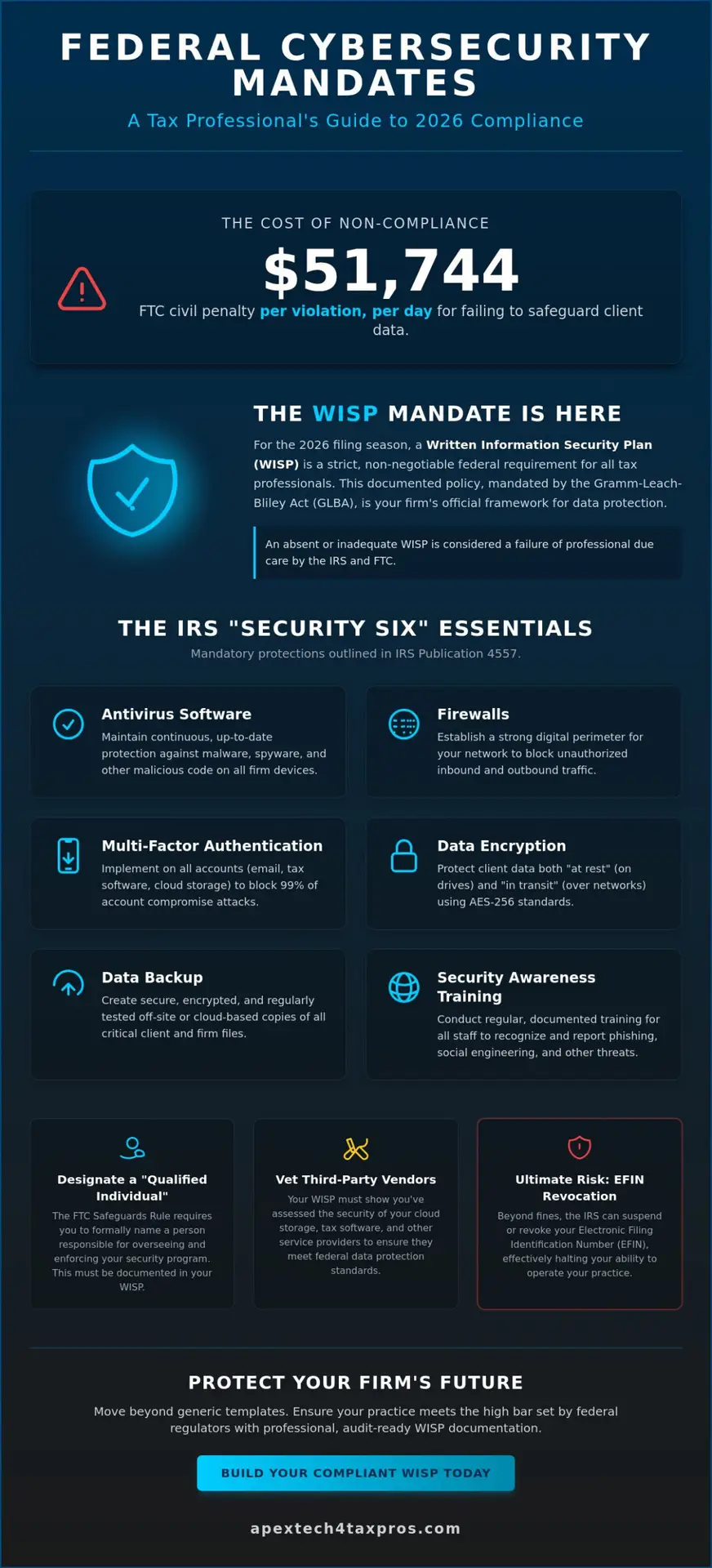
Did you know the FTC can now impose civil penalties of up to $51,744 per violation, per day, for failing to safeguard client data? While these figures are sobering, they underscore the critical need for precision in your firm’s defensive posture. Developing a comprehensive cybersecurity policy for a small accounting practice has transitioned from a recommended best practice to a strict federal mandate for the 2026 filing season. You likely feel the pressure of managing complex tax codes while simultaneously acting as an unplanned IT director. It’s often difficult to distinguish between basic office security and the specific, documented requirements of a Written Information Security Plan (WISP).
We understand that your primary mission is serving clients, not troubleshooting server encryption. This guide will demystify federal expectations and show you how to build an IRS-approved policy that protects your firm without requiring a massive IT budget. We’ll explore the “Security Six” essentials, the latest NIST CSF 2.0 standards, and provide a clear roadmap to achieving full compliance and peace of mind before the next tax season begins.
Key Takeaways
- Identify the core components of the Gramm-Leach-Bliley Act (GLBA) and why a documented WISP is now a non-negotiable requirement for all tax professionals.
- Establish a comprehensive cybersecurity policy for a small accounting practice by addressing the three essential pillars of administrative, technical, and physical safeguards.
- Recognize the tactical advantages cybercriminals find in smaller firms and how to effectively harden your practice against targeted social engineering and ransomware.
- Implement a methodical five-step process to transform your security policy into a living document that evolves alongside emerging digital threats.
- Distinguish between generic security templates and audit-ready professional documentation to ensure your practice meets the high bar set by IRS regulators.
Understanding the Regulatory Mandate: Why Your Small Practice Needs a Formal Policy
Developing a robust cybersecurity policy for a small accounting practice is no longer a matter of internal preference or “best efforts.” For the 2026 filing season, federal regulators have transitioned from offering suggestions to enforcing strict, documented requirements. The center of this regulatory shift is the Written Information Security Plan (WISP), a formal document that the IRS now requires all tax preparers to maintain. This isn’t a generic IT manual; it’s a legally mandated framework that bridges the gap between tax law and technical defense.
The statutory authority for these requirements stems from the Gramm-Leach-Bliley Act (GLBA). While this legislation has existed for decades, its application to small firms has intensified. In 2026, the IRS and FTC view the absence of a WISP as a failure of professional due care. These protocols are rooted in the core principles of information security, ensuring that the confidentiality, integrity, and availability of client financial data remain uncompromised. Failing to meet these standards carries severe consequences. The FTC can impose civil penalties of up to $51,744 per violation, per day, and the IRS maintains the authority to suspend or revoke a firm’s Electronic Filing Identification Number (EFIN), effectively halting its ability to operate.
The FTC Safeguards Rule: A Non-Negotiable Standard
The FTC Safeguards Rule is the regulatory backbone of accounting data privacy. Many practitioners mistakenly believe they’re exempt due to their size, but the rule applies to any business “significantly engaged” in financial activities. This includes “one-person” tax shops. In 2026, a critical requirement is the designation of a “qualified individual” to oversee and enforce your security program. This person doesn’t need to be a full-time IT staffer, but they must be responsible for coordinating your cybersecurity policy for a small accounting practice and reporting on its effectiveness. You cannot claim compliance without this specific designation in your documentation.
IRS Publication 4557: The Roadmap for Tax Professionals
IRS Publication 4557 serves as the primary checklist for your formal policy, breaking down security into seven specific areas: management and education, system security, hardware, facility security, personnel, and community. It’s the blueprint that ensures your WISP isn’t just a stack of papers but a functional defense system. Within this framework, the IRS mandates the “Security Six” essentials that every small firm must implement immediately:
- Antivirus Software: Continuous protection against malicious code.
- Firewalls: A digital perimeter to block unauthorized access.
- Multi-Factor Authentication (MFA): A secondary layer of verification that blocks 99% of account compromise attempts.
- Data Encryption: Utilizing AES-256 standards for data at rest and in transit.
- Data Backup: Secure, off-site copies of critical client files.
- Security Awareness Training: Regular education to help staff recognize phishing and social engineering.
By aligning your practice with Publication 4557, you create a defensible position against both cybercriminals and federal auditors. This structured approach moves your firm from a state of potential vulnerability to one of secure, verified compliance.
The Anatomy of a Compliant Written Information Security Plan (WISP)
Administrative Safeguards: Managing the Strategy
Administrative safeguards are the procedural heart of your plan. Even in a small team, you must designate a Security Coordinator to take ownership of the WISP. This individual oversees the mandatory annual risk assessment, which identifies exactly where your client data might be vulnerable. Your policy should also include clear employee management protocols. These must cover the entire lifecycle of a staff member, from secure hiring practices and ongoing training to immediate access revocation upon termination. Following FTC cybersecurity guidance helps ensure these administrative layers are legally defensible and thorough.
Technical Safeguards: Protecting the Digital Perimeter
Technical controls provide the digital barrier between your clients’ Social Security numbers and cybercriminals. Multi-factor authentication (MFA) is non-negotiable for all tax software and email accounts. It’s a simple step that blocks 99% of account compromise attempts. You must also enforce AES-256 encryption for data at rest and in transit, particularly when emailing tax returns. Implementing automated secure cloud backups is equally vital. This serves as your ultimate insurance policy against ransomware, allowing you to restore operations without ever considering a criminal’s payment demands.
Physical Safeguards: Securing the Office Environment
Physical security is the most overlooked gap in small accounting practices. Technical firewalls mean little if an unauthorized person can walk into your office and access physical files or server hardware. Your WISP must include policies for controlling office access and the secure disposal of paper records and old hard drives through certified shredding services. If you’re currently building your documentation, you can start with a FREE WISP Download Template to see how these pillars fit together. Securing the physical space ensures that your digital defenses aren’t bypassed by simple proximity or negligence.
Addressing the Small Business Myth: Why Accounting Firms Are Prime Targets
Many practitioners believe their firm is too small to attract the attention of international cybercrime syndicates. This assumption is a dangerous miscalculation. In reality, small firms are often preferred targets because they represent the “path of least resistance.” While large financial institutions invest millions in enterprise-grade defense, smaller practices often lack dedicated security personnel. Hackers aren’t just looking for the biggest vault; they’re looking for the easiest lock to pick. For a small firm, a single breach isn’t just a technical hurdle. It often results in catastrophic reputational damage that can end a decades-long practice overnight.
The Monetization of Tax Data
Cybercriminals view your server as a high-yield asset. A single completed Form 1040 contains everything needed for sophisticated identity theft, including Social Security numbers, bank account details, and employment history. On the dark web, this data is sold to facilitate fraudulent tax refunds and large-scale credit applications. According to 2026 data, the average cost of a data breach for businesses with fewer than 500 employees has reached $3.31 million. We’re also seeing a sharp rise in Business Email Compromise (BEC) specifically tailored for CPAs. These attacks use generative AI to mimic client voices or writing styles, tricking staff into diverting funds or sharing sensitive files. Adhering to FTC cybersecurity guidance for small businesses is the first step in ensuring your client data doesn’t become a commodity for criminals.
Beyond the Firewall: The Human Element
Technical defenses like firewalls and antivirus software are essential, but they are not infallible. Research indicates that 60% of data breaches involve a human element, such as phishing, social engineering, or simple negligence. A hacker doesn’t always need to “break in” if they can convince an employee to “let them in” through a malicious link. This is why staff training is not a secondary task; it’s a foundational pillar of a cybersecurity policy for a small accounting practice. Your WISP must mandate regular Cybersecurity Awareness Training to ensure every team member can identify a deepfake audio message or a spoofed IRS notification. A disciplined, vigilant staff acts as a human firewall, providing a layer of protection that software alone cannot replicate.
Implementing Your Policy: From Documentation to Daily Practice
A cybersecurity policy for a small accounting practice serves no purpose if it remains a static file on a server. To satisfy FTC auditors and protect your clients, you must translate your written plan into a series of repeatable, daily actions. This transition from documentation to practice ensures that security becomes a core part of your firm’s culture rather than a seasonal burden. Implementation is a methodical process that requires clear ownership and consistent execution. It’s vital to remember that your WISP is a living document. As new threats emerge and tax software evolves, your defensive protocols must adapt to maintain their effectiveness.
Integrating these requirements into your daily workflow doesn’t have to compromise productivity. When security steps like multi-factor authentication and secure file sharing become habitual, they protect the firm without creating significant friction. The goal is to build a resilient environment where data protection is as fundamental as accurate bookkeeping. This disciplined approach is what distinguishes a compliant firm from one that is merely hoping to avoid a breach.
Step 1: Conduct a Professional Risk Assessment
The first step in any implementation is identifying exactly where your sensitive data resides. You must evaluate whether non-public personal information (NPI) is stored on local hard drives, external servers, or within cloud-based tax preparation software. A thorough assessment also examines the security protocols of your software vendors. To ensure no vulnerability is overlooked, many firms choose to learn more about our professional risk assessment services. This baseline allows you to prioritize your technical upgrades based on actual risk rather than guesswork.
Step 2: Draft and Distribute the WISP
While generic templates offer a starting point, your WISP must be customized to reflect your firm’s specific hardware, software, and staffing structure. Once the document is finalized, every employee must receive a copy and sign a formal acknowledgment. This signature is a critical component of your legal defense, proving that staff were informed of their security responsibilities. You should also keep a physical copy of your WISP in a secure off-site location. This ensures you can access your incident response plan even if your primary office or network is compromised.
Step 3: Ongoing Training and Testing
Staff vigilance is your most dynamic defense. You should schedule quarterly cybersecurity awareness training sessions to keep emerging threats like AI-driven phishing top-of-mind for your team. Complement this training by running unannounced phishing simulations to test real-world responses. If an employee fails a simulation, use it as a low-stakes coaching opportunity. This ongoing testing ensures that your cybersecurity policy for a small accounting practice remains effective long after the initial drafting. To maintain compliance, you can partner with us for customized WISP development that includes these essential testing protocols.
Finally, remember the “Annual Review” requirement. The FTC Safeguards Rule mandates that you review and update your security plan at least once a year. This review should account for any changes in your technology stack, new federal regulations, or lessons learned from previous security incidents. Documenting this review is just as important as the review itself, as it provides the paper trail auditors require.
Professional WISP Development: Protecting Your Firm’s Future
Choosing between a DIY approach and professional WISP development is a decision that impacts your firm’s long-term viability. While many practitioners attempt to use a generic template found online, these documents often fail to meet the rigorous standards of an IRS audit. A cybersecurity policy for a small accounting practice must be as unique as the client list it protects. It requires a multi-disciplinary approach that combines technical IT infrastructure with a deep understanding of federal compliance mandates. By investing in professional development, you’re not just checking a box; you’re building a resilient foundation for your firm’s growth.
Beyond mere compliance, a robust security posture serves as a distinct competitive advantage. High-value clients, such as corporate entities and high-net-worth individuals, are increasingly scrutinizing the data protection practices of their financial advisors. Demonstrating that you have a professionally managed Written Information Security Plan signals that you value their privacy as much as their financial success. It positions your practice as a sophisticated, safe harbor in an era of digital volatility.
The Danger of the “Set It and Forget It” Mentality
Static policies become obsolete within months in the 2026 threat landscape. Cybercriminals constantly evolve their tactics, which means a “set it and forget it” mentality is a significant liability. A managed security partner who understands the tax industry provides the vigilant oversight necessary to keep your defenses current. This professional management reduces the personal liability of firm owners, ensuring that you aren’t left standing alone if a regulatory body requests a compliance review. Our heritage in this niche allows us to anticipate shifts in the regulatory environment before they impact your daily operations.
How Apex Tech 4 Tax Pros Bridges the Gap
Apex Tech 4 Tax Pros bridges the gap between technical complexity and regulatory necessity. Our customized WISP services are specifically engineered to meet the latest IRS and FTC mandates, moving beyond generic checklists to provide a functional, defensible strategy. We integrate comprehensive risk assessments and ongoing staff training into a single, cohesive solution designed specifically for the accounting niche. Whether you’re just starting your compliance journey or need to modernize an existing plan, you can download your FREE WISP Template or schedule a consultation today to secure your firm’s future.
Securing Your Firm’s Legacy for the 2026 Filing Season
The 2026 regulatory environment leaves no room for ambiguity. A Written Information Security Plan is now a fundamental requirement for every tax professional, regardless of firm size. We’ve explored how a comprehensive cybersecurity policy for a small accounting practice must bridge the gap between technical safeguards and federal documentation mandates. By moving beyond generic templates and embracing a living, risk-based strategy, you protect your clients’ sensitive data and your firm’s hard-earned reputation.
Professional oversight ensures that your defenses stay ahead of evolving AI-driven threats and shifting IRS standards. Our team specializes in providing IRS Publication 4557 compliant plans and expert-led risk assessments designed specifically for the unique needs of tax and accounting professionals. Don’t wait for an audit or a breach to discover the gaps in your security posture.
Secure Your Practice with a Customized WISP Today. You’ve spent years building your practice; let’s ensure it remains a safe and compliant harbor for your clients for years to come.
Frequently Asked Questions
Is a WISP legally required for a solo accounting practice?
Yes, a WISP is legally required for solo practitioners under the Gramm-Leach-Bliley Act and the FTC Safeguards Rule. The IRS mandates that every tax professional, regardless of firm size, maintains a current, documented Written Information Security Plan. This requirement ensures that even the smallest practice implements a baseline of protection for sensitive client data, such as Social Security numbers and bank details.
What is the difference between an IT policy and a WISP?
An IT policy typically outlines acceptable use of office equipment, whereas a WISP is a specialized regulatory document. While a general IT policy might cover password strength or personal internet browsing, a WISP specifically addresses the administrative, technical, and physical safeguards required by federal law. It’s a comprehensive framework designed to protect non-public personal information from unauthorized access or disclosure.
How often does the IRS require me to update my cybersecurity policy?
The IRS and FTC require you to update your security documentation at least once per year. However, you should also revise your cybersecurity policy for a small accounting practice whenever there are significant changes to your technology stack, such as migrating to new cloud software or hiring remote staff. Regular reviews ensure your defensive protocols remain effective against the latest social engineering and ransomware tactics.
What are the penalties for not having a Written Information Security Plan?
Non-compliance can lead to severe financial and operational penalties. The FTC can impose civil penalties of up to $51,744 per violation, per day, for failing to meet Safeguards Rule standards. Additionally, the IRS may suspend or revoke your Electronic Filing Identification Number (EFIN), effectively preventing you from operating your business during the tax season.
Can I use a free WISP template for my accounting firm?
You can use a template as a starting point, but it must be extensively customized to your firm’s specific operations. Generic templates often lack the firm-specific details that IRS auditors look for during a compliance review. To be valid, your plan must reflect your actual software, physical office security, and the specific individual designated to coordinate your security program.
Does my cybersecurity policy need to cover remote employees?
Yes, your WISP must explicitly address security protocols for any remote or hybrid work environments. This includes mandating multi-factor authentication for home networks, ensuring data is encrypted on laptops, and establishing clear rules for accessing client files from off-site locations. A compliant cybersecurity policy for a small accounting practice leaves no blind spots in its digital perimeter.
What happens if I have a data breach but I have a WISP in place?
Maintaining a WISP provides a critical defensible position during a post-breach investigation. While a WISP cannot prevent every attack, it proves to regulators that you exercised professional due care and followed federal guidelines. This documentation can significantly mitigate civil penalties and help you avoid a “willful neglect” designation, which carries much harsher legal consequences.
Does the FTC Safeguards Rule apply to small tax preparers?
Yes, the FTC Safeguards Rule applies to any business significantly engaged in financial activities, which includes all tax preparers. Under this rule, accounting firms are classified as financial institutions. This classification remains true whether you have one hundred employees or you’re a solo practitioner working from a home office, making compliance a universal requirement for the industry.