
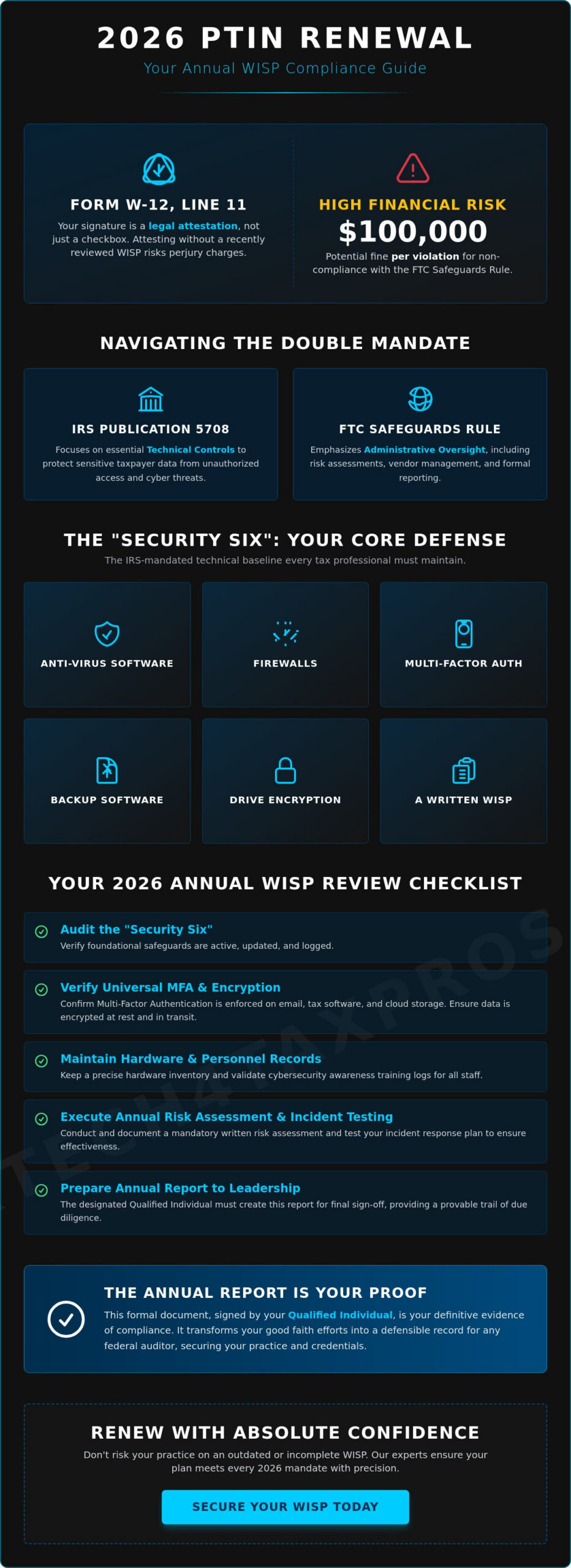
Is your signature on Form W-12 Line 11 a statement of fact or a legal liability waiting to be triggered? As you approach the December 31 deadline for PTIN renewal, the requirement to attest to a Written Information Security Plan carries significant professional weight. We recognize the pressure of balancing high-stakes client service with the technical demands of IRS Publication 5708 and the FTC Safeguards Rule. It’s understandable to feel concerned that a subtle gap in your documentation could lead to perjury charges or civil penalties reaching $100,000 per violation.
This guide offers a comprehensive annual wisp review checklist for financial firms, designed to ensure your security program meets every 2026 mandate with precision. You’ll gain a clear understanding of the technical controls now required, including universal multi-factor authentication and specific vendor oversight protocols. We’ll preview the essential compliance artifacts you must maintain to secure your practice and provide a provable trail of due diligence for any federal auditor, allowing you to renew your credentials with absolute confidence and protective reassurance.
Key Takeaways
- Understand the legal gravity of Form W-12, Line 11 and how a compliant WISP protects your practice from perjury charges during the 2026 PTIN renewal season.
- Learn how to audit the IRS-mandated “Security Six” and maintain a precise hardware inventory that accounts for every device accessing your network.
- Deploy our annual wisp review checklist for financial firms to validate your 2026 Cybersecurity Awareness Training logs and enforce the principle of least privilege.
- Master the requirements for your mandatory written risk assessment and incident response testing to ensure your safeguards remain effective against evolving threats.
- Identify the essential components of the Annual Report to Leadership that the FTC Safeguards Rule requires your Qualified Individual to provide for final sign-off.
Why the Annual WISP Review is Mandatory for 2026 PTIN Renewals
A Written Information Security Plan (WISP) isn’t a mere suggestion or a template to be filed away; it’s a federal mandate that serves as the cornerstone of your firm’s data protection strategy. For the 2026 tax season, the IRS has made it clear that “checking the box” on regulatory compliance without active maintenance is a high-risk gamble. Federal regulators have shifted away from a minimal-effort approach toward active enforcement. As of January 2026, penalties for non-compliance with the FTC Safeguards Rule can reach up to $100,000 per violation. This shift means that an annual wisp review checklist for financial firms is no longer just a best practice. It’s a necessary shield against catastrophic financial and professional loss.
The Intersection of IRS Pub 5708 and FTC Safeguards
The regulatory environment for tax and financial professionals is uniquely complex because you must satisfy two distinct federal agencies. IRS Publication 5708 focuses heavily on technical controls like universal multi-factor authentication (MFA), while the FTC Safeguards Rule emphasizes administrative oversight. Both agencies rely on the core principles of information security to define what a “reasonable” plan looks like. A compliant 2026 plan must include the “Security Six” baseline: anti-virus software, firewalls, multi-factor authentication, backup software, drive encryption, and a WISP. Central to this is the “Qualified Individual,” a designated person responsible for overseeing the security program. Their annual sign-off isn’t a formality; it’s a documented confirmation that your safeguards actually work.
The Perjury Risk: Understanding Form W-12 Line 11
When you renew your Preparer Tax Identification Number (PTIN) for the $18.75 fee, you encounter Form W-12, Line 11. This line requires you to attest that you have a WISP in place. Doing so without a recently reviewed and updated plan constitutes a false attestation under penalty of perjury. To an IRS auditor, “maintaining a WISP” means you’ve conducted a risk assessment within the last 12 months and updated your protocols to match current threats. The ideal timeline for this review is during the late summer or early fall, well before the December 31 expiration of your previous year’s PTIN. Utilizing a structured annual wisp review checklist for financial firms ensures that your attestation is backed by verifiable artifacts rather than just good intentions. It transforms a potential legal liability into a provable record of professional diligence.
Technical Controls: Auditing the Security Six and Hardware Inventory
Auditing technical controls requires moving beyond policy statements into the realm of verifiable evidence. Your annual wisp review checklist for financial firms must begin with the “Security Six,” the foundational safeguards the IRS expects every tax professional to maintain. These include anti-virus software, firewalls, multi-factor authentication, backup software, drive encryption, and the WISP itself. Under the FTC Safeguards Rule, these controls aren’t optional; they must be actively monitored and tested to ensure they remain effective against modern exploits. If you need a professional perspective on these technical requirements, consider a Customized Written Information Security Plan to bridge any gaps.
Effective data protection for 2026 centers on universal multi-factor authentication (MFA) for every system that touches personally identifiable information (PII). This standard, clarified in the August 2024 update to IRS Publication 5708, applies to email, tax software, and cloud storage. Encryption remains equally critical. You must verify that data is protected at rest on every workstation and in transit during any client communication. If these technical layers are compromised, a Secure Cloud Backup serves as your final fail-safe, providing the only reliable path to recovery after a hardware failure or ransomware event.
Verifying MFA and Encryption Artifacts
An auditor won’t take your word that MFA is active; they’ll want to see the logs. Your annual wisp review checklist for financial firms should include a process for capturing “point-in-time” screenshots of your security dashboard. These artifacts prove that encryption is enabled on all removable drives and that your MFA deployment covers 100% of your staff. Keeping these records in a dedicated compliance folder demonstrates the proactive oversight regulators now demand.
The 2026 Hardware and Device Lifecycle Audit
Your hardware inventory must account for every device that connects to your network, including mobile phones and home office equipment. The audit process involves identifying retired or “bricked” hardware and ensuring it has been decommissioned properly. You should collect and file secure disposal certificates for old hard drives and even office copiers, which often store sensitive document images. For firms utilizing remote staff, this is also the time to audit “Bring Your Own Device” (BYOD) policies to ensure personal hardware meets the firm’s encryption standards.
Administrative and Physical Safeguards: Personnel and Vendor Reviews
Technical perimeters are only as strong as the individuals who operate within them. While encryption and firewalls form a digital shield, the integrity of your security posture relies on the administrative and physical protocols that govern your daily operations. Integrating an annual wisp review checklist for financial firms into your workflow allows you to identify where human behavior or physical access might create vulnerabilities. This process ensures that your firm’s commitment to security extends beyond software into the very culture of your office.
Enforcing the principle of least privilege is a critical administrative safeguard. It’s a pragmatic approach that restricts employee access to only the specific client files and systems required for their professional duties. During your annual review, you must verify that access levels remain appropriate for each staff member’s current role. Physical security also demands your attention. This includes maintaining visitor logs, securing server rooms with physical locks, and enforcing clean-desk policies to prevent sensitive documents from being left in plain sight. These measures are foundational components of a data security plan for tax professionals, as mandated by the IRS and FTC.
Employee Training Records and Access Revocation
Training shouldn’t be a static, one-time event. For the 2026 tax season, your Cybersecurity Awareness Training must address sophisticated threats like AI-generated phishing and deepfake scams. You’re required to maintain detailed logs proving that all personnel have completed this training. Equally important is the “Same-Day Revocation” process. When an employee leaves the firm, their access to all systems, from email to tax software, must be terminated immediately. Your annual wisp review checklist for financial firms should include a verification that every current staff member has signed an updated 2026 security policy to confirm their understanding of these high-stakes requirements.
Vetting Third-Party Service Providers (TSPs)
Your responsibility for data protection doesn’t end at your office door. You’re legally required to oversee the security practices of any third-party vendor that handles client information. This “Trust but Verify” approach involves reviewing the contracts of your software providers, CRM platforms, and cloud services to ensure they maintain their own compliant WISPs. Requesting SOC 2 reports from key vendors provides the clinical precision needed to validate their security claims. As you finalize your 2026 review, update your vendor inventory to include any new SaaS tools adopted during the year, ensuring no third-party connection remains unvetted.
Executing the Mandatory Annual Risk Assessment and Incident Testing
A WISP is not a static trophy for your office shelf; it’s a dynamic operational cycle. Both the FTC Safeguards Rule and IRS guidelines require a “written” risk assessment to be updated at least every 12 months. This process involves a disciplined evaluation of how your firm manages sensitive data as threats evolve. By following an annual wisp review checklist for financial firms, you can systematically identify vulnerabilities before they become liabilities. If your firm needs a structured approach to this requirement, our professional Risk Assessments offer the clinical precision and documentation necessary to satisfy an auditor’s scrutiny.
The 2026 tax season presents a unique set of challenges that must be modeled within your assessment. Internal threats, such as accidental data exposure by staff, are just as critical as external attacks from sophisticated criminal syndicates. Your Incident Response Plan (IRP) serves as your playbook for these moments. However, a plan that hasn’t been tested is merely a theory. Annual “tabletop” testing transforms that theory into a proven capability. Documenting the “lessons learned” from these exercises provides the definitive proof that your WISP is an active, living program rather than a forgotten PDF.
Identifying New Threats in the 2026 Landscape
Modern threat modeling must account for sophisticated business email compromise (BEC) schemes that use personalized data to deceive even seasoned professionals. You must also assess the risk of “shadow IT,” which refers to unauthorized applications or cloud storage used by staff without official approval. Every assessment must conclude by documenting “residual risk.” Residual risk is the level of vulnerability that remains after all your security controls have been implemented. Acknowledging this reality is a hallmark of a mature, compliant security program.
Tabletop Exercises for Incident Response Plans
Running a 30-minute “What If” session for a ransomware scenario is one of the most effective ways to validate your IRP. During this exercise, you should document the participants, the specific scenario, and any gaps identified in your response. This is the time to verify that your “Breach Notification” contact list is current, including legal counsel and regulatory bodies. The goal isn’t a perfect performance; it’s the identification of weaknesses so they can be remediated before a real crisis occurs. These documented sessions are the artifacts that prove your firm is vigilant and prepared.
Finalizing the Annual Report to Leadership and WISP Updates
The culmination of your security cycle is the Annual Report to Leadership. This document is a specific mandate under the FTC Safeguards Rule, and it transforms your year of technical and administrative effort into a legally defensible record. For the 2026 tax season, the report must provide a clear summary of your firm’s security posture. It’s the final piece of the annual wisp review checklist for financial firms, ensuring that stakeholders understand their regulatory obligations and the steps taken to mitigate risk. This process signals to both regulators and clients that their sensitive data is in safe, capable hands.
A Qualified Individual must lead this finalization process. Their sign-off confirms that the safeguards are not just present but are functioning as intended across your technical infrastructure. This report serves as a bridge between technical operations and executive responsibility. It provides the protective reassurance that your firm is prepared for both regulatory scrutiny and potential cyber events. By documenting this review, you move from a state of potential vulnerability to a state of secure compliance.
Drafting the Qualified Individual’s Compliance Report
The report must address four essential elements to meet 2026 standards. First, it should detail the overall status of the information security program. Second, it must include the results of any testing, such as the tabletop exercises conducted earlier in the year. Third, it should evaluate the performance of third-party service providers and their adherence to your standards. Finally, it must list specific recommendations for improvements. Presenting security gaps to firm owners should be handled with a mission-driven approach, focusing on professional remedies rather than faults. We recommend maintaining an “Artifact Folder” where all proof of compliance, from training logs to MFA screenshots, is stored for immediate retrieval during an audit.
Beyond Templates: The Case for Professional WISP Management
Relying on a “free template” is a common pitfall that often leads to failure during an actual IRS audit. Generic documents lack the clinical precision required to address your firm’s unique hardware, software, and personnel structure. A Customized WISP provides a plan specifically engineered for your niche, identifying blind spots that a template would naturally miss. Professional management ensures your documentation evolves alongside federal regulations, protecting you from the $100,000 per-violation penalties enforced by the FTC. Executing a professional Risk Assessment is the ultimate way to secure the peace of mind that your practice is truly compliant and your professional reputation remains untarnished.
Securing Your Firm’s Future for the 2026 Tax Season
Navigating the intersection of IRS mandates and FTC regulations requires more than a casual commitment to security. We’ve established that a WISP is a living process, demanding rigorous technical auditing and proactive administrative oversight. By implementing a structured annual wisp review checklist for financial firms, you transform a complex regulatory burden into a provable record of professional diligence. This disciplined approach ensures your PTIN renewal remains valid and your client data stays protected against increasingly sophisticated threats.
Our team brings over 20 years of niche compliance experience to your practice. As specialists in the FTC Safeguards Rule and experts in IRS Publication 4557 and 5708 guidance, we provide the clinical precision your firm needs to thrive in a high-stakes environment. Don’t leave your compliance to chance or outdated templates. Get Your Professional 2026 WISP Compliance Assessment today to secure the protective reassurance your practice deserves. You’ve built a legacy of trust with your clients; we’re here to help you defend it.
Frequently Asked Questions
Is an annual WISP review really required for small one-person tax firms?
Yes, the size of the firm doesn’t exempt you from federal mandates. The Gramm-Leach-Bliley Act (GLBA) and the FTC Safeguards Rule apply to all financial institutions, including solo practitioners. Every tax professional must maintain a plan to protect client data, and the 2026 PTIN renewal process reinforces this by requiring an attestation from every individual preparer regardless of firm size.
What is the difference between an IRS WISP and the FTC Safeguards Rule?
The IRS WISP is a specific requirement outlined in Publication 4557, while the FTC Safeguards Rule is the broader federal regulation that mandates it. Think of the IRS guidelines as the “how-to” for tax professionals to comply with the FTC’s legal “must-do.” Both agencies coordinate to ensure that firms handle sensitive taxpayer information with technical and administrative safeguards that meet modern security standards.
Does the IRS actually audit Written Information Security Plans?
The IRS is increasingly requesting WISPs during office visits and as part of broader compliance checks. If your firm experiences a data breach, the IRS and the FTC will immediately demand your written plan to determine if you were negligent. Failing to produce a documented, reviewed plan can lead to severe penalties and the termination of your PTIN.
What artifacts do I need to keep as proof of my annual WISP review?
You should maintain a dedicated compliance folder containing dated risk assessments, training logs, and screenshots of your technical controls. An effective annual wisp review checklist for financial firms will prompt you to save evidence of your MFA deployment and hardware inventory updates. These artifacts serve as the clinical proof that your security program is active rather than just a dormant document.
Can I use a free WISP template for my 2026 compliance?
While a free WISP download template provides a helpful starting point, it isn’t a complete solution on its own. You must customize any template to reflect your firm’s specific hardware, software, and personnel. A generic document that doesn’t match your actual operations won’t protect you during a technical audit or after a security event.
Who is considered a “Qualified Individual” under the FTC Safeguards Rule?
A Qualified Individual is a designated person responsible for overseeing and enforcing your firm’s information security program. This person doesn’t need a specific degree but must possess the expertise to manage your safeguards effectively. They can be a firm employee or a third-party service provider, provided they have the authority to report on the program’s status to leadership.
What happens if I attest to having a WISP on my PTIN renewal but do not have one?
Falsely attesting on Form W-12 Line 11 is considered perjury and can result in professional and legal consequences. The IRS has the authority to terminate your PTIN, effectively ending your ability to file taxes for clients. Additionally, you may face significant fines and civil penalties under the FTC Safeguards Rule if a breach occurs and no plan is found.
How often should I train my staff on cybersecurity to stay compliant?
You should conduct Cybersecurity Awareness Training at least once per year to meet basic regulatory standards. However, the 2026 landscape demands more frequent updates as new threats like AI-driven phishing emerge. Many firms now provide quarterly refreshers to ensure that staff remain vigilant and that training logs are current for the annual wisp review checklist for financial firms.