
Your Written Information Security Plan isn’t just a document you file away; it’s a living defense system that determines whether your practice survives an IRS audit or a $100,000 FTC fine. With cyberattacks on tax practices increasing by 30% annually, the stakes for your data protection strategy have never been higher. You’ve likely felt the pressure of balancing high-stakes client deadlines with the dense requirements of the FTC Safeguards Rule. It’s understandable to feel overwhelmed by technical jargon when you’d rather focus on the complexities of tax law.
When weighing the choice of diy wisp vs professional service for tax pros, it’s easy to assume a free template from IRS Publication 5708 is a sufficient shortcut. However, true compliance involves far more than just filling in blanks. This article evaluates the true costs and risks of building your own plan versus hiring experts to handle the heavy lifting. You’ll learn how to meet 2024 mandates like multi-factor authentication and security event reporting while spending the minimum time possible on administrative paperwork. We provide a clear comparison of compliance outcomes so you can choose a path that truly secures your practice and your reputation.
Key Takeaways
- Learn how current IRS and FTC mandates link your Written Information Security Plan directly to your PTIN renewal and professional eligibility.
- Discover why generic templates from IRS Publication 5708 often fail to provide the technical depth required by modern federal audits.
- Compare the long-term risks and compliance outcomes of diy wisp vs professional service for tax pros to protect your practice from high-stakes penalties.
- Use our decision framework to assess whether your firm’s internal capacity is sufficient to manage the ongoing requirements of a living security plan.
- Explore the transition from basic documentation to a customized WISP that integrates risk assessments and employee training into your firm’s daily operations.
The 2026 Compliance Landscape: Why Your WISP Matters More Than Ever
The regulatory environment for tax professionals has shifted from suggested guidelines to rigid, enforceable mandates. Under the Gramm-Leach-Bliley Act (GLBA), the federal government classifies tax preparers as “financial institutions.” This designation places your practice under the same data protection standards as national banks. Central to these standards is the Written Information Security Plan (WISP), a requirement that the IRS and FTC now monitor with increasing scrutiny. For many firms, the choice between a diy wisp vs professional service for tax pros becomes a question of whether their internal systems can withstand a federal audit.
The IRS has explicitly linked WISP compliance to the Preparer Tax Identification Number (PTIN) renewal process. Checking a box to confirm you have a plan is no longer a formality; it’s a legal attestation. According to the IBM Cost of a Data Breach Report 2024, the average cost of a breach has reached $4.88 million. This financial reality, combined with the fact that cyberattacks on tax practices are increasing by 30% annually, makes a robust security strategy essential for survival.
The IRS and FTC Safeguards Rule in 2026
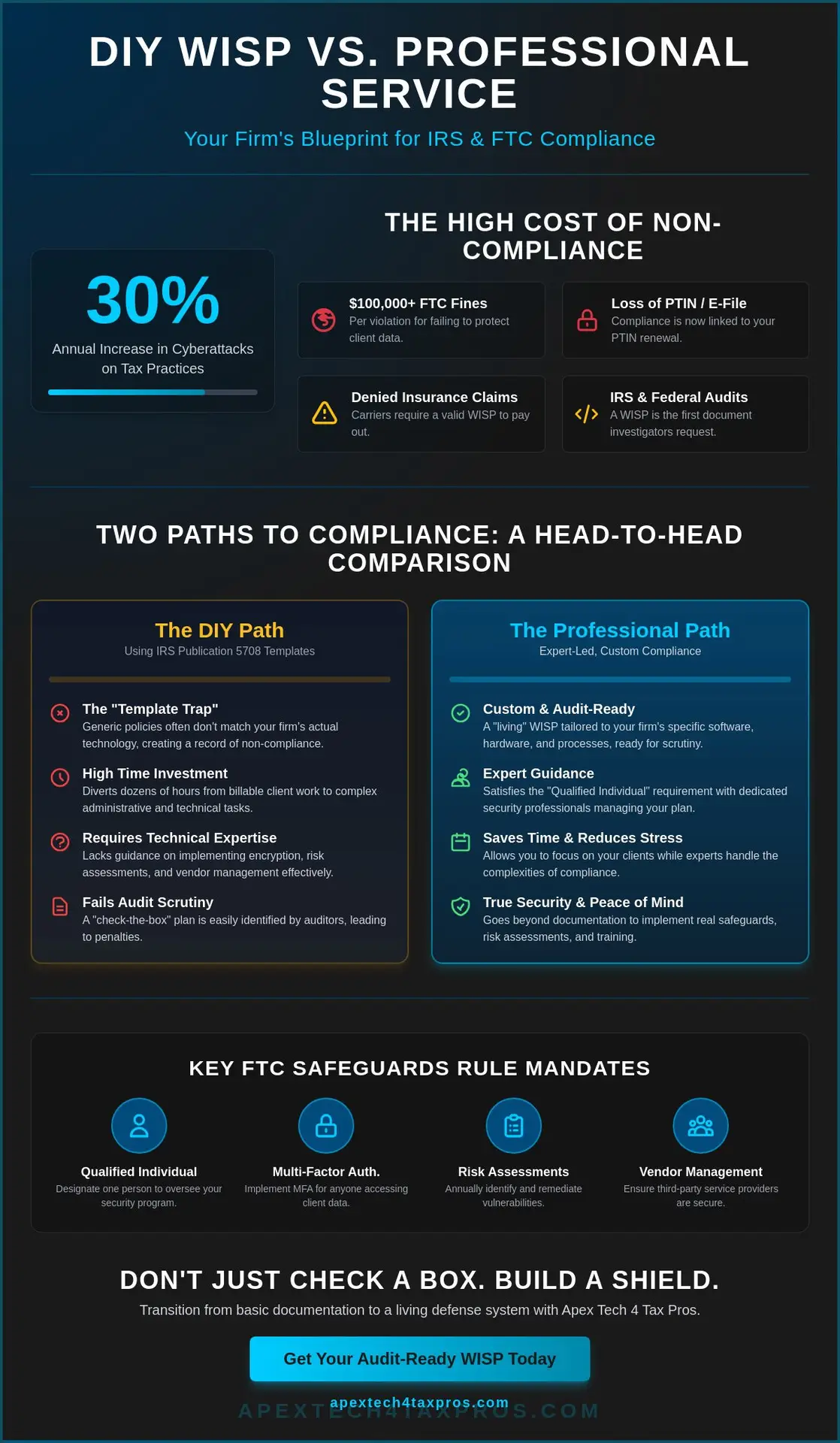
Recent updates, specifically the August 2024 revision of IRS Publication 5708, have clarified the technical expectations for firms of all sizes. The Safeguards Rule now mandates the use of Multi-Factor Authentication (MFA) for any individual accessing your information systems. Additionally, firms must now report any security event affecting 500 or more individuals to the FTC within 30 days of discovery. Key 2026 mandates include:
- Designation of a “Qualified Individual” to oversee the program.
- Implementation of robust Multi-Factor Authentication across all platforms.
- Annual risk assessments to identify and remediate vulnerabilities.
- Specific procedures for managing the security practices of third-party vendors.
A critical component of these updates is the role of the Qualified Individual. This person is responsible for overseeing and enforcing your security protocols. While the regulations allow for an internal employee to fill this role, they must possess the technical competency to manage foundational information security principles effectively. Without this expertise, the document remains a hollow shell rather than a protective shield.
The Hidden Risks of Non-Compliance
Failure to maintain an active, accurate WISP carries consequences that extend far beyond a simple warning. The FTC can impose fines of up to $100,000 per violation. Perhaps more damaging is the potential loss of your e-filing privileges, which can effectively shut down a practice during peak tax season. Evaluating the diy wisp vs professional service for tax pros helps you determine if your practice can meet these rigorous standards without sacrificing billable hours.
Professional liability also hangs in the balance. Many cyber insurance carriers now require a documented WISP before they’ll issue or renew a policy. If a breach occurs and your documentation is found lacking, your carrier might deny the claim entirely. It’s a sobering reality that a WISP is the first document requested by federal investigators and insurance adjusters following any data security incident.
The DIY WISP Path: Navigating IRS Publication 5708 and Templates
Many tax professionals begin their compliance journey by downloading IRS Publication 5708. This document provides a foundational framework, offering sample language and a structured outline for protecting taxpayer data. It includes essential sections on data collection, storage, and disposal policies. It’s a logical first step for a practice owner trying to understand their obligations. However, the debate over diy wisp vs professional service for tax pros often centers on the difference between having a document and having a functional security program. A template acts as a map, but it doesn’t build the actual road.
The technical burden lies in bridging the gap between written policy and digital reality. If your WISP states you use encryption for all data at rest, but your local server remains unencrypted, you’ve created a record of non-compliance. This is the “Template Trap.” By signing off on generic controls you haven’t actually implemented, you aren’t just failing to protect data; you’re providing federal auditors with evidence of negligence. This creates a significant liability that a simple download cannot solve.
The Limitations of Free Templates
Free templates lack a firm-specific risk assessment. Every practice has a unique footprint, from the specific software used to how remote employees access the network. A generic IRS data security plan cannot account for these variables. Auditors are trained to identify “paper-only” compliance. They look for specific evidence that policies are active, such as logs from Multi-Factor Authentication or records of employee training. If your plan is a carbon copy of a sample, it signals to regulators that your security culture is superficial and potentially non-compliant.
The Hidden Costs of “Free”
Choosing the DIY route involves significant opportunity costs. Researching the latest encryption standards and drafting a comprehensive plan can take dozens of hours. For a busy professional, these are diverted billable hours that could be spent on high-value client work during peak season. You might also accrue what experts call “compliance debt.” This is the future cost, including potential fines and emergency remediation fees, required to fix an inadequate DIY plan after a vulnerability is exposed. If you’re looking for a structured way to start, reviewing a high-quality FREE WISP Download Template can help you understand the requirements before you decide to commit to a fully managed solution.
DIY vs. Professional WISP Services: A Comparative Analysis
Evaluating the diy wisp vs professional service for tax pros requires looking beyond the initial cost of a document. While a DIY plan is essentially a static file, a professional service delivers an active security framework. The primary difference lies in technical accuracy. A tax practitioner might understand the legal requirement for a WISP, but a cybersecurity expert understands the underlying architecture needed to make that plan functional. Professional services move from abstract policies to concrete implementations, ensuring that your encryption protocols and access controls actually meet the rigorous standards of the FTC Safeguards Rule.
Self-assessments often suffer from “blind spot” syndrome. It’s difficult to audit your own systems effectively when you’re focused on the high-stakes demands of tax preparation. A professional risk assessment identifies vulnerabilities that a non-technical eye might miss, such as insecure wireless configurations or outdated firmware on network hardware. When a regulator asks for your documentation, a professional version provides an “audit-ready” confidence that a self-drafted document simply cannot match. It shifts the burden of proof from your shoulders to a verified set of security controls.
Expertise and Technical Implementation
Cybersecurity expertise is a distinct discipline from tax law. While you excel at navigating the tax code, a professional service excels at the technical “how-to” of data protection. They don’t just tell you to use Multi-Factor Authentication; they help you implement it across your entire tech stack. This includes:
- Configuring end-to-end encryption for all sensitive client communications.
- Verifying that secure cloud backups are isolated from your primary network to prevent ransomware spread.
- Ensuring that all firmware and software meet current federal standards for data at rest.
Having a third party verify these controls provides a level of objectivity that auditors value. It demonstrates a commitment to security that goes beyond mere compliance and suggests a proactive stance toward client protection.
Long-term Liability and Support
The value of a professional service becomes most apparent during a security incident. If a breach occurs, having a “defensible” plan in court or during a federal investigation is your strongest protection. Professional WISPs are designed to be living documents that integrate with staff training and ongoing risk management. When regulations change, a professional service updates your plan automatically, ensuring you don’t fall out of compliance. This ongoing support transforms your security from a seasonal chore into a year-round asset, protecting your practice’s legacy and your clients’ sensitive data.
Decision Framework: Is Your Firm Ready for DIY or Professional Help?
Deciding on the right security path for your practice requires a pragmatic look at your operational reality. When evaluating diy wisp vs professional service for tax pros, you must consider how much data you handle and how many hands touch it. A solo practitioner with a single workstation faces a different threat profile than a firm with five employees and remote access protocols. However; the volume of data doesn’t necessarily dictate the level of risk. Even a small volume of high-quality taxpayer data is a prime target for attackers, and your risk tolerance for a federal audit should be the primary driver of your decision.
Budgeting for compliance is often the sticking point for many firm owners. It’s helpful to view security as an investment in your practice’s equity rather than a simple expense. A documented, professionally managed security plan increases the value of your firm and protects you from the catastrophic costs of a breach. If you treat your WISP as a burden to be minimized, you’re likely leaving gaps that an auditor will eventually find.
The Solo Practitioner vs. The Multi-Staff Firm
Solo pros often feel they can manage their own IT because they have total control over their hardware. This assumption is risky. While you don’t have to worry about employee negligence, you are solely responsible for every technical update and regulatory shift. In contrast, multi-staff firms face an exponential increase in risk. Every new employee, contractor, or remote connection is a potential vulnerability. The FTC Safeguards Rule requires oversight that often exceeds the bandwidth of a busy partner. Larger firms almost always require professional oversight to ensure that policies aren’t just written but are consistently enforced across the entire team.
The “WISP Health Check” Questions
Use these five questions to determine if your current security posture is sufficient or if you’re operating with a dangerous compliance gap:
- Do you have a current inventory of every device and software application that accesses client data?
- Have you conducted and documented a formal risk assessment in the last 12 months?
- Is Multi-Factor Authentication (MFA) enforced on every single login point, including email and tax software?
- Do you have a written protocol for reporting a data breach to the FTC within 30 days?
- Can you provide proof of annual cybersecurity training for everyone with network access?
If you cannot explain your encryption method, you are not DIY-ready. Transitioning from a basic template to a managed plan signals that your practice has reached a level of maturity where data protection is a core business value. Before you commit to a full service, you can start by evaluating your needs with a FREE WISP Download Template to see the depth of documentation required.
Apex Tech 4 Tax Pros: Professional Compliance Tailored to Your Practice
Apex Tech 4 Tax Pros exists at the critical intersection of federal tax regulations and robust information technology. We understand that your primary mission is serving clients and navigating the tax code, not managing complex network security. By choosing our specialized approach, you resolve the tension inherent in the diy wisp vs professional service for tax pros debate. We don’t just provide a document; we build a comprehensive security culture. Our process moves beyond the static limitations of a generic template to create a Customized Written Information Security Plan that reflects the specific operational realities of your practice.
Our methodology integrates every requirement of the modern regulatory environment. This includes conducting thorough Risk Assessments to identify vulnerabilities before they’re exploited. We also provide Cybersecurity Awareness Training to ensure your staff becomes your strongest line of defense rather than your weakest link. To protect your practice from catastrophic data loss, our Secure Cloud Backup services provide a resilient recovery path that meets federal standards for data integrity and isolation.
The Apex Advantage: Specialized Security for Tax Professionals
General IT providers often lack the specialized knowledge required to interpret the nuances of IRS Publication 4557. They might secure a network, but they often miss the specific documentation and reporting requirements that federal auditors demand. Our firm brings a heritage of mission-driven expertise to every engagement. We focus on creating a living security plan that evolves alongside your firm and the shifting threat landscape. For example, when the FTC updated its reporting requirements for security events in 2024, our clients were already positioned for compliance because their plans weren’t just “check the box” documents; they were active frameworks designed for longevity.
Getting Started with Your Professional WISP
We’ve engineered our onboarding process to respect the demanding schedule of a tax professional. During your initial risk assessment, we handle the technical heavy lifting, allowing you to focus on your practice. We identify the Qualified Individual within your firm and provide them with the tools and support needed to oversee your security program effectively. This structured approach minimizes your personal time commitment while maximizing your protection. You can move forward with the confidence that your client data is secured by a firm that values personal accountability and professional excellence. Schedule your professional risk assessment with Apex Tech 4 Tax Pros today.
Securing Your Firm’s Future Beyond the Template
The regulatory landscape of 2026 demands a proactive approach to data protection that goes far beyond a passive document. You’ve seen how the choice between a diy wisp vs professional service for tax pros directly impacts your standing with federal auditors and your overall professional liability. While basic templates offer a starting point; they don’t provide the technical implementation or the “Qualified Individual” oversight required by the FTC Safeguards Rule. Moving from a static file to an active security framework is the most effective way to protect your practice and your clients’ sensitive data.
Apex Tech 4 Tax Pros maintains a specialized focus on IRS Publication 4557 and FTC Safeguards Rule compliance. We ensure that comprehensive risk assessments are a foundational part of your plan development; reflecting our proven track record with tax and accounting professionals nationwide. It’s time to trade compliance anxiety for professional confidence. Secure Your Practice with a Professional WISP Plan. Protecting your clients’ most sensitive information is a shared mission; and we’re here to ensure your practice remains both compliant and resilient.
Frequently Asked Questions
Is a WISP legally required for solo tax preparers?
Yes, a Written Information Security Plan is mandatory for all professional tax return preparers regardless of firm size. The Gramm-Leach-Bliley Act and the FTC Safeguards Rule classify tax professionals as financial institutions. This status requires you to maintain a documented plan to protect sensitive client data. Solo practitioners aren’t exempt from these federal requirements; they must meet the same standards as larger firms.
Can I use the IRS Publication 5708 template without any changes?
No, the template provided in IRS Publication 5708 is a framework that requires significant customization to be legally valid. You must adapt the document to reflect your practice’s specific hardware, software, and data handling procedures. Using a generic, unedited template often signals to auditors that you haven’t actually implemented the required security controls, which increases your professional liability.
What is the difference between an IRS WISP and the FTC Safeguards Rule?
The FTC Safeguards Rule is the federal regulation that mandates data protection standards for financial institutions. The WISP is the specific document required by this rule to prove your compliance. While the IRS provides guidance through Publication 4557 and Publication 5708, the legal authority and enforcement power reside with the FTC. Both work in tandem to ensure tax professionals protect taxpayer information.
How often do I need to update my Written Information Security Plan?
You should review and update your WISP at least annually to remain compliant with federal standards. Additionally, the plan must be updated whenever your business undergoes significant changes. This includes implementing new software, hiring employees, or moving to a new office. Regular updates ensure your security protocols match your current operational reality and address emerging cyber threats effectively.
What happens if I check the “WISP” box on my PTIN renewal but don’t have one?
Checking the WISP compliance box during PTIN renewal without having a plan is a false attestation to the IRS. This can lead to serious consequences, including the loss of your e-filing privileges and potential federal investigations. In the event of a data breach, auditors will request your plan immediately. If it doesn’t exist, you may face fines of up to $100,000 per violation.
Does a WISP cover my remote employees or contractors?
Yes, your security plan must explicitly cover all individuals who access your information systems, including remote staff and third-party contractors. The 2024 updates to the Safeguards Rule emphasize vendor management and secure remote access. When evaluating diy wisp vs professional service for tax pros, ensure your plan includes specific protocols for Multi-Factor Authentication and secure connections for off-site team members.
How much does a professional WISP service typically cost for a small firm?
The cost of a professional service depends on the complexity of your practice and the level of technical support required. When comparing diy wisp vs professional service for tax pros, consider that professional fees cover risk assessments, expert consultation, and the creation of a defensible plan. These services provide the technical depth that a free template lacks, ensuring your investment leads to total regulatory compliance.
Will a WISP prevent my firm from being hacked?
A WISP isn’t a guarantee against all cyberattacks, but it significantly reduces your firm’s vulnerability. According to industry reports, firms with comprehensive security plans see a 40% reduction in data breach incidents. Beyond prevention, the plan provides a critical roadmap for incident response. This helps you contain damage and meet mandatory reporting requirements if a security event occurs.