
As of the 2024 filing season, fewer than 40% of small tax preparation practices had a documented Written Information Security Plan, even though the FTC can impose civil penalties of up to $100,000 per violation. This gap in compliance represents a significant vulnerability for many professionals who are already stretched thin by the demands of tax season. You likely recognize that the irs data security plan requirements for enrolled agents have shifted from general recommendations to strict federal mandates, especially with the 2026 PTIN renewal requiring formal certification of your security protocols. The fear of identity theft resulting in a practice-ending PTIN suspension is a heavy burden to carry alone.
We believe you should be able to protect your clients and your license without being forced to become an information technology specialist. This guide provides a definitive roadmap to master federal mandates and implement a WISP that actually functions as a dynamic shield for your firm. You’ll learn how to move beyond a simple template to satisfy IRS auditors by integrating mandatory 2026 controls like universal multi-factor authentication and data encryption. We’ll show you exactly how to secure your practice’s future while maintaining the professional focus your clients depend on.
Key Takeaways
- Understand how the Gramm-Leach-Bliley Act and the FTC Safeguards Rule define the legal necessity of a functional Written Information Security Plan for your practice.
- Identify the specific irs data security plan requirements for enrolled agents, including the mandatory designation of a security coordinator and the performance of annual risk assessments.
- Learn about the essential technical controls required for 2026, such as universal multi-factor authentication and data encryption for both stored and transmitted taxpayer information.
- Discover why relying on a generic WISP template can create a false sense of security and how to ensure your documentation is actually executed and audit-ready.
- Explore how customized security plans and professional risk assessments bridge the gap between complex federal regulations and your firm’s daily operations.
The Legal Mandate: Why Enrolled Agents Must Have a Written Information Security Plan (WISP)
Federal law is clear: if you handle sensitive financial data for clients, you aren’t just a tax professional; you’re a financial institution. Under the Gramm-Leach-Bliley Act (GLBA), Enrolled Agents must adhere to strict information security principles to protect consumer privacy. The core of this obligation is the Written Information Security Plan (WISP). It isn’t a suggestion or a static document to be tucked away in a drawer; it’s a living regulatory requirement that reflects your commitment to client safety. The IRS now directly ties your ability to practice to these standards. During your annual PTIN renewal, you must certify that you have a plan in place. Neglecting the irs data security plan requirements for enrolled agents puts your EFIN and your professional standing at immediate risk.
Understanding the FTC Safeguards Rule for Small Tax Practices
The Federal Trade Commission (FTC) Safeguards Rule provides the enforcement mechanism for these federal regulations. Many Enrolled Agents believe they’re exempt if they serve fewer than 5,000 consumers, but this is a dangerous misunderstanding. While firms with fewer than 5,000 clients may have reduced documentation requirements for specific risk assessments, they’re still legally obligated to implement core administrative, technical, and physical safeguards. As we enter the 2026 filing season, the FTC has intensified its focus on mandatory reporting. You’re now required to notify the FTC within 30 days of discovering a breach affecting 500 or more people. Non-compliance can lead to civil penalties of up to $100,000 per violation, a sum that can easily disrupt the stability of a small practice.
IRS Publication 4557 and 5708: Your Regulatory North Stars
IRS Publication 4557, “Safeguarding Taxpayer Data,” serves as your primary operational framework. It outlines the “Security Six” foundational controls that every practice must adopt to remain compliant. To help you build the actual document, the IRS updated Publication 5708 in August 2024. This publication provides the blueprint for a compliant WISP structure and addresses the evolving threats in the digital landscape. Adhering to these guides isn’t just about avoiding a fine; it’s a matter of professional ethics. Circular 230 requires EAs to exercise due diligence in all their tax matters. In 2026, that diligence extends to the technical infrastructure housing your clients’ most private information. Ignoring these irs data security plan requirements for enrolled agents can result in the suspension of filing privileges and permanent reputational damage. At Apex Tech 4 Tax Pros, we provide a customized Written Information Security Plan (WISP) designed to meet these exact federal standards, ensuring you remain protected without needing to become an IT expert.
The 6 Core IRS Data Security Plan Requirements for Enrolled Agents
Compliance isn’t a one-time event but a series of structured actions. The IRS requirements for a WISP specify six pillars designed to protect taxpayer data from increasingly sophisticated threats. These pillars form the backbone of your operational security, ensuring that sensitive information remains confidential throughout its entire lifecycle. In an era where AI-driven phishing and automated credential stuffing are common, these requirements provide a necessary framework for practice survival.
Step 1: Designating Your Security Coordinator
Every firm must appoint at least one qualified individual to oversee the security program. Solo practitioners can fulfill this role themselves, but they must recognize the legal weight it carries. In the event of a breach, the coordinator is responsible for demonstrating that the firm followed its documented procedures. This role requires more than just a title; it demands a commitment to ongoing education. Our Cybersecurity Awareness Training helps coordinators stay ahead of evolving threats, ensuring the firm remains vigilant against 2026-specific risks like AI-generated social engineering attacks.
Step 2: Identifying Risks to Customer Information
A functional plan begins with a thorough inventory of where data lives. You must analyze how client information enters your firm, where it is stored, and how it is transmitted to the IRS. This assessment must account for internal threats, such as employee errors or “Bring Your Own Device” (BYOD) policies that lack proper management. External threats have evolved beyond simple viruses. Modern risks include sophisticated phishing and system failures caused by environmental hazards like fire or hardware crashes. Identifying these vulnerabilities is the first step toward building a resilient practice.
Beyond these initial steps, the irs data security plan requirements for enrolled agents mandate the implementation of specific safeguards. These include technical measures like encryption and physical controls like restricted access to paper files. You must also manage your service providers. Your software vendors must meet the same high standards you do, and you’re responsible for verifying their compliance. Finally, your program requires regular monitoring and testing. Safeguards that worked last year may not withstand the threats of 2026. Regular Risk Assessments provide the necessary data to adjust your plan before a vulnerability becomes a disaster. This methodical approach ensures your firm doesn’t just check a box, but maintains a truly secure environment for your clients.
Beyond Paperwork: Implementing Technical and Administrative Safeguards
Compliance is not a static state achieved through a signature on a template. It requires the active execution of technical and administrative controls that evolve alongside emerging threats. To truly meet FTC Safeguards Rule standards, Enrolled Agents must demonstrate that their plan is operational. This means moving beyond the “check-the-box” mentality and integrating security into the daily rhythm of the firm. The 2026 mandates are specific. They require multi-factor authentication (MFA) for all access to taxpayer data, whether you’re working remotely or sitting in your primary office.
Modern Encryption Standards for Tax Professionals
Basic password protection is no longer sufficient to satisfy the irs data security plan requirements for enrolled agents. Federal standards now mandate 256-bit AES encryption for all taxpayer data, both at rest and in transit. Standard email has become a significant compliance liability because it lacks the end-to-end security required by the IRS. Professional firms must transition to secure client portals for all document exchanges. Coupled with a Secure Cloud Backup, these technical safeguards ensure that even if hardware fails or an office is compromised, client data remains unreadable to unauthorized parties.
Cybersecurity Awareness Training: The Human Firewall
The most sophisticated technical defenses can be bypassed by a single human error. This is why the IRS considers Cybersecurity Awareness Training a mandatory component of your security plan. In 2026, Enrolled Agents are primary targets for AI-driven phishing and social engineering tactics that are nearly indistinguishable from legitimate communications. Training your staff to recognize these advanced threats is essential for maintaining your practice’s integrity. You must document these training sessions meticulously to satisfy potential audits. A plan that exists only on paper, without a trained team to execute it, is considered a failure of due diligence under federal guidelines.
Administrative and physical safeguards round out the protective shell of your practice. Administrative controls involve developing a culture of security where access is granted only on a “need-to-know” basis. Physically, your “brick and mortar” environment must be secured against unauthorized entry. This includes locking file cabinets containing sensitive documents and ensuring that computer screens are not visible to visitors. By combining these physical measures with a Customized Written Information Security Plan (WISP), you create a comprehensive defense system that protects your license, your clients, and your professional reputation.
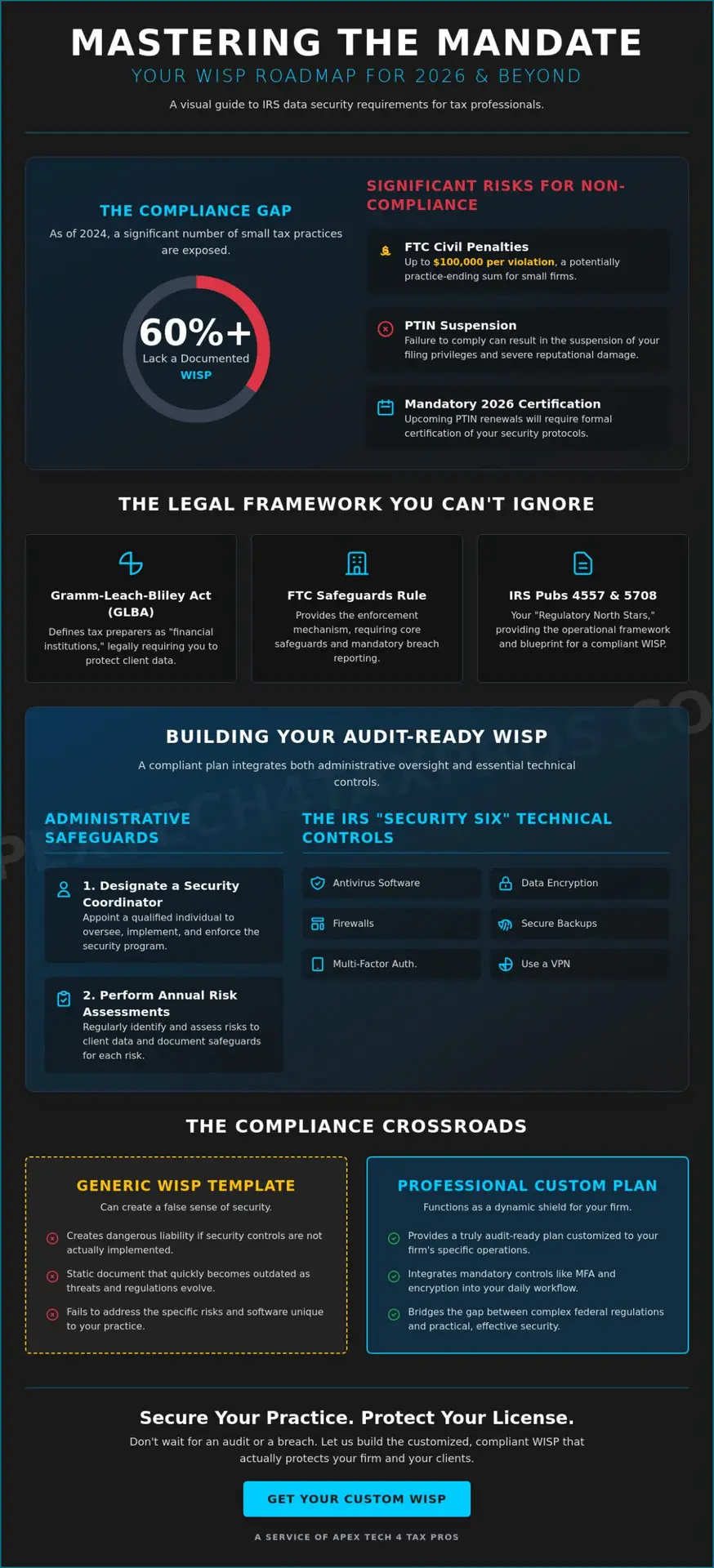
The Compliance Crossroads: Free WISP Templates vs. Professional Security Plans
Many Enrolled Agents find themselves at a critical crossroads when choosing how to document their security protocols. While we provide a FREE WISP Download Template as a foundational starting point for the smallest practices, it’s vital to understand the distinction between possession and performance. A static document that doesn’t accurately reflect your firm’s actual IT stack is a significant liability. If an auditor discovers your written plan promises specific log reviews or encryption standards that you don’t actually perform, the document becomes evidence of negligence. Satisfying the irs data security plan requirements for enrolled agents involves more than just holding a document; it requires a plan that is actively executed and verified.
The “Check-the-Box” trap is a common pitfall where a professional believes they’re protected simply because they have a file labeled “WISP.” In the event of a breach, federal investigators will look for evidence that the plan was operational. This includes training logs, records of system updates, and documented responses to security incidents. Integrating the irs data security plan requirements for enrolled agents into your daily operations requires a pragmatic approach that aligns your written policies with your technical reality. A professional plan is engineered to be dynamic, evolving as your firm adopts new software or moves more operations to the cloud.
When a Free Template is Sufficient (And When It Isn’t)
For a solo practitioner with a single, dedicated computer and no staff, a template may provide a basic framework for compliance. However, the limitations of generic documents become apparent as soon as you add employees or remote contractors. Copy-pasting a generic WISP often leads to “self-incrimination” during an audit because the document describes safeguards that don’t exist in your specific environment. An effective plan for 2026 must be an “Active” WISP. This means it’s supported by real-world activity logs and regular updates that reflect the current threat landscape, ensuring your firm remains protected and audit-ready.
The Value of Professional Risk Assessments
A template cannot see your blind spots. Professional Risk Assessments provide the third-party validation that many professional liability insurance providers now require to maintain coverage. These assessments identify specific vulnerabilities in your network that a generic document would overlook. Furthermore, a professional plan ensures that your safeguards, such as Secure Cloud Backup, are correctly configured and fully integrated into your disaster recovery strategy. This holistic view moves your practice from a state of potential vulnerability to a state of secure, documented compliance.
Investing in a Customized Written Information Security Plan (WISP) is a mission-driven decision that protects your professional legacy. While the average cost of a data breach reached $4.88 million in 2024, the cost of professional implementation is a fraction of that risk. By choosing a tailored solution, you ensure that your security measures are specifically engineered for the tax industry, allowing you to focus on your clients while we handle the complexities of federal data protection standards.
Securing Your Practice with Apex Tech 4 Tax Pros
Navigating the intersection of federal tax law and information technology requires a partner who understands the high-stakes nature of your profession. Apex Tech 4 Tax Pros exists to bridge this gap, translating complex regulations into actionable security protocols. We recognize that your primary focus is serving your clients during peak filing seasons, not decoding the technical nuances of the Gramm-Leach-Bliley Act. Our mission is to provide the protective reassurance that comes from knowing your irs data security plan requirements for enrolled agents are fully met by a system engineered specifically for your niche.
Our process begins with a deep dive into your firm’s unique operational structure. We don’t believe in generic solutions because every EA practice utilizes a different combination of tax software, cloud storage, and remote access tools. We develop a customized Written Information Security Plan (WISP) that’s audit-ready and reflects your actual environment. This methodology ensures that if the IRS or FTC ever requests your documentation, you can provide a dynamic record of compliance rather than a hollow template. By integrating professional Risk Assessments and staff training into a single ecosystem, we ensure your firm remains vigilant and resilient.
Tailored Solutions for Enrolled Agents
We focus exclusively on the tax and accounting industry because we understand the specific rhythms and regulatory burdens of your business. Our “Done-With-You” approach empowers you to lead your security coordination without requiring you to manage the technical implementation alone. This partnership ensures that as IRS requirements evolve, your security posture remains current. We provide continuous support to keep your WISP updated, allowing you to maintain your focus on tax representation while we secure your digital infrastructure. Our Secure Cloud Backup is specifically engineered for tax pros, ensuring that your business continuity is never compromised by hardware failure or data loss.
Take the First Step Toward 2026 Compliance
The path to secure compliance begins with understanding your current vulnerabilities before they’re exploited. We invite you to engage in a professional Risk Assessment to identify any hidden gaps in your existing infrastructure. By combining this assessment with our Cybersecurity Awareness Training, you build a robust defense that protects your practice from the inside out. Don’t leave your professional license to chance by relying on unverified safeguards.
- Customized Written Information Security Plan (WISP) tailored to your specific IT stack.
- Cybersecurity Awareness Training designed to recognize 2026-era social engineering.
- Secure Cloud Backup to protect your client data and ensure rapid disaster recovery.
Protect your practice with a customized WISP from Apex Tech 4 Tax Pros and ensure your firm meets all federal mandates with the precision and authority your clients expect.
Protecting Your Professional Legacy in 2026
The 2026 filing season demands a shift from passive documentation to active, operational security. You’ve seen that the irs data security plan requirements for enrolled agents are no longer just about having a file on your desk. They require verified technical controls like mandatory multi-factor authentication and 256-bit encryption. A static template might offer a baseline, but true protection comes from a plan that’s integrated into your firm’s daily rhythm and supported by staff who understand their role as the human firewall.
Apex Tech 4 Tax Pros is a national provider of customized WISP solutions specialized in IRS Publication 4557 compliance. We offer the expert-led risk assessments for tax firms that bridge the gap between complex federal law and your technical infrastructure. By securing your data today, you ensure your practice remains resilient against evolving threats while maintaining the high standards your clients expect.
Download Your Free WISP Template or Schedule a Professional Consultation
Your commitment to data security is the ultimate shield for your professional reputation. Take the next step with confidence, knowing you have the right framework to protect your practice and your legacy for years to come.
Frequently Asked Questions
Do solo Enrolled Agents really need a Written Information Security Plan?
Yes, every Enrolled Agent must maintain a WISP regardless of their practice size. The Gramm-Leach-Bliley Act (GLBA) classifies all tax preparers as financial institutions; therefore, the law makes no exception for solo practitioners. You’re required to certify your compliance during your annual PTIN renewal process to maintain your professional standing and your ability to file returns electronically.
What is the difference between IRS Publication 4557 and a WISP?
IRS Publication 4557 provides the regulatory framework and the “Security Six” recommendations, whereas a WISP is your firm’s specific, written implementation of those rules. Think of the publication as the building code and your WISP as the actual blueprints for your practice. Your plan must detail the exact administrative and technical safeguards you’ve deployed to satisfy irs data security plan requirements for enrolled agents.
How often should an Enrolled Agent update their data security plan?
You should review and update your data security plan at least once every twelve months. Federal guidelines also mandate updates whenever you make significant changes to your business operations, such as hiring new staff, moving to a new office, or switching software providers. Regular updates ensure your safeguards remain effective against modern 2026 threats like AI-driven phishing and social engineering.
Are Enrolled Agents required to encrypt all client emails by law?
The FTC Safeguards Rule requires the encryption of all customer information while it is in transit. Because standard email is inherently unsecure and travels across open networks, it doesn’t meet federal standards for protecting sensitive taxpayer data. Enrolled Agents should utilize secure client portals or specialized encrypted email services to ensure full compliance with these federal privacy mandates and protect client confidentiality.
What happens if I tell the IRS I have a WISP but I actually don’t?
Falsely certifying that you have a security plan during PTIN renewal can lead to severe professional consequences. The IRS may suspend your PTIN or revoke your Electronic Filing Identification Number (EFIN), effectively halting your ability to practice. Additionally, the FTC can impose civil penalties of up to $100,000 per violation if a breach occurs and you’re found to be without a functional, documented plan.
Does a WISP cover remote employees or independent contractors?
Yes, your WISP must explicitly address the security protocols for any remote employees or independent contractors who handle client data. The plan should define authorized access levels, mandatory multi-factor authentication for remote logins, and security standards for “Bring Your Own Device” (BYOD) scenarios. Failing to include these external contributors in your documentation leaves a significant gap in your practice’s defensive perimeter.
Can I use a generic WISP template for my tax practice?
You may use a template as a foundational starting point, but it must be meticulously customized to reflect your firm’s unique IT infrastructure. A generic document that lists safeguards you haven’t actually implemented can be viewed as evidence of negligence during an IRS audit. A functional plan must accurately describe your specific irs data security plan requirements for enrolled agents, including your designated coordinator and risk assessment results.
What are the technical requirements for MFA under the FTC Safeguards Rule?
Multi-factor authentication is now a mandatory technical control for any individual accessing any system that contains taxpayer information. Under the updated FTC Safeguards Rule, this requirement isn’t limited to remote access; it applies to all logins, including those performed on-site within your primary office. Your MFA solution must utilize at least two different types of credentials to verify a user’s identity effectively before granting access.