
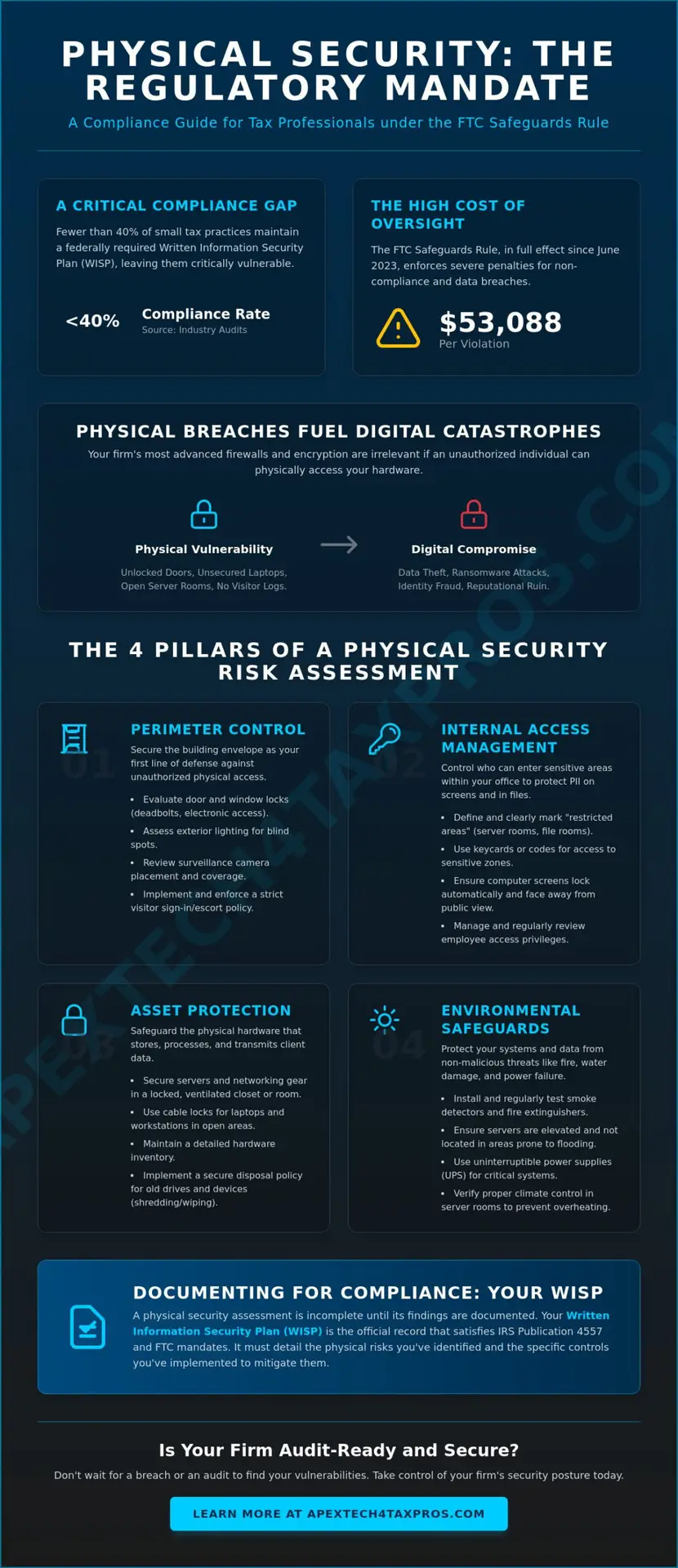
Did you know that fewer than 40% of small tax preparation practices currently maintain a documented Written Information Security Plan (WISP), despite it being a strict federal requirement? This gap in compliance leaves many firms vulnerable to more than just data breaches. With the FTC Safeguards Rule now in full effect as of June 2023, the financial cost of an oversight can reach $53,088 per violation. It’s understandable if you feel a sense of unease regarding the overlap between your office’s physical locks and your digital data protection. Executing a thorough physical security risk assessment for accounting firm compliance is the first step toward reclaiming your professional peace of mind.
Most practitioners find the prospect of an IRS audit daunting, especially when they aren’t sure how to document their physical safeguards for a regulatory reviewer. You’ll learn exactly how to conduct a comprehensive assessment that satisfies IRS Publication 4557 mandates while protecting your most sensitive client assets. We’ll provide a clear, documented process to integrate these findings into your WISP, ensuring your firm is both secure and audit-ready. This article outlines the essential physical requirements of the FTC Safeguards Rule and offers a strategic framework for strengthening your firm’s overall security posture.
Key Takeaways
- Understand why physical security is a mandatory regulatory pillar under the FTC Safeguards Rule rather than a simple theft-prevention measure.
- Identify the four essential pillars of a physical security risk assessment for accounting firm compliance, focusing on perimeter integrity and internal access management.
- Discover the critical link between physical office access and digital data protection, including how to mitigate social engineering risks at your firm’s entry points.
- Learn a methodical, step-by-step approach to auditing your firm’s floor plan and identifying vulnerabilities using standardized compliance checklists.
- Gain clarity on documenting your physical findings within a Written Information Security Plan (WISP) to satisfy the specific mandates of IRS Publication 4557.
Beyond Locks: Why Physical Security is a Regulatory Mandate for Tax Pros
Many tax professionals treat security as a digital-only endeavor, focusing heavily on firewalls and encryption while leaving the office front door vulnerable. This perspective is no longer viable. In 2026, the regulatory environment has shifted, placing physical controls on equal footing with technical safeguards. Performing a physical security risk assessment for accounting firm operations is now a foundational requirement for any practice handling sensitive taxpayer data. The FTC Safeguards Rule explicitly demands that financial institutions, a category that includes tax preparers and bookkeepers, implement safeguards to protect customer information from unauthorized access or theft.
A physical breach often serves as the “patient zero” for a digital catastrophe. If an unauthorized person gains access to your server room or lifts an unencrypted laptop from a desk, your sophisticated cyber defenses become irrelevant. Federal mandates recognize this reality. A compliant physical security risk assessment for accounting firm management must identify every point where a physical action could compromise digital integrity. This includes everything from how you manage visitor logs to the way you secure your hardware endpoints. In the current enforcement cycle, failing to document these risks can lead to civil penalties of up to $53,088 per violation.
The Intersection of IRS Pub 4557 and Your Office Layout
IRS Publication 4557 provides the framework for protecting taxpayer data through specific “physical safeguards.” You’re required to identify and secure “restricted areas” where sensitive information is processed or stored. This doesn’t just mean the file room; it applies to any workstation where Personally Identifiable Information (PII) is visible on a screen. Effective internal access management ensures that only authorized personnel can enter these zones. According to current IRS standards, a physical safeguard is any measure used to protect data and information systems from physical threats, including unauthorized access and environmental hazards. Failing to define these areas in your office layout can lead to significant gaps in your Written Information Security Plan (WISP).
Consequences of Non-Compliance in 2026
The stakes for ignoring physical protocols have never been higher. Beyond the immediate threat of FTC fines, security gaps now directly impact your firm’s professional liability insurance. Many carriers now require evidence of a compliant WISP and a formal risk assessment before they’ll renew a policy. There’s also the devastating reputational risk of a “low-tech” breach. If a client learns their data was compromised because of a stolen file or an unlocked office door, the loss of trust is often permanent. Under the FTC Safeguards Rule, you must notify the commission within 30 days of discovering a breach affecting 500 or more consumers, a public disclosure that can derail a firm’s growth for years. Making physical security a core part of your mission isn’t just about compliance; it’s about protecting the heritage and future of your practice.
The 4 Pillars of a Physical Security Risk Assessment
A comprehensive physical security risk assessment for accounting firm operations rests on four strategic pillars: perimeter control, internal access management, asset protection, and environmental safeguards. Each pillar serves as a layer of defense, ensuring that the human element of your office doesn’t become a liability for your digital infrastructure. A formal Risk Assessment isn’t a one-time event; it’s a methodical review of how your physical environment impacts regulatory compliance and client trust. By examining these areas, you move beyond simple lock-and-key thinking and toward a mission-driven security posture.
Perimeter and Entry Point Vulnerabilities
The building envelope is your first line of defense. You must evaluate door hardware, deadbolts, and electronic access systems to ensure they meet professional standards. In high-PII environments, simple locks are rarely enough. You should also assess exterior lighting and surveillance placement to deter document theft or unauthorized entry. A disciplined approach to visitor management is essential. Implementing mandatory visitor logs and requiring escorted access for all non-employees ensures that no one wanders into sensitive areas unobserved. If you’re looking for a baseline to measure your current protocols against, a FREE WISP Download Template can provide a structured starting point for your documentation.
Securing the ‘Data Core’: Server Rooms and Filing Areas
Your “Data Core” includes any space where sensitive client information is processed or stored. Servers hosting tax software and client databases require physical isolation, ideally behind a reinforced door with restricted access. Server room access must be logged and audited to maintain a tamper-resistant record of who interacted with the hardware hosting sensitive taxpayer databases. This level of scrutiny prevents “low-tech” breaches that could bypass your digital firewalls.
Paper-based records demand equal vigilance. Locking file cabinets are a minimum requirement, but your internal culture must also support a “Clean Desk” policy. This means all taxpayer documents, unencrypted flash drives, and printed reports are cleared from desks and secured at the end of each day. Because 66% of accounting firms now use OCR tools to digitize data, the risk of a physical document being left out during the extraction process is high. Managing these internal movements is a critical part of a physical security risk assessment for accounting firm success. Vigilance in the server room and at individual workstations ensures that your firm’s most sensitive assets remain under your direct control.
Bridging the Gap: Where Physical Security Meets Data Protection
The line between a physical lock and a digital firewall is often thinner than most professionals realize. For many firms, the greatest vulnerability isn’t a remote hacker; it’s an unescorted visitor who gains physical access to a workstation. A comprehensive physical security risk assessment for accounting firm compliance must address how physical proximity can lead to digital compromise. This is where social engineering becomes a tangible threat. An intruder posing as a service technician or delivery person can easily bypass technical controls if they’re allowed to sit at an unlocked desk or plug a malicious device into an unsecured USB port.
In open-plan offices, visual hacking remains a significant concern. Sensitive tax returns displayed on monitors can be captured by a simple smartphone photo from across the room. Using privacy screens and positioning monitors away from windows or high-traffic areas are practical remedies that should be documented in your assessment. Additionally, securing endpoints like laptops with physical cable locks and ensuring docking stations are bolted to desks prevents the “snatch and grab” theft that often precedes a major data breach. Unsecured network jacks in conference rooms or reception areas should also be disabled when not in use to prevent unauthorized hardware from joining your internal network.
Hardware Inventory and Disposal Protocols
Managing the lifecycle of your hardware is as important as securing it while in use. Your risk assessment should include a detailed inventory of all physical IT assets, from servers to encrypted flash drives. A common oversight involves decommissioned hardware left in storage closets; these devices often still contain sensitive PII and represent a massive liability if the office is ever compromised. When it’s time to retire equipment, you must ensure the physical destruction of drives aligns with the standards found in IRS Publication 4557. Simply deleting files isn’t enough; the magnetic or solid-state media must be rendered unreadable to satisfy federal mandates.
The Human Element: Staff Training and Physical Awareness
Your team is your most effective surveillance system if they’re properly trained. A culture of physical vigilance means every employee feels empowered to challenge an unescorted visitor, regardless of their supposed credentials. This awareness doesn’t happen by accident. It requires ongoing Cybersecurity Awareness Training that specifically highlights the connection between physical office behavior and data integrity. By teaching staff to recognize the signs of tailgating or suspicious hardware tampering, you turn your workforce into a proactive layer of your physical security risk assessment for accounting firm strategy. This human-centric approach ensures that your technical safeguards aren’t undermined by a simple lack of situational awareness.
How to Conduct and Document Your Firm’s Physical Security Audit
Conducting a physical security risk assessment for accounting firm compliance isn’t a casual stroll through the office. It’s a disciplined, multi-step process that transforms raw observations into an actionable defense strategy. This methodical approach ensures that your firm doesn’t just “feel” secure but can actually prove its resilience during an IRS or FTC inquiry. By following a structured audit path, you move from a state of potential vulnerability to one of documented, defensible compliance.
The process begins with assembling your assessment team. While an office manager understands daily workflows, involving external experts often provides the clinical objectivity required for a high-stakes audit. Once the team is set, you’ll perform a comprehensive walkthrough using a standardized checklist to identify gaps across your perimeter, internal zones, and data core. Following the floor walk, you must analyze the “Likelihood vs. Impact” of each threat, create a remediation plan with firm deadlines, and integrate these findings into your annual WISP update. This documentation is your primary shield during a regulatory review.
Using the Likelihood-Impact Matrix for Accounting Risks
Not every security gap deserves the same level of immediate investment. You must prioritize remediation based on regulatory urgency and the potential for data exposure. For example, an unencrypted laptop left on a desk in a high-traffic area is a High Impact risk because it directly threatens PII. Conversely, an unlocked supply closet that contains no client data is a Low Impact issue. You score a vulnerability based on the probability of unauthorized access multiplied by the sensitivity and volume of taxpayer records that would be compromised if the physical control failed. This scoring allows you to allocate your budget toward the most critical threats first, satisfying the FTC’s mandate for “reasonable” safeguards.
The Importance of Photographic and Logged Evidence
Documentation is the only currency regulators accept. During your walkthrough, you should take clear photographs of identified security gaps, such as propped-open server room doors or obstructed surveillance cameras. These photos serve as a baseline for your “Security Improvement Log,” a living document where you record the discovery date, the remediation action taken, and the completion date. Maintaining this log demonstrates your firm’s “Good Faith” effort to comply with federal standards, even if you’re still in the process of upgrading certain hardware. If you need a professional framework to begin this process, see our Risk Assessments page for expert-led audit support. This level of meticulous record-keeping turns a simple physical security risk assessment for accounting firm requirements into a robust pillar of your overall professional integrity.
Integrating Physical Controls into Your Written Information Security Plan (WISP)
The WISP is the definitive record of your firm’s commitment to data integrity. It shouldn’t sit on a shelf gathering dust; it must function as a living document that evolves alongside your physical environment. Every finding from your physical security risk assessment for accounting firm compliance must be codified within this plan to ensure a consistent, defensible security posture. By integrating physical controls into the WISP, you create a unified framework that satisfies both the FTC Safeguards Rule and IRS expectations. This documentation serves as the bridge between your high-level security goals and the daily actions of your team.
Mapping your findings to specific sections of IRS Publication 4557 is a critical step in this integration. For instance, your policies on restricted area access and document shredding should point directly to the federal standards they fulfill. This alignment simplifies the process for your designated Security Coordinator, who is responsible for maintaining these standards. The Security Coordinator doesn’t just manage passwords; they’re the primary guardian of the physical environment, ensuring that visitor logs are maintained and that “Clean Desk” policies are followed daily. Their role is to ensure that the physical security risk assessment for accounting firm requirements you’ve identified are actually met through consistent enforcement.
Standardizing Your Security Documentation
Translating a “gap” identified during an audit into a formal “policy” requires precision. If your audit reveals that laptops are often left unsecured, your WISP should mandate the use of physical cable locks for all portable devices. This documentation must also extend to the home office. As remote work remains a staple for many practices, your WISP needs to define physical security standards for employees handling client data outside the main office. This includes requirements for locking home office doors and securing printed documents in home-based filing systems. To begin building this framework, you can Download our FREE WISP Template to start your documentation.
Preparing for an IRS Security Review
An IRS security review is a rigorous test of whether your written policies match your daily reality. During a physical site visit, an auditor looks for visible evidence of the safeguards described in your WISP. They’ll check for locked file cabinets, restricted access to server rooms, and the presence of visitor logs. You must be prepared to produce “Evidence of Compliance” on demand, including your recent risk assessment reports and security improvement logs. Meticulous record-keeping is your best defense against potential penalties. For a professional compliance assessment that ensures your firm is fully prepared for scrutiny, Contact Apex Tech 4 Tax Pros. This final step transforms your security efforts from a series of tasks into a robust, mission-driven strategy that protects your firm’s legacy and its clients’ trust.
Securing Your Firm’s Legacy Through Proactive Compliance
We’ve established that physical safeguards are no longer a secondary concern but a central requirement of the FTC Safeguards Rule and IRS Publication 4557. A resilient security posture requires more than just digital firewalls; it demands a disciplined review of your office layout, hardware lifecycle, and employee awareness. By conducting a periodic physical security risk assessment for accounting firm operations, you transform potential vulnerabilities into a documented, defensible strategy that satisfies federal mandates while shielding your most sensitive assets.
Our team provides specialized expertise in tax and accounting compliance, drawing on decades of professional security experience to protect your practice. We understand the clinical precision required to meet IRS Publication 4557 standards and can help you integrate these physical controls seamlessly into your WISP. Secure Your Firm with a Professional Risk Assessment today to ensure your practice remains audit-ready and resilient. Protecting your clients’ sensitive information is a mission that defines your professional integrity. With the right framework in place, you can face future regulatory cycles with absolute confidence.
Frequently Asked Questions
Is a physical security risk assessment required by the IRS?
Yes, a physical security risk assessment for accounting firm compliance is a mandatory requirement under IRS Publication 4557 and the FTC Safeguards Rule. These regulations dictate that all paid tax preparers must implement and document physical safeguards to protect sensitive taxpayer data. Failing to maintain a written record of these assessments can result in significant civil penalties during a federal audit.
How often should an accounting firm conduct a physical security audit?
You should conduct a formal physical security audit at least once a year as part of your annual WISP review. It’s also necessary to perform a new assessment whenever your firm undergoes a significant change, such as moving to a new office suite or implementing a major hardware overhaul. A regular cadence ensures that your physical controls remain effective against evolving environmental threats and operational shifts.
What are the most common physical security gaps in tax offices?
The most frequent vulnerabilities in tax offices include unescorted visitors in restricted areas and unlocked server rooms hosting sensitive client databases. Many firms also struggle with “visual hacking” risks where computer monitors displaying PII are visible from public windows or reception areas. Identifying these gaps is a primary objective of a professional physical security risk assessment for accounting firm safety.
Do I need a security camera system to be FTC Safeguards compliant?
While the FTC Safeguards Rule doesn’t explicitly name “security cameras,” it does mandate that firms implement procedures to monitor and log access to customer information. Surveillance systems are the most effective way to provide tamper-resistant evidence of this monitoring. Cameras serve as both a deterrent for unauthorized entry and a critical investigative tool if a physical breach occurs in your restricted zones.
What is a ‘Clean Desk Policy’ and why is it important for tax pros?
A Clean Desk Policy is a formal requirement that all sensitive taxpayer documents and hardware must be secured in locking storage when a workstation is unattended. For tax professionals, this is vital because physical records are often the weakest link in the security chain. It ensures that unencrypted flash drives or printed tax returns aren’t left out for unauthorized persons to see or take.
How do I document physical security in my WISP?
You document physical security by mapping your audit findings directly to the “Physical Safeguards” section of your Written Information Security Plan. Each identified risk should be paired with a corresponding control, such as “Locked server room door” or “Visitor log implementation.” This creates a clear trail of accountability that proves to regulators that you’ve identified your vulnerabilities and implemented reasonable remedies.
Can I perform my own physical security assessment or do I need a pro?
You can perform an internal assessment, but engaging a professional ensures your firm meets the “reasonable” standard expected of high-PII environments. Professionals bring an objective perspective and specialized knowledge of IRS Publication 4557 that internal staff might overlook. A professional audit provides the mission-driven reassurance that your safeguards are engineered to withstand the scrutiny of a federal regulatory review.
What physical security measures are needed for remote accounting staff?
Remote accounting staff must maintain physical standards that mirror the main office, including locking home office doors and using physical cable locks for laptops. They’re required to secure all printed taxpayer documents in locking cabinets and ensure that family members or visitors can’t view sensitive screens. These requirements must be clearly defined in your WISP to ensure compliance across your entire distributed workforce.