
Would your tax practice survive an FTC audit tomorrow if they discovered your security plan was just an unedited template sitting in a digital folder? You’ve likely felt the mounting pressure as the IRS and FTC tighten their grip on data protection standards. This data security compliance checklist for tax professionals addresses the reality that compliance isn’t a static document; it’s a defensive posture you must maintain. Between managing a heavy client load and staying current on tax law, finding the time to decipher complex IT mandates feels nearly impossible. It’s a common frustration; many practitioners worry that a single oversight could lead to devastating fines or the loss of their EFIN.
This guide provides the definitive, actionable roadmap you need to secure client data and meet mandatory federal WISP requirements. We’ve engineered this resource to help you transition from a state of potential vulnerability to one of secure compliance. You’ll gain a clear understanding of the Security Six controls, the updated FTC Safeguards Rule penalties that can reach $46,517 per violation, and the specific documentation needed to protect your practice from evolving cyber threats. By following this methodical approach, you can finally achieve the peace of mind that comes from knowing your sensitive data is in safe, capable hands.
Key Takeaways
- Understand how the GLBA classifies tax practitioners as financial institutions and why the 2026 FTC Safeguards Rule mandates specific administrative and technical protocols.
- Follow a detailed data security compliance checklist for tax professionals to implement the Security Six controls, including drive encryption and secure cloud backups.
- Discover why generic WISP templates often fail regulatory scrutiny and how to develop documentation that accurately reflects your firm’s specific software stack.
- Identify immediate vulnerabilities through a baseline risk assessment and learn the steps to operationalize your security framework before the filing season begins.
- Master the transition from a state of vulnerability to secure compliance by integrating cybersecurity awareness training into your firm’s annual professional development.
The 2026 Regulatory Landscape: Why Compliance is Mandatory for Every Tax Pro
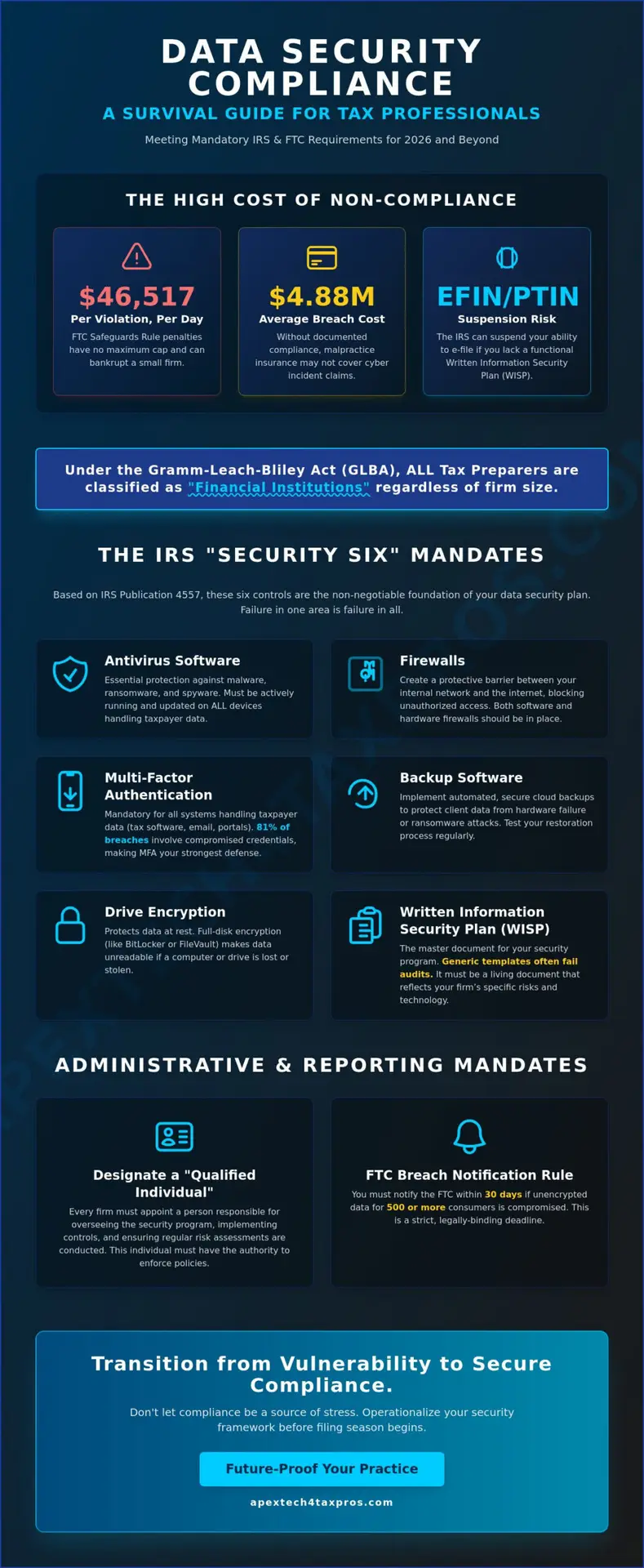
The regulatory environment for 2026 is no longer a set of suggestions; it’s a rigid legal framework anchored in federal financial privacy laws. The Gramm-Leach-Bliley Act (GLBA) remains the cornerstone of this structure, mandating that any entity handling sensitive financial data must implement rigorous protections. For tax practitioners, this translates directly into IRS Publication 4557, specifically the Rev. 6-2024 revision. This document outlines the “Security Six” foundation that every firm must master: antivirus software, firewalls, multi-factor authentication (MFA), backup software, drive encryption, and a Written Information Security Plan (WISP). These aren’t just technical tools. They’re the essential components of a robust data security compliance checklist for tax professionals designed to protect both the taxpayer and the practitioner.
The Legal Consequences of Non-Compliance
The FTC hasn’t stayed static. As of 2026, civil penalties for violating the Safeguards Rule have reached $46,517 per violation, per day. There’s no maximum cap on these fines, which can quickly bankrupt a small firm. Beyond the immediate monetary loss, a data breach puts your Electronic Filing Identification Number (EFIN) and Preparer Tax Identification Number (PTIN) at risk. If the IRS determines your practice lacks a functional WISP, they can suspend your ability to e-file returns entirely. Additionally, most professional malpractice insurance carriers now require proof of compliance with federal standards before they’ll honor a claim related to a cyber incident. Without documented adherence, you’re essentially self-insuring against a catastrophe that averages $4.88 million in costs.
Who Qualifies as a “Financial Institution”?
A common misconception persists that small firms or solo practitioners are exempt from these complex mandates. Under the GLBA, tax preparers are explicitly classified as “financial institutions” regardless of their client volume. Whether you file fifty returns or five thousand, the requirements remain identical. The 2026 standards emphasize that every firm must designate a “Qualified Individual” responsible for overseeing the security program. This person doesn’t need to be a coding expert, but they must possess the authority to implement a functional data security compliance checklist for tax professionals and ensure that risk assessments are conducted regularly. The FTC’s May 2024 update regarding breach notifications further solidifies this responsibility; you must notify the FTC within 30 days if unencrypted data for 500 or more consumers is compromised.
The Comprehensive 2026 Data Security Compliance Checklist
A functional security posture requires more than just installing an antivirus program. It demands a structured approach that spans administrative, technical, and physical domains. This data security compliance checklist for tax professionals serves as your operational blueprint, ensuring no vulnerability remains unaddressed. Under the FTC Safeguards Rule, your firm must not only implement these controls but also document their effectiveness through regular risk assessments. Administrative safeguards begin with your designated Qualified Individual, who must oversee the continuous monitoring of your protective systems.
Technical Requirements for 2026 Practice Standards
Password-only access is now considered a critical failure in data protection. Since the Verizon 2025 Data Breach Investigations Report notes that 81% of breaches involve compromised credentials, Multi-Factor Authentication (MFA) is mandatory for every system that touches taxpayer data. This includes your tax software, email, and document portals. We’re seeing a significant transition from traditional VPNs to Secure Access Service Edge (SASE) architectures. SASE provides more granular control than a standard VPN by verifying the identity and security posture of every device before granting access. Every communication containing sensitive information must utilize end-to-end encryption. If you’re still sending unencrypted PDFs via email, your practice is out of compliance with 2026 standards. Implementing a secure cloud backup system ensures that data remains accessible even if local hardware fails.
Physical and Operational Security Points
The 2026 standards for secure remote work require a level of scrutiny that many firms haven’t yet achieved. Home office security audits are now a standard part of a professional WISP. Practitioners must ensure that remote environments are as secure as the primary office. This involves implementing clean desk policies and ensuring physical taxpayer records are stored in locked cabinets. You shouldn’t assume a home Wi-Fi network is secure without verifying its encryption settings and password strength.
- Hardware Hardening: Disable USB ports on all firm laptops to prevent unauthorized data extraction or the introduction of malware via thumb drives.
- Access Control: Restrict administrative privileges; employees should only have access to the specific client data required for their roles.
- Disposal Protocols: Use cross-cut shredding for all paper documents and secure wiping software for decommissioned hardware.
Your organizational safeguards must include thorough background checks for all staff members who handle client data. Finally, your incident response plan must be ready to act. You don’t want to be designing a recovery strategy while a breach is actively occurring. This plan should outline exactly how you’ll notify the IRS Stakeholder Liaison and meet the 30-day FTC notification deadline if a breach affects 500 or more consumers. Utilizing a comprehensive data security compliance checklist for tax professionals ensures these vital steps aren’t overlooked during the pressure of tax season.
Documentation vs. Action: Why a WISP Template is Not Enough
Compliance isn’t a destination you reach by signing a generic document. It’s a continuous state of operational readiness. While a data security compliance checklist for tax professionals provides the necessary structure, the actual value lies in how those steps are executed within your specific firm. A template is merely a starting point. If your WISP doesn’t reflect your actual software stack, your specific hardware inventory, and your unique office workflow, it won’t stand up to the scrutiny of an IRS or FTC audit. Regulators look for evidence of implementation, not just the existence of a file on your server.
Your documentation must serve as a “living document” that evolves alongside your practice. According to IRS Publication 4557, Safeguarding Taxpayer Data, tax professionals are required to review and update their security plans at least annually. This ensures that as you adopt new technologies or as cyber threats shift, your protective measures remain relevant. You must be able to provide evidentiary proof that you’re following your written plan. This might include logs of staff training sessions, records of quarterly vulnerability scans, or signed agreements from third-party vendors.
The Anatomy of a Functional WISP
A professional-grade WISP begins by defining the scope of your data environment. You must identify every location where taxpayer data resides, including local drives, cloud storage, and mobile devices. Once the scope is clear, your plan should detail specific risk mitigation strategies for each identified gap. Finally, don’t overlook third-party service provider management. The FTC Safeguards Rule mandates that you vet your software and IT vendors to ensure they maintain security standards that match your own.
Common Pitfalls in DIY Security Plans
Many practitioners fall into the “Qualified Individual” trap. While a firm owner can certainly serve as the designated security coordinator, they shouldn’t act as their own auditor. True compliance requires objective verification that controls are working. Another common error is failing to document the “reasonable steps” taken to protect data. If a breach occurs, you’ll need to demonstrate that your security measures were appropriate for your firm’s size and complexity. Relying on a data security compliance checklist for tax professionals helps ensure you don’t ignore mandatory requirements like regular vulnerability scanning and staff background checks.
Operationalizing Compliance: Implementing Your Security Framework
Transitioning from a theoretical understanding of regulations to a functional defense requires a methodical, phased approach. While a data security compliance checklist for tax professionals provides the necessary structure; the actual implementation determines your practice’s resilience. This process isn’t a one-time event; it’s a cycle that integrates technical controls with human vigilance. By breaking the transition into manageable phases, you can ensure that security becomes a natural part of your firm’s daily operations rather than a seasonal burden.
- Phase 1: Baseline Risk Assessment. You must identify immediate vulnerabilities within your current network and physical office space before any new controls are introduced.
- Phase 2: WISP Formalization. Once gaps are identified, formalize your WISP to address them. This phase is critical for gaining partner and staff buy-in; as everyone must understand their specific role in data protection.
- Phase 3: Technical Deployment. Implement the core technical stack, including MFA, drive encryption, and secure cloud backups.
- Phase 4: Training Launch. Initiate your cybersecurity awareness training program to bridge the gap between technical tools and human behavior.
- Phase 5: Audit and Update Cycle. Establish a recurring schedule for system reviews and WISP updates to account for new threats or software changes.
Staff Training: Your Strongest (or Weakest) Link
Human error remains the primary entry point for most cyberattacks. Implementing simulated phishing tests allows you to evaluate staff readiness without risking actual data. These exercises help employees recognize sophisticated social engineering tactics, such as “urgent” IRS-themed scams that mimic official correspondence. It’s vital to foster a “no-blame” culture where staff feel comfortable reporting potential security incidents immediately. When an employee clicks a suspicious link, the priority should be mitigation and education, not punishment. Protecting your firm’s reputation starts with a team that’s trained to spot a threat before it bypasses your technical barriers. To build this foundation, consider scheduling our professional Cybersecurity Awareness Training for your entire team.
Managing the “Off-Season” Compliance Cycle
The post-April window offers a unique opportunity for deep-dive system audits that are impossible during the height of tax season. Use this time to review access logs and remove permissions for former employees or seasonal contractors. Every software addition or hardware upgrade must be documented in your WISP to maintain its status as a “living document.” This off-season diligence ensures that when the next filing cycle begins, your data security compliance checklist for tax professionals is already fully operational and verified. Proactive auditing during the summer months prevents the frantic, last-minute compliance scrambles that often lead to critical security oversights.
Future-Proofing Your Practice with Apex Tech 4 Tax Pros
The complexity of federal mandates shouldn’t hinder your firm’s growth or disrupt your focus during the filing season. Apex Tech 4 Tax Pros serves as a specialized partner, bridging the gap between intricate tax law and the technical precision required for modern security. Our mission is to transform the data security compliance checklist for tax professionals from a source of anxiety into a source of institutional strength. We understand that your reputation is built on trust; therefore, we provide the technical infrastructure necessary to safeguard that trust against evolving cyber threats. Our heritage as a firm dedicated to this niche ensures that we speak your language and understand your high-stakes environment.
Generic templates often fail because they don’t account for the specific nuances of your software stack or firm size. We move beyond basic documentation by offering Customized Written Information Security Plan (WISP) development. This process begins with an expert-led Risk Assessment that uncovers hidden liabilities within your network. By identifying these gaps early, we can implement remedies that are both effective and compliant. Our approach ensures your documentation is professional-grade and ready for regulatory review, providing you with the reassurance that your practice is built on a solid, secure foundation.
Data protection isn’t just about prevention; it’s about resilience. Our Secure Cloud Backup solutions are specifically designed for financial records, utilizing end-to-end encryption to ensure your clients’ sensitive information remains protected. This technical layer is reinforced by our Cybersecurity Awareness Training, which is tailored specifically for accountants and tax practitioners. We provide the tools and education needed to maintain a vigilant posture throughout the year, not just when an audit is looming. Our services aren’t generic; they’re specifically engineered for the unique demands of the tax industry.
From Vulnerable to Vigilant: Our Proven Process
Our “Done-for-You” compliance framework allows you to remain focused on your clients while we handle the technical heavy lifting. We’ve seen that firms prioritizing security often gain a significant marketing advantage. Clients feel more secure knowing their data is managed by professionals who value personal accountability and technical excellence. Our process moves your firm from a state of potential vulnerability to a state of disciplined, verified compliance. This transition is methodical and educational, guiding you through every step of the 2026 regulatory landscape.
Take the First Step Toward Total Compliance
You don’t have to navigate these requirements alone. Start by accessing our FREE WISP Download Template to evaluate your current standing. For those seeking a comprehensive, customized security roadmap, we invite you to schedule a professional consultation. We’ll help you implement every element of your data security compliance checklist for tax professionals with the precision your practice deserves. Ensure your practice is IRS-compliant with a custom WISP today.
Securing Your Firm’s Legacy in an Era of Digital Threat
The 2026 regulatory environment demands a shift from passive awareness to active, documented defense. You’ve seen that a functional security posture requires the integration of technical controls, staff vigilance, and methodical documentation. By implementing a comprehensive data security compliance checklist for tax professionals, you protect your firm’s EFIN and your clients’ most sensitive information. This proactive approach transforms compliance from a seasonal burden into a permanent professional asset that instills confidence in every taxpayer you serve.
Apex Tech 4 Tax Pros brings decades of experience in niche compliance markets to help you navigate these high-stakes requirements. We specialize in the specific demands of IRS Publication 4557 and the FTC Safeguards Rule, offering customized solutions for firms of all sizes. Whether you need a professional-grade risk assessment or a secure cloud backup strategy, our mission is to ensure your practice remains both compliant and resilient. You don’t have to carry the weight of federal mandates alone; we’re here to provide the technical expertise you need.
Download Your Free WISP Template or Request a Custom Compliance Plan today to begin your journey toward total data security. You’ve worked hard to build your practice; let’s work together to protect it.
Frequently Asked Questions
What is a Written Information Security Plan (WISP), and why do I need one?
A WISP is a formal, documented strategy that outlines the administrative, technical, and physical safeguards your firm uses to protect taxpayer data. You’re legally required to maintain this document under the FTC Safeguards Rule and IRS Publication 4557. It serves as your primary defense during an audit, proving that your security measures aren’t accidental but are part of a disciplined, professional framework.
Does a solo tax preparer really need to comply with the FTC Safeguards Rule?
Solo practitioners are not exempt from federal mandates. Under the Gramm-Leach-Bliley Act (GLBA), anyone significantly engaged in providing financial products or services, including tax preparation, is classified as a financial institution. This means the 2026 standards apply to you regardless of whether you file fifty returns or five thousand annually. Protecting client data is a universal professional obligation.
How often should I update my tax firm’s data security checklist?
You must update your data security compliance checklist for tax professionals at least once per year to remain in compliance. However, you should also conduct a review whenever you introduce new software, hire new staff, or move to a different office location. Regular updates ensure your security posture reflects your firm’s current operational reality rather than a snapshot from the past.
What are the “Security Six” requirements mentioned by the IRS?
The “Security Six” are the fundamental technical and administrative controls mandated by the IRS for every tax professional. These include antivirus software, firewalls, multi-factor authentication (MFA), backup software, drive encryption, and a Written Information Security Plan (WISP). Implementing these six pillars provides the essential baseline for protecting sensitive taxpayer information from unauthorized access and potential cyber threats.
What happens if my tax practice suffers a data breach but I have no WISP?
Operating without a WISP during a data breach exposes your practice to severe regulatory and financial consequences. The FTC can impose civil penalties of up to $46,517 per violation, and the IRS may suspend or revoke your Electronic Filing Identification Number (EFIN). Additionally, your professional liability insurance provider might deny coverage if you haven’t met the mandatory federal documentation requirements.
Can I use a free WISP template for IRS compliance?
You can certainly use a free template to begin the process, but a generic document is rarely sufficient on its own. To meet IRS standards, you must customize the plan to reflect your firm’s specific software, hardware, and internal workflows. A template provides the structure, but your specific operational details turn it into a functional data security compliance checklist for tax professionals.
What is a “Qualified Individual” under the FTC Safeguards Rule?
A “Qualified Individual” is a designated person responsible for overseeing and enforcing your firm’s information security program. This individual doesn’t need a specific degree, but they must have the authority and expertise to manage your security posture. They’re responsible for providing regular reports on the program’s effectiveness to your firm’s leadership, ensuring that all regulatory burdens are understood and addressed.
How does secure cloud backup help with IRS Publication 4557 compliance?
Secure cloud backup directly addresses the IRS requirement for data redundancy and disaster recovery. By maintaining encrypted off-site copies of taxpayer records, you ensure that client data remains accessible even if your local hardware fails or is compromised by ransomware. This control is a vital part of the technical safeguards outlined in IRS Publication 4557 and provides essential protection for your practice.