
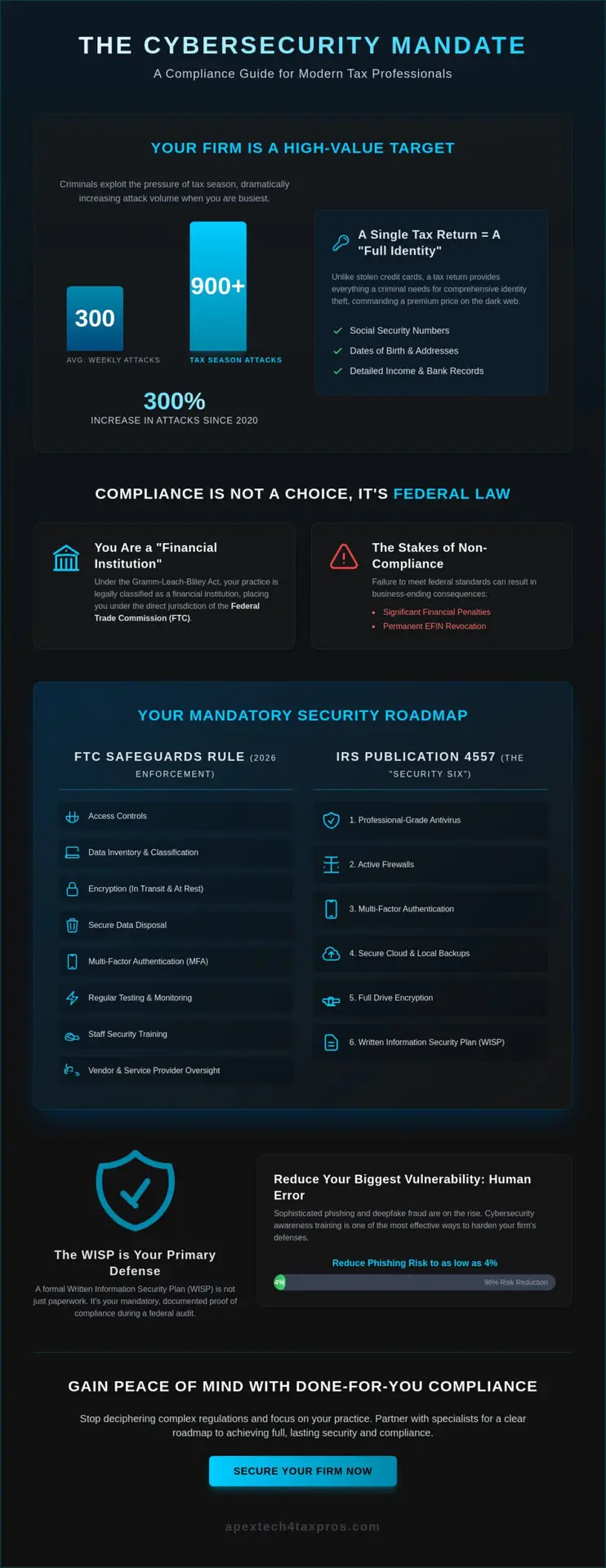
Accounting firms now face an average of 300 cyberattacks every week, a figure that surges past 900 during the height of tax season. This 300% increase since 2020 confirms that your practice is a high-value target for criminals seeking sensitive taxpayer data. Managing robust cyber security for accountants isn’t just about protecting your reputation; it’s a mandatory federal requirement under the latest 2026 FTC Safeguards Rule enforcement cycle.
You likely feel the weight of these regulatory burdens while trying to manage a busy tax practice, often wondering if your current IT setup actually meets the strict definitions of IRS Publication 4557. We understand that deciphering the difference between general IT support and a formal Written Information Security Plan (WISP) is a daunting task when time is your most limited resource. This guide provides a clear roadmap to master the technical safeguards and federal compliance mandates necessary to protect your firm. You’ll learn how to implement a WISP, secure your cloud backups, and train your staff to reduce phishing risks to as low as 4%; this ensures you can finally gain peace of mind that your client data is truly secure.
Key Takeaways
- Understand why the 2026 FTC Safeguards Rule enforcement cycle classifies your firm as a financial institution and mandates specific technical controls.
- Learn how to develop a customized Written Information Security Plan (WISP) that meets IRS Publication 4557 requirements instead of relying on generic IT policies.
- Master the essential components of cyber security for accountants, including multi-layered defense strategies and secure cloud backups to protect high-value client identities.
- Identify how professional risk assessments and cybersecurity awareness training can reduce your firm’s vulnerability to sophisticated phishing and deepfake fraud.
- Discover a clear roadmap to achieving full compliance through specialized, “done-for-you” security solutions that provide lasting peace of mind.
The Regulatory Reality: FTC Safeguards and IRS Publication 4557
Many tax professionals view IT security as a technical preference or a discretionary expense. In reality, federal law dictates your firm’s technical infrastructure with clinical precision. Under the Gramm-Leach-Bliley Act, your practice is legally defined as a financial institution. This classification brings you under the direct jurisdiction of the Federal Trade Commission (FTC), making robust cyber security for accountants a non-negotiable compliance standard rather than a choice.
If you fail to maintain these standards, the consequences go beyond the immediate trauma of data loss. You risk significant financial penalties and the permanent revocation of your Electronic Filing Identification Number (EFIN), which effectively ends your ability to practice. The IRS and FTC now work in tandem to ensure that every firm, regardless of size, designates a single Qualified Individual. This person is responsible for overseeing and enforcing a comprehensive security program that protects sensitive taxpayer information from evolving threats.
The FTC Safeguards Rule Mandate
The FTC Safeguards Rule specifically targets any business significantly engaged in financial activities. This includes CPAs, solo practitioners, and large tax firms. To remain compliant in 2026, you must implement eight specific safeguards: access controls, data inventory, encryption, secure disposal, multi-factor authentication (MFA), regular testing, staff training, and vendor oversight. A critical update for 2026 involves breach notification protocols. You’re now required to notify the FTC within 30 days if unencrypted data involving at least 500 consumers is acquired without authorization.
IRS Publication 4557 Standards
While the FTC provides the broad legal framework, IRS Publication 4557 offers the specific operational blueprints for tax professionals. It outlines seven key areas of security, ranging from physical office safety to electronic data disposal. Central to this is the “Security Six.” These essential protections include professional-grade antivirus software, active firewalls, multi-factor authentication, secure backup services, drive encryption, and a formal Written Information Security Plan (WISP).
Compliance also requires administrative diligence. As of April 2026, the IRS continues to mandate that tax professionals monitor their EFIN activity through their e-Services account. You must be prepared to verify that your WISP is current and fully implemented during any regulatory inquiry. This documentation isn’t just paperwork; it’s your primary defense during a federal audit. Effective cyber security for accountants requires a methodical approach to these documentation requirements to ensure your practice remains both secure and operational.
Why Accounting Firms are High-Value Targets for Cybercriminals
A single tax return contains every data point a criminal needs to execute comprehensive identity theft. Social Security numbers, dates of birth, and detailed income records represent a “Full Identity” on the dark web, commanding a premium price compared to simple credit card numbers. For this reason, cyber security for accountants is no longer just a background IT concern. It’s a critical shield against an industry of professional hackers who view your firm’s server as a high-yield asset.
Criminals often prefer small to mid-sized firms over large corporations. They operate under the assumption that smaller practices lack the sophisticated defenses of a global enterprise. While a large firm might have a dedicated security operations center, a solo practitioner or small partnership might rely on unmonitored networks. This perceived vulnerability makes smaller firms frequent targets for automated scanning and targeted intrusions.
The timing of these attacks is rarely accidental. Research indicates that accounting firms experience an average of 300 cyberattacks per week, but this number spikes to over 900 during the first two quarters of the year. Criminals leverage the high-pressure environment of tax season, knowing that a busy professional is more likely to click a malicious link while rushing to meet a filing deadline. This seasonal surge is why the FTC Safeguards Rule mandates year-round vigilance rather than periodic checks.
Social Engineering and Phishing Lures
Modern phishing scams are highly personalized. A common “New Client” lure involves an email from a supposed prospect asking for a tax consultation. The email includes an attachment labeled “Tax Records” or “Prior Year Return.” Once opened, this file installs malware that can bypass standard antivirus programs. Spear phishing takes this a step further by impersonating a firm partner to request urgent wire transfers or sensitive payroll data. This Business Email Compromise (BEC) is particularly dangerous because it exploits the trust established within your professional hierarchy.
Ransomware and Practice Interruption
Ransomware has evolved into a sophisticated service model. Attackers now employ “Double Extortion” tactics. They don’t just encrypt your data to halt your operations; they also exfiltrate it. They threaten to release your clients’ private financial records publicly unless a ransom is paid. With the average cost of a data breach reaching $4.44 million, the financial impact is devastating. However, the long-term reputational damage is often worse. Rebuilding client trust after their private data appears on a public forum is a challenge many firms never overcome. Performing a professional risk assessment can help identify these vulnerabilities before a criminal does.
The Written Information Security Plan (WISP): Your Mandatory Shield
While technical tools like firewalls and encryption provide the muscle for your defense, the Written Information Security Plan (WISP) serves as the brain. The IRS and FTC don’t just want you to be secure; they require you to document exactly how you achieve that security. According to IRS Publication 4557, every tax professional must have a written plan that is appropriate to their firm’s size and complexity. This document is the first thing a regulator will request during an audit or following a data breach. Without it, your firm is technically non-compliant, regardless of how many passwords you’ve changed.
A generic IT policy is not a substitute for a customized WISP. General policies often focus on broad corporate goals, whereas a WISP is a granular, specialized document engineered for the unique risks of the tax industry. It serves as your primary defense against professional liability claims by proving you exercised “due care” in protecting client information. Effective cyber security for accountants relies on this documentation to bridge the gap between technical settings and legal requirements. A compliant plan must include:
- Designation of a Qualified Individual to coordinate the program.
- A thorough assessment of risks to customer information.
- Design and implementation of safeguards to control identified risks.
- Regular monitoring and testing of those safeguards.
- A plan for overseeing third-party service providers.
- A protocol for evaluating and adjusting the program as the firm grows.
WISP Templates vs. Professional Customization
Many practitioners fall into the trap of using a “fill-in-the-blank” template found online. While these can provide a starting point, a template that isn’t implemented is just a stack of paper. The FTC Safeguards Rule requires your plan to reflect your firm’s specific hardware, software, and staff workflows. If your WISP claims you use multi-factor authentication on all devices but your staff doesn’t actually use it, the document becomes evidence of negligence. You’re also required to conduct annual reviews to ensure the plan stays current with new technology and emerging threats.
Operationalizing Your Security Plan
To be effective, your WISP must move from a binder on the shelf into your daily operations. This means integrating its standards into your employee handbook and making security part of your firm’s culture. Staff should know exactly what to do if they suspect a phishing attempt or lose a firm-issued device. Training sessions should reference the WISP so employees understand that these aren’t just “IT rules” but firm-wide mandates. A WISP is a living document that evolves alongside your technology and the regulatory environment. By treating it as a foundational part of your practice, you ensure that cyber security for accountants remains a manageable, proactive process rather than a reactive crisis.
A Multi-Layered Security Strategy for the Modern Practice
Defense in depth is the gold standard for protecting sensitive financial data. This concept assumes that any single security measure will eventually fail. By stacking technical, administrative, and physical safeguards, you create multiple hurdles for an intruder. Effective cyber security for accountants requires this holistic view. It ensures that if a phishing email bypasses your filter, your multi-factor authentication or endpoint detection stands ready to block the unauthorized access. Relying on a single solution is no longer a viable strategy for a professional firm.
A resilient practice treats security as a continuous process rather than a static goal. This involves regular testing of your defenses and maintaining the ability to recover quickly if a breach occurs. By integrating these layers into your daily operations, you build a practice that is not only compliant but truly secure against the sophisticated threats of 2026.
Risk Assessments and Vulnerability Management
A professional risk assessment identifies critical gaps in your infrastructure before a hacker exploits them. Many firms rely on a one-time scan performed years ago, yet the threat landscape changes daily. Continuous monitoring is the modern requirement. Legacy tax preparation software often carries unpatched vulnerabilities that serve as open doors for malware. By conducting regular Risk Assessments, you can prioritize patches and hardware upgrades based on actual risk levels rather than guesswork. This proactive approach prevents the common “set it and forget it” mentality that leads to many avoidable breaches.
Secure Cloud Backup and Data Integrity
Data loss can occur through hardware failure, natural disasters, or ransomware. We recommend the “3-2-1” backup rule: maintain three copies of your data, on two different media types, with one copy stored off-site. Secure cloud backup provides this off-site redundancy with high-level encryption. This ensures that even if your local network is compromised by ransomware, your historical financial records remain untouched and recoverable. Moving away from risky email attachments to secure client portals further protects data integrity during the exchange of sensitive documents. These portals provide a controlled environment that keeps client data off vulnerable local hard drives.
Cybersecurity Awareness Training
Technical tools are only as effective as the people who use them. Your staff represents the “Human Firewall.” They must master fundamental topics including sophisticated phishing detection, password hygiene, and the proper use of MFA. Training shouldn’t be a once-a-year event; security must stay top-of-mind through quarterly sessions. Simulated phishing tests are particularly effective for measuring staff readiness. These tests send safe, fake phishing emails to identify which employees need additional coaching. Investing in Cybersecurity Awareness Training transforms your team from a potential liability into your strongest line of defense.
Partnering with Apex Tech 4 Tax Pros for Secure Compliance
Apex Tech 4 Tax Pros understands that tax professionals shouldn’t have to be IT experts to maintain compliance. We act as a dedicated partner, bridging the gap between the clinical requirements of federal law and the daily operations of your firm. Our team brings decades of experience navigating both technical infrastructure and industry-specific mandates. By prioritizing cyber security for accountants, we ensure that your practice remains a secure environment where client trust is never compromised. We don’t just provide generic support; we offer a mission-driven approach engineered specifically for the tax industry.
Professional security is more than a defensive measure. It’s a powerful marketing advantage. High-value clients, especially those with complex financial portfolios, are increasingly aware of data breach risks. When you can demonstrate a robust, documented security posture, you distinguish your firm from competitors who may still be using outdated or unmonitored methods. This proactive stance signals to your clients that their sensitive data is in safe, capable hands. Our ongoing support through regular risk assessments and staff training ensures that your defenses evolve as quickly as the threats do.
Customized WISP and Compliance Solutions
Creating a personalized security plan requires a deep understanding of your firm’s specific hardware, software, and staff workflows. Apex Tech 4 Tax Pros eliminates the guesswork by providing a “Done-For-You” WISP development process. We ensure every element of your plan aligns with the strict mandates of the IRS and the FTC. This methodical approach transforms a complex regulatory burden into a structured, manageable asset. For those just beginning to evaluate their current standing, we offer a FREE WISP Download Template as a foundational starting point. This resource helps you visualize the documentation required to meet federal standards before moving toward a fully customized solution.
Securing Your Practice’s Future
The peace of mind that comes from professional risk management is invaluable. Knowing that your client data is backed up, your staff is trained, and your firm is compliant allows you to focus on your core mission of serving clients. Our comprehensive cybersecurity evaluation identifies vulnerabilities in your current systems and provides a clear remedy for every gap. We take personal accountability for the technical success of our client base, ensuring you’re never left to navigate a compliance crisis alone. Don’t wait for an audit or a breach to discover the weaknesses in your network. Schedule your professional risk assessment today and take the first step toward a secure, compliant future. Mastering cyber security for accountants is a journey, and we’re here to guide you every step of the way.
Securing Your Practice Against Evolving Federal Mandates
The regulatory environment of 2026 requires tax professionals to move beyond basic IT and embrace a rigorous framework of data protection. You’ve seen how the FTC Safeguards Rule and IRS Publication 4557 have transformed compliance into a mandatory operational standard. Relying on outdated systems or generic policies leaves your firm vulnerable to the seasonal surges in cybercrime that target high-value client data. By implementing a multi-layered strategy that includes expert-led cybersecurity awareness training and secure cloud backup solutions, you protect both your reputation and your professional standing.
Mastering cyber security for accountants is a complex undertaking; however, it doesn’t have to be a burden you carry alone. Apex Tech 4 Tax Pros provides the specialized expertise needed to bridge the gap between technical security and federal mandates. We focus specifically on the unique requirements of the tax industry to ensure your practice is fortified against evolving threats. Get Your Customized Written Information Security Plan (WISP) Today to ensure your firm meets every technical and administrative safeguard required by law. Taking this proactive step provides the peace of mind you need to focus on your clients’ success while we secure your practice’s future.
Frequently Asked Questions
Is a Written Information Security Plan (WISP) really mandatory for solo practitioners?
Yes, a WISP is a mandatory requirement for every tax professional under the FTC Safeguards Rule and IRS Publication 4557. Federal law does not provide an exemption based on firm size. Even if you operate as a solo practitioner, you must maintain a written plan that details the administrative, technical, and physical safeguards you use to protect taxpayer data.
What are the penalties for not complying with IRS Publication 4557?
Non-compliance can result in significant monetary fines and the permanent revocation of your Electronic Filing Identification Number (EFIN). Losing your EFIN effectively terminates your ability to practice as a tax professional. The IRS and FTC have intensified enforcement in 2026, treating the absence of a WISP as a serious regulatory failure rather than a minor oversight.
Does my existing IT company provide a WISP as part of their service?
Most general IT providers do not include a WISP because it is a specialized compliance document rather than a standard technical service. While an IT company might manage your firewall or backups, a WISP requires a deep understanding of specific IRS and FTC regulations. You should verify if your provider has the expertise to bridge the gap between technical settings and federal tax law.
How often should an accounting firm conduct a cybersecurity risk assessment?
The FTC Safeguards Rule requires accounting firms to conduct risk assessments regularly to ensure cyber security for accountants remains effective. You should perform a comprehensive assessment at least annually or whenever you implement significant changes to your software or hardware. This proactive approach identifies new vulnerabilities before they can be exploited by criminals during peak tax seasons.
What is the difference between the FTC Safeguards Rule and IRS security requirements?
The FTC Safeguards Rule is the federal law that legally classifies tax preparers as “financial institutions” and mandates specific data protections. IRS Publication 4557 provides the practical, industry-specific guidelines for meeting those legal standards. Together, they form the regulatory framework you must follow to protect sensitive client information and maintain your professional standing.
Can I use a free WISP template for my accounting practice?
A free template is a helpful starting point, but it must be heavily customized to meet federal standards. The IRS requires your WISP to reflect your firm’s unique hardware, software, and staff workflows. A generic, “fill-in-the-blank” document that does not match your actual office practices will likely fail a regulatory audit or leave you vulnerable during a liability claim.
What should I do if I suspect my firm has experienced a data breach?
You must activate your WISP’s incident response plan immediately to contain the threat. Under 2026 mandates, you’re required to notify the FTC within 30 days if unencrypted data involving at least 500 consumers is compromised. You should also contact your local IRS Stakeholder Liaison and your insurance carrier to begin the recovery and notification process.
How does cybersecurity awareness training benefit my staff and clients?
Staff training is the most effective way to reduce human error, which remains a primary cause of data breaches. Regular sessions can lower phishing click rates to approximately 4%, significantly strengthening cyber security for accountants. Clients feel more secure knowing your team is trained to recognize sophisticated deepfake fraud and social engineering tactics that target their financial records.