
Did you know that as of 2026, a single oversight in your firm’s data protection can result in FTC civil penalties reaching up to $51,744 per violation, per day? For a busy professional, the weight of these federal mandates often feels like a secondary tax on your time and peace of mind. You likely feel the pressure of peak season while trying to decode technical jargon like MFA, VPNs, and encryption. That’s why we’ve developed this irs data security compliance checklist for tax preparers to help you master IRS Publication 4557 and the FTC Safeguards Rule with total confidence.
You deserve to know that your firm is protected from data theft without needing a degree in information technology. This article provides a clear, non-technical roadmap that translates dense regulatory jargon into actionable steps for your practice. We’ll walk you through the mandatory Security Six measures and show you how to build a defensible security plan that satisfies both the IRS and the FTC. By the end of this guide, you’ll have a practical strategy to safeguard your clients’ sensitive information and ensure your firm remains audit-ready throughout the year.
Key Takeaways
- Understand the regulatory intersection of IRS Publication 4557 and the FTC Safeguards Rule to confirm your firm’s compliance as a designated financial institution.
- Learn to harden your digital perimeter by transitioning from basic antivirus to advanced Endpoint Detection and Response (EDR) for both office and remote networks.
- Use a comprehensive irs data security compliance checklist for tax preparers to build a Written Information Security Plan (WISP) that serves as a defensible roadmap for federal audits.
- Establish a methodical operational rhythm through daily monitoring and quarterly cybersecurity awareness training to keep your firm’s data protection consistent year-round.
- Identify how professional risk assessments and secure cloud backups provide the technical oversight needed to protect sensitive client data without disrupting your workflow.
The 2026 Regulatory Landscape: IRS Publication 4557 and the FTC Safeguards Rule
The regulatory environment for tax professionals has shifted from a period of general guidance into an era of strict federal enforcement. This change centers on the intersection of the Gramm-Leach-Bliley Act (GLBA) and specific IRS mandates. Under the GLBA, the Federal Trade Commission (FTC) now classifies all professional tax preparers as “financial institutions.” There’s no exemption based on firm size; even a sole proprietor is legally required to implement the same rigorous safeguards as a large corporation. This classification means you’re held to a higher standard of accountability regarding how you handle and store sensitive client information.
IRS Publication 4557 acts as the primary roadmap for the protection of personal data. This encompasses any sensitive information that could identify a client, such as Social Security numbers, bank details, or financial history. Neglecting to follow a formal irs data security compliance checklist for tax preparers carries severe financial and professional consequences. As of 2024, FTC civil penalties can reach up to $51,744 per violation, per day. Additionally, the IRS has the authority to suspend your Electronic Filing Identification Number (EFIN), which effectively terminates your ability to file returns and damages your firm’s reputation beyond easy repair.
The FTC Safeguards Rule: Mandatory Requirements for 2026
Compliance in 2026 requires a “Qualified Individual” to be formally designated as the lead for your firm’s security program. This role involves more than just passive oversight; it demands the active management of your Written Information Security Plan (WISP) and the implementation of specific technical controls like multi-factor authentication. Modern audit standards now prioritize documented risk assessments. You must provide a clear paper trail showing that you’ve identified vulnerabilities and applied professional remedies to mitigate them. This shift from suggested practices to mandatory requirements means that “doing your best” is no longer a valid defense during a federal audit.
Publication 4557 vs. Publication 5293: Which Do You Need?
You actually need both to maintain a truly secure and compliant environment. Publication 4557 is your operational checklist, detailing the administrative and technical requirements necessary for federal compliance. Publication 5293 serves as a secondary resource guide specifically designed for your staff. It helps them recognize sophisticated phishing attempts and understand their role in data protection. Integrating both documents into your firm’s irs data security compliance checklist for tax preparers ensures that security becomes a cultural habit rather than a seasonal chore. This methodical approach protects your firm’s heritage and provides the protective reassurance your clients expect in a high-stakes digital world.
The Expanded “Security Six”: Hardening Your Firm’s Digital Perimeter
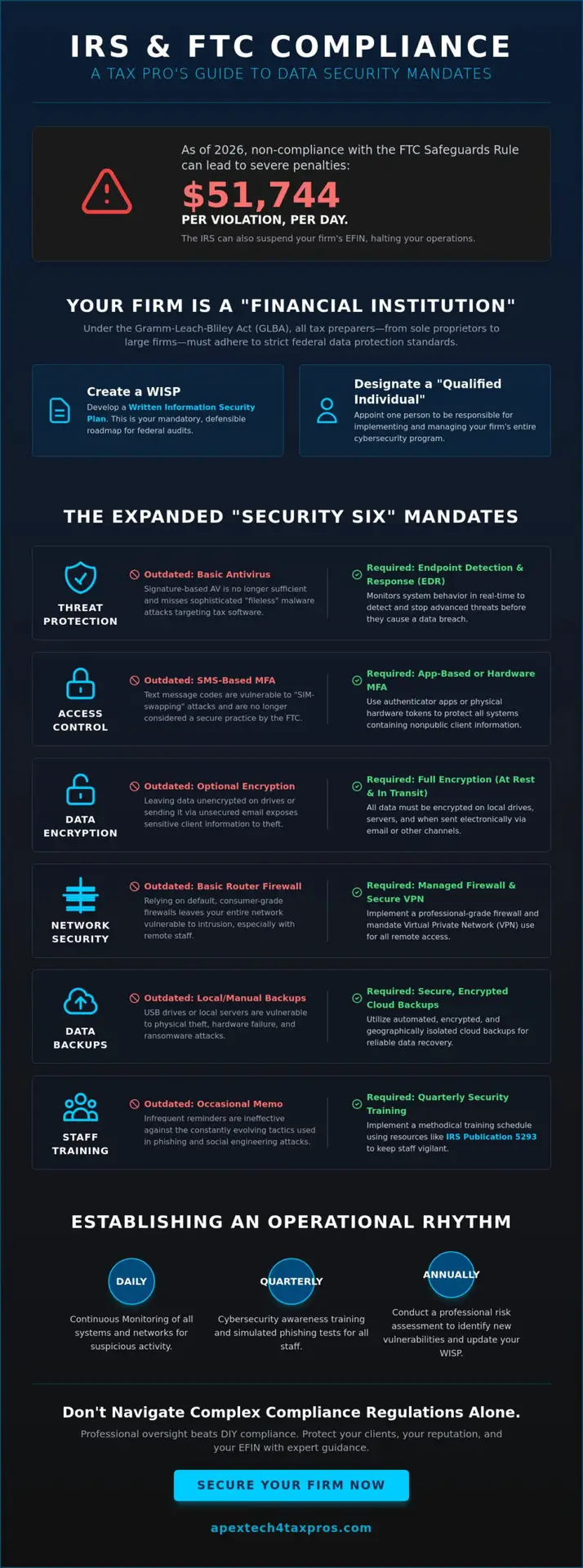
The traditional baseline security measures originally outlined in IRS Publication 4557 have evolved from simple recommendations into mandatory technical controls. Simply installing consumer-grade antivirus is no longer sufficient for a modern tax practice. Your irs data security compliance checklist for tax preparers must now prioritize Endpoint Detection and Response (EDR) over signature-based software. EDR monitors system behavior in real-time, allowing it to stop sophisticated “fileless” malware that standard programs often miss entirely. This transition is essential as cybercriminals increasingly target the specialized software used by tax professionals.
Multi-factor authentication (MFA) has also seen a critical shift in 2026. The FTC mandates MFA for all systems containing nonpublic personal information, and relying on SMS text codes is no longer considered a secure practice due to the rise in SIM-swapping attacks. You should implement app-based authenticators or hardware tokens to ensure that a stolen password doesn’t lead to a total firm breach. Similarly, encryption is required for all data at rest on your local drives and all data in transit via email. If you’re managing a hybrid team, a professional-grade Virtual Private Network (VPN) is the only way to secure the connection between a home office and your central server environment. Maintaining these standards is a core part of being a disciplined, vigilant protector of your clients’ financial lives.
Backup Solutions: Beyond Simple Cloud Storage
A secure backup strategy follows the “3-2-1” rule: three total copies of your data, stored on two different types of media, with one copy kept off-site. In 2026, the most critical component of this strategy is “immutability.” Immutable backups are write-protected and cannot be deleted or encrypted by ransomware, providing a final line of defense if your primary systems are compromised. We recommend conducting a professional risk assessment to identify if your current backup solution can actually meet the recovery time objectives required to keep your firm operational during the high-pressure tax season.
Modern Additions: AI-Phishing Defense and Zero Trust
AI-driven phishing attacks have become terrifyingly convincing, often mimicking the tone and style of your actual clients or IRS agents with flawless precision. Defending against these requires a “Zero Trust” architecture. This security philosophy assumes that every user and device is a potential threat until verified, regardless of whether they’re inside or outside your network. Automated patch management is another non-negotiable addition. Since software vulnerabilities are discovered daily, your tax software and operating systems must update automatically to close security gaps before they can be exploited. This methodical approach ensures your firm remains a fortress against evolving digital threats.
Beyond the Template: Building a Defensible Written Information Security Plan (WISP)
While technical controls like EDR and VPNs form your digital shield, the Written Information Security Plan (WISP) serves as the legal foundation of your firm’s defense. It’s a living document that outlines exactly how your practice protects client data. Many professionals mistakenly believe that downloading a free template fulfills their federal obligation. In reality, a template represents only about 10% of the work required for actual compliance. To be truly defensible during an audit, your WISP must reflect the specific operational realities of your office and align with a comprehensive irs data security compliance checklist for tax preparers.
Federal law now mandates the designation of a Program Coordinator to oversee your security program. This individual is responsible for ensuring that all protocols are followed and that the plan is updated as the firm grows. This isn’t just a title; it’s a role that carries significant accountability for the firm’s adherence to the irs data security compliance checklist for tax preparers. The core of this document is the Risk Assessment, where you must formally identify potential threats and document the specific professional remedies you’ve implemented to mitigate them.
Customizing Your WISP for Firm-Specific Risks
You must document the precise flow of Personally Identifiable Information (PII) within your office. This involves identifying every touchpoint where sensitive data enters your system, how it’s processed, and where it’s archived. You also need to verify the security standards of your third-party software vendors. A robust WISP requires a formal annual review. This ensures your plan accounts for new digital threats and stays aligned with any changes in your business structure or remote work arrangements.
Employee Training and Management
Human error remains a primary vulnerability in any security chain. Your WISP should mandate regular cybersecurity awareness training for all staff members. It’s vital to maintain detailed logs of these sessions to provide a clear audit trail for the IRS or FTC. We also recommend implementing the “Least Privilege” principle, which restricts data access to only those employees who need it for their specific roles. Finally, your plan must include immediate termination protocols. These procedures ensure that all digital access is revoked the moment an employee leaves the firm, preventing any potential internal data leaks.
Operational Compliance: A Practical Implementation Checklist
Compliance isn’t a seasonal project; it’s a daily operational rhythm that guards your firm’s legacy. Integrating a professional irs data security compliance checklist for tax preparers into your firm’s routine ensures that protection remains constant even during the height of tax season. Daily tasks must include monitoring system logs and verifying that your secure cloud backup successfully synced overnight. You should also check automated software updates to confirm no workstation was left vulnerable. These small, methodical actions form a wall against the AI-driven threats that modern firms face.
Moving into quarterly and annual cycles adds deeper layers of security. Every three months, your firm should conduct phishing simulations to test staff vigilance and change administrative passwords. Annually, you’re legally required to perform a full risk assessment and update the signatures on your WISP. If a breach is suspected, the first 24 hours are vital. You must isolate affected systems, document the timeline, and prepare for potential notification requirements. The FTC requires notification within 30 days for breaches affecting 500 or more consumers. This rapid response protects your firm from additional liability and demonstrates your commitment to data protection standards.
Physical Security and Asset Management
Protecting digital data requires securing the physical environment. A clean desk policy prevents sensitive documents from being left exposed to unauthorized eyes; this is a simple but effective administrative safeguard. You should maintain a detailed IT Asset Inventory that tracks every laptop, tablet, and smartphone with access to client data. When hardware reaches the end of its life, professional destruction of drives is mandatory. This prevents data recovery from discarded machines and ensures that your firm’s disposal methods meet federal standards. Documenting these physical controls is a necessary part of your defensible security plan.
Service Provider Due Diligence
Your firm’s security is only as strong as your weakest vendor. The FTC Safeguards Rule requires you to oversee your service providers by verifying their security standards. This means confirming that your cloud tax software maintains SOC 2 compliance and ensuring your contracts include specific data protection clauses. Conducting a vendor risk assessment allows you to identify vulnerabilities in your supply chain without needing a degree in information technology. You should verify that vendors have their own incident response plans in place. This methodical oversight ensures that your sensitive data remains in safe, capable hands throughout the entire data lifecycle.
Scaling Security: Why Professional Oversight Beats DIY Compliance
Attempting to manage an irs data security compliance checklist for tax preparers on your own often leads to a dangerous state of false confidence. While you’re an expert in the tax code, the technical nuances of cybersecurity require a different level of specialization that most tax offices simply don’t possess internally. DIY efforts usually result in hidden costs, particularly the time lost during peak filing season and the lingering vulnerability of misconfigured systems. Apex Tech 4 Tax Pros bridges this gap by providing the technical infrastructure that allows you to focus on your clients while we handle the meticulous regulatory burden. We act as your multi-disciplinary protector, ensuring your firm stays ahead of evolving mandates.
Professional oversight changes your firm’s posture from reactive to proactive. A professional Risk Assessment serves as your strongest defense during an IRS audit scenario, providing a documented narrative of your security efforts. Instead of viewing these mandates as a burden, you can transition them into a competitive marketing advantage. Clients in 2026 are more aware of data privacy than ever. They want to know their financial lives are in safe hands. Demonstrating that you have a professionally managed security plan builds deep trust and distinguishes your firm from less-prepared competitors who rely on outdated methods.
Customized WISP Development vs. Generic Templates
A generic template is a static document that rarely survives federal scrutiny because it lacks the firm-specific details auditors require. Our expert-led, customized Written Information Security Plans (WISP) are specifically engineered to withstand the rigors of an FTC or IRS investigation. Partnering with a “Qualified Individual” ensures that your firm meets the formal oversight requirements of the Safeguards Rule. This collaboration aligns your technology stack with your legal obligations, providing the protective reassurance that your sensitive data is in safe, capable hands. We ensure your WISP isn’t just a file on a shelf but a functional part of your firm’s heritage.
Getting Started: Your Roadmap to 2026 Compliance
The road to secure compliance begins with three immediate steps. First, designate your Qualified Individual to oversee your program. Second, conduct a formal gap analysis of your current technical controls to see where you’re vulnerable. Third, finalize your WISP to reflect your firm’s unique operations and staff protocols as part of your irs data security compliance checklist for tax preparers. If you’re ready to secure your practice, you can protect your firm and your clients with a customized WISP from Apex Tech 4 Tax Pros. Scheduling a professional risk assessment is the most effective way to ensure your firm is truly audit-ready and resilient against 2026 threats.
Securing Your Firm’s Future in a High-Stakes Regulatory Era
The shift toward mandatory technical controls and formal documentation signifies a new era of accountability for tax professionals. You’ve seen how the intersection of IRS Publication 4557 and the FTC Safeguards Rule requires a disciplined, year-round commitment to data protection. Implementing a robust irs data security compliance checklist for tax preparers is no longer a seasonal task; it’s a foundational requirement for any practice that values its reputation and client trust.
At Apex Tech 4 Tax Pros, we bring decades of experience in niche compliance markets to help you navigate these complex federal mandates. Our mission is to provide you with IRS-aligned Risk Assessments and specialized Cybersecurity Awareness Training that empowers your staff to act as a first line of defense. We understand the high-stakes environment you operate in, and we’re here to ensure your regulatory burdens are handled with clinical precision.
Don’t leave your firm’s security to chance or generic templates. Secure Your Practice with a Customized WISP Today and gain the peace of mind that comes from professional oversight. Your commitment to security today ensures a resilient and successful practice for years to come.
Frequently Asked Questions
Is a Written Information Security Plan (WISP) required for a one-person tax office?
Yes, a Written Information Security Plan is mandatory even for a solo practitioner. The FTC Safeguards Rule classifies all tax preparers as financial institutions regardless of their employee count. This means you must document your security protocols to meet federal standards. Using an irs data security compliance checklist for tax preparers helps ensure your one-person office remains compliant and prepared for any potential audit or inquiry.
What are the specific penalties for not having an IRS-compliant security plan?
Financial penalties for non-compliance are severe and can reach up to $51,744 per violation, per day. Beyond these FTC fines, the IRS can suspend your Electronic Filing Identification Number (EFIN), which immediately halts your ability to conduct business. You also face potential state attorney general actions and private lawsuits. A defensible security plan is your primary protection against these devastating professional and financial consequences.
Can I use a free WISP template for my accounting firm?
You can use a free template as a baseline, but a generic document rarely withstands federal scrutiny. Federal mandates require your WISP to be tailored to your firm’s specific risks and technical infrastructure. A template is only about 10% of the actual work required for compliance. To ensure your plan is truly defensible, you must customize it to reflect your firm’s unique operations and data flow.
What is the “Security Six” and is it enough for 2026 compliance?
The Security Six includes antivirus, firewalls, MFA, backup, encryption, and VPNs. While these are essential baseline measures, they are no longer sufficient on their own for 2026 compliance. Modern standards require advanced controls like Endpoint Detection and Response (EDR) and immutable backups. Your irs data security compliance checklist for tax preparers should expand on these basics to address sophisticated AI-driven threats and hybrid work environments.
How often do I need to update my tax firm’s risk assessment?
You are required to update your firm’s risk assessment at least once per year. However, you should also conduct a new assessment whenever you implement significant changes to your technology stack or office structure. This methodical approach ensures that your security measures stay aligned with current digital threats. Documenting these regular reviews is a core requirement of the FTC Safeguards Rule and demonstrates your firm’s ongoing vigilance.
What should I do if I suspect a client data breach?
You should immediately isolate any compromised systems and document the discovery timeline. If you determine that the breach affects 500 or more consumers, you must notify the FTC within 30 days of discovery. It’s also vital to contact your insurance provider and potentially local law enforcement. Having a pre-defined incident response plan within your WISP allows you to handle these high-stakes situations with professional precision and calm.
Does the FTC Safeguards Rule apply to small tax preparation businesses?
Yes, the FTC Safeguards Rule applies to all tax preparation businesses regardless of their size or client volume. The Gramm-Leach-Bliley Act defines any entity engaged in financial activities, including tax preparation, as a financial institution. This means small firms and solo practitioners must designate a Qualified Individual and implement formal administrative and technical safeguards. There’s no “small business” exemption when it comes to protecting sensitive client data.
How do I prove to the IRS that my staff has received cybersecurity training?
You can prove compliance by maintaining detailed documentation of every training session conducted for your staff. These records should include the date, a list of attendees, and a summary of the cybersecurity topics covered. The IRS and FTC look for a clear audit trail that demonstrates your firm’s commitment to security awareness. Keeping these logs organized within your WISP ensures you are always ready to provide evidence of your staff’s training.