
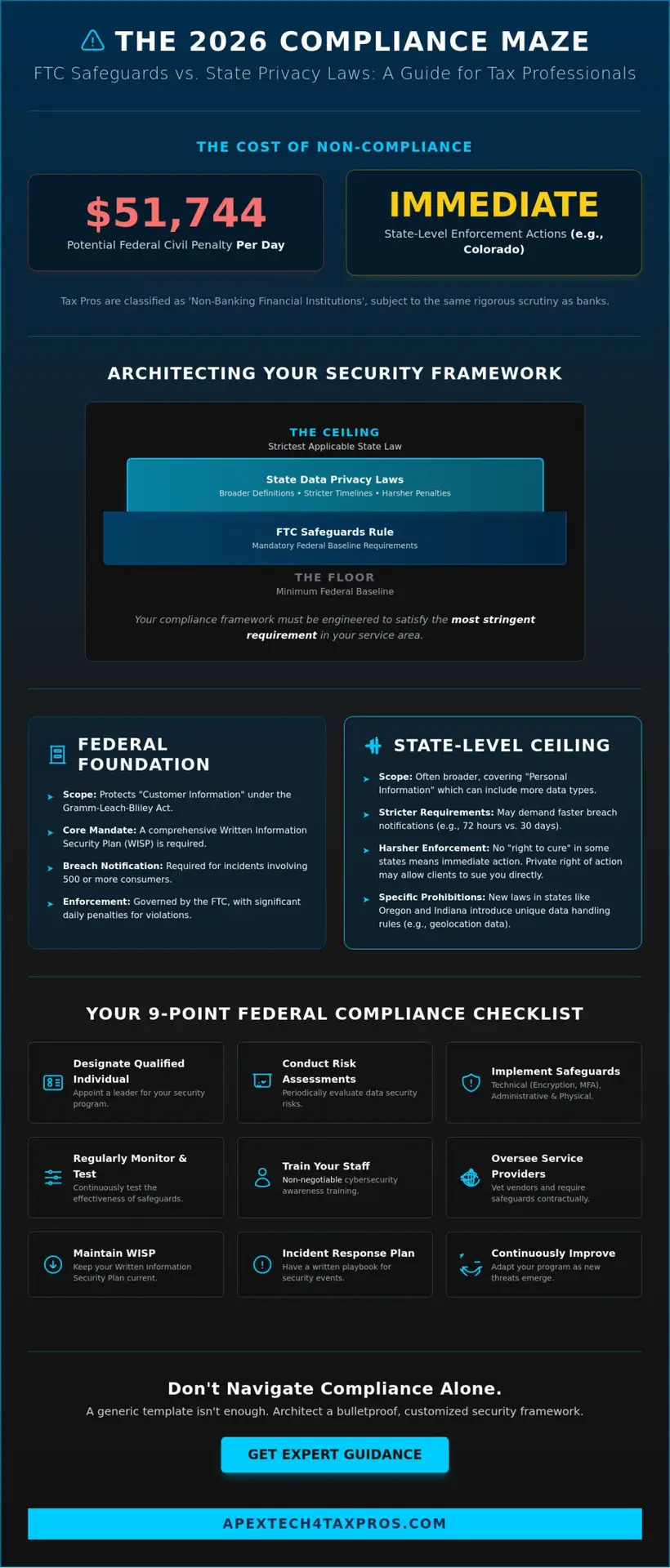
Could a single oversight really cost your practice $51,744 per day in federal civil penalties while simultaneously triggering an immediate enforcement action under the Colorado Privacy Act? You likely feel the weight of compliance fatigue as you manage overlapping regulations that seem to shift every quarter. It’s exhausting to track whether your current security measures satisfy the IRS, the FTC, and the twenty different states that now have comprehensive data privacy laws in effect as of 2026. With the expiration of the right to cure in Colorado and new mandates in Indiana, Kentucky, and Rhode Island, the margin for error has vanished.
Understanding the ftc safeguards rule vs state data privacy laws for tax professionals is no longer a technical luxury; it’s a fundamental requirement for your 2026 operations. This guide provides the clarity you need to navigate the complex intersection of federal mandates and state statutes to ensure your practice remains fully compliant. We’ll explore how to architect a security framework that treats federal rules as the floor and state laws as the ceiling. You’ll gain a unified strategy for data protection that instills confidence during a potential audit or breach investigation.
Key Takeaways
- Recognize your status as a non-banking financial institution under federal law to properly prioritize your multi-layered regulatory obligations.
- Master the nuances of the ftc safeguards rule vs state data privacy laws for tax professionals to ensure your breach notification protocols meet the strictest jurisdictional requirements.
- Learn how to appoint a Qualified Individual and conduct a comprehensive data inventory that satisfies both federal mandates and evolving state-level statutes.
- Implement mandatory cybersecurity awareness training as a non-negotiable pillar of your administrative safeguards to mitigate human-centric risks.
- Discover why a customized Written Information Security Plan (WISP) provides the necessary depth to bridge the gap between basic templates and full regulatory adherence.
The 2026 Compliance Landscape: Federal Mandates and State Sovereignty
Modern tax practices operate within a dual-layered reality. Federal mandates establish a baseline, while state sovereignty creates a complex ceiling that varies by jurisdiction. The IRS and FTC explicitly categorize professional tax preparers as ‘non-banking financial institutions’ under the Gramm-Leach-Bliley Act. This classification isn’t a mere suggestion; it places your firm under the same rigorous scrutiny as traditional banks. Understanding the U.S. financial privacy laws that govern this space is essential for maintaining your e-file provider status.
The year 2026 marks a definitive shift from suggested guidelines to mandatory enforcement. We’ve moved past the era of “reasonable effort” into an era of documented proof. Determining the correct path between the ftc safeguards rule vs state data privacy laws for tax professionals requires a meticulous approach to data mapping. Federal law typically acts as a floor, not a ceiling. While federal preemption exists in limited cases, most state privacy statutes supplement federal rules with stricter requirements and broader definitions of protected data.
What is the FTC Safeguards Rule for Tax Pros?
The core federal requirement is the implementation of a comprehensive, Written Information Security Plan (WISP). You must designate a Qualified Individual to oversee firm-wide security. This person is responsible for coordinating your information security program and conducting regular risk assessments. Mandatory technical elements now include encryption for all customer information, both at rest and in transit, alongside robust multi-factor authentication (MFA) for anyone accessing your systems. It’s no longer optional; it’s a structural necessity for your practice.
The Rise of Comprehensive State Privacy Laws
The “California Effect” has officially spread across the nation. As of January 1, 2026, comprehensive data privacy laws in Indiana, Kentucky, and Rhode Island have gone into effect. These state laws often define ‘Personal Information’ more broadly than the FTC’s definition of ‘Customer Information’. For example, Oregon’s law now prohibits the sale of precise geolocation data. Furthermore, states like Colorado have eliminated the “right to cure,” meaning enforcement actions for non-compliance can be immediate. Some jurisdictions even allow for a private right of action, which grants clients the power to sue your firm directly following a data breach.
Successfully managing the ftc safeguards rule vs state data privacy laws for tax professionals involves identifying which law takes precedence during a crisis. Usually, the law that offers the greatest protection to the consumer is the one that regulators will expect you to follow. If a state law requires breach notification within 72 hours, while the FTC allows 30 days, the state window becomes your operational deadline. Your compliance framework must be engineered to satisfy the most stringent requirement in your service area.
Deep Dive: The Federal Foundation of the FTC Safeguards Rule
The federal foundation of data protection rests on nine specific safeguards designed to secure consumer information. These requirements are divided into administrative, technical, and physical categories. While technical tools like encryption are vital, the FTC emphasizes that administrative controls are equally critical. This includes a non-negotiable requirement for regular Cybersecurity Awareness Training for all staff members. Human error remains a primary vector for breaches; therefore, your team must be trained to recognize phishing and social engineering attempts.
Service provider oversight is another pillar of federal compliance. You can’t outsource your regulatory responsibility. The rule requires you to select service providers capable of maintaining appropriate safeguards and to contractually require them to do so. This means vetting every software vendor that touches your client data. Additionally, your firm must maintain a written incident response plan. This “playbook” details exactly how your practice will respond to a security event, ensuring you meet the federal breach notification requirement for incidents involving at least 500 consumers. According to the 2024 amendment, this notification must occur no later than 30 days after discovery.
IRS Publication 4557 and the WISP Requirement
IRS Publication 4557 explicitly links tax professional status to these federal standards. Every EFIN holder is required to have a Written Information Security Plan (WISP). The IRS enforces this through the annual PTIN renewal process, where preparers must attest to having a WISP in place. By aligning Pub 4557 with the FTC compliance guide for businesses, the IRS creates a clear mandate for data protection. This connection ensures that the 870,679 individuals holding active PTINs for the 2025 tax year are held to a consistent security standard.
Continuous Monitoring and Risk Assessments
Continuous monitoring is the final shift in the federal landscape. Annual checkups are no longer sufficient to protect sensitive financial data. You must implement active vulnerability management, which includes regular penetration testing and vulnerability scans. Documenting the logic behind your security choices is essential for satisfying auditors during a review. When evaluating the ftc safeguards rule vs state data privacy laws for tax professionals, remember that the federal rule provides the mandatory infrastructure while state laws often dictate the specific nuances of consumer rights. Your risk assessments must be updated whenever there is a material change to your business operations or the external threat landscape.
Federal vs. State: Navigating the Key Differences
The comparison between the ftc safeguards rule vs state data privacy laws for tax professionals is primarily a matter of scope and definition. While the federal rule focuses on “Customer Information” obtained during the provision of financial services, state laws like the CCPA or NY SHIELD expand this to include any “Personal Information.” This distinction is vital because state definitions often encompass biometric data, precise geolocation, and even digital identifiers like IP addresses. Adhering to the guidance in IRS Publication 4557 helps you meet the federal baseline, but it doesn’t automatically shield you from state-level obligations that may be more granular.
Consumer rights represent the widest functional gap between these two layers of regulation. The Safeguards Rule focuses on the security, confidentiality, and integrity of data. In contrast, modern state laws grant clients specific rights to delete their data, opt-out of data sales, and correct inaccuracies. If a client in California or Colorado exercises their right to delete, your federal compliance alone won’t protect you from a state enforcement action. You must maintain an operational system that recognizes and facilitates these specific rights based on where your client resides. It’s a logistical challenge that requires your firm to distinguish between federal security mandates and state privacy rights.
Data minimization is another area where divergence occurs. The FTC requires you to protect data for as long as you have it. However, many state statutes require the actual deletion of data once it’s no longer necessary for the original business purpose. This creates a potential tension between federal record-keeping requirements and state-mandated data disposal. You’ll need a policy that balances these competing interests without compromising your regulatory standing.
Stricter Standards: When State Laws Take the Lead
State sovereignty allows individual jurisdictions to mandate specific technical controls that exceed federal requirements. Massachusetts, for instance, requires specific encryption standards that are often more prescriptive than the general encryption requirement of the Safeguards Rule. As of 2026, twenty states have comprehensive privacy laws in effect. These laws frequently include protections for biometric and geolocation data that the FTC hasn’t explicitly prioritized. Following the “highest standard” principle is the only safe way to operate. If one state requires a higher level of encryption or more frequent risk assessments, adopting that standard across your firm protects you from multi-jurisdictional liability.
The Breach Notification Trap
The most dangerous area for tax pros is the breach notification timeline. The FTC requires notification within 30 days if a breach affects at least 500 consumers. However, you’re also subject to a maze of 50 different state notification requirements. Some states require notification within 72 hours of discovery, while others require reporting to the state Attorney General regardless of the number of individuals affected. Your Written Information Security Plan (WISP) must include a state-by-state notification matrix. This ensures you don’t miss a critical window while waiting for the federal 30-day deadline. Failure to meet these overlapping timelines can lead to compounding fines from both federal and state regulators.
Actionable Guidance: Building a Unified Compliance Framework
Building a unified framework begins with a meticulous data inventory that transcends federal definitions. You can’t protect what you haven’t mapped. This process requires identifying not only the ‘Customer Information’ protected by federal law but also the ‘Personal Information’ guarded by state statutes. Once mapped, you must appoint a Qualified Individual who understands both technical infrastructure and the legal layers of your practice. This individual’s primary mission is to draft a ‘Universal WISP’ that addresses the complexities of the ftc safeguards rule vs state data privacy laws for tax professionals by meeting the most stringent applicable standards.
Implementation continues with a multi-jurisdictional staff training program. Your team needs to understand that a client’s rights may change based on their residency. Finally, establish a regular audit cycle for your Secure Cloud Backup and encryption protocols to ensure they remain resilient against evolving threats. This disciplined approach ensures that your technical defenses keep pace with regulatory shifts. It’s a methodical way to transition from a state of vulnerability to one of secure, documented compliance.
The ‘Highest Common Denominator’ Strategy
Adopting the ‘Highest Common Denominator’ strategy is the most efficient path to total compliance. By building your security controls to satisfy the most rigorous standards, such as those found in California or New York, you effectively protect your firm nationwide. This approach simplifies operations by applying one high standard to all client data rather than managing a fragmented system of 50 different protocols. It’s a pragmatic way to reduce the long-term cost of compliance while reinforcing your firm’s reputation for data integrity. You don’t want to be caught guessing which law applies during a high-stakes audit.
Addressing the ‘Too Small to Comply’ Myth
Many practitioners fall victim to the ‘Too Small to Comply’ myth. While the FTC Safeguards Rule offers minor documentation exceptions for firms maintaining fewer than 5,000 consumer records, these exceptions don’t exempt you from core security mandates. You’re still required to implement encryption, MFA, and incident response plans. The intersection of small firm status and big firm liability is dangerous; a single breach can be catastrophic for a boutique practice. Leveraging professional Risk Assessments allows you to identify low-hanging fruit and secure your perimeter without the overhead of a massive IT department.
Beyond Templates: Professional Security Solutions for Tax Pros
Free templates offer a convenient starting point, but they often fail to address the operational realities of a modern tax practice. Relying on a generic document creates a dangerous “paper thin” defense that won’t survive a forensic audit or a multi-state litigation process. These static forms rarely account for the specific nuances involved in the ftc safeguards rule vs state data privacy laws for tax professionals, especially when your clients reside in states with aggressive enforcement like Colorado or California. A template cannot verify your encryption standards or test the resilience of your technical infrastructure; it only provides the illusion of compliance.
True protection requires an integrated approach that connects your administrative policies with your technical reality. This involves conducting professional Risk Assessments that identify actual vulnerabilities in your specific workflow. Once these gaps are identified, they must be closed using engineered solutions like Secure Cloud Backup and ongoing Cybersecurity Awareness Training for your staff. This holistic strategy ensures that your firm isn’t just checking a box but is actively defending the sensitive financial data entrusted to your care. It transforms compliance from a seasonal burden into a permanent pillar of your firm’s professional reputation.
Why a Customized WISP is Essential in 2026
A customized Written Information Security Plan (WISP) is your firm’s primary defense during an IRS or state regulatory inquiry. In 2026, auditors look for plans that are tailored to your specific software stack and internal communication protocols. Your WISP should detail exactly how data moves through your firm, from initial client intake to final filing. By moving from a generic paper plan to an active, defensible security posture, you demonstrate the “due diligence” required to mitigate potential fines. It proves to regulators that you’ve taken deliberate steps to satisfy both federal mandates and the specific privacy statutes of the states where your clients live.
Secure Your Practice with Apex Tech
Apex Tech 4 Tax Pros was founded with a clear mission: protecting the professionals who protect our financial system. We understand that you’re a tax expert, not a cybersecurity engineer. Our integrated approach simplifies the complexities of federal and state compliance by aligning your technical security with your regulatory obligations. We help you bridge the gap between tax preparation and IT security, ensuring that your practice remains resilient in an increasingly hostile digital landscape. Don’t leave your firm’s longevity to chance or outdated templates. Secure your firm’s future with a professional WISP today and gain the confidence that comes from expert-led data protection.
Securing Your Practice for the 2026 Regulatory Shift
Navigating the complex intersection of the ftc safeguards rule vs state data privacy laws for tax professionals requires more than a passive understanding of the law. It demands a proactive architecture that bridges the gap between technical security and regulatory documentation. By adopting a “highest common denominator” approach, you protect your firm from both federal civil penalties and the immediate enforcement actions seen in states like Colorado. Success in this high-stakes environment depends on moving beyond static templates toward an active, defensible security posture.
At Apex Tech 4 Tax Pros, we bring decades of experience in niche compliance markets to help you secure your perimeter. We specialize in expert-led WISP development and comprehensive risk assessments that meet the most rigorous IRS standards. Our mission is to provide the protective reassurance you need to focus on your clients while we handle the technical complexities of data protection. Don’t leave your firm’s longevity to chance; instead, embrace a unified compliance framework.
Download our Professional WISP Guide for Tax Professionals to begin fortifying your practice today. Your commitment to data integrity is the foundation of your professional legacy, and we’re here to ensure that foundation remains unshakable.
Frequently Asked Questions
Does the FTC Safeguards Rule apply to solo tax practitioners?
Yes, the FTC Safeguards Rule applies to you regardless of whether you are a solo practitioner or a multi-partner firm. Under the Gramm-Leach-Bliley Act, professional tax preparers are defined as non-banking financial institutions. While firms with fewer than 5,000 consumer records have limited exemptions regarding written risk assessments and incident response plans, you must still maintain core technical safeguards like encryption and multi-factor authentication.
If I follow the IRS Publication 4557, am I automatically compliant with the FTC?
Following IRS Publication 4557 is a significant step toward compliance, but it does not guarantee automatic adherence to every FTC mandate. The IRS guidelines are designed to align with federal standards, yet the FTC Safeguards Rule includes specific administrative requirements, such as designating a Qualified Individual, that go beyond the general advice in Pub 4557. You must ensure your program addresses the distinct nuances of the ftc safeguards rule vs state data privacy laws for tax professionals.
What is the penalty for non-compliance with the FTC Safeguards Rule in 2026?
The civil penalty for non-compliance with the FTC Safeguards Rule in 2026 is up to $51,744 per violation per day. These fines are compounded by potential state-level penalties and the possible suspension of your IRS e-file provider status. Beyond financial costs, the reputational damage from a public enforcement action often results in the permanent loss of client trust and firm stability.
How do state privacy laws like CCPA affect tax pros outside of California?
State privacy laws affect you if you serve clients residing in those states, regardless of where your physical office is located. If you have a single client in California, Indiana, or Colorado, you must comply with the specific privacy rights and notification requirements of that jurisdiction. This reality makes it essential to understand the ftc safeguards rule vs state data privacy laws for tax professionals when building your security framework.
What is a ‘Qualified Individual’ and do I need to hire someone full-time?
A Qualified Individual is a designated person responsible for overseeing and enforcing your firm’s information security program. You don’t need to hire a full-time employee for this role; it can be an existing staff member or an outsourced professional service provider. The key requirement is that this individual possesses the technical expertise to coordinate your safeguards and report regularly to your firm’s leadership.
How often should my tax firm conduct a cybersecurity risk assessment?
You should conduct a formal Risk Assessment at least annually or whenever there is a material change to your business operations. A material change might include migrating to new tax software, opening a secondary office, or experiencing a significant shift in your IT infrastructure. Regular assessments are essential for identifying new vulnerabilities before they can be exploited by bad actors in the digital landscape.
Are cloud-based tax software providers responsible for my firm’s compliance?
Cloud-based providers are responsible for the security of their own platforms, but you remain legally responsible for the security of the data you input and how your staff accesses it. The FTC requires you to oversee your service providers by ensuring they maintain appropriate safeguards. You must verify that your software vendors meet federal standards as part of your overall written information security plan.
What should I do first if I suspect a data breach in my accounting practice?
If you suspect a data breach, your first step is to activate your written incident response plan to contain the threat and prevent further data loss. You must immediately secure your systems and begin documenting the scope of the incident for regulatory purposes. Depending on the size of the breach, you may be required to notify the FTC within 30 days and comply with specific state-level notification windows.