
What if your most diligent seasonal employee is the one who accidentally hands the keys to your firm’s data to a cybercriminal? According to the 2024 Verizon Data Breach Investigations Report, 68% of breaches involve a human element, including social engineering or simple errors. For tax professionals, this statistic isn’t just a technical concern; it’s a direct threat to your professional standing and your compliance with the FTC Safeguards Rule. You likely feel the weight of these regulations, especially when sophisticated phishing attacks target your office during the height of tax season. We understand that training a rotating staff while maintaining a rigorous Written Information Security Plan (WISP) feels like a moving target.
This guide provides a pragmatic roadmap to implement cybersecurity awareness training that protects sensitive taxpayer data and satisfies federal mandates. You’ll learn how to build a documented culture of security that shields your firm from IRS penalties and reduces the risk of a devastating breach. We’ll examine the specific training requirements for 2026 and how to bridge the gap between technical regulations and your daily tax office operations.
Key Takeaways
- Understand the mandatory legal requirements of the FTC Safeguards Rule and why specialized education is critical for maintaining regulatory compliance.
- Identify industry-specific threats, such as “New Client” phishing scams, by learning the psychological triggers used to bypass traditional data security measures.
- Learn how to build a robust cybersecurity awareness training program that satisfies IRS Publication 4557 and protects your firm’s sensitive client data.
- Evaluate the limitations of generic learning modules versus tailored, multi-modal curriculums designed specifically for the high-stakes environment of tax preparation.
- Discover how bridging the gap between IT security and tax practice management can transform your firm’s vulnerability into a state of secure compliance.
Why Specialized Cybersecurity Awareness Training is Mandatory for Tax Firms
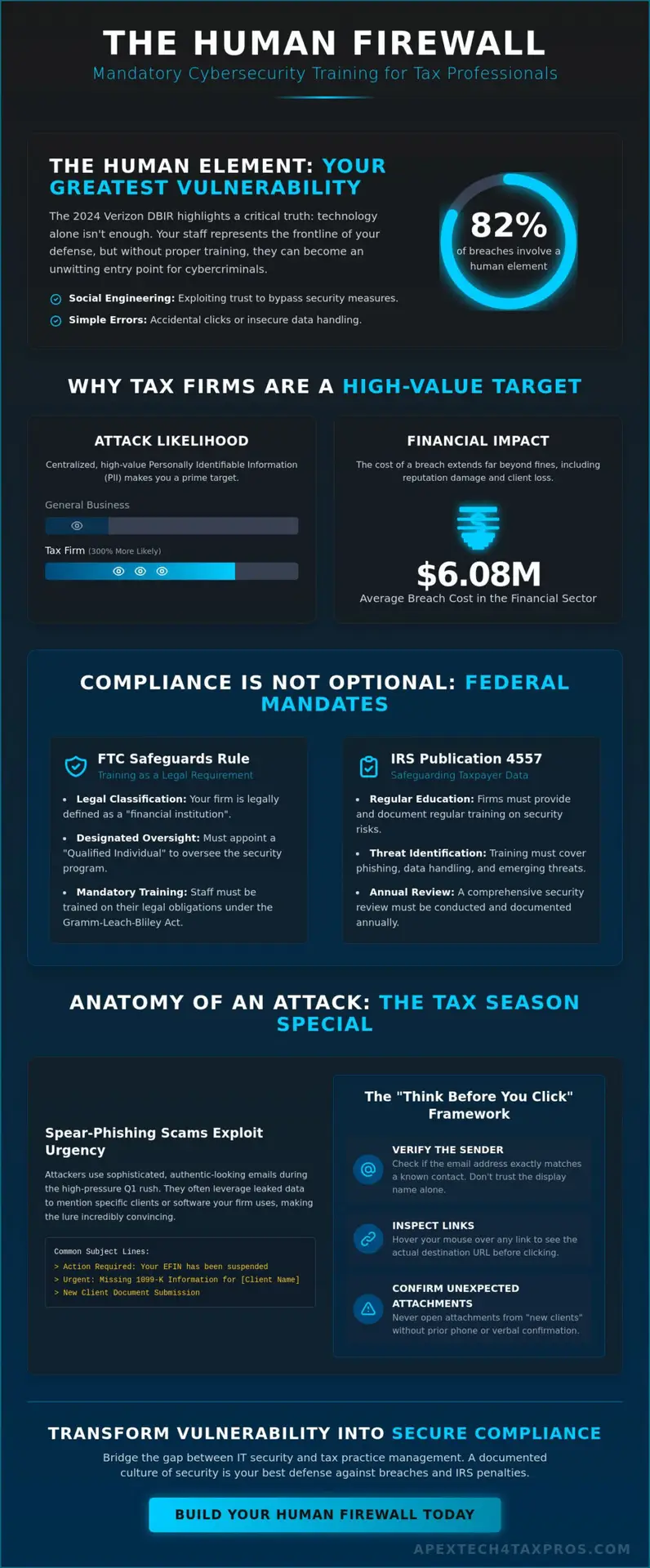
In the high-stakes environment of tax preparation, cybersecurity awareness training isn’t a luxury; it’s a foundational pillar of federal compliance. The IRS identifies “uninformed staff” as the single greatest vulnerability within tax practices, as 82% of data breaches involve a human element such as social engineering or phishing. For a firm to remain compliant in 2026, training must move beyond basic IT tips to encompass a structured understanding of Security Awareness and its role in protecting sensitive financial data. A “check-the-box” approach often leads to catastrophic failure, as the 2024 Cost of a Data Breach Report indicates that financial sector breaches now average $6.08 million in total damages. Our team has spent 20 years bridging the gap between complex IT requirements and the daily realities of tax professionals, ensuring that your staff acts as a human firewall rather than a liability.
Meeting the Mandates of IRS Publication 4557
IRS Publication 4557, titled “Safeguarding Taxpayer Data,” outlines rigorous education requirements for every individual with access to firm systems. The guide specifies that firms must provide regular training to staff on identifying phishing attempts and handling taxpayer information securely. Documentation of these sessions serves as your primary defense during a federal audit, proving that the firm exercised due diligence in risk mitigation. The IRS mandates that firms conduct and document a comprehensive security review at least once every 12 months to ensure safeguards remain effective against evolving threats.
The FTC Safeguards Rule: Training as a Legal Requirement
Under the 2021 updates to the FTC Safeguards Rule, tax preparers are legally classified as “financial institutions,” placing them under the same scrutiny as regional banks. This regulation requires the designation of a “Qualified Individual” (QI) to oversee the firm’s security posture and staff awareness programs. There’s a critical distinction between general IT knowledge and regulatory compliance training. While general IT might cover password strength, specialized cybersecurity awareness training ensures staff understand specific legal obligations under the Gramm-Leach-Bliley Act. This tailored approach provides the protective reassurance that your practice is not only technically sound but also fully compliant with federal law.
- Legal Classification: Tax firms must meet financial institution standards.
- Designated Oversight: A “Qualified Individual” must verify that training occurs.
- Risk Mitigation: Targeted education reduces the likelihood of a $6 million breach event.
Anatomy of a Breach: Identifying Threats Specific to the Tax Industry
Tax firms represent a goldmine for cybercriminals because they centralize high-value data within a single digital environment. A single successful breach can provide enough PII (Personally Identifiable Information) to file hundreds of fraudulent returns or sell complete identity profiles on the dark web. This concentration of wealth and data makes tax professionals a 300% more likely target for cyberattacks than the general business population. Understanding these industry-specific threats is the first step toward building a robust IRS Cybersecurity Guide compliant defense system.
Phishing Scams: The Tax Season Special
During the Q1 rush, attackers exploit the high-pressure environment of tax season by sending emails that demand immediate action. Common subject lines include “Action Required: Your EFIN has been suspended” or “Urgent: Missing 1099-K Information.” Spear-phishing has evolved into a highly sophisticated tactic where attackers use leaked data from previous breaches to mention specific software or past filings, making the lure seem authentic. Effective cybersecurity awareness training helps staff implement the “Think Before You Click” framework. This involves verifying the sender’s actual email address, hovering over links to inspect the destination, and never downloading attachments from unverified “new clients” without prior phone confirmation.
Social Engineering and the “Helpful Clerk” Trap
Attackers often use “vishing,” or voice phishing, to bypass multi-factor authentication (MFA) protocols. They’ll call a staff member while posing as IT support or a government agent, tricking the employee into providing a one-time code or temporary password. Open-office environments also pose unique physical risks. If a visitor can view a monitor or grab a discarded document from a printer, your firm’s data integrity is compromised. Staff must be trained to verify identities before releasing any financial documents, ensuring that “helpfulness” never overrides security protocols. Maintaining a disciplined, vigilant culture is essential when the stakes involve federal compliance and client trust.
Shadow IT adds another layer of risk to the modern accounting firm. When employees use personal cloud storage or unauthorized PDF converters to meet tight deadlines, they bypass the firm’s established security safeguards. Bridging the gap between tax preparation and IT security requires a tailored security strategy that accounts for these human variables. Our 20 years of experience suggests that technology alone isn’t enough; your team must be your strongest firewall. By implementing cybersecurity awareness training that focuses on these industry-specific triggers, you protect your clients and your professional reputation from the evolving tactics of modern threat actors.
Evaluating Training Methods: Generic LMS vs. Compliance-Focused Programs
Many firms rely on free, generic content to meet their educational requirements. It’s a mistake that leaves the practice vulnerable. These videos often cover broad topics like avoiding public Wi-Fi but ignore the specific workflows of a tax office. Effective cybersecurity awareness training must go beyond basic digital hygiene to address the specific regulatory burdens tax professionals face every day. Relying on outdated or broad materials creates a disconnect between the training and the actual risks present in a high-stakes financial environment.
The Failure of Generic Cybersecurity Training
Generic platforms designed for retail giants like Amazon or broad government agencies fail to address tax software vulnerabilities. These systems don’t account for the unique data structures or the specific login protocols within Lacerte, Drake, or UltraTax CS. Most non-specialized learning management systems (LMS) lack the robust compliance tracking required to prove to regulators that your staff actually completed their modules. While a generic IT tip might suggest changing passwords every 90 days, IRS-specific security protocols demand a multi-layered approach involving encrypted data transmission and documented access controls. Without this specificity, employees view training as a distraction rather than a vital safeguard for client data integrity.
The Benefits of Tailored Tax-Pro Awareness Programs
Industry-specific training increases staff engagement because employees see their daily tasks reflected in the lessons. When a module explains how a phishing email might mimic a 1099 request or a transcript delivery notification, retention rates climb. Professional programs often include simulated phishing tests to identify high-risk employees before a real threat arrives. According to the IRS Cybersecurity Guide for Tax Professionals, maintaining an informed workforce is a critical component of your legal responsibility. Tailored programs ensure that every team member understands their role in the firm’s defense strategy.
Integrating these educational efforts with your Written Information Security Plan (WISP) is non-negotiable for 2026 compliance. A “one-and-done” annual video doesn’t change behavior; it creates a false sense of security. Frequent, bite-sized updates keep data integrity at the forefront of the firm’s culture. Data shows that firms using continuous education models can reduce their susceptibility to phishing by up to 75% within the first 12 months. This consistent reinforcement bridges the gap between technical requirements and daily office habits.
The financial argument for professional cybersecurity awareness training is clear. IBM’s 2023 Cost of a Data Breach Report found that the average cost of a breach for organizations with fewer than 500 employees reached $3.31 million. Investing in a tailored program costs a fraction of a single incident. You aren’t just buying videos; you’re safeguarding your firm’s reputation and its long-term viability in an increasingly regulated market.
Building a Staff Training Program that Satisfies IRS Publication 4557
IRS Publication 4557 provides a rigorous framework for protecting taxpayer data, and it explicitly requires firms to educate their employees about security risks. A compliant cybersecurity awareness training program isn’t a “set it and forget it” task. It’s a structured, five-step process designed to bridge the gap between technical safeguards and human behavior.
- Step 1: Baseline Assessment. You can’t fix what you haven’t measured. Conduct a baseline risk assessment using simulated phishing attacks to identify which staff members are most vulnerable. According to the 2024 Verizon Data Breach Investigations Report, 68% of breaches involved a non-privileged human element.
- Step 2: Multi-Modal Curriculum. Develop training that covers diverse scenarios, specifically focusing on the handling of Personally Identifiable Information (PII) and the risks of social engineering.
- Step 3: Continuous Learning Cycles. The Ebbinghaus Forgetting Curve shows that learners forget 70% of new information within 24 hours if it isn’t reinforced. Move away from annual sessions in favor of monthly micro-learning modules.
- Step 4: Formal Incident Response. Every staff member must know exactly who to contact the moment they click a suspicious link. This protocol should be a written, accessible document.
- Step 5: Rigorous Documentation. Maintain a master log of training completion dates and scores. This serves as your primary evidence of compliance during an IRS inquiry or a state-level audit.
Training Seasonal and Remote Staff
Peak tax season often requires a surge in temporary staffing, which creates significant security gaps. You must onboard seasonal preparers with the same intensity as permanent hires. Provide specific modules on home network security for remote workers, emphasizing that public Wi-Fi is strictly prohibited for accessing tax software. Ensure all distributed team members use a firm-approved VPN and multi-factor authentication (MFA) before they touch a single client file. Consistency across your entire team, regardless of their location or tenure, is the only way to maintain your firm’s data integrity.
The Documentation Trail: Preparing for an Audit
If the IRS audits your security practices, they’ll look for proof of “reasonable care.” This means your cybersecurity awareness training records must be meticulous. Keep digital certificates of completion and detailed logs that show when each employee last updated their security knowledge. These records shouldn’t exist in a vacuum; integrate them directly into your firm’s annual Written Information Security Plan (WISP) update. This alignment proves to regulators that your training program is a live, functioning component of your overall compliance strategy rather than a performative gesture.
Protect your firm from evolving threats by implementing a security plan that meets federal standards. Schedule a consultation with our compliance experts today.
Implementing a Culture of Security with Apex Tech 4 Tax Pros
Most IT providers treat security as a purely technical checklist. At Apex Tech 4 Tax Pros, we recognize that tax professionals operate under a unique set of federal mandates that require more than just a firewall. We bridge the gap between tax preparation and IT security by aligning your digital defenses with IRS Publication 4557 and the FTC Safeguards Rule. Our “Dual-Expert” advantage stems from a deep understanding of tax workflows combined with technical rigor. We don’t just install software; we design programs that reflect how a tax firm actually functions during the height of filing season.
Security isn’t a one-size-fits-all solution. Whether you’re a solo practitioner or managing a large practice with 50 employees, our services scale to meet your specific needs. We move beyond simple instruction by integrating cybersecurity awareness training with your Written Information Security Plan (WISP) and annual risk assessments. This holistic approach ensures that your firm’s defenses are consistent, documented, and ready for any regulatory audit.
Our Mission-Driven Approach to Tax Firm Security
Our 20-year commitment to protecting sensitive financial data began with a focus on high-stakes environments where accuracy is non-negotiable. Today, our family-owned roots drive us to provide protective, pragmatic solutions for the tax industry. We’ve spent two decades refining how we safeguard data integrity for our clients. We understand that you’re a professional, not a technician. That’s why we simplify complex regulatory standards into actionable staff habits that stick.
Our approach is grounded in empathy. We know the pressure of deadlines and the weight of client trust. By transforming cybersecurity awareness training from a seasonal chore into a natural part of your firm’s daily operations, we help you build a resilient culture. Our goal is to instill confidence in your team. When your staff knows how to spot a sophisticated phishing attempt or secure a client portal, they can focus on their core work without the constant fear of a data breach. We act as your “Dual-Expert Guardian,” watching the perimeter so you can focus on the returns.
Take the Next Step Toward Full Compliance
Moving toward 2026 compliance requires a clear roadmap. A professional risk assessment is the first step to identifying vulnerabilities in your current setup. This assessment allows us to tailor your training program to the specific threats your firm faces, rather than wasting time on generic modules. It’s about precision and efficiency.
Every tax professional is now required by the IRS to maintain a Written Information Security Plan. To help you jumpstart your security framework, we offer a free WISP template. This document serves as the foundation for your firm’s protection and is a core requirement for maintaining your EFIN. When you’re ready to move from a template to a fully managed security culture, our team is ready to assist.
Securing Your Firm’s Future Through Proactive Compliance
Navigating the 2026 regulatory landscape requires more than just a basic understanding of data protection. Tax firms must implement a Written Information Security Plan (WISP) that meets the rigorous standards of IRS Publication 4557 and the FTC Safeguards Rule. A generic approach to security often fails because it doesn’t address the specific phishing and social engineering tactics targeting tax professionals. Effective cybersecurity awareness training serves as your first line of defense; it transforms your staff from potential vulnerabilities into vigilant guardians of sensitive client data.
Apex Tech 4 Tax Pros brings over 20 years of specialized experience to this mission. We’ve spent two decades bridging the gap between complex IT security and the daily realities of tax preparation. Our team understands that compliance isn’t just a checkbox. It’s a commitment to your clients’ trust and your firm’s longevity. By choosing a partner who specializes exclusively in your industry, you ensure your training program satisfies every federal mandate while fostering a genuine culture of security.
Ready to fortify your practice against evolving threats? Schedule a Consultation for Your Firm’s Cybersecurity Training to get started. Protecting your firm is a journey, and we’re here to guide you every step of the way.
Frequently Asked Questions
Is cybersecurity awareness training legally required for all tax preparers?
Yes, cybersecurity awareness training is a federal mandate for all tax professionals under the updated FTC Safeguards Rule (16 CFR Part 314). This regulation requires any financial institution, including solo tax practitioners and large firms, to implement a formal security program. According to IRS Publication 4557, you must provide regular education to all employees to safeguard taxpayer data. Failure to comply can result in FTC fines exceeding $50,000 per violation.
How often should my tax office staff undergo security training?
You should conduct security training at least once per year to maintain compliance with federal standards. However, the IRS recommends more frequent sessions to address the 400 percent increase in phishing attacks typically seen during the January to April filing season. Many successful firms implement quarterly refreshers. Short, monthly micro-learning modules help keep data integrity top of mind without disrupting your team’s billable hours during peak tax months.
Does the IRS provide free cybersecurity training that meets compliance standards?
The IRS doesn’t offer a comprehensive, certified training program that fulfills all FTC Safeguards Rule requirements. While they provide excellent resources through the “Protect Your Clients; Protect Yourself” campaign and Publication 4557, these are informational guides rather than a structured curriculum. To meet regulatory standards, you’ll need a tailored program that tracks individual completion and tests employee knowledge. This documentation is vital if your firm faces an IRS or FTC audit.
What is the difference between a WISP and cybersecurity awareness training?
A Written Information Security Plan (WISP) is the foundational document that outlines your firm’s security policies, whereas cybersecurity awareness training is the method used to teach those policies to your staff. The IRS has required every tax professional to have a WISP since the 2023 filing season. Think of the WISP as your firm’s internal law book and the training as the classroom session that ensures everyone understands and follows those laws.
How do I train seasonal employees who are only with the firm for three months?
Seasonal employees must complete their security training during the onboarding process before they’re granted access to any sensitive taxpayer information. The FTC Safeguards Rule doesn’t offer exemptions for temporary or part-time staff. We recommend a concentrated, two-hour training module focused on password hygiene and phishing recognition. This ensures your 90-day hires don’t become the weak link that compromises your firm’s data integrity during the busiest time of year.
What happens if a staff member fails a simulated phishing test?
A staff member who fails a simulated test should immediately receive targeted remedial training to address the specific mistake they made. Data from 2024 shows that employees who receive “just-in-time” feedback within 24 hours of a failed test are 60 percent less likely to click a real malicious link later. We treat these moments as supportive learning opportunities. It’s much safer to have an employee fail a controlled simulation than a real-world ransomware attack.
Can cybersecurity training reduce my firm’s professional liability insurance premiums?
Implementing verified cybersecurity awareness training often leads to a reduction in professional liability or cyber insurance premiums by 5 percent to 15 percent. Most major insurance carriers now require proof of employee training as a condition for coverage or renewal. By documenting your training efforts, you prove to underwriters that your firm is a lower risk. This proactive approach helps bridge the gap between basic tax prep and sophisticated digital protection.