
Purchasing the most expensive platform on the market won’t protect your firm if you haven’t integrated that tax software security into a federally-mandated Written Information Security Plan (WISP). Many professionals assume that built-in encryption handles their regulatory burdens, but the IRS reported in late 2024 that data breaches often target the gaps between software features and firm-wide protocols. You likely feel the pressure of an impending FTC Safeguards Rule audit or the weight of complex encryption standards that seem designed for IT experts rather than tax preparers.
We understand that your primary focus is serving your clients with precision, not managing a server room. This guide provides a clear, pragmatic path to securing your practice while meeting every mandatory IRS and FTC standard for 2026. You’ll learn how to evaluate software vendors using a professional 10 point checklist, understand the legal definition of “reasonable security”, and bridge the gap between your software’s features and your firm’s total compliance. By the end of this article, you’ll have a concrete strategy to transition from technical overwhelm to a state of secure, documented compliance.
Key Takeaways
- Learn how to implement the IRS “Security Six” to strengthen your tax software security and ensure every technical safeguard is properly configured.
- Discover why transitioning from SMS to hardware-based Multi-Factor Authentication is essential for protecting client credentials against sophisticated cyber threats.
- Understand the legal necessity of a Written Information Security Plan (WISP) and how it bridges the gap between software features and firm-wide responsibilities.
- Gain a pragmatic framework for conducting annual risk assessments and vetting software vendors before you renew your annual contracts.
- Identify the advantages of a “Dual-Expert Guardian” approach to secure your practice against both technical failures and regulatory audits.
Understanding the High Stakes of Tax Software Security in 2026
Tax software security represents more than just a complex password or a localized firewall. In 2026, we define this discipline as the precise intersection of technical safeguards and strict regulatory compliance. For cybercriminals, your tax software credentials are the “Holy Grail” because they provide a direct gateway to a client’s entire financial identity, including Social Security numbers, bank accounts, and investment histories. While traditional malware remains a threat, the landscape has shifted toward AI-powered spear-phishing. These sophisticated attacks use generative models to mimic the specific writing styles of your colleagues or the IRS, making them nearly impossible to detect with a casual glance. Under the Gramm-Leach-Bliley Act (GLBA) and the updated FTC Safeguards Rule, the responsibility to defend against these sophisticated intrusions rests squarely on your shoulders.
The Financial and Reputational Cost of a Breach
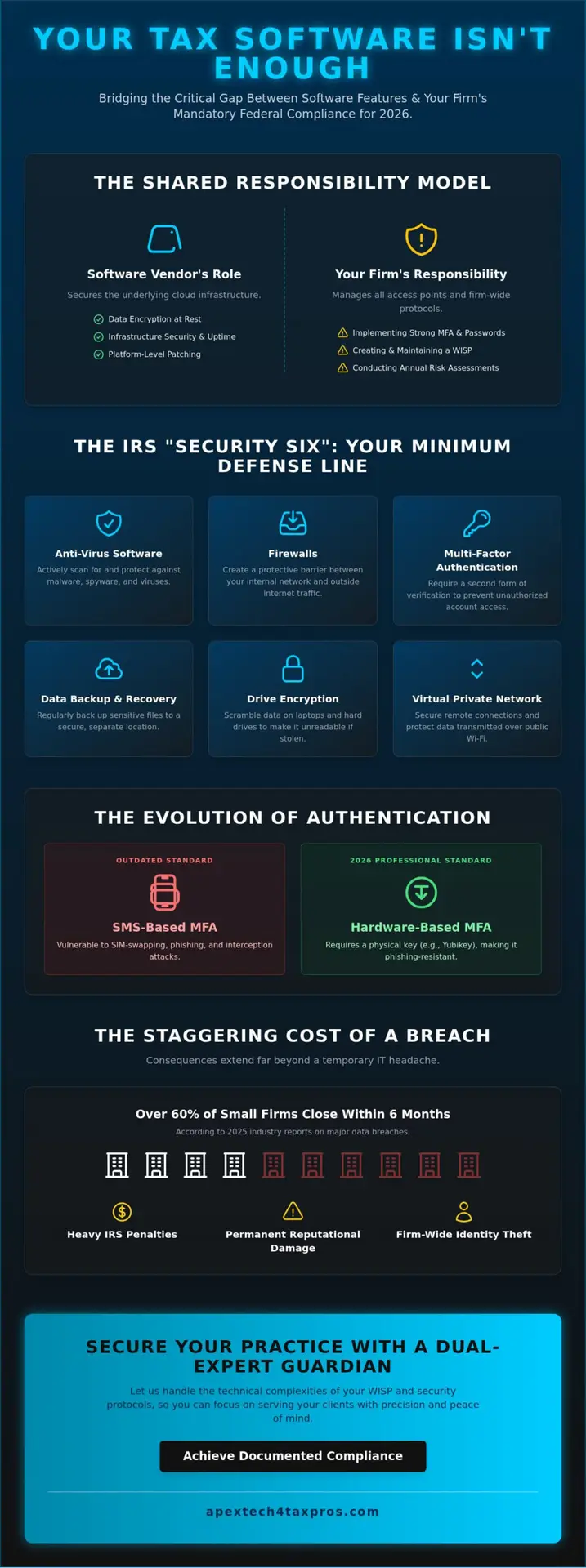
The consequences of a security failure extend far beyond a temporary IT headache. The IRS can levy significant penalties for non-compliance with Publication 4557, and these fines can quickly escalate into the thousands for a single firm. According to industry reports from 2025, over 60% of small tax firms that suffer a major data breach close their doors within six months. A single compromised login doesn’t just leak one return; it exposes your entire database to firm-wide identity theft. Once client trust is shattered, the reputational damage is often permanent. Taxpayers prioritize the safety of their sensitive data over long-standing professional relationships, and they won’t hesitate to move their business to a firm that demonstrates superior data integrity.
Why Your Software Vendor is Not Solely Responsible
A common misconception among tax professionals is that cloud-based providers handle the entire security burden. This ignores the Shared Responsibility Model, which is a framework where the vendor secures the underlying infrastructure while you remain responsible for securing the access points. While your provider might encrypt data at rest, they can’t prevent a breach if your staff uses weak passwords or lacks hardware-based MFA. Most “out of the box” settings are designed for ease of use rather than maximum protection. Relying on default configurations often leaves critical gaps in your defense, failing to meet the rigorous professional standards required for full WISP compliance. You must take an active role in configuring your tax software security to ensure it aligns with your firm’s specific risk profile.
The Technical Pillars of a Secure Tax Preparation Environment
Building a resilient environment starts with the IRS “Security Six” standards. These aren’t just suggestions; they’re the minimum requirements for safeguarding taxpayer data. To achieve true tax software security, you must look beyond the software interface and secure the local network where that software operates. This includes using a Virtual Private Network (VPN) for any remote connection. A VPN creates a secure, encrypted tunnel for data moving between a remote laptop and the firm’s central server, preventing “man-in-the-middle” attacks on public or home Wi-Fi networks.
Multi-Factor Authentication (MFA) has evolved significantly. By 2026, SMS-based codes are considered vulnerable to SIM-swapping and interception. Professional firms now utilize hardware tokens, such as Yubikeys, which require a physical device to authorize access. This ensures that even if a cybercriminal steals a password through an AI-phishing scam, they can’t enter the system without the physical key. Managing these technical layers can feel overwhelming, but you don’t have to do it alone when you partner with a specialized IT advisor who understands the tax industry’s specific needs.
Advanced Authentication and Access Controls
Role-based access control (RBAC) allows you to limit software permissions based on staff seniority. A junior preparer shouldn’t have the same administrative rights as a partner. Unique user IDs are mandatory. Sharing logins creates “blind spots” in your audit logs that make it impossible to trace the source of a data leak or an unauthorized change. Many 2026 software suites now integrate biometrics, using FaceID or fingerprinting to add a layer of biological verification to the login process. These systems ensure that only the authorized professional is actually sitting at the keyboard.
Secure Data Storage and Cloud Backups
There is a critical distinction between “cloud sync” and “secure cloud backup” that many pros miss. Sync services like OneDrive or Dropbox often mirror deletions or ransomware infections instantly across all devices. A professional backup solution must be immutable and encrypted off-site to prevent total data loss. 256-bit AES encryption is the industry gold standard for protecting tax data at rest and in transit. Implementing these layers ensures your practice remains operational even if local hardware fails or a localized cyber attack occurs. Every layer of tax software security you add serves as a safeguard for your clients’ financial legacies and your firm’s professional reputation.
Beyond Encryption: Why Software Features Aren’t Enough for Compliance
Having encryption and MFA is a vital start, but these technical features don’t constitute a complete compliance strategy. The FTC Safeguards Rule, updated in June 2023, requires all financial institutions including tax preparers to implement a comprehensive, written security program. This is where tax software security must be integrated into a Written Information Security Plan (WISP). A WISP isn’t just a static document; it’s a living framework that governs how your firm handles sensitive data from the moment it enters your office until it is safely archived or destroyed. Without this documented plan, your firm remains in a state of non-compliance, regardless of how advanced your software features may be.
There is a dangerous gap between having a secure tool and operating a secure practice. For example, your software might use the highest encryption standards, but if your staff leaves printed tax returns on an unattended desk, you’ve failed your regulatory obligations. Bridging the gap between tax preparation and IT infrastructure requires a holistic view of your firm’s operations. You must account for every touchpoint where data could be exposed, ensuring that your technical safeguards are supported by robust administrative and physical protocols that protect your clients’ most sensitive information.
The Anatomy of a Compliant WISP
A compliant WISP must name a “Qualified Individual” who is responsible for overseeing and enforcing the firm’s security posture. This person ensures that the firm maintains an accurate software inventory, documenting every application that touches taxpayer data, including e-signature tools and document portals. You must also establish a clear protocol for responding to a potential software breach. If a breach occurs, the IRS requires notification to the state’s Stakeholder Liaison within 24 hours of discovery to protect taxpayer accounts from fraudulent filings. Mapping these data flows is essential for maintaining tax software security and proving due diligence during an audit.
WISP Templates vs. Customized Security Plans
Many firms fall into the trap of using “check-the-box” templates found online. While these might seem convenient, they often fail to reflect the actual day-to-day operations of a specific firm. IRS Publication 4557 explicitly requires a security plan that is tailored to the size and complexity of your business. A generic document won’t protect you during a professional audit if it doesn’t match your actual workflows or the specific software stack you use. To ensure your practice meets these high standards, you can learn more about our customized WISP solutions which are engineered specifically for the tax industry. Our approach ensures your security plan is a living, breathing document that evolves alongside new federal mandates and emerging cyber threats.
Implementing a Risk-Based Approach to Software Management
Effective tax software security requires shifting from a passive user mindset to an active risk manager role. You can’t simply install a platform and assume your obligations are met. A risk-based approach involves identifying the specific vulnerabilities within your unique ecosystem. This begins with an annual risk assessment, a process mandated by the FTC Safeguards Rule for any firm handling more than 5,000 consumer records. You must evaluate how data flows between your tax preparation software, your document portals, and your internal servers to ensure no “leaks” exist in your digital workflow.
Vetting your software vendors is a critical part of this cycle. Before you sign a renewal contract for the 2026 season, ask your provider for their latest SOC 2 Type II report. This document provides third-party verification of their security controls. You should also inquire about their specific data breach notification timeline. If a vendor can’t promise to notify you within 24 hours of a suspected incident, they represent a significant compliance risk. Managing the “last mile” of security means ensuring that your staff understands these stakes as well as you do. If you need assistance with a professional evaluation of your current stack, contact our team for a tailored security assessment.
Step-by-Step Software Security Audit
A formal audit prevents the “set it and forget it” mentality that leads to breaches. In 2024, industry data showed that 80% of exploited vulnerabilities were linked to patches that were available but not applied. Follow these steps to verify your defenses:
- Inventory every application: List every tool that touches taxpayer data, including PDF editors, e-signature tools, and email clients.
- Verify individual permissions: Ensure that 100% of staff accounts follow the principle of least privilege, limiting access to only what’s necessary for their specific role.
- Test your incident response plan: Conduct a “mock breach” scenario to identify response delays and ensure your team knows exactly who to call if a system is compromised.
Cybersecurity Awareness Training for Tax Staff
Your employees are often the first line of defense against AI-powered spear-phishing. In 2025, security researchers identified a 40% increase in phishing emails that successfully bypassed traditional spam filters by using generative AI to mimic professional styles. Training must be specific to the tax industry. Teach your team to recognize “urgent” requests for bank changes or credential resets that appear to come from senior partners. Establishing “clean desk” and “clear screen” policies ensures that sensitive physical and digital data isn’t exposed to unauthorized visitors or family members in a remote work environment. These human-centric safeguards are just as vital as the technical encryption protocols within your tax software security framework.
Securing Your Practice with Professional WISP Integration
Securing your practice in 2026 requires more than just a software subscription; it demands a partnership with a Dual-Expert Guardian who understands both the technical nuances of IT and the regulatory pressures of tax preparation. We focus on bridging the gap between your daily operations and the stringent requirements of federal law. By integrating your tax software security into a customized, firm-wide strategy, you move from a state of vulnerability to one of documented compliance. This transition doesn’t have to be a source of technical overwhelm when you have a structured path forward. Our process ensures that your technical safeguards are not just active but are also fully documented to withstand a rigorous IRS or FTC audit.
Moving from vulnerability to secure compliance involves three distinct steps. First, we conduct a deep-dive assessment to identify where your current systems fall short of federal mandates. Second, we develop a tailored Written Information Security Plan (WISP) that reflects your actual firm operations rather than a generic template. Finally, we implement continuous monitoring to ensure your tax software security remains resilient against the AI-driven threats of the 2026 landscape. This methodical approach allows you to return your focus to your clients, knowing your data integrity is managed by specialists who speak your language.
Our Mission-Driven Approach to Your Firm’s Safety
Our firm draws on 20 years of experience in high-stakes compliance environments, including both healthcare IT and tax preparation. These decades in the trenches have taught us that security is as much about personal accountability as it is about encryption keys. As a family-owned business, we act as a trusted advisor for independent professionals who often feel overlooked by large, faceless IT corporations. We understand the high stakes of your profession and the empathy required to guide you through complex regulatory changes. A professional risk assessment is the most effective way to identify hidden gaps in your infrastructure before they are exploited by cybercriminals.
Next Steps: From Free Templates to Full Protection
You can begin your journey toward compliance today by utilizing our resources designed specifically for tax pros. While many start with our FREE WISP Download Template to understand the basic requirements, a generic document is rarely enough to satisfy an auditor’s scrutiny. Upgrading to a personalized security framework ensures that every protocol, from hardware MFA to secure remote access, is engineered for your specific practice. Don’t wait for a data breach to discover the weaknesses in your current plan. To ensure your firm is fully protected and compliant with the latest 2026 standards, Schedule your professional risk assessment today and take the first step toward total peace of mind.
Transitioning to a State of Secure Compliance
Modern tax software security requires a dual approach that combines high-level technical safeguards with a documented administrative framework. You’ve seen that relying on vendor features alone leaves your firm vulnerable to AI-driven threats that escalated throughout 2025 and 2026. By prioritizing hardware-based MFA and integrating your tools into a customized Written Information Security Plan, you protect your firm from the severe penalties associated with the FTC Safeguards Rule and IRS Publication 4557.
We specialize in bridging the gap between complex IT requirements and the daily realities of tax preparation. With over 20 years of experience in compliance and IT security, our family-owned firm provides the specialized expertise you need to maintain data integrity and satisfy federal auditors. You don’t have to navigate these regulatory burdens alone. Secure Your Practice with a Customized WISP and move forward with the confidence that your practice is fully protected. Your commitment to security today builds the foundation for a resilient and successful practice tomorrow.
Frequently Asked Questions
Does the IRS require tax software to have specific security features?
Yes, the IRS mandates specific technical standards for all authorized e-file providers through Publication 1345. These requirements include mandatory multi-factor authentication, session timeouts after 30 minutes of inactivity, and unsuccessful login lockout protections. Your software must also support modern encryption protocols to protect data during transmission to IRS systems.
Is cloud-based tax software more secure than desktop versions?
Security depends on your firm’s specific implementation rather than the platform type itself. Cloud-based software shifts the burden of server maintenance and physical security to the vendor, but it introduces risks related to browser vulnerabilities and internet connectivity. Desktop versions offer more control over data localization but require you to manage your own server encryption and off-site backup protocols manually.
What is a WISP and why do I need one if my software is encrypted?
A Written Information Security Plan (WISP) is a legally required document that outlines your firm’s administrative, technical, and physical safeguards. While encryption is a vital technical tool, it doesn’t address the human or physical risks your practice faces. Federal law requires a WISP to document how you train staff, manage service providers, and respond to potential data emergencies.
How often should I perform a security risk assessment for my tax practice?
The FTC Safeguards Rule requires you to perform a formal risk assessment at least once per year. You must also conduct a new assessment whenever you make a significant change to your business arrangements, such as hiring new staff or switching to a different tax software security provider. This ensures your defenses remain effective against the evolving cyber threats of 2026.
Can I use a free WISP template to meet IRS Publication 4557 standards?
A free template serves as a helpful starting point, but it won’t satisfy an auditor unless it’s heavily customized. IRS Publication 4557 explicitly requires your security plan to be tailored to the size and complexity of your specific firm. An unedited template that doesn’t reflect your actual software inventory or staff workflows will likely fail a professional compliance review.
What should I do if I suspect my tax software credentials have been compromised?
You must immediately reset your passwords and notify both your software vendor and your local IRS Stakeholder Liaison within 24 hours. Rapid reporting is essential because it allows the IRS to place “identity theft indicators” on your clients’ accounts, which helps block fraudulent tax returns. You should also consult your WISP to trigger your documented incident response protocol.
Does the FTC Safeguards Rule apply to solo tax preparers?
Yes, the FTC Safeguards Rule applies to all financial institutions, regardless of their size. While solo preparers or firms with fewer than 5,000 consumer records are exempt from certain written reporting requirements, they’re still legally obligated to maintain a WISP. You must implement the same core technical safeguards as larger firms to protect the sensitive client data in your care.
What are the “Security Six” measures the IRS recommends?
The “Security Six” are the foundational technical pillars of tax software security and general practice safety. They include professional-grade anti-virus software, a robust firewall, multi-factor authentication, automated backup solutions, full-drive encryption, and a Virtual Private Network (VPN). Implementing all six measures creates a layered defense that significantly reduces the risk of a successful data breach or unauthorized access.