
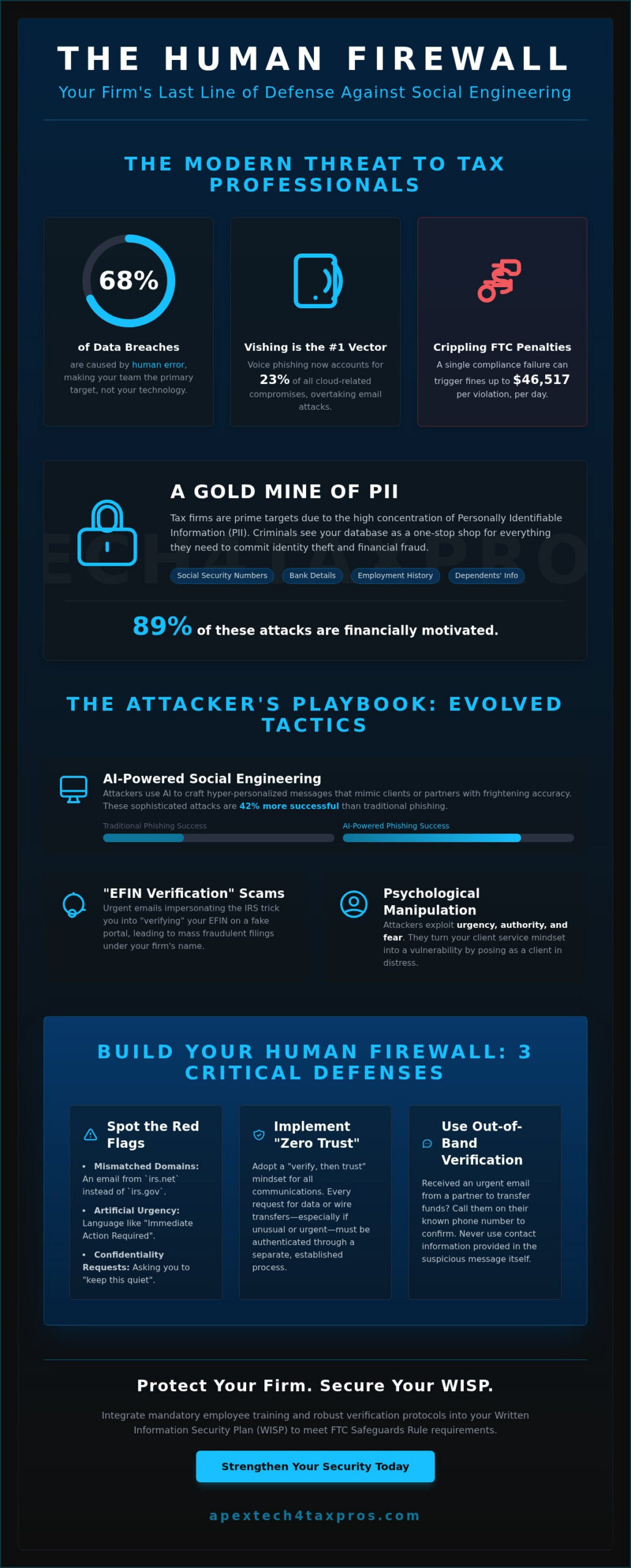
With human error causing 68% of data breaches in 2024, the most significant threat to your firm isn’t a broken firewall, but a convincing voice on the other end of a phone. In 2026, social engineering in finance has evolved far beyond the clumsy emails of the past. Vishing has overtaken email as the primary attack vector, accounting for 23% of cloud-related compromises. Attackers now use AI to create personalized messages that are 42% more successful than traditional phishing. For a tax professional, a single slip-up isn’t just a technical glitch; it’s a regulatory disaster that could trigger FTC civil penalties of up to $46,517 per violation per day.
You understand the high stakes of handling sensitive taxpayer data, yet the complexity of IRS Publication 4557 and the mandatory Written Information Security Plan (WISP) can feel overwhelming. This article provides the clarity you need to bridge the gap between technical requirements and daily operations. You’ll learn how to identify sophisticated vishing attacks, implement the “Security Six” protocols, and meet the 30-day FTC breach notification deadline for incidents involving 500 or more customers. We’ll outline a roadmap to foster a firm-wide culture of security that protects your reputation and ensures full compliance with the FTC Safeguards Rule.
Key Takeaways
- Understand why psychological manipulation has become the new security frontier and why the concentration of PII makes your tax practice a high-value target.
- Identify the latest AI-driven threats, such as deepfake vishing and browser-based “ClickFix” attacks, that define the current landscape of social engineering in finance.
- Learn how to strengthen your Written Information Security Plan (WISP) by integrating mandatory employee training as required by the FTC Safeguards Rule.
- Implement a “Zero Trust” culture and strict out-of-band verification (OOBV) protocols to validate suspicious requests for wire transfers or client data.
The Human Perimeter: Why Social Engineering Targets Tax Professionals
Cybersecurity is often discussed as a battle of algorithms, but the modern reality is far more personal. Social engineering in finance isn’t a technical hack; it’s a psychological one. To understand the threat, we must first answer the question: What is Social Engineering? At its core, social engineering is the exploitation of human trust to bypass digital safeguards. While your firewall works 24/7, it can’t prevent a person from making a mistake. It’s the art of manipulating people into giving up access.
Tax preparation firms are particularly vulnerable because they represent a high-value “gold mine” for criminals. Your database contains a concentrated stream of Personally Identifiable Information (PII), including Social Security numbers, bank details, and employment history. In the financial sector, we’ve observed a definitive transition from broad, bulk phishing campaigns to surgical pretexting. Attackers no longer just cast a wide net. They use detailed research to impersonate clients or vendors with frightening precision. When 89% of these attacks are financially motivated, the incentive to target your practice is immense.
The Psychology of Deception in Finance
Attackers rely on three primary levers: urgency, authority, and fear. By creating a high-pressure scenario, they aim to bypass the logical critical thinking that tax professionals usually excel at. Tax season stress makes staff especially susceptible to “quick” or “urgent” requests that seem to come from a partner or a government agency. The helpful nature of accountants is often turned against them. A criminal might pose as a frustrated client who “can’t access their portal,” counting on your team’s desire to provide excellent service to trick them into bypassing security protocols. They turn your greatest professional asset, client service, into a vulnerability.
Beyond the Firewall: The Limits of Technical Security
It’s a common misconception that technical tools are a total solution. Traditional antivirus software cannot stop a staff member from voluntarily sharing a login credential or clicking a link in a highly personalized email. Human error was the cause of 68% of data breaches in 2024, proving that your team is the final line of defense. Even robust measures like Multi-Factor Authentication (MFA) are being circumvented through “push fatigue.” This happens when an attacker triggers dozens of login prompts until a distracted employee clicks “approve” just to stop the notifications. Building a “Human Firewall” through awareness and culture is the only way to bridge the gap between technical security and true data integrity.
Tactics Evolving in 2026: From Phishing to AI Deepfakes
Business Email Compromise (BEC) has matured from simple spoofed headers into a sophisticated “long game.” Attackers now employ pretexting, where they spend days or even weeks building rapport with a staff member before ever making a request for money or data. This methodical approach is a hallmark of modern social engineering in finance. We are also seeing the rise of “Quishing,” where malicious QR codes are embedded in fake digital document delivery notifications. These codes often bypass traditional email filters because the malicious payload is hidden within an image, leading the user to a credential-harvesting site on their mobile device where security software is often less robust.
Tax-Themed Spear Phishing and EFIN Scams
The IRS and major tax software providers remain the most impersonated entities in the industry. One particularly damaging trend is the “EFIN Verification” scam. In this scenario, a practitioner receives an urgent email claiming their Electronic Filing Identification Number has been suspended. The link leads to a professional-looking portal that requests an upload of the firm’s EFIN acceptance letter and the principal’s driver’s license. Once these are captured, the attacker can file fraudulent returns in bulk. To protect your practice, your team should maintain a checklist of red flags for every incoming request:
- Mismatched Domains: The sender’s email address looks correct at a glance but uses a .net or .org instead of a .gov or .com.
- Artificial Urgency: Language like “Immediate Action Required” or “Account Suspension in 2 hours” is designed to trigger panic.
- Confidentiality Requests: Instructions to “keep this request quiet” to avoid alarming clients or other partners.
If you suspect your team needs a more robust defense, we can help you evaluate your firm’s security posture to ensure these gaps are closed.
AI and the Era of Synthetic Impersonation
The most alarming shift in 2026 is the use of AI-synthesized voices. Voice phishing, or vishing, has overtaken email as the primary social engineering vector, accounting for 23% of cloud-related compromises in 2025. Attackers can now scrape LinkedIn or public webinars to clone a firm partner’s voice with startling accuracy. They then call a junior staff member to authorize an “emergency” payment for a supposed closing or vendor settlement. Because AI-powered phishing campaigns have a 42% higher success rate than conventional email, technical barriers alone are insufficient.
Defeating synthetic impersonation requires Actionable Prevention Strategies that rely on human protocols rather than software. We recommend establishing internal “safe words” or mandatory out-of-band verification (OOBV) for any request involving financial transfers or credential changes. This means if a partner calls to request a wire transfer, the employee must hang up and call that partner back on a pre-verified internal number to confirm the request before proceeding.
Regulatory Stakes: Social Engineering and IRS Compliance
In the tax industry, a successful social engineering attack is viewed by regulators as a failure of internal controls. Many practitioners believe that having a firewall and antivirus software fulfills their legal obligations. However, federal mandates have evolved to include the human element as a core technical standard. If a staff member clicks a malicious link because they weren’t trained to spot it, the firm is often found non-compliant with the Gramm-Leach-Bliley Act (GLBA). This intersection of human behavior and federal law is where the concept of Social Engineering and IRS Compliance becomes critical for every firm’s survival.
The regulatory landscape does not distinguish between a technical hack and a psychological one. A breach is a breach, regardless of whether it started with a sophisticated piece of malware or a simple phone call. For tax professionals, this means that data integrity is tied directly to staff awareness. You are legally responsible for the actions of your employees, and “good intentions” do not satisfy federal data protection mandates. Without documented proof of security training and a robust plan, your practice remains in a state of potential vulnerability that could lead to devastating professional consequences.
IRS Publication 4557 and Your Duty to Protect
IRS Publication 4557, “Safeguarding Taxpayer Data,” serves as the primary guide for tax professionals to meet their legal requirements. It specifically outlines the “Security Six” measures, but it goes much further by mandating staff awareness programs. The IRS requires you to protect taxpayer data against unauthorized access, which includes preventing deception-based breaches. IRS Publication 4557 treats human-layer security as a non-negotiable technical standard. Your firm must maintain a formal Written Information Security Plan (WISP) that details exactly how you educate your team and verify suspicious requests. This document is not a secondary service; it is the core mission of your practice’s security framework.
The FTC Safeguards Rule: Training as a Legal Requirement
The updated FTC Safeguards Rule has turned cybersecurity training from a best practice into a strict legal requirement. Every firm must designate a “Qualified Individual” to oversee the security program and conduct regular risk assessments. These assessments must account for social engineering in finance, specifically identifying vulnerabilities like vishing or credential harvesting. The stakes for ignoring these requirements are high. As of May 2026, the FTC can impose civil penalties of up to $46,517 per violation per day for non-compliance. Additionally, a recent amendment requires you to notify the FTC of security breaches involving 500 or more customers within 30 days of discovery. Failure to maintain documented training records can lead to the loss of your Electronic Filing Identification Number (EFIN), effectively ending your ability to practice.
Building a Human Firewall: Actionable Prevention Strategies
Moving from regulatory theory to office practice requires a shift in how your team perceives every digital interaction. Technical defenses are essential, but they are often bypassed by the sophisticated tactics used in social engineering in finance. To bridge this gap, your firm must adopt a “Zero Trust” culture. In this environment, no request for sensitive data or financial transfers is considered legitimate until it’s verified through a secondary, independent channel. This mindset doesn’t imply a lack of trust in your clients or colleagues; rather, it’s a disciplined commitment to data integrity that protects everyone involved.
One of the most effective ways to neutralize the threat of credential theft is the mandatory use of hardware security keys, such as Yubikeys. While traditional SMS-based multi-factor authentication can be intercepted or bypassed through “push fatigue,” a physical hardware key requires a staff member to be present and touch the device to authorize a login. This simple hardware requirement can stop an attacker even if they’ve successfully tricked an employee into revealing their password. Additionally, you should implement regular phishing simulations. These aren’t meant to “catch” employees, but to identify those who might need extra support. Since AI-powered phishing has a 42% higher success rate, these simulations provide a safe environment for your team to sharpen their instincts before a real attack occurs.
Developing SOPs for Sensitive Requests
Your firm needs a rigid standard operating procedure (SOP) for any request that involves money or PII. We recommend a strict out-of-band verification (OOBV) protocol for all wire transfers or changes to client bank information. If a request arrives via email, the staff member must call the client at a pre-existing number on file to confirm the details. Never use a phone number provided in the suspicious email itself. Inside the office, prohibit sharing passwords or MFA codes through internal chats or text messages. It’s also vital to foster a “no-blame” culture. If an employee realizes they’ve clicked a malicious link, they must feel safe reporting it immediately. Rapid reporting can be the difference between a minor IT reset and a full-scale breach that requires an FTC notification.
Continuous vs. Annual Training
The days of checking a box with once-a-year security training are over. Threats in 2026 evolve too quickly for annual sessions to remain effective. Instead, we advocate for 5-minute “micro-learning” sessions delivered monthly. These bite-sized updates keep security top-of-mind without disrupting the heavy workload of tax season. Each session should be tracked and documented, ensuring your practice is always audit-ready if the IRS or FTC requests proof of your training program. If you’re unsure how to start building these protocols, we can help you tailor a security awareness program that fits the specific needs of your tax practice.
Bridging the Gap: Integrating Awareness into Your WISP
A Written Information Security Plan (WISP) is often treated as a static document, a set of technical rules stored in a digital folder. For a WISP to be effective in 2026, it must be a living framework that accounts for the unpredictability of human behavior. Bridging the gap between tax preparation and IT security means recognizing that your staff’s ability to spot a vishing call is just as vital as your firewall’s ability to block a virus. At Apex Tech 4 Tax Pros, we specialize in customizing WISPs to include specific social engineering protocols that reflect the daily realities of a high-stakes tax office.
Cybersecurity awareness training is the logical partner to your technical risk assessments. While software updates protect the digital perimeter, education protects the human one. Our “Dual-Expert Guardian” approach stems from decades of experience in both healthcare IT and tax preparation. We understand that your regulatory burdens are heavy, and we aim to provide protective reassurance that your data integrity is handled with clinical precision. Social engineering in finance is a dynamic threat. A generic training module won’t prepare your team for a deepfake voice impersonating a partner during the April deadline.
Customized Training for Tax Professionals
Generic cybersecurity videos often feel like a distraction from billable hours. Our training is specifically engineered for the tax industry, mapping results directly to your IRS compliance documentation. We look for the specific human-layer gaps that could lead to an EFIN breach or an unauthorized wire transfer. As a family-owned business with 20 years of experience, we have a mission-driven commitment to protecting boutique firms. We don’t just provide a service; we provide personal accountability for the success of your practice. This specialized approach ensures that your staff understands the specific vocabulary of tax regulations and the gravity of their role in safeguarding client data.
Next Steps: From Vulnerability to Verified Security
Securing your 2026 tax season starts with a clear understanding of where your firm stands today. Moving from a state of potential vulnerability to one of secure compliance requires a methodical evaluation of both your technical and human defenses. We invite you to move beyond the confusion of the FTC Safeguards Rule and establish a culture of vigilance. You can protect your firm today with a customized security plan that bridges every gap in your defense strategy. Booking a professional assessment is the first step toward ensuring that your client data remains in safe, capable hands. Don’t wait for a breach to discover the weaknesses in your human firewall.
Fortifying Your Practice for the 2026 Tax Season
The rise of sophisticated social engineering in finance demonstrates that your firm’s security is only as strong as your team’s ability to spot a deception. With human error accounting for 68% of data breaches in 2024, it’s clear that technical tools alone cannot provide total protection. You’ve worked hard to build your practice; don’t let a single fraudulent phone call or a convincing deepfake compromise your clients’ trust or your professional standing. Compliance isn’t just a hurdle; it’s the foundation of your firm’s reputation.
At Apex Tech 4 Tax Pros, we bring over 20 years of experience bridging the gap between tax preparation and IT security. As a family-owned boutique firm, we specialize in helping tax professionals navigate the complexities of IRS Publication 4557 and the FTC Safeguards Rule with clinical precision. We provide the protective reassurance you need to focus on your clients while we ensure your data integrity remains unassailable. Proactive preparation is the only way to turn your human perimeter into your strongest defense.
Secure Your Tax Practice with a Customized WISP
You have the expertise to manage your clients’ complex financial lives. We have the technical precision to protect them. Together, we can ensure your practice remains a secure, compliant, and trusted pillar of the community.
Frequently Asked Questions
What is the most common social engineering attack in finance?
Phishing remains the most prevalent threat, accounting for 65% of social engineering in finance incidents identified in 2025. However, voice phishing, or vishing, has seen a rapid increase and now represents 23% of cloud-related compromises. These attacks are increasingly sophisticated, often utilizing AI-synthesized voices to impersonate firm partners or high-value clients during the high-pressure tax season.
How does the IRS require tax professionals to train their staff?
The IRS mandates that all tax practitioners implement a staff awareness program as a core component of their mandatory Written Information Security Plan (WISP). According to IRS Publication 4557, firms must educate every employee on the “Security Six” protocols and maintain documented proof of this training. This requirement ensures that human-layer security is treated with the same technical rigor as firewalls or encryption.
Can multi-factor authentication (MFA) stop social engineering?
While MFA is a critical defense, it isn’t foolproof against psychological manipulation. Attackers often use “push fatigue” to bombard employees with login approvals until they inadvertently grant access. To provide a more resilient safeguard, firms should transition to hardware security keys, which require a physical touch to authorize access and cannot be bypassed through remote social engineering tactics.
What should I do if a staff member clicks on a phishing link?
The employee must immediately disconnect the affected device from the network and report the incident to your firm’s designated “Qualified Individual.” You should then trigger your WISP incident response plan, which includes resetting all firm-wide credentials and scanning for unauthorized data exfiltration. Rapid reporting is essential, as the FTC requires notification of breaches involving 500 or more customers within 30 days of discovery.
Is a WISP mandatory for a solo CPA or small tax office?
Yes, federal law requires all professional tax preparers to create and maintain a formal Written Information Security Plan, regardless of their firm’s size. The FTC Safeguards Rule applies to solo practitioners and boutique firms with the same weight as large corporations. Failing to maintain this documented security framework can result in civil penalties of up to $46,517 per violation per day.
How often should my accounting firm conduct cybersecurity training?
Your firm should move away from annual training in favor of continuous, monthly micro-learning sessions. Because AI-powered phishing campaigns in 2026 have a 42% higher success rate than traditional methods, your team needs regular updates to recognize evolving threats like deepfakes and quishing. Monthly 5-minute sessions keep security top-of-mind without disrupting your billable workflow during peak filing periods.
What are the penalties for failing an IRS security audit?
The consequences of non-compliance include significant civil fines and the potential loss of your Electronic Filing Identification Number (EFIN). Beyond the daily FTC penalties, a failure to protect data integrity can lead to a total cessation of your ability to file returns. Additionally, a documented lack of security training can increase your liability in the event of a client data breach.
Does cyber insurance cover losses from social engineering?
Standard cyber insurance policies frequently exclude social engineering unless you have a specific “Crime” or “Fraud” endorsement. Many insurers view the voluntary transfer of funds, even when triggered by a deceptive vishing call, as a “voluntary parting” rather than a technical breach. It’s vital to verify that your policy specifically covers the unique risks associated with social engineering in finance to ensure your practice is fully protected.