
By 2026, a generic IT security plan will be the fastest way to trigger a “Pass with Deficiencies” rating during your AICPA evaluation. It’s frustrating to realize that mastering the tax code is no longer the only requirement for a successful practice. You likely feel the weight of overlapping regulations as the IRS Safeguards Rules and professional standards merge into a complex technical burden. This anxiety is common, especially when you’re unsure if your current documentation can withstand the scrutiny of a specialized auditor.
Maintaining robust accountant peer review security is now a core component of firm health, not just a back-office task. We understand the high stakes of these evaluations and have spent over 20 years bridging the gap between technical infrastructure and tax compliance. You’ll learn how to align your firm’s cybersecurity with AICPA standards and federal mandates to ensure a seamless evaluation. This guide provides a checklist of mandatory safeguards to implement before the reviewer arrives, ensuring your WISP meets 2026 standards with clinical precision.
Key Takeaways
- Understand how modern AICPA standards integrate data protection into your firm’s system of quality management to ensure client confidentiality and data integrity.
- Learn why adhering to IRS Publication 4557 serves as a foundational roadmap for satisfying broader professional regulatory requirements during an evaluation.
- Identify why generic security templates often fail and how to move beyond “compliance theater” toward a truly audit-ready, tailored security posture.
- Master the accountant peer review security requirements for 2026, including the mandatory documentation of your Written Information Security Plan (WISP) and MFA implementation.
- Discover how bridging the gap between technical infrastructure and professional standards ensures a seamless and successful evaluation for your practice.
The Role of Cybersecurity in Modern Accountant Peer Reviews
Peer reviews historically focused on audit methodology and workpaper documentation. By 2026, the evaluation criteria have expanded to include a firm’s digital perimeter. Professional accountant peer review security is no longer a secondary IT concern; it’s a foundational pillar of the AICPA’s Peer Review Program. Reviewers now scrutinize how firms protect client confidentiality and maintain the integrity of financial records throughout their entire lifecycle. This shift reflects a reality where the majority of accounting workflows involve cloud-based platforms or remote access points that exist outside the traditional office wall.
Achieving a “Pass” rating requires a dual-expert perspective. You can’t rely solely on a general IT provider who doesn’t understand Circular 230 or specific IRS security requirements. Similarly, a tax professional without deep technical knowledge cannot effectively audit their own firewall configurations or encryption protocols. Bridging the gap between tax regulation and IT security ensures that your safeguards are tailored to the specific risks of the 2026 regulatory environment.
The oversight of accounting standards often draws parallels with the Public Company Accounting Oversight Board (PCAOB), which maintains rigorous inspection standards for public audits. While peer reviews handle private firm quality management, the emphasis on technological reliability is becoming universally standardized across the profession. Firms that treat security as an afterthought risk more than just a technical glitch; they risk their professional standing and their ability to practice.
Quality Management Standards (SQMS) and Data Security
The Statement on Quality Management Standards (SQMS) No. 1 required firms to have their systems designed and implemented by December 15, 2025. This standard specifically targets technological resources as a core component of firm operations. Peer reviewers evaluate the “Information and Communication” element to ensure that the data used for financial reporting is both accurate and shielded from unauthorized access. Key areas of focus include:
- Technological Resource Integrity: Ensuring that software and hardware are updated to prevent data corruption.
- Access Controls: Verifying that only authorized personnel can access sensitive client workpapers.
- Incident Response: Documenting how the firm handles potential breaches to maintain service continuity.
Reviewers look for evidence that your firm’s quality control is supported by a robust IT infrastructure. If your system lacks documented encryption or multi-factor authentication, the reviewer may conclude that your information integrity is compromised, leading to a direct hit on your compliance rating.
The Consequences of Security Gaps in Peer Review
A peer review results in one of three ratings: Pass, Pass with Deficiencies, or Fail. Security gaps often lead to a “Pass with Deficiencies” if the reviewer finds that the firm lacks a Written Information Security Plan (WISP) or fails to monitor third-party cloud vendors effectively. These deficiencies require a formal response and a corrective action plan that the firm must follow to maintain its standing.
A “Fail” occurs when systemic security flaws suggest the firm cannot reliably protect sensitive taxpayer data. This often happens when a firm has no documented accountant peer review security protocols or when remote work access is completely unmanaged. A failed peer review serves as a public signal of operational negligence, often resulting in a permanent loss of client confidence and immediate scrutiny from state licensing boards.
Bridging the Gap: AICPA Standards vs. IRS Publication 4557
Accounting firms often view AICPA peer reviews and IRS security mandates as separate hurdles. In reality, they’re inextricably linked. For the 2026 review cycle, meeting federal data protection requirements is the foundational step toward satisfying accountant peer review security standards. Reviewers no longer accept vague assertions of “safe practices.” They demand proof of a structured, documented framework that protects the entire data lifecycle.
The IRS Publication 4557 provides the essential roadmap for this process. It outlines the specific expectations for safeguarding taxpayer data, which peer reviewers now use as a benchmark for professional competency. Transitioning from “reasonable security” to a verifiable system is mandatory for firms that want to pass their reviews without deficiency. This shift was accelerated by the FTC Safeguards Rule updates in June 2023, which established clear requirements for non-banking financial institutions, including tax professionals. By 2026, these federal rules will be the primary lens through which reviewers judge a firm’s technical reliability.
IRS Mandates as Professional Benchmarks
Peer reviewers utilize IRS standards as a baseline for best practices in modern practice management. They look for the Written Information Security Plan (WISP) as your firm’s “Statement of Record.” This document shouldn’t be a generic folder on a server; it must reflect your actual operations. To provide sufficient evidence for a reviewer, you must document your adherence to the IRS “Security Six” protocols:
- Advanced antivirus software with real-time monitoring and reporting.
- Hardware and software firewalls protecting all network entry points.
- Multi-factor authentication (MFA) for every user and every application.
- Encrypted, off-site backup solutions with regular testing.
- Full-disk encryption for all portable devices and laptops.
- A comprehensive, updated WISP that’s reviewed annually.
Data Integrity and Regulatory Standards
Data integrity is a core pillar of the AICPA’s evaluation. Reviewers look for evidence that your firm’s data remains unaltered and protected throughout the tax preparation lifecycle. Off-the-shelf IT templates fail this test because they don’t address the specific workflows of a tax office. A tailored security plan ensures that your technical defenses align with your regulatory obligations. The Written Information Security Plan serves as the primary document bridging technical IT security with federal tax compliance mandates. If your firm hasn’t updated its documentation since the 2023 rule changes, it’s time to consult with a specialist to begin aligning your accountant peer review security posture with the latest 2026 standards.
Why Generic Security Plans Fail the Peer Review Test
Many firms fall into the trap of “Compliance Theater.” This is the dangerous practice of maintaining a binder full of policies that no one actually follows. For an accountant peer review security evaluation, this approach is often more damaging than having no plan at all. Reviewers look for evidence of active implementation, not just static signatures on a template. When a reviewer finds a Written Information Security Plan (WISP) that hasn’t been updated since 2022, it signals a systemic failure in firm leadership and quality control.
Generic IT templates often lack the specialized administrative safeguards required by IRS Publication 4557. A common objection from firm partners is, “My IT guy says we’re secure.” While your IT provider might maintain a strong firewall, they rarely understand the specific regulatory burdens of the tax industry. Peer reviewers don’t just check for antivirus software; they look for tailored documentation that reflects your firm’s unique workflow. They can easily spot “canned” documentation that fails to account for how your specific staff handles sensitive data during the height of tax season.
The Risk Assessment Gap
Generic plans fail because they don’t address the specific vulnerabilities of tax preparation software and client portals. A 2024 AICPA study indicated that 62% of security breaches in small firms originated from misconfigured third-party portals or unauthorized access to tax software. Your annual risk assessment must mirror AICPA quality control goals by documenting “mitigating controls” for risks you can’t entirely eliminate. If you allow remote work, you must document how you’ve secured home networks via encrypted tunnels or strict IP address white-listing. This level of detail proves to a reviewer that your accountant peer review security strategy is proactive rather than reactive.
Staff Training as Evidence of Compliance
Evidence of compliance is found in your people, not just your paperwork. Peer reviewers frequently interview staff members to verify that security policies are practiced daily. If a junior associate can’t explain the firm’s protocol for verifying a client’s identity over the phone, your written policy is considered ineffective. Documented Cybersecurity Awareness Training proves a “culture of security” exists within the firm. You should maintain a training log that records completion dates and quiz scores for every employee. This log serves as a high-value exhibit during your review, showing that your team can identify sophisticated phishing attempts targeting client K-1 data or Social Security numbers.
- Reviewers check for specific mentions of software like Drake, UltraTax, or CCH Axcess in your security protocols.
- Documentation must include a clear incident response plan that was tested within the last 12 months.
- Administrative safeguards must account for the physical security of paper documents and removable media.
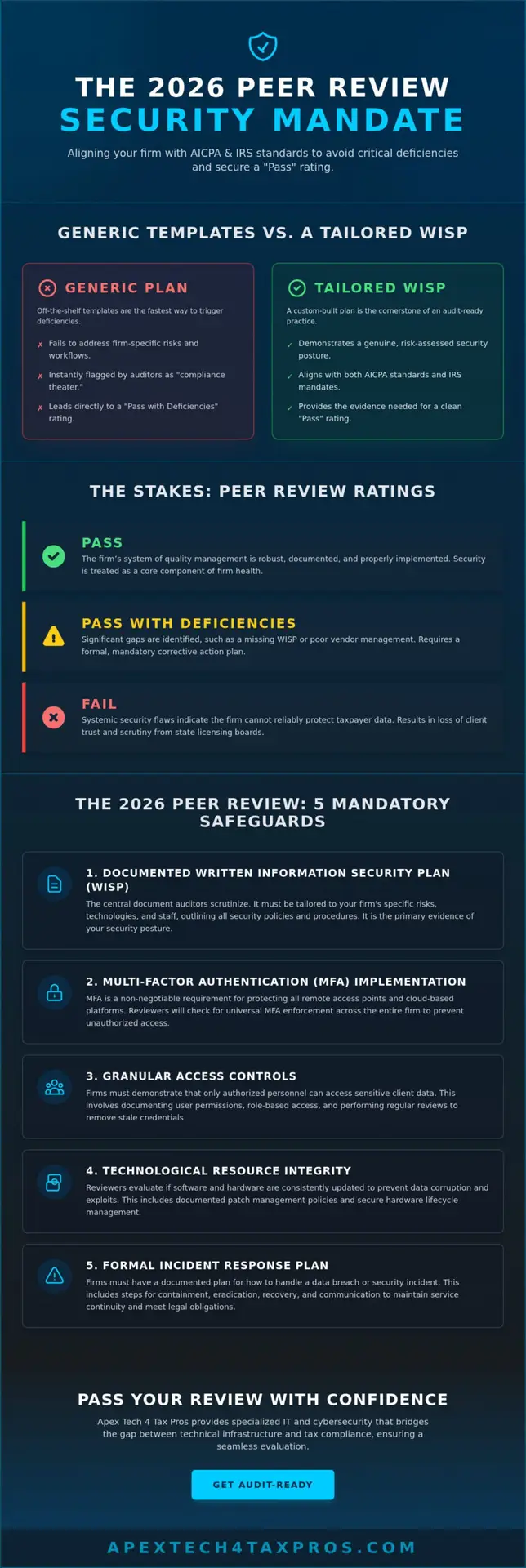
The 2026 Peer Review Security Checklist: 5 Mandatory Safeguards
Preparation for a peer review in 2026 requires more than a cursory glance at your digital infrastructure. Reviewers now look for a mature security posture that aligns with the updated IRS Safeguards Rule. To maintain compliance and protect your firm’s reputation, you must treat accountant peer review security as a continuous operational requirement rather than a once-a-year event.
- Step 1: Update your WISP for 2026 standards. Your Written Information Security Plan (WISP) must reflect the latest federal mandates. This includes specific protocols for remote work and the use of encrypted communication channels for all taxpayer data.
- Step 2: Document universal MFA implementation. It’s no longer enough to have Multi-Factor Authentication on your email. You must provide evidence that MFA is active across all financial and tax software, including Drake, ProConnect, or CCH Axcess.
- Step 3: Verify tested Disaster Recovery Plans. Reviewers will ask for proof that your encrypted off-site backups are functional. Conduct a full restoration test at least once every 180 days and log the results to prove business continuity.
- Step 4: Execute a data flow IT Risk Assessment. Map every point where taxpayer data enters, moves through, and leaves your firm. This assessment should identify vulnerabilities in your local network, cloud storage, and mobile devices.
- Step 5: Maintain training and confidentiality logs. Keep a verified record of staff cybersecurity training. Every employee must sign an updated confidentiality agreement annually to ensure they understand their role in protecting sensitive information.
Documentation and Evidence Collection
Organize your “Security Binder” as a digital repository that’s easily accessible during your review. Use clear version control to demonstrate that your WISP is a living document. Reviewers prioritize firms that show a history of updates rather than a static file created years ago. You’ll need to present at least three specific logs: administrative access logs, daily backup success reports, and software patch history. These documents prove that your accountant peer review security measures are active and monitored.
Technical Safeguards for Tax Data
Ensure your secure client portals utilize AES 256-bit encryption for all document exchanges. Secure cloud backups serve as the backbone of your firm’s resiliency; without them, a single ransomware incident could end your practice. When replacing hardware, follow NIST 800-88 standards for media sanitization. Documenting the professional decommissioning of “End of Life” assets prevents data leaks and satisfies the reviewer’s requirement for hardware lifecycle management.
How Apex Tech 4 Tax Pros Secures Your Practice Status
Our mission focuses on bridging the gap between your current IT infrastructure and the rigorous IRS and AICPA professional standards. We don’t just provide generic tech support; we align your firm’s digital environment with the specific mandates of accountant peer review security. This alignment is critical because a single oversight in data handling can lead to a modified report or a failing grade during your evaluation. Our “Dual-Expert Guardian” approach stems from 20 years of experience in both technical IT and tax compliance. This background ensures we understand the nuances of a tax practice, from the high-pressure deadlines of filing season to the precision required by regulatory bodies.
Many firms rely on generic templates for their Written Information Security Plan (WISP). These documents often fail under the scrutiny of a 2026 peer review because they don’t reflect the firm’s actual daily operations. We move beyond these templates to provide a tailored framework designed specifically for your office. Our professional risk assessments identify the specific gaps peer reviewers look for, such as unauthorized access points, insufficient encryption on legacy hardware, or lack of multi-factor authentication. By documenting these controls in a customized WISP, we provide the evidence needed to satisfy the most demanding reviewers.
Comprehensive Support for Peer Review Readiness
Security isn’t just about software; it’s about people. Our staff training programs build the security culture necessary to pass the rigorous staff interviews conducted during a review. We verify that every team member knows the protocol for handling sensitive PII and can explain it clearly to an evaluator. Our secure cloud backup solutions protect data integrity so your firm’s records are never in question. Because we maintain ongoing vigilance, our clients feel reassured throughout their three-year review cycle. We monitor your systems 24/7, ensuring that your accountant peer review security posture remains robust long after the initial audit is complete.
Your Next Steps Toward a Successful Review
Timing is critical for a successful outcome. You should start your security audit at least six months before your scheduled peer review date. This window allows for the remediation of any discovered vulnerabilities without the stress of a looming deadline. It also provides time to establish a track record of compliance that reviewers can verify. Our team provides the professional resources and customized security plans needed to satisfy modern standards and protect your practice’s reputation. Don’t leave your compliance to chance when specialized help is available.
Securing Your Practice for the 2026 Regulatory Shift
Navigating the evolving landscape of accountant peer review security means moving beyond simple checklists. The shift toward 2026 standards requires a rigorous alignment between AICPA expectations and the mandatory IRS Publication 4557 framework. Generic security plans aren’t just insufficient; they’re a liability during a formal audit. By implementing the five mandatory safeguards we’ve outlined, you’re not just checking a box. You’re fortifying your practice against real-world threats while ensuring your professional standing remains untarnished.
Apex Tech 4 Tax Pros brings 20+ years of specialized experience in tax and healthcare IT compliance to your firm. As a family-owned firm providing Dual-Expert Guardian support, we bridge the gap between technical complexity and regulatory necessity. Our tailored strategies ensure your practice meets the strict FTC Safeguards Rule without the stress of trial and error. You’ve worked hard to build your reputation, and we’re here to help you protect it with precision and care. Let’s make your next peer review your most successful one yet.
Take the next step toward total compliance: Download our FREE WISP Template or schedule a professional Risk Assessment today.
Frequently Asked Questions
Does a peer reviewer actually look at my cybersecurity settings?
Yes, your reviewer examines how you manage technological resources under AICPA Statement on Quality Management Standards No. 1. While they don’t perform a deep penetration test, they verify that your firm has established protocols to protect client data and ensure system reliability. They’ll specifically look for evidence that your accountant peer review security measures align with your firm’s stated risk assessment.
Is a WISP required for a successful AICPA peer review in 2026?
A Written Information Security Plan (WISP) is absolutely mandatory for compliance with IRS Publication 4557 and the FTC Safeguards Rule. Because peer reviewers evaluate whether your firm follows applicable professional standards, the absence of a WISP is a direct violation. In 2026, reviewers expect to see a documented plan that’s been reviewed by management within the last 12 months.
How does the FTC Safeguards Rule impact my peer review results?
The FTC Safeguards Rule requires specific administrative, technical, and physical protections that directly influence your firm’s quality control rating. If a reviewer finds you’ve failed to designate a qualified individual to oversee security, it can result in a “pass with deficiencies” report. This rule applies to 100% of accounting firms that handle sensitive financial data, making it a focal point for modern reviews.
What is the most common security deficiency found during accountant peer reviews?
The most frequent finding is an outdated or incomplete WISP that doesn’t reflect the firm’s actual IT environment. Industry reports indicate that 40% of small firms fail to perform the required annual risk assessment. This oversight creates a gap between written policy and daily practice, which reviewers identify as a failure in the firm’s system of quality management.
Can I use a free WISP template to pass my peer review?
You can use a template, but a generic document won’t satisfy a reviewer if it isn’t tailored to your specific operations. The IRS and FTC require your plan to address your unique “reasonably foreseeable risks.” If your accountant peer review security documentation includes references to hardware or processes you don’t actually use, the reviewer will flag it as an ineffective control.
How often should I update my security risk assessment for compliance?
You must perform a formal risk assessment at least once every 12 months to remain compliant with federal regulations. The FTC Safeguards Rule also requires an update whenever you make a material change to your business, such as migrating to a new cloud provider. Regular updates ensure your safeguards stay effective against the 30,000 new malware samples identified daily by the AV-Test Institute.
What happens if my peer reviewer finds a security deficiency?
If a deficiency is identified, your firm will receive a report detailing the non-compliance and you’ll have to submit a letter of response. This response must include a specific corrective action plan that you’ll implement within 30 to 60 days. The Peer Review Board may then require a follow-up visit or additional monitoring to confirm you’ve resolved the security gaps.
Do I need a SOC 2 report for my small accounting firm peer review?
A SOC 2 report isn’t a regulatory requirement for a standard AICPA peer review, though it’s a valuable asset for larger firms. For most small practices, a robust WISP and evidence of regular risk assessments are sufficient. However, if you provide outsourced services to clients, 75% of those clients may eventually request a SOC 2 to verify your internal data integrity controls.