
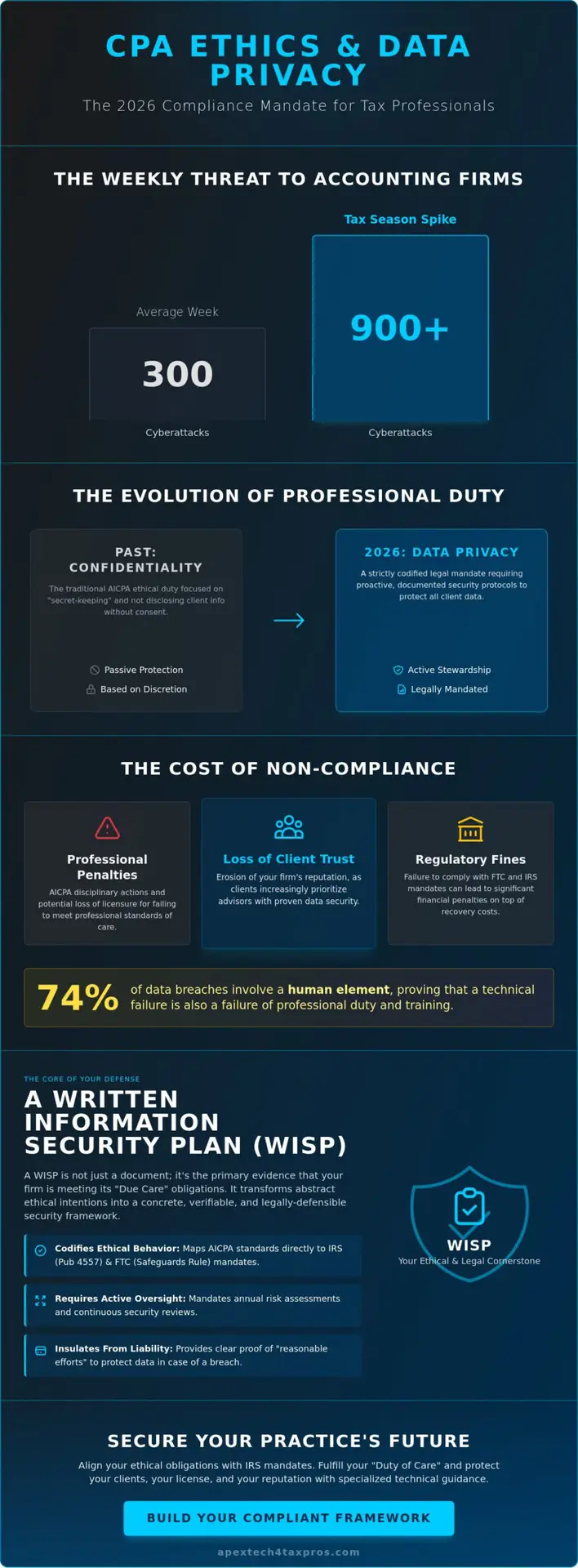
Did you know that accounting firms now face an average of 300 cyberattacks every week, a figure that often spikes to over 900 during the height of tax season? In 2026, the intersection of cpa ethics and data privacy has shifted from a professional ideal to a strictly codified legal mandate. You likely feel the pressure of maintaining compliance as new privacy laws in Indiana, Kentucky, and Rhode Island join an increasingly complex regulatory patchwork. It’s a heavy burden to ensure that your firm’s “reasonable efforts” to protect data actually meet the technical requirements of the FTC Safeguards Rule.
We recognize the difficulty of translating abstract ethical standards into concrete security protocols. This article will teach you how to align your AICPA ethical obligations with modern IRS data privacy mandates to secure your clients and your practice. We’ll explore how a Written Information Security Plan (WISP) functions as the core of your professional duty, providing a clear framework for compliant data handling that reduces your risk of professional liability and disciplinary action.
Key Takeaways
- Understand why traditional client confidentiality is no longer sufficient to meet modern digital security standards and legal obligations.
- Learn how to bridge the gap between cpa ethics and data privacy by mapping AICPA professional standards directly to IRS Publication 4557 mandates.
- Discover why relying solely on secure software creates ethical vulnerabilities and how to maintain the active oversight required by the FTC Safeguards Rule.
- Identify the specific steps required to formalize a Written Information Security Plan (WISP) and conduct the annual risk assessments necessary for compliance.
- Explore how specialized technical guidance helps tax professionals fulfill their “Duty of Care” while insulating their practice from potential regulatory disciplinary action.
The Intersection of CPA Professional Ethics and Data Privacy
In 2026, the traditional role of a CPA as a trusted advisor has expanded into a more rigorous position: the digital data gatekeeper. While your firm has always been a repository for sensitive financial information, the modern threat landscape has transformed that repository into a high-value target for sophisticated cybercriminals. The public trust, which is the cornerstone of the accounting profession, no longer rests solely on the accuracy of your audits or the integrity of your tax advice. It now depends heavily on your technical security posture. The intersection of cpa ethics and data privacy represents a fundamental shift where passive protection is no longer an acceptable standard of practice. You’re now expected to be an active steward of data, ensuring that every byte of client information is shielded by robust, documented protocols.
The AICPA Code of Conduct: Confidentiality vs. Privacy
There’s a critical distinction between the ethical duty of confidentiality and the legal mandate of data privacy. Historically, the AICPA Code of Professional Conduct focused on the “secret-keeping” aspect of the profession, ensuring that CPAs didn’t disclose client information without consent. However, the principle of “Due Care” has evolved. In the current regulatory environment, exercising due care requires you to go beyond simple discretion. It demands that you implement technical safeguards that are proportionate to the risks. In 2026, a password-protected laptop is merely the baseline; it doesn’t satisfy the ethical requirement to protect client data from unauthorized access. True ethical compliance now involves a proactive approach to security that anticipates vulnerabilities before they’re exploited.
The Consequences of Ethical Lapses in Data Handling
The fallout from a data breach is rarely confined to technical recovery costs. When a firm fails to secure taxpayer information, the AICPA may view the incident as a violation of professional standards, potentially leading to disciplinary actions or the loss of licensure. These ethical failures often precede legal non-compliance. Statistics from 2026 indicate that 74% of data breaches involve a human element, such as stolen credentials or social engineering. This highlight’s why cpa ethics and data privacy are so closely linked. If a firm hasn’t provided adequate cybersecurity awareness training or established a Written Information Security Plan, a breach isn’t just a technical failure. It’s a failure of professional duty. The resulting damage to your reputation and the erosion of client trust can be far more costly than any regulatory fine, as clients increasingly choose their advisors based on their demonstrated ability to keep data safe.
CPA Ethics and Data Privacy: AICPA Standards vs. IRS Mandates
The transition from professional discretion to legal liability is often found in the gap between AICPA Section 1.700 and the Gramm-Leach-Bliley Act (GLBA). While the AICPA standards establish the moral baseline for confidentiality, the GLBA provides the federal enforcement mechanism that classifies CPA firms as financial institutions. This classification isn’t optional. It subjects even the smallest tax practices to the same data protection standards as national banks. In 2026, your ethical duty to protect client information is no longer a private matter of professional conduct; it’s a public mandate enforced by the FTC and the IRS. Aligning these two worlds requires a shift in perspective from protecting “secrets” to securing “systems.”
IRS Publication 4557: The Ethical Roadmap
IRS Publication 4557 serves as the operational manual for modern tax professionals. It codifies ethical behavior by breaking taxpayer data protection into seven specific areas: management and educational safeguards, file and information protection, and technical security protocols. Adhering to these guidelines is how a practitioner demonstrates the “Due Care” required by their license. By 2026, the IRS has made it clear that a Written Information Security Plan (WISP) is the primary evidence of this care. Without a documented WISP, a firm cannot claim to be meeting its cpa ethics and data privacy obligations. It’s the difference between having a vague intention to be secure and having a verified, repeatable process for safety.
FTC Safeguards Rule: Mandatory Protections for Tax Pros
The FTC Safeguards Rule adds another layer of complexity by requiring specific technical and administrative actions. Every firm must now designate a “Qualified Individual” to oversee their security program. This person is responsible for conducting regular, comprehensive risk assessments to identify vulnerabilities before they lead to a breach. The FTC defines “reasonable” security based on the sensitivity of the data handled, and for CPAs, that sensitivity is at the highest level. This rule applies regardless of firm size. Whether you’re a solo practitioner or a multi-partner firm, the expectation of vigilance remains the same. If the technical requirements of these mandates feel overwhelming, starting with a professional WISP template can provide the necessary structure to begin your compliance journey.
As of January 1, 2026, new state-level privacy laws in Indiana, Kentucky, and Rhode Island have further complicated the landscape. These regulations, alongside the California Consumer Privacy Act (CCPA) risk assessment requirements, create a patchwork of duties that can easily lead to professional liability. Staying ethically compliant in 2026 means moving beyond a simple checklist. It requires a commitment to active data stewardship that protects your clients’ most sensitive financial lives from increasingly sophisticated threats. Your technical security posture is now the most visible reflection of your professional integrity.
The Myth of “Tool-Based Compliance” in Accounting
A common misconception in the profession is that migrating to a “secure cloud” environment satisfies a firm’s regulatory obligations. While modern software provides essential layers of protection, it doesn’t absolve you of your professional responsibility. The new standards on data protection clarify that a tool is merely an instrument; the CPA remains the primary steward of the data. Relying on a “set it and forget it” mentality creates a significant ethical risk. True cpa ethics and data privacy compliance requires active oversight of the entire digital ecosystem, from document collection to final delivery.
The 2026 AI boom has introduced new complexities to this duty. With 64% of financial services employees admitting to using unauthorized generative AI tools early this year, “Shadow AI” has become a major vector for data breaches. Entering sensitive client information into public AI models without proper oversight is a direct violation of your ethical duty to supervise third-party processing. You must ensure that any technology used in tax preparation adheres to the same rigorous standards as your internal systems.
Vetting Your Tech Stack: An Ethical Framework
Your duty to supervise extends to every software vendor in your stack. You shouldn’t take marketing claims of “bank-level security” at face value. Instead, request and review SOC 2 Type II reports to verify that a vendor’s controls are actually functioning as intended. Ask specific questions about data encryption, both at rest and in transit. You need to know exactly who has access to your data and where it is stored geographically. Due diligence in 2026 is the continuous process of verifying that every third-party vendor maintains technical and administrative safeguards that meet or exceed the practitioner’s own ethical and legal requirements.
The Human Element: Training as an Ethical Mandate
Technology cannot fix a culture of negligence. Research shows that 74% of data breaches involve a human element, including stolen credentials and social engineering. Stolen credentials alone are a factor in 86% of all breaches. Because of this, staff cybersecurity awareness training is no longer optional; it’s an ethical mandate for professional oversight. You’re responsible for ensuring that every member of your team understands how to identify sophisticated AI-powered phishing and deepfake impersonations. Implementing a culture of security that mirrors your firm’s ethical values is the only way to protect the “confidentiality” you’ve promised to your clients. Technical security and professional ethics are now two sides of the same coin.
Building an Ethically Sound Data Privacy Framework
Merging professional integrity with technical security requires a structured approach that moves beyond theory. An ethically sound framework provides the evidence needed to demonstrate that you’ve fulfilled your “Duty of Care.” In 2026, this isn’t just about avoiding a breach; it’s about proving you took every reasonable step to prevent one. Adopting a systematic framework ensures that cpa ethics and data privacy are integrated into your firm’s daily operations rather than treated as a yearly compliance hurdle. Following these five steps will help you build a resilient practice:
- Step 1: Conduct a Comprehensive Annual Risk Assessment. You must evaluate your physical, technical, and administrative safeguards to identify vulnerabilities before they’re exploited.
- Step 2: Formalize Your Written Information Security Plan (WISP). This document acts as the primary roadmap for your security protocols and is a federal requirement under the Gramm-Leach-Bliley Act.
- Step 3: Implement Multi-Factor Authentication (MFA). Since stolen credentials are a factor in 86% of all data breaches, MFA is a non-negotiable ethical safeguard for every system containing client data.
- Step 4: Establish Secure Cloud Backup and Disaster Recovery. Protecting data availability is just as important as protecting confidentiality. You need a protocol that ensures client records remain accessible even after a system failure.
- Step 5: Document Every Security Decision. Maintain a detailed log of your security upgrades and policy changes. This documentation serves as your “Ethical Defense” should your firm ever face an IRS audit or a disciplinary inquiry.
The WISP: Your Practice’s Most Critical Document
A 2026-compliant WISP must be more than a static file on your server. It should be a living document that outlines exactly how your firm handles sensitive information, manages third-party vendors, and responds to potential incidents. Generic templates often fail the “Reasonable Effort” test because they don’t account for the specific technical environment of your practice. To ensure your plan meets federal standards, consider using a customized WISP that reflects your actual workflows. An effective WISP is your best protection against claims of professional negligence, as it proves you’ve established a deliberate, ethically grounded security program.
Risk Assessments: Identifying Vulnerabilities Before Hackers Do
The ethical necessity of a risk assessment lies in its ability to uncover “Shadow IT” and unauthorized software use within your team. In the current landscape, employees may inadvertently compromise data by using unvetted generative AI tools or personal devices for work tasks. Your assessment must scrutinize every entry point into your network, including remote access portals and mobile applications. By identifying these risks early, you can turn your findings into actionable security upgrades. This proactive stance is what distinguishes a dedicated data steward from a firm that merely reacts to crises. Vigilance is the highest form of professional duty in the digital age.
Securing Your Practice’s Future with Apex Tech 4 Tax Pros
In 2026, the complexity of regulatory mandates makes it difficult for tax professionals to manage technical security without specialized guidance. Apex Tech 4 Tax Pros exists to bridge the gap between tax ethics and IT security, providing the specific expertise required for high-stakes environments. We understand that your professional reputation depends on more than just tax accuracy. It depends on your ability to safeguard sensitive data against a record high average breach cost of $10.22 million. Our mission is to provide you with the technical infrastructure needed to uphold your cpa ethics and data privacy obligations with absolute confidence.
We provide professional risk assessments designed specifically for the tax industry. We evaluate your firm through the lens of a financial institution, identifying vulnerabilities that general IT providers might overlook. Beyond technical fixes, we empower your team with cybersecurity awareness training. Since 74% of breaches involve a human element, training your staff is a direct extension of your ethical duty to supervise your practice. We help you move from a state of potential vulnerability to a state of secure, documented compliance.
Why a “One-Size-Fits-All” Plan Puts You at Risk
Generic templates often provide a false sense of security. They don’t account for the specific software integrations or remote access protocols unique to your practice. Using an outdated or non-industry-specific security plan is an ethical risk that could lead to IRS disciplinary action. Our customized WISPs are engineered to align precisely with IRS Publication 4557 and the FTC Safeguards Rule. This level of specificity is essential for protecting your PTIN and your professional license during a regulatory audit. You need a plan that reflects your actual operations, not a generic document that fails the “reasonable effort” test. If you aren’t ready for a full customization, you can start by exploring our FREE WISP download template to see the baseline requirements.
Next Steps: From Vulnerability to Secure Compliance
Transitioning toward a secure future begins with a clear understanding of your current posture. A professional risk assessment provides the roadmap for necessary upgrades, ensuring that your cpa ethics and data privacy framework is robust. When combined with a secure cloud backup strategy, you ensure that client data is protected from both external theft and internal system failures. This comprehensive approach provides the peace of mind that comes from knowing your firm is ethically and legally sound. Taking these steps today prevents the catastrophic financial and reputational fallout of a preventable breach.
Schedule your 2026 compliance review with Apex Tech 4 Tax Pros today to ensure your practice meets the highest standards of professional duty.
Mastering Your Professional Duty in the Digital Age
Navigating the complex landscape of 2026 requires a shift from passive confidentiality to active data stewardship. You’ve seen how professional integrity is now inextricably linked to your technical security posture. Mastering the intersection of cpa ethics and data privacy allows you to fulfill your ethical “Duty of Care” while insulating your practice from regulatory scrutiny. These actions aren’t just administrative burdens. They’re the foundational elements of a modern, resilient accounting firm.
Apex Tech 4 Tax Pros provides the specialized expertise needed to align your operations with IRS Publication 4557 and the FTC Safeguards Rule. We offer secure cloud backup solutions engineered for financial data and expert-led cybersecurity training for your staff. Protecting your practice doesn’t have to be an overwhelming solo journey. You can take the first step toward secure compliance by accessing our resources today.
Download your FREE WISP Template or schedule a professional consultation to secure your clients and your legacy. Your commitment to excellence is your firm’s greatest asset. With the right framework in place, you can focus on what you do best with total peace of mind.
Frequently Asked Questions
Is a WISP legally required for all CPAs in 2026?
Yes, a Written Information Security Plan (WISP) is a mandatory federal requirement for all tax professionals under the Gramm-Leach-Bliley Act and the FTC Safeguards Rule. These regulations classify CPA firms as financial institutions, regardless of their size. Failure to maintain a documented, updated WISP can lead to the suspension of your EFIN and significant regulatory oversight.
What is the difference between data privacy and data security for accountants?
Data privacy focuses on the legal and ethical rights of your clients to control how their personal information is collected, shared, and used. Data security is the technical framework, such as encryption and multi-factor authentication, that protects that information from unauthorized access. Mastering cpa ethics and data privacy requires you to implement robust security to ensure the privacy you’ve promised is actually maintained.
How does the AICPA Code of Professional Conduct address cybersecurity?
The AICPA Code addresses cybersecurity through the principles of “Due Care” and “Confidentiality,” which require practitioners to take reasonable steps to protect client information. In 2026, “reasonable steps” are defined by your adherence to modern federal standards. If you don’t implement the technical safeguards outlined in IRS Publication 4557, you may be found in violation of your professional ethical duties.
Can I be held ethically liable if my cloud provider has a data breach?
You can be held ethically liable if the breach resulted from your failure to perform adequate due diligence or supervision of the third-party vendor. Your professional duty to protect client data cannot be fully outsourced. You’re responsible for verifying that your providers maintain high-level security certifications, such as SOC 2 Type II reports, and adhere to strict data protection protocols.
What are the penalties for failing to comply with the IRS Safeguards Rule?
Penalties for non-compliance include significant monetary fines, the permanent loss of your PTIN, and potential criminal charges under the Gramm-Leach-Bliley Act. Beyond federal sanctions, you may face state-level penalties from agencies like the California Privacy Protection Agency. Perhaps most damaging is the potential for AICPA disciplinary action, which can result in the public revocation of your professional license.
How often should a tax firm update its Written Information Security Plan?
Your firm should update its WISP at least once a year or whenever there’s a significant change in your technology stack or business operations. The 2026 regulatory environment moves quickly, and your plan must reflect new threats like AI-powered phishing. Regular updates ensure that your security measures remain “proportionate” to the risks, which is a key requirement of the Connecticut Data Privacy Act and similar state laws.
Does professional liability insurance cover ethical lapses in data privacy?
Professional liability insurance often covers the costs associated with a data breach, such as client notification and legal defense, but it rarely covers fines for ethical negligence. Many policies have specific exclusions for firms that fail to maintain a WISP or ignore federal security mandates. It’s vital to review your policy to see if it specifically addresses the intersection of cpa ethics and data privacy and technical non-compliance.
What is the first step for a small firm to become ethically compliant with data laws?
The first step is conducting a comprehensive risk assessment to identify exactly where sensitive taxpayer data is stored and how it’s protected. You can’t secure what you haven’t identified. Once you understand your vulnerabilities, you can begin formalizing your Written Information Security Plan and implementing critical technical safeguards like multi-factor authentication to meet your ethical and legal obligations.